Baccalaureate Sunday

Westminster Presbyterian Church
Westminster           Presbyterian Church

June 1st was Baccalaureate Sunday at Minneapolis’ Westminster Presbyterian Church to celebrate the university and high school graduations of some of our members.[1]

The Sermon

The sermon, “What’s Next for Me?” by Rev. Dr. Timothy Hart-Andersen was primarily addressed to the new graduates, but its message had meaning for everyone. He emphasized “the metaphor of journey, or pilgrimage, to understand Christian life.”

“The next steps you take on your pilgrimage through life do not have to be definitive. Lots of twists and turns lie ahead. Some will be delightful surprises; others, painful disappointments.”

Hart-Andersen, using his own life as an example, said, “Only after multiple false starts did I finally begin to pay attention to the nagging sense that God had other ideas for my life. It was, for me a matter of feeling ‘at home.’ That became a test for me: did I feel at home in a given occupation? Even if I was good at it, that didn’t prevent me from feeling like a stranger on a particular path. And if I felt like that, I moved on. Only later did I understand that God was at work in those twists and turns.”

“It may not always have been obvious to you, but God has been your companion along the way. Sometimes God may not have felt present to you, or maybe you went through times where you felt abandoned by God. But, the journey is long and we are people of faith. We believe God is the Guide. It may seem as if we’re on our own, but in this we trust: God is on the pilgrimage with us.”

“Scripture is replete with accounts of people trying to sort out which way their path is taking them. The Bible is the story of God’s people trying to find their way. Sometimes it’s clear; at other times, it’s not.”

“Think of the Israelites wandering forty years in the wilderness after leaving Egypt. That was one, long search for the way forward . . . . The dream of freedom turned into something that felt a lot like a nightmare. . . . They forgot about God’s promise; [instead] they made a new, little god they could manage, a golden calf. They were grasping at anything to find some sense of clarity in their lives.” [Exodus 32:1-9.]

“[W]hen Jesus ascends to heaven . . .[He] tells his followers to wait until the Holy Spirit descends on them. They return to Jerusalem, go into an upper room, and settle in together until the time is right. . . . [They wait.] Their waiting involves prayer. They’re not passive in their hope of the promise fulfilled. Prayer is active waiting in anticipation of divine response, active trusting that God is listening. Prayer helps on the journey. Their waiting involves watching. They pay attention to the signs around them, looking for glimmers of the promise, “the trailing wisps of glory.” Their waiting is done together, in community.” [Acts 1:1-14.]

“What’s next for me is a question aimed at vocation . . . . Every one of us ought to be asking the same question of our own pilgrimage in life: what’s next? Where do I go from here? What does God have in store for me at this point in my life?”[2]

“We Presbyterians are known to emphasize the vocation of each person. It begins with John Calvin who argues that everyone has a vocation, not only those called into ministry. Everyone has a role to play in the community, in business, in education or medicine or industry or technology or the military or science or public service or _____ – you fill in the blank.”

“Calvin views every occupation as an opportunity to excel, and in our excelling, we glorify God. All human work, Calvin writes, is capable of ‘appearing truly respectable and being considered highly important in the sight of God.’ . . . For Calvin it’s the person that matters, the person, not the job.”

“In his view, people are not called by God out of the world, in order not to sully themselves with ordinary life, but rather, people are called by God into the world, right into the mundane stuff by which we make our living. And there, right there, in the everyday challenges of the jobs we do, God is found, and God can be glorified in what we do, no matter what it is.”[3]

“The Israelites cowering in fear in the wilderness and the followers of Jesus huddled together in that upper room struggled with what was next for them. They wondered if God had given up on them; some of them gave up on God.”

“Each of us is tempted to wonder the same thing when the way forward is not clear, or when it’s littered with challenges that seem to overwhelm, or when it leads into darkness that offers little respite.”

“But those who wait for God’s promise, even if it takes forty years, will not be disappointed. Light will illumine the path. The way forward will be clear. We will find it together, trusting that the Spirit will meet us on the way. “

What’s next for me? We need only open our eyes, take a step in trust, and then another, and another, and another. We will discover what God’s future holds for us.”

Choir’s Anthem

The sermon’s emphasis on pilgrimage was echoed in the choir’s anthem for the day: The Road Not Taken with music by Randall Thompson and the words from Robert Frost’s poem by the same name:[4]

“Two roads diverged in a yellow wood

And sorry I could not travel both

And be one traveler, long I stood

And looked down one as far as I could

To where it bent in the undergrowth;

Then took the other, as just as fair,

And having perhaps the better claim,

Because it was grassy and wanted wear;

Though as for that the passing there

Had worn them really about the same,

And both that morning equally lay

In leaves no step had trodden black.

Oh, I kept the first for another day!

Yet knowing how way leads on to way,

I doubted if I should ever come back.

I shall be telling this with a sigh

Somewhere ages and ages hence:

Two roads diverged in a wood, and I—

I took the one less traveled by,

And that has made all the difference.”

========================

[1] The bulletin for this worship service is available online.

[2]A number of posts to this blog have discussed the religious notion of vocation.

[3] The notion of God calling us into the world was also embraced by poet Christian Wiman.

[4]The Road Not Taken” is one of seven Frost poems in Frostiana: Seven Country Songs, a piece for mixed chorus and piano composed by Thompson in 1959 to commemorate the bicentennial of the Massachusetts town of Amherst, where Frost (1874-1963), who had known Thompson and admired his music, had lived for many years. Thompson (1899-1984) was an American composer, particularly noted for his choral works. A colleague said “Thompson’s choral works are a shining reflection of the joy and creative skill with which he taught musical craft—of Palestrina and Lasso, of Monteverdi and Schütz, of Bach and Handel. It has been his belief that music of this craft is timeless in its nature, and can form part of the basis of a composer’s working vocabulary without loss to his individual talent. In this he is a true classicist and an academic in the best sense.”


Theodore Roosevelt’s Involvement in the U.S. Presidential Election of 1900

Theodore Roosevelt
Theodore Roosevelt

A prior post reviewed the U.S. presidential election of 1900, in which Republicans William McKinley and Theodore Roosevelt were the winning candidates for President and Vice President. Now we focus on Roosevelt’s involvement in that election.

Attending the Republican Party’s National Convention

The involvement began at the Republican Party’s national convention in Philadelphia in June. Although Roosevelt repeatedly had opposed suggestions that he be the Party’s vice presidential nominee, he did attend the convention as a New York delegate-at-large. Once there, he made dramatic arrivals in the city and on the convention floor.

Roosevelt commanded the attention of the entire convention when he seconded the nomination of McKinley. In the words of his biographer, Edmund Morris, Roosevelt “moved confidently through his prepared text, speaking at a torrential speed unusual even for him, his body trembling with the force of his gestures.”[1] He said that the Republican Party in the prior election “did not promise the impossible . . . and kept our word. . . . [the U.S.] has reached a pitch of prosperity never before attained . . . . So it has been in foreign affairs [as well].” He concluded his seconding speech with these words:

  • “We stand on the threshold of a new century big with the fate of mighty nations. . . . The young giant of the West stands on a continent and clasps the crest of an ocean on either hand. Our nation, glorious in youth and strength, looks into the future with eager eyes and rejoices as a strong man to run a race. . . . We challenge the proud privilege of doing the work that Providence allots us, and we face the coming years high of heart and resolute of faith that to our people is given the right to win such honor and renown as has never yet been vouchsafed to the nations of mankind.”

On the convention’s vote on his own vice presidential nomination, Roosevelt cast the only negative vote, but immediately afterwards told party officials that he would be a loyal member of the team. He said, “I am as strong as a bull moose, and you can use me to the limit taking heed of but one thing and that is my throat.”[2]

Roosevelt confirmed his acceptance of the nomination in a lengthy letter of September 15th (two and a half months after the convention) that repeated some of the points of his seconding speech at the convention and that attacked the issues promoted by William Jennings Bryan.

Roosevelt’s letter also addressed the “serious problem” presented by “the great business combinations . . . [or] trusts.” This real problem was “immensely aggravated” by “honest but wrong-headed attacks on our whole industrial system in the effort to remove some of . . . [its] evils. . . . No good whatever is subserved by indiscriminate denunciation of corporations generally, and of all forms of industrial combination in particular.”   Instead, the “real abuses” need to be attacked first by finding out and publicizing the facts regarding “capitalization, profits and all else of importance.” Those facts would “enable us to tell whether or not certain proposed remedies would be beneficial.”

 Campaigning

As indicated in a prior post, Roosevelt conducted a real “whistle-stop” campaign from the rear of a railroad train in 1900. He covered 21,000 miles, giving 673 speeches in 24 states to an estimated three million people. These speeches defended the gold standard and McKinley’s foreign policy. He attacked Bryan for wanting to “paralyze our whole industrial life” and for appealing to “every foul and evil passion of mankind.”

Theodore Roosevelt speech 1900
Theodore Roosevelt "Whistle-Stop" Speech 1900
Theodore Roosevelt “Whistle-Stop” Speech 1900


The Almanac of Theodore Roosevelt’s compilation of his “Complete Speeches,” however, only has six campaign speeches, three of which are rebuttals of William Jennings Bryan.[3] The other three bear comment.


The Labor Question” Speech

Roosevelt on his campaign train from Quincy, Illinois to Chicago in September was accompanied by three railroad executives: my maternal great-great-uncle, William Carlos Brown, then General Manager of the Chicago Burlington & Quincy Railroad; Theodore P. Shonts, then the President of the Illinois & Iowa Railroad (“I&I RR”);[4] and Paul Morton, then the President of the Santa Fe Railroad (“the Santa Fe”).[5]

W. C. Brown
W. C. Brown
T.P. Shonts
T.P. Shonts
Paul Morton
Paul Morton


I have not been able to discover the substance of the conversations the four of them had on the train, but they presumably discussed the issue of federal regulation of business, especially railroads. The three railroaders presumably also were present in Chicago on Labor Day when candidate Roosevelt gave a remarkable speech, even to 21st century ears, on “The Labor Question.”[6]

The general theme of the speech was the importance of “the spirit of brotherhood in American citizenship” that is fostered by association with others not in our “own little set.” Roosevelt emphasized this from his own life in working with “mighty men of their hands” in the Northwest cattle country, with farmers and with “skilled mechanics of a high order.” He added that he had been “thrown into intimate contact with railroad men [and] . . . gradually came to the conclusion that [they] . . . were about the finest citizens there were anywhere around.” Presumably the three railroad executives with him on that trip were included in that group.

Therefore, Roosevelt argued, we “must beware of any attempt to make hatred in any form the basis of action.” He continued, “our chief troubles come from mutual misunderstanding, from failing to appreciate one another’s point of view [and] the great need is fellow feeling, sympathy, brotherhood.”

At the end of the speech, Roosevelt sketched his approach to the issues of the day. He said, “Before us loom industrial problems large in their importance and in their complexity. The last half-century has been one of extraordinary social and industrial development. . . . It is not yet possible to say what shall be the exact limit of influence allowed the State, or what limit shall be set to that right of individual initiative. . . .” Therefore, undertaking efforts to change the State’s involvement in these areas should be with caution and humility. “We can do a great deal when we undertake soberly, to do the possible. When we undertake the impossible, we too often fail to do anything at all.”

The “Free Silver, Trusts and the Philippines” Speech

On September 7th in Grand Rapids, Michigan, Roosevelt castigated Bryan’s “Free Silver” proposal as “the one and only way to insure wide-spread industrial and social ruin.”

Roosevelt also touched on the problems of industrial combinations or trusts that had been raised by Bryan. Roosevelt conceded that “trusts have produced great and serious evils. There is every reason why we should try to abate these evils and to make men of wealth, whether they act individually or collectively, bear their full share of the country’s burdens and keep as scrupulously within the bounds of equity and morality as their neighbors.” However, he added, “wild and frantic denunciation does not do them the least harm and simply postpones the day when we can make them amenable to proper laws.” Repeating his letter of acceptance of the vice presidential nomination, Roosevelt said the first thing was to learn “exactly what each corporation does and earns,” thereby enabling the formulation of “measures for attacking the . . .[ evils] with good prospects of success.”

The “Prosperity, Unity and National Honor” Speech

Roosevelt’s last major speech before the November 6th election was on October 26th at New York City’s old Madison Square Garden.

According to the New York Times, when he arrived at the Garden, “the buzzing sound of many voices became a roar of cheers and the 14,000 people . . . yelled with all their might as they waved small and large American flags. . . . For ten minutes the uproar was deafening. . . . Just as the enthusiasm had reached a climax Gov. Roosevelt spied his wife in [the audience] and bowed and smiled. For the first time his teeth were in plain sight. This little act aroused the people to renewed cheering, drowning the loudest noise which could be produced by two bands of fifty men playing ‘A Hot Time in the Old Town Tonight.’”[7]

Eventually Roosevelt spoke. He lambasted Bryan’s “Free Silver” proposal and his seeking “to sow seeds of malice and envy” in the manner of Robespierre. “No greater evil, oh, my fellow countrymen, can be done this nation of ours than to teach any group of Americans that their attitude should be one of sullen hatred and distrust of their fellows.” Such “bitter class hatreds . . . leads ultimately to class strife, . . . to the loss of liberty . . . [whose] most dangerous enemy [is] anarchy, license, mob violence in any form.”

He concluded by appealing to his fellow countrymen “to keep the conditions under which we have grown so prosperous” and to maintain “the honor of a mighty nation.”

Conclusion

After winning the 1900 election, President McKinley and Vice President Roosevelt were inaugurated on March 4, 1901. In his short inaugural address, Roosevelt said, “For weal or for woe, for good or for evil, . . . [playing “a leading part in shaping the destinies of mankind”] is true of our own mighty nation. Great privileges and great powers are ours, and heavy are the responsibilities that go with these privileges and these powers. . . . We belong to a young nation, already of giant strength, yet whose political strength is but a forecast of power that is yet to come. We stand supreme in a continent, in a hemisphere.”

=========================================

[1] Edmund Morris, The Rise of Theodore Roosevelt at 767-68 (Random House; New York; 1979).

[2] Id. at 768. In 1912 after the Republican Party re-nominated William Howard Taft as its presidential candidate, over Roosevelt’s opposition, Roosevelt organized the Progressive Party (nicknamed the Bull Moose Party) and ran as its presidential candidate. With these two parties splitting the conservative vote, the Democratic presidential candidate, Woodrow Wilson, won the election.

[3] The rebuttals of Bryan were in Detroit on September 7th and Evansville, Indiana on October 12th and in a published letter of October 15th.

[4] Shonts grew up in Centerville, Iowa, and after graduating from Illinois’ Monmouth College, worked in Iowa as a bookkeeper, then an attorney and as an executive of a construction company that built stretches of railroad track. This lead to his becoming an executive for the I&IRR. In 1905 then President Roosevelt appointed Shonts to be the Chairman of the Isthmian [Panama] Canal Commission, a position he held until March 1907, when he became President of the Interborough Rapid Transit Company, which operated  New York City’s rapid transit system.

[5] Morton was born in Michigan and grew up in Nebraska as the son of a former U.S. Secretary of Agriculture; his older brother was the founder of Morton Salt. In 1904 President Roosevelt appointed Morton as Secretary of the Navy, but in 1905 he was forced to resign after evidence surfaced that the Santa Fe under his presidency had granted illegal rebates. Morton, however, then became the President of the Equitable Life Assurance Society in New York City.

[6] This account of the Quincy-Chicago trip is based on a January 30, 1907, letter from Brown to Schonts saying “I often think of the trip from Quincy to Chicago, when . . . you and Paul [Morton] and I had the pleasure and the honor of a ride across Illinois with Theodore Roosevelt, then a candidate for Vice-President.” (Image (# 71-0572) provided courtesy of the Library of Congress Prints and Photographs Divisions and Theodore Roosevelt Center at Dickinson State University, www.theodorerooseveltcenter.org.) I plead for anyone who has more information about the Quincy-Chicago trip or the discussions the three railroad executives had with Roosevelt to share such information in a comment to this post.

[7] Gov. Roosevelt Speaks, N.Y. Times (Oct. 27, 1900).

William Carlos Brown’s Loyalty to His Parents and Home State of Iowa

While W C. Brown (my great-great-uncle) was an important top executive of the powerful New York Central Railroad in New York City, 1902-1913, he still demonstrated loyalty to the state of Iowa, where he grew up, and to his parents (and my maternal great-great-grandparents), Rev. Charles E. Brown and Frances Lyon Brown.

W. C. Brown
W. C. Brown
Frances Lyon Brown & Charles E. Brown


After Rev. Charles E. Brown, died in 1901, W.C. paid for an imposing monument for his parents in the Pleasant Hill Cemetery” in Lime Springs in northeastern Iowa, for the establishment of the “Brown Park in the town and for a beautiful stained-glass window in honor of his father at the First Baptist Church of nearby Cresco, Iowa. W.C. also financed the private publication of his father’s memoirs, Personal Recollections 1813-1893 of Rev. Charles E. Brown with Sketches of His Wife and Children and Extracts from an Autobiography of Rev. Phillip Perry Brown 1790-1862 with Sketches of His Children and the Family Record 1767-1907.[1]

Brown Park, LIme Springs, IA
Baptist Church, Cresco
Baptist Church, Cresco, IA


W.C. owned a home in Lime Springs (Howard County) for himself and his family as well as a farm in the neighboring countryside. In addition, W.C. owned a farm and home near the southwestern Iowa town of Clarinda (Page County) where a brother-in-law (Charles P. Hewitt) and a sister-in-law (Hattie Hewitt Galloway) lived. In that town W.C. also owned an interest in a small bank and manufacturer. Brown usually returned in the summers to visit these towns and farms during his New York City years.

Howard County Iowa
Howard County Iowa
Page County Iowa
Page County Iowa


His summer sojourns to Lime Springs were in W. C.’s private railroad car, which sat on a siding while he and his family (but not always his daughters) stayed in their home in the town. The African-American cook and chauffeur stayed in another house across the street from the Brown house.

Back in the City, W. C. served as the president of the Iowa Society of New York. At its annual dinner in 1910, he spoke with pride of Iowa’s hatred of slavery and its first railroad, the underground railroad, whose “builder and maker were God.” One of its passengers was John Brown, who in 1859 stayed with Josiah B. Grinnell, after whom Grinnell College (my alma mater) was named. W.C. also commended Iowa’s “unconditional, sleepless opposition to the saloon,” which was a cause dear to his father’s heart.

At the Iowa Society’s dinner two years later, in March 1912, W. C. said “I love Iowa and her people, and when I go back to Iowa, as I hope to very soon, . . . I look forward to . . . returning to New York . . . and telling you of their sensible citizenship, a citizenship that has always saved her from the sophistries of the designing demagogue.”[2]

After Brown retired from the New York Central at the end of 1913, he and his wife usually returned to their Iowa homes in the summer after spending the winter months at their retirement home in Pasadena, California.

===========================================

[1] W. C. also donated the organ to the Methodist Church of Lime Springs in honor of his wife and made large financial contributions for the construction of the Church’s building and for the endowment of the town’s Pleasant Hill Cemetery.

[2] Also in attendance at the dinner that night was the Iowa Congressman from Clarinda, William P. Hepburn, about whom we hear in a later post about federal regulation of railroad freight rates.


William Carlos Brown’s New York Central Railroad Career


W. C. Brown
W. C. Brown


After his successful 19th century career with railroads in the Midwest, in 1902 my great-great-uncle, William Carlos (or W.C.) Brown, became the Vice President in charge of the transportation, engineering, mechanical and purchasing departments of the New York Central Railroad, which as described in a prior post was one of the most powerful corporations in the country.

Brown’s joining the Central in 1902 prompted a letter writer to the New York Times to state that W.C. “has made a careful study of [railroad] safety appliances, and he is in large part responsible for the adoption of the operating rules now in force on [U.S. railroads]. He was a member of the first Committee on Safety Appliances and Train Rules of the American Railway Association.” In addition, according to this writer, Brown had a “strong and vigorous personality and he has a faculty of making friends with all of his employees.”

Brown was a Vice President until 1906, when he was promoted to the position of the Senior Vice President. He held this position until 1909 when he was appointed to be the Central’s President, Director and member of its Executive Committee. Effective December 31, 1913, he retired from the Central.

When Brown assumed the Central’s presidency in 1909, a trade journal said W.C. was “a studious man, clear-headed, with retentive memory” and “an accurate judge of men and subjects.”

The New York Times added that Brown was “one of the most popular railroad officials” in the U.S. and had “an extraordinary forcefulness and energy. He has a faculty of disposing of things in the shortest possible span of time, and an equally strong one for analyzing propositions down to the backbone. He talks quickly, energetically, and very clearly. Among his subordinates and associates he is immensely popular, and the joy over his promotion is heartfelt and unaffected.” He also was described as “courteous and modest . . . [a] moderate disciplinarian . . . kind-hearted and considerate . . . [and] not as uncompromising as many of his contemporaries [toward labor unions].”

Another journalist in 1909 said Brown “knows what the duty is of every one of his 150,000 men in the system.” The National Cyclopedia of American Biography in its 1910 edition stated that Brown was then “probably one of the best posted and most able and efficient railroad men in the [U.S.] He is firm and determined . . . . His career affords a splendid example of accomplishments due to untiring industry, perseverance, and fidelity to one’s duties.”

Brown himself was quoted in the New York Times at the time of his promotion to President of the Central. He said, “ In the United States, it is the workingman who, even though he starts at the bottom, ends in the important posts at the top of our railroads and our great industrial enterprises. The day of favoritism and family has departed. I believe that plain sticking to it is a good rule for every workingman who is earnest in his ambition. I believe, too, it may not be for his best welfare for any worker to set for himself . . . a definite goal.”

For another publication, Brown continued on this theme. He said the most important factor his advancement was, “Just sticking to it and making a business of my business, filling every job I got as well as I knew how. . . . [I]t is more or less a mistake to preach to young men that they should fix for themselves a specific goal, and strive toward it . . . . If a fellow sets out with that idea, he is apt to become an office politician, and he wastes more time figuring out how he is going to get the step over somebody else than he expends in attending to the business in hand. The thing he has to do is bend every energy . . . to doing today, as well as it can be done, what he has to do. The man who does that does not need to worry about promotion . . . . Promotion will look for him.”

Here are some of the significant events at the Railroad in which he was involved during his 12 years at the Central and which have been or will be covered in other posts:

  • the demolition of the old Grand Central Terminal and the construction of the new Terminal at 42nd Street and Park Avenue in Manhattan;[1]
  • the related electrification of the trains coming into and going out of that Terminal;
  • the Woodlawn Crash, February 16, 1907, when a Central train with a new electric engine flew off the tracks, instantly killing 20 people and injuring more than 150, some seriously;
  • the financial panic of 1907;
  • the national political issue of whether and how the federal government should regulate railroads, especially their freight rates; and
  • other public issues, including promotion of agriculture.

In these and other issues over those 12 years, Brown, of course, was not a sole actor. Just look at the members of the Railroad’s Board of Directors, 1909-1913, whom we reviewed in an earlier post and with whom Brown worked.

During this time at the Central, Brown and his family lived in Manhattan at 135 Central Park West overlooking Central Park. But every summer he and his family returned to Iowa to visit his parents and friends and his farms. These visits along with other ways he honored his parents will be discussed in a subsequent post.

————————————-

[1] A prior post discussed the Terminal on its centennial in 2013 with other details provided in another post.


The New York Central Railroad at Start of the 20th Century

New_York_Central_Herald

 At the start of the 20th century the New York Central Railroad was one of the most important and powerful railroads in the U.S., and because of the importance of railroading at the time, it was one of the country’s most powerful corporations. Its lines stretched from Boston in the east to Chicago and St. Louis in the west and from New York City in the south to the Canadian border in the north.

20th Century Limited

Starting in 1902, its flagship operation was the luxurious first-class Twentieth Century Limited, operating on a fast schedule between New York’s Grand Central Terminal and Chicago’s LaSalle Street Station. Here are an image of an early Twentieth Century Limited train and a map of the Central’s lines in 1914.


 rail.str.0249.01        

 The Central’s Board of Directors

From its headquarters in New York City, the Central’s board of directors during the first decade of the century included men (all white and no women, sorry) who were wealthy and powerful in their own right and who are important in American history. Here are profiles of some of these figures.

William K. Vanderbilt

William K. Vanderbilt, a grandson of Cornelius “Commodore Vanderbilt, [1] had been active in the day-to-day operations of the Central from 1863 until 1903. He was a yachtsman who won the America’s Cup in 1895, an owner of many race horses, an active supporter of the Metropolitan Opera and an owner of fine paintings which he eventually bequeathed to the Metropolitan Museum of Art. His mansion on Fifth Avenue  was regarded as one of Manhattan’s most magnificent residences. When he died in 1920 his estate publicly was estimated at $100 million.

Frederick K. Vanderbilt was another grandson of the Commodore who also had been active in the Central.

Hamlton McKown Twombly


Hamilton McKown Twombly was married to the Commodore’s granddaughter, Florence Adele Vanderbilt, and through wise investment of her inheritance and his own money became very wealthy.


Chauncey Depew
Chauncey Depew

Chauncey M. Depew was the Vanderbilts’ lawyer, a “glib raconteur, master of ceremonies and after-dinner speaker” who used his legal talents in “an essentially public relations role for the [Central] and other Vanderbilt properties.”

Depew also was a prominent Republican Party politician. He was one of the organizers of the Party in 1858; a delegate to every Party convention from 1860 to 1920; a member of the New York legislature, 1861-62; New York’s Secretary of State, 1864-65; a candidate for the Party’s presidential nomination in 1888; President Harrison’s choice for U.S. Secretary of State, which Depew declined; and a U.S. Senator from New York, 1899-1911 (while he was a Director of the Central). During the Civil War he was a confidant of President Lincoln, which lead to Depew’s being New York’s official escort for President Lincoln’s funeral train on its way to Illinois.

In 1866 Depew as the principal speaker at the dedication of the Statue of Liberty said,“We dedicate this statue to the friendship of nations and the peace of the world. The spirit of liberty embraces all races in common; it voices in all languages the same needs and aspirations. The full power of its expansive and progressive influence cannot be reached until wars cease, armies are disbanded, and international disputes are settled by lawful tribunals and the principles of justice. Then the people of every nation, secure from invasion and free from the burden and menace of great armaments, can calmly and dispassionately promote their own happiness and prosperity.” This sounds like the post-World War II Universal Declaration of Human Rights.


J. P. Morgan
J. P. Morgan


John Pierpont (“J.P.”) Morgan, of course, was the famous Wall Street financier of the robber barons in the late 19th century. He reorganized major industrial companies and railroads and was one of the most powerful figures in railroading. J.P. also helped to halt financial panics in 1893 and 1907.


George S. Bowdoin was a wealthy partner of J. P. Morgan.[2]

William Rockefeller
William Rockefeller


William Rockefeller with his older brother, John D. Rockefeller, established and was active in the Standard Oil Company. William also was part of the “Standard Oil Gang” that engaged in various financial promotions. William was a jovial man who liked good living with little taste for philanthropy.


George F. Baker
George F. Baker


George F. Baker was another Wall Street financier, an ally of the Rockefellers and a founder of the First National Bank of New York. During the Civil War he was consulted by members of the Lincoln Cabinet on financial matters. He endowed the Harvard Business School and made large contributions to the Metropolitan Museum of Art and the Red Cross.[3]


James Stillman
James Stillman

James Stillman was the President of the National City Bank of New York City (now known as Citibank), and his two daughters married sons of William Rockefeller. Stillman was considered to be one of the 100 wealthiest Americans of his time.

Edward H. Harriman
Edward H. Harriman


Edward H. Harriman was the President of the Union Pacific Railroad and an ally of William Rockefeller and James Stillman.[4]


Marvin Hughitt
Marvin Hughitt


Marvin Hughitt was the President of the Chicago & Northwestern Railroad.

Lewis Cass Ledyard
Lewis Cass Ledyard


Lewis Cass Ledyard, a Wall Street lawyer, co-founder of the law firm of Carter, Ledyard & Milburn and counsel for the New York Stock Exchange and noted corporations. Ledyard was the executor of the J.P. Morgan estate.


Darius O. Mills
Darius O. Mills


Darius O. Mills was a Gold Rush adventurer who turned to finance and banking. For a time he was the wealthiest person in California.

William H. Newman was the Central’s President at the start of the 20th century until he was succeeded by W. C. Brown.  Newman was from Virginia and started his railroad career at age 23 in 1869 as a station agent to become in 1898 the president of two Central subsidiaries–the Lake Shore & Michigan Southern and the Lake Erie & Western Railroads.

Conclusion

This was the world that in 1902 welcomed into its senior executive ranks William Carlos Brown, a man of modest background from the State of Iowa.

——————————————-

[1] “Commodore” Vanderbilt through a shipping fortune and stock manipulations gained control of the Central in the 1860’s. His grand ball in 1883 is often seen as the epitome of the gilded age. The Commodore gave $1 million to Tennessee’s Central University in exchange for its being renamed as Vanderbilt University. A contemporary descendant of the “Commodore” is CNN’s Anderson Cooper.

[2] One of George S. Bowdoin’s ancestors, James Bowdoin, was a Governor of Massachusetts, and the latter’s son, James Bowdoin III, was an early benefactor of Bowdoin College in Brunswick, Maine. The College was chartered in 1794 by Massachusetts Governor Samuel Adams when Maine was part of Massachusetts and was named for Governor Bowdoin.

[3] Baker’s son, George F. Baker, Jr., was another Wall Street financier whose trust established a college scholarship program, of which I was a beneficiary as a George F. Baker Scholar at Grinnell College.

[4] Edward Harriman’s son, W. Averell Harriman (1891 – 1986), was a special envoy to Europe for President Franklin D. Roosevelt, U.S. Secretary of Commerce under President Truman, Governor of New York and U.S. Ambassador to the Soviet Union and later to Great Britain. He was a candidate for the Democratic presidential nomination in 1952, and again in 1956, but lost to Adlai Stevenson both times.


William Carlos Brown: A 19th Century Railroading Success Story

My great-great-uncle, William Carlos (or W.C.) Brown, was a senior executive of the New York Central Railroad when Manhattan’s Grand Central Terminal was built in the early 20th century at 42nd Street and Park Avenue. He was one of its Vice Presidents, 1902-1906; Senior Vice President, 1906-1909; and President, 1909-1913.[1]

As we will see in this post, W.C. rose to these important positions with the New York Central from very modest beginnings. He was a 19th century railroading success story.

On July 29, 1853, W.C. and his twin brother, George Lyon, were born in Norway, New York. His father was my maternal great-great-grandfather, Rev. Charles Edwin Brown, who was recuperating in his native upstate New York from “inflammatory rheumatism” he had caught while working as a Baptist missionary in the Iowa Territory (and State after 1846). W.C.’s mother (and my maternal great-great-grandmother) was Frances Lyon Brown.[2]

Four years later (July 1857) Rev. Brown returned to Iowa to continue his missionary work in the northeastern part of that State.[3] Going with him were his wife and their four sons: Charles Perry, 17 years old; James DeGrush (my maternal great-grandfather), 11 years old;[4] and the four-year old twins, William and George.

William in 1869, at the age of 16, after being educated at home and in schools in small towns, started working as a “section hand and wooder” in Illinois for the Chicago, Milwaukee & St. Louis Railroad [“the Milwaukee Road”]. During the day W.C. loaded, unloaded and piled wood that powered the seam-engines of the locomotives. At night he learned telegraphy skills from the station agent.

This was the start of Brown’s 33-year journey in the railroad industry to become a senior executive of the New York Central Railroad in New York City.

By the spring of 1870 he was a telegraph operator for the Milwaukee Road in Iowa, and the next year (1871) he was promoted to night-operator at the Road’s train dispatcher’s office in Minneapolis, Minnesota.

In 1872 W.C. left the Milwaukee Road to join the Illinois Central Railroad as train dispatcher in Iowa. Three years later, in 1875, he was hired in the same position at another Iowa town by the Chicago, Rock Island & Pacific Railroad.

The Chicago, Burlington & Quincy Railroad (“the Burlington Road”) was the next stop on W.C.’s advancement in railroading for the next 18 years. From 1876 to 1880 he was a train dispatcher in Iowa, and during a blizzard he volunteered to help rescue cattle from 400 stalled cattle-cars. This demonstration of ability to act in an emergency and his other skills brought him successive promotions to chief dispatcher, trainmaster, assistant superintendent and then superintendent for the Burlington Road from 1880 to 1890.

In the 1880’s while on duty in St. Louis, W.C. pulled a switch to let a train proceed in the middle of striking switchmen holding rifles. He instantly was anointed with the nickname: “Little Man Unafraid.” This moniker was used again when in 1888 he took over as engineer to take a train out of Ottumwa, Iowa during an engineer’s strike and safely piloted the train to Chicago. Perhaps for the working men on the railroads, he was known as “the Strikebreaker.”

From 1890 to 1896, W.C. was general manager for several railroads with operations in Missouri (Hannibal & St. Joseph; Kansas City, St. Joseph & Council Bluffs; and Chicago, Burlington & Kansas City). In 1893 after learning that a band of robbers were planning to hold up a passenger train, Brown quietly replaced the passengers on that train with armed policemen in the baggage car. When the bandits stopped the train and forced the engineer and fireman to open up the baggage car, the bandits were surprised to be looking into the barrels of police rifles. The robbery was foiled, and a St. Louis newspaper said, “the lives of some innocent passengers, were undoubtedly saved. Mr. Brown thus adds another circlet to the palm and laurel which he already wears.”

In 1896 W.C. returned to the Burlington Road as general manager. This prompted an Ottumwa newspaper to say, “There are a few especial reasons for Brown’s success. He took whatever duties that were assigned to him and gave them his best effort. His methods were always clean and honest and his treatment of his subordinates and of the public has been based on the same candor and courtesy accorded his superiors in rank. The story of his life reads like a romance and in this story is the greatest incentive to youth, for hard work, intelligent effort, and clean methods, in whatever is undertaken.”

Brown remained with the Burlington until 1901 when at age 48 he joined the New York Central system as Vice President and General Manager of its Lake Shore & Michigan Southern Railroad, which ran from Buffalo along the southern shore of Lake Erie through Cleveland, Toledo, and South Bend to Chicago, and of its Lake Erie & Western Railroad, which ran from Fremont Ohio to Bloomington Illinois.

Thus, over his past 33 years, W.C. had advanced from a manual laborer handling wood for steam-engines to become the C.E.O. of two railroads affiliated with the New York Central Railroad. He did this with the modest education available in small towns on the prairie. This remarkable journey shows the amazing employment opportunities then available in railroading before the age of university business education.[5]

During this period of career advancement, W.C. married his sweetheart from Lime Springs, Mary “Ella” Hewitt, in 1874 in her parents’ home in the town, and their five children were born: Georgia Frances Brown, 1875; Charles Edwin “Eddie” Brown, 1877; Lura Belle Brown, 1880; Bertha Adelaide Brown, 1882; and Margaret Heddens Brown, 1891. Two of the children died during this period: “Eddie” Brown, 1882; and Lura Belle, 1882, while Georgia Frances was married to Dr. Frank Ellis Pierce, 1899.

Subsequent posts will look at what the New York Central looked like at the start of the 20th century, at W.C.’s career with the New York Central, his retirement, his being charged (but not prosecuted) with a federal crime, and his death.

——————————————

[1] A prior post discussed the Terminal on its centennial in 2013 with other details provided in another post.

[2] Other posts discussed Rev. Brown’s lineage in America, his initial trip to the Iowa Territory in 1842, his missionary work in that Territory (and State), 1842-1851; and his recuperation in New York State, 1851-1857.

[3] Another post was about Rev. Brown’s missionary work in Iowa, 1857-1887.

[4] An earlier post focused on my maternal great-grandparents, James DeGrush and Ella Francelia Dye Brown.

[5] Two of W.C.’s brothers also went into railroading. His twin brother, George Lyon, was a trainman for the Milwaukee Road, but died at age 18 in 1871 from injuries received while coupling railroad cars in St. Paul, Minnesota. Another brother (and my maternal great-grandfather), James DeGrush Brown, worked in railroading his entire working life.


A Trial Lawyer’s Reflections on His Calling

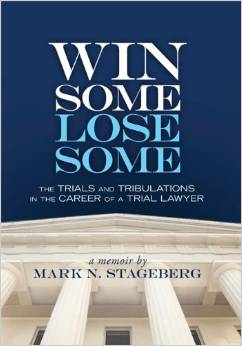
jpegMark N. Stageberg, a Minnesota civil trial lawyer with over 40 years of experience, has written a fascinating review of his career in Win Some Lose Some: The Trials and Tribulations of a Trial Lawyer.

I am amazed by the broad variety of his experience–insurance defense work in personal injury cases as he was starting out and then plaintiff’s personal injury and other types of cases over the rest of his career. Most were in state and federal courts in his home state of Minnesota, but he also has handled cases in the courts in 14 other states. Moreover, he has been a lawyer in over 175 completed jury trials or an average of about four per year.

In an era when most civil cases are settled, that is a truly remarkable accomplishment. This is shown by the statistics for all civil cases for all the federal district courts for Fiscal 2013 (10/01/12–09/30/13):


Civil Cases Number
Pending at 09/30/12 271,141
Filed FY 2013 284,604
Terminated by trials FY 2013 (11,036)
Terminated by other means FY 2013 (244,224)
Terminated subtotal FY 2013 (255,260)
Pending at 09/30/13 300,485

In other words, only 4.3% (11,306/255,260) of all the federal court civil cases that were terminated in FY 2013 were terminated by trial. I believe similar statistics exist for other years for the federal courts. The same is true, I believe, for most state courts.

Becoming a Capable Trial Lawyer

Stageberg starts by saying that finishing law school and passing a bar exam do not by themselves make anyone ready to conduct a civil trial (p. 20-21). Instead, it takes actually trying cases and learning from experience. This would be aided by having an experienced mentor, something he did not have (p. 27).

As a retired lawyer reflecting on my first years of practice nearly 50 years ago, I wholeheartedly agree.

Like almost all law students in my first year I had civil procedure, an essential tool of a trial lawyer and litigator, but it was book-learning, and it seemed like ancient history three years later when I was starting to practice and trying to learn how civil procedure worked in the “real world.”

Moreover, there is not a general overarching set of procedural rules that apply in all courts in the U.S. There is the Federal Rules of Civil Procedure that govern all civil cases in all the federal district courts plus local rules for each of the 94 such courts. The local rules with which I am most familiar is the set for the District of Minnesota. In addition, each federal district judge often has his or her own additional rules or practices.

Each state in turn has its own set of civil procedural rules. Thankfully for the trial lawyer, most states have adopted rules modeled on the Federal Rules of Civil Procedure, but there are usually some differences between the two. Here I reference the Minnesota Rules of Civil Procedure. The states also frequently have an additional set of rules; in Minnesota it is called the General Rules of Practice. Again the lawyer also needs to be aware if the individual trial court judge has other rules or practices.

Trial lawyers also need to be intimately familiar with the jurisdiction’s law of evidence. Now there is the Federal Rules of Evidence for trials in the federal district courts, and there are separate evidentiary rules in each state. Again the trial lawyer is thankful that today they are modeled on the Federal Rules of Evidence; an example is the Minnesota Rules of Evidence.

Another body of law needs to be in the trial lawyer’s tool kit: conflict of laws. Because many cases involve facts in different states or different countries, there has to be a set of rules or principles to determine which jurisdiction’s substantive law applies. Each state has its own body of such law, and the rules applicable in federal court cases are even more complex.

All of these areas of law—procedure, evidence and conflicts—are in addition to the substantive law that determines whether or not there is liability and the appropriate remedy. Frequently the trial lawyer will look for guidance on these substantive issues to other lawyers in his or her law firm with appropriate expertise. For example, I handled a case raising issues under the complex federal Employee Retirement Income Security Act (ERISA), for which other lawyers in the firm who specialized in that area provided the substantive legal analysis.

For all of these areas of law the trial lawyer needs to keep abreast of any amendments to the rules and statutes and their interpretations by the courts.

As a result, if the lawyer is handling or trying a case outside his or her home state, the lawyer is required by court rule to associate with an attorney of the bar of that jurisdiction, and such co-counsel needs to be knowledgeable about all these issues in that jurisdiction. Stageberg learned this lesson when his local counsel was not so qualified (p. 188).

Another requirement for the trial lawyer is developing the skills of using the courts’ discovery rules plus independent investigations to discover the facts relevant to the case and to assemble the evidence for the case, including the retention of expert witnesses when appropriate.

All of the foregoing knowledge is necessary before you enter the more complex and challenging trial courtroom. There the lawyer needs to develop the skills of oral advocacy, of asking non-objectionable questions, of making appropriate objections, and of making tactical and strategic decisions, all in the pressure cooker of a trial courtroom when there is an opposing lawyer who is trying to counter whatever you do and defeat you in the courtroom battle.

Yes, indeed, learning how to be an effective trial lawyer takes a lot of learning by doing.

The Stress of Being a Trial Lawyer

Stageberg tells us, “Trying lawsuits is very strenuous, high-pressure occupation. Working thirteen or fourteen hour days for the duration of the trial is . . . very hard work” (p. 382).

Amen! From my much more limited experience of actually trying cases, I concur, and a prior post discussed some of the aspects of this stress.

Indeed, the mere foregoing recital of the things that have to be learned by a trial lawyer should make it self-evident that trial work is very stressful and very hard work. But wait, there is more.

When you are in the courtroom itself, even though that may “only” be three or so hours in the morning and another three or so in the afternoon, your mind is continuously multitasking. Here are a few of the questions that are running through your mind when you are examining your own witnesses. What did the witness say? How do you respond to any objection? What is the next question? Are you covering the essential points for the plaintiff’s claim or the defendant’s defense? Have you covered all you wanted to do with this witness? Have you introduced and offered into evidence all the exhibits you planned? How is the judge reacting to the testimony? The jury? Who is the next witness? Do your plans for that witness have to be changed in light of what this witness is saying?

The opposing lawyer has all these questions running through his or her mind plus others. Is the question objectionable, based upon the law of evidence? If so, what objection and whether and how to state it? Is the witness’ testimony consistent with what he or she said in a deposition or an affidavit, both under oath, or in a letter, memo or email or other document? How should I cross-examine this witness? Then conducting the cross-examination puts you in the shoes of the lawyer described in the prior paragraph.

Moreover, before you start in the courtroom in the morning, you are also multitasking. Preparing the witnesses who will be testifying that day. Anticipating what the opposing counsel will do or say. Changing and adjusting the plans you had made before the trial started. Checking in with your assistants on current and new assignments. This process continues during any breaks during the day in court and after you leave the court to prepare for the next day. Thus, it is easy to have 14 or more billable hours for each day of trial. (This shows why trial is so expensive and why the cost of continuing litigation is a frequent factor in settling cases, before, during or after trial.)

You also have to find time during trial for bathroom breaks, meals and sleep. Sleep does not come easily as your mind races over all of the decisions you made that day and those you will have to make the next day. As a result, your sleep suffers and you get exhausted. You need to eliminate all other demands on your time, including commuting. For example, in my last trial in state court in downtown Minneapolis in January 2001, I stayed in a hotel close to the courthouse in order to eliminate the daily seven-mile commute from my home and the risk of winter storms and traffic making such commutes even more difficult and time-consuming.

Practical Tips for the Trial Lawyer

Stageberg emphasizes that the attorney should never believe everything a prospective or actual client says and that a new client should not be accepted before the attorney has done some independent research about the prospective client (p. 327). I recall a case for a regular client of the law firm when I should have followed this precept. The client’s distributorship had been terminated by the manufacturer, and after obtaining the client’s file for the distributorship, I commenced a lawsuit for breach of contract and other alleged wrongs only to have the manufacturer’s lawyer provide me with a copy of the written contract (which I had never seen) that torpedoed the lawsuit.

Stageberg frequently tells us of lessons learned about trial practice as he tried more and more civil cases. Here are some of them:

  • “Don’t take loser cases to trial. Settle them.” (p. 23)
  • Evaluating pre-trial settlement offers is difficult. It requires evaluation of the strength of all the witnesses and other evidence as well as the lawyers involved. (p. 43)
  • Juries can go off on tangents so try to provide careful explanations of photographs and other exhibits (pp. 21-22). Be honest with the jury. Do not downplay the problems with your case (p. 306).
  • Trying to “read” a jury’s reaction to the testimony and to you as attorney is very difficult and easy to mistake (p. 23). Also avoid prejudging a jury based on stereotypes (p. 45).
  • An expert’s testimony about his or her opinions requires the prior establishment of foundation for that testimony (P. 22).
  • The lawyer needs to know how to pronounce the unusual names of witnesses and places (p. 51). The lawyer should also be careful about what vehicle he or she drives to court, not wanting to offend U.S. workers by driving a foreign vehicle (p. 50).
  • The lawyer needs to make a trial court record for anything that might become an appellate issue, including the judge’s inattentiveness (pp. 91-92).
  • Always try to anticipate the unexpected and maximize your control of the situation (p. 126).
  • Eyewitness testimony is not always reliable (p. 129). In certain cases, the lawyer should make his or her own inspection of the accident or other important scene in the case (p. 133). Having a jury inspect such scenes can also be a very effective tool for the lawyer (p. 210).
  • Especially in personal injury cases, the plaintiff and his or her attorney needs to be aware that insurance companies frequently conduct surveillance of the plaintiff (p.142).
  • The attorney’s presentation of the essentials of a case to a focus group or mock jury can greatly assist the attorney in revising the case to make it more effective in the court (150-57).
  • The attorney needs to counsel the client to be careful on what he or she says and their appearance in the presence of the jury or individual jurors in and out of court (p. 214).

Stageberg has harsh words about some lawyers from large law firms who represented clients in litigation, but did not have much actual trial experience (pp. 245-50). In at least one instance Mark, known as an experienced trial lawyer, bluffed about his eagerness to go to trial and thereby induced the defense counsel to make a substantially better settlement offer (248-50).

When I encountered Stageberg in a case, I was a “litigator” from a large law firm with much less actual trial experience than him. I do not recall if he tried this “trick” with me, but I know we did not accept any of his pretrial settlement demands or substantially change our counteroffers. As a result, we went to trial and only settled after the trial of the liability issues and before the damage phase of the trial. Moreover, although Mark is critical of pretrial motions (p. 245), the dismissal and summary judgment motions that I made were granted and his motion to add punitive damages was denied, all substantially reducing the ad terrorem nature of his case. (A prior post discussed my disagreement with some of the things Stageberg said about this case.)

Trials by the Court

Trial by jury, or course, is not the only way U.S. courts try civil cases. In the federal system, parties may waive their constitutional right to jury trial under the Seventh Amendment and have a single judge hear all the evidence and render a decision in that case.

This is another tactical and strategic decision for the client with the lawyer’s advice. For a lawyer like Stageberg with extensive jury trial experience facing other lawyers who probably have less jury experience, Stageberg would favor trial by jury.

I, however, tended to favor trial by the judge unless there was some reason to doubt the ability or fairness of the judge. In addition, the lawyer usually knows a lot about the judge’s record and manner whereas nothing is known about the abilities and skills of an unknown jury. Finally I often believed that a judge can better understand the complexities of a case than a jury.

In 2013 (long after my retirement from lawyering), I was called for jury duty in Minneapolis and was on two panels of prospective juries, but as anticipated, I was stricken from both by preemptory challenges. Trial lawyers generally do not want other lawyers to serve as jurors on suspicion that they will be too dominating in the jury’s deliberations. But it was an educational experience to see the process from a different angle and to appreciate and respect the seriousness of the prospective jurors and the trial judges.

I did not find a discussion of this issue for the trial lawyer in the Stageberg book. This is merely an observation, not a criticism.

Alternative Dispute Resolution (ADR)

The foregoing discussion by itself should demonstrate the high cost of litigation through trial. Given the legitimate public interest in resolving disputes as quickly and as cheaply as possible, many of our courts have adopted what is often called court-annexed ADR (Alternative Dispute Resolution).

For example, in Minnesota state court cases, pursuant to General Rules of Practice 114.04, the parties are required to confer promptly after the commencement of a case on various matters, including “the selection and timing of the ADR process,” and if the parties do not so agree, “the court, at its discretion, may order the parties to utilize one of the non-binding processes, or may find that ADR is not appropriate.”

A similar rule exists in Minnesota’s federal district court. Its Local Rule 16.5(b) provides that with certain stated exceptions, “the court must schedule a mediated settlement conference before a magistrate judge. The court, at a party’s request or on its own, may require additional mediated settlement conferences. Each party’s trial counsel, as well as a party representative having full settlement authority, must attend each mediated settlement conference. If insurance coverage may be applicable, an insurer’s representative having full settlement authority must also attend.” In addition, Local Rule 16.5(c) states that the court may order the parties to participate in other ADR procedures.

Independent of these court measures, the parties to contracts often agree to submit their disputes to arbitration or another form of ADR under the rules of a private agency that will administer the process such as the American Arbitration Association. These rules are similar in many ways, but not identical, to the relevant court rules of civil procedure, so the lawyer needs to be knowledgeable about these rules too. These proceedings are private and hopefully shorter than court trials. But the arbitrators or other neutrals are paid by the parties, which adds another expense to the cost of dispute resolution.

I spent a lot of time promoting ADR in the Minnesota State Bar Association and elsewhere. One of my motivations was to reduce the estrangement of parties that is often a by-product of litigation. I also acted as an arbitrator, drafted contractual arbitration and other dispute resolution provisions for other lawyers in the firm and was a lawyer for parties in arbitration.

I did not see a discussion of this aspect of the life of a trial lawyer in Stageberg’s book. Again, this is merely an observation.

Conclusion

This book is entertaining and educational for anyone interested in the contemporary American civil justice system. It also is most useful for someone who is thinking about becoming a trial lawyer or just starting down that long winding road. I thank Mark for sharing his career with the rest of us.


Litigation Over an Early Compact Fluorescent Lamp

Unknown-1

In 1988 the Faegre & Benson law firm of Minneapolis was retained to defend the Phillips Lighting Company [1] in a civil lawsuit brought in U.S. District Court for the District of Minnesota, and I was assigned as the lead attorney for the case.[2]

The plaintiff was Ibac Industries, Inc. of Princeton, Minnesota, a small town about 50 miles north of Minneapolis. It had been working at manufacturing a plastic cover for an early Compact Fluorescent Lamp (CFL) designed by Phillips.[3]

The complaint asserted claims for alleged breach of a joint venture agreement; violation of the Racketeer Influenced and Corrupt Organizations Act (RICO), which if successful entitled the plaintiff to treble the amount of actual damages plus attorneys’ fees; fraud; negligent misrepresentation; and four other theories. I do not recall what the alleged damages were except that they were significant.

Before trial on behalf of Phillips I successfully moved to dismiss the RICO and joint venture claims for failure to state a claim on which relief could be granted and for summary judgment on another claim. I also was successful in resisting the plaintiff’s motion for leave to amend the complaint to add a claim for punitive damages.

As a result, we went to trial in December 1989 on the fraud, negligent misrepresentation and three other claims. At the end of the evidence, the court granted Philips’ motion for directed verdict on the three other claims, leaving only two for the jury to decide.

The jury returned a special verdict for Phillips on the fraud claim. Thus, the only remaining claim for resolution by the jury’s special verdict was negligent misrepresentation.

Under the Minnesota common law of negligent misrepresentation, at the time, as I recall, a person who, through his or her profession, business, or employment, or in any transaction in which he or she has a pecuniary interest, fails to exercise reasonable care or competence in obtaining or communicating information and thereby supplies false information while guiding others in their business transactions, is liable for any pecuniary loss caused by the claimant’s justifiable reliance on the information. However, such a claim is subject to the comparative fault doctrine, whereby the plaintiff can recover only the percentage of fault attributable to the defendant, and if the plaintiff’s fault exceeds the defendant’s, the plaintiff can recover nothing.

To prevail on a negligent misrepresentation claim under Minnesota law at the time, as I recall, a plaintiff must establish that: (1) the defendant owed the plaintiff a duty of care; (2) the defendant supplied false information to the plaintiff; (3) the plaintiff justifiably relied upon the information; and (4) the defendant failed to exercise reasonable care in communicating the information; and (5) damages.

Even though, as I recall, Phillips contested all of these elements, the jury’s special verdict found such negligent misrepresentation and assigned slightly greater responsibility to Phillips (something like 60%) than to Ibac (something like 40%). This was good news for Phillips in that Ibac’s recovery of its damages would be reduced by the percentage of responsibility assigned to Ibac. This was bad news for Phillips, on the other hand, in that Ibac was not shut out from recovering anything. At the time I was disappointed after coming so close to “zeroing out” the plaintiff.

The trail was bifurcated between liability and damages, and after the above jury determinations on liability and before a trial before the same jury on damages, there was a settlement in January 1990 with Phillips paying Ibac a sum of money, the amount of which I do not recall.

The bifurcation of the trial provides insights about the life of the litigator/trial lawyer and being subject to the demands or whims of the court.

Judge Edward J. Devitt
Judge                Edward J. Devitt

As I recall, U.S. Senior District Court Judge Edward J. Devitt, the presiding judge,[4] called a pretrial conference in early December 1989 and much to my surprise and consternation and without any prior notice, set the trial to commence just before Christmas, only a few weeks away. Perhaps this was the Judge’s stratagem to try to force a settlement because of all the difficulties this short notice would present to the parties and their attorneys.

Unfortunately my wife and I already had paid for a vacation to Costa Rica for later that month. When I objected to this date for the trial on that basis and on the difficulties of having my client’s witnesses come from Boston on short notice during the holiday season, Judge Devitt accommodated me by bifurcating the trial between liability and damages and only conducting the liability trial before I was scheduled to go on vacation.

While I was in Costa Rica, I received news from my law firm that the plaintiff was increasing its alleged damages. This forced me to leave Costa Rica early when I was not feeling well. I well remember leaving La Selva Research Station in the rain forest where we were staying to catch a local bus on a country road for a long ride to the capital city of San Jose. When the bus came over the mountain, I saw the widespread lights of the city looking as large as Los Angeles. That really impressed upon me the lure of cities across the world to people living in the countryside.

The opposing counsel for Ibac was Mark N. Stageberg, an able, very experienced civil trial lawyer. He discusses this very case, I assume based on recollection, in his memoir, Win Some Lose Some: The Trials and Tribulations of a Trail Lawyer (pp. 94-96). [5]

I have no disagreements with what Stageberg said about this case, except for the following:

  • First, he did not mention his losses on the previously mentioned pretrial motions that significantly reduced the potential of his case.
  • Second, he says his client had “developed and sold a new prototype fluorescent lightbulb to . . . Phillips.” According to my firm recollection, that is absolutely erroneous because the bulb, to my recollection, was designed by Phillips, especially its crucial electronics parts, and Ibac was only retained to manufacture the plastic cover according to Phillips’ specifications
  • Third, I do not recall Stageberg’s account of the so-called “smoking gun” document from Phillips’ files, and I certainly do not believe that this document or any other evidence proved that the Phillips’ witnesses were lying, as Stageberg claims. Indeed, the jury’s rejection of the fraud claim undercuts Stageberg’s interpretation or recollection of this point.
  • Fourth, contrary to what Stageberg said, the jury did not determine that Phillips had “breached its contract and had committed fraudulent misrepresentations” with Ibac. As previously stated, the breach of contract claim was dismissed on motion or on directed verdict, and the jury determined that there was no fraudulent misrepresentation.
  • Fifth, we will never know that would have happened if Ibac had started the whole process with a more reasonable demand.

Nevertheless, I have to admit that after all of the skirmishing, his client walked away with a substantial settlement amount (minus attorneys’ contingent fee).

I also note that Stageberg expressed his consternation in another case when he was subjected to a trial court’s unexpectedly setting a trial date that interfered with his plans to do other things. (Win Some Lose Some at 189-192).

————————————-

[1] Phillips was part of Koninklijke Philips N.V. (Royal Philips, commonly known as Philips), a Dutch diversified technology company headquartered in Amstrerdam and one of the largest companies in the world.

[2] This post is based upon my personal recollection and on my December 1989 and 1990 descriptions of the status of this case in my annual reports to the partner in charge of my group at Faegre & Benson, which I am confident accurately reflected what had happened in the case. I do not have any documents from the case. I am confident that Faegre’s files for a 24-year-old closed case were destroyed a long time ago under regular document-retention guidelines. Finally the court’s files for the case (# 3:88cv-00482-EJD) have been sent to storage in a remote federal facility.

[3] In 1980 Phillips introduced its model SL, which was a screw-in lamp with integral magnetic ballast. The lamp used a folded T4 tube, stable tri-color phosphors, and a mercury amalgam. This was the first successful screw-in replacement for an incandescent lamp. All of this, as I recall, was before any involvement of Ibac with respect to the plastic cover.

[4] In 1989 Judge Devitt at age 78 was a very eminent federal jurist. He had served as one of Minnesota’s federal District Judges, 1954-1958, as its Chief Judge, 1959-1981, and as one of its Senior Judges since 1982. He continued in that capacity until his death in 1992. Before his federal judicial career, he served one term in the U.S. House of Representatives.

[5] I plan to write a general review of the memoir after I finish reading it.

The Novel “Ordinary Grace” Wins Awards


ordinary-grace-200A prior post recorded my delight in the novel “Ordinary Grace” by William Kent Krueger despite my criticism for his use of an Aeschylus quotation about suffering and wisdom. Not surprisingly the book has received many awards.

On May 1, 2014, the Mystery Writers of America granted its 2014 Edgar Allan Poe Award for Best Novel to “Ordinary Grace.”

Earlier the novel had won (a) the 2014 Midwest Booksellers Choice Award for Best Novel of the year; (b) the 2014 Dilys Award from the Independent Mystery Booksellers Association for the mystery book their members most enjoyed selling; and (c) the Squid Award from Left Cost Crime , a group of mystery fans for the best mystery set in the U.S. The novel also has been included on many Best of 2013 lists.


Death Certificates’ Documentation of Mortality

The April 7th issue of the New Yorker has a fascinating article by Kathryn Schulz[1] on death certificates, a subject you never thought you would want to know about.

She says, “every dead body is a mystery. Death is an assassin with infinite aliases, and the question of what kills us is tremendously complex. . . . Today, ‘Why do we die?’ is one of the fundamental questions of epidemiology, and we have developed a vast and macabre bureaucracy to answer it.”

Only one half of the 50 million people who will die this year, she reports, will get a death certificate. The half who do not are in the world’s poorest places that do not have the infrastructure for such documentation.

The antecedent of the modern death certificate was the Bill of Mortality in early-sixteenth century England that recorded the weekly numbers of death by the plague.

In 1836 they were replaced in England by what would become the global prototype of the modern death certificate.

In 1893 the International List of Causes of Death was published by a committee headed by the French statistician and demographer Jacques Bertillon. That list after 10 revisions is still used today and now is managed by the World Health Organization. The latest version has over 8,000 ways to die.

Today the one-page death certificate has 250 pages of instructions on how to fill it out by physicians, funeral directors, medical examiners and coroners. Although 90% of the certificate can be filled out easily, the problem arises with the four lines for cause-of-death.

The certificates for deaths in hospitals typically are filled out by residents who have inadequate training for doing so. This results in errors that “overstate leading causes of death, obscure emerging ones, and distort the data we use to allocate funds for research, education, prevention and treatment.”

The author concludes that a death certificate “provides the pathological basis of death, determined by some combination of fact, convention, and guesswork, and described in terms that most non-doctors struggle to understand.” She adds, “The bureaucratization of death . . . has evolved over time into a massively complex checkpoint at the border between the living and the dead; Charon’s[2] T.S.A. [Transportation Security Agency].”

I now add the history of the death certificate to my prior post’s reflection on mortality.

———————————————————

[1] Schulz is a journalist, author and book critic for New York Magazine. Her book Being Wrong: Adventures in the Margin of Error was described as a “funny and philosophical meditation on why error is mostly a humane, courageous and extremely desirable human trait.” She has spoken at TED on “Don’t regret regret” and “On being wrong.”

[2] In Greek mythology, Charon is the ferryman of Hades who carries souls of the newly deceased across the rivers Styk and Acheron that divided the world of the living from the world of the dead.