Oscar Romero is remembered in music and film.[1] We also have seen some of the art about Romero.[2] Now let us look at some of the other art.
Romero mural on country church
There are murals of Romero on the exteriors of churches throughout the country. Many of them are painted by artists employed by a Salvadoran NGO, Equipo Maiz, one of whose missions is to keep Romero’s memory alive. In 2000 I observed one such mural being painted on a country church.
Romero posters @ Equipo Maiz
Equipo Maiz also produces posters and t-shirts with Romero’s image for the celebrations of his life on the anniversaries of his assassination.
Romero bust @ Universidad de Centro AmericaRomero Chapel, Universidad de Centro America
One also sees busts of Romero at churches. One is outside the entrance to the Romero Chapel at the Universidad de Centro America, not too far from where his friends, the six Jesuit priests, were murdered in 1989.
Romero painting, March 2000
For the 20th anniversary celebrations in 2000 there was a special art exhibit in the capitol city of paintings about Romero. Here is one of the paintings in that exhibit.
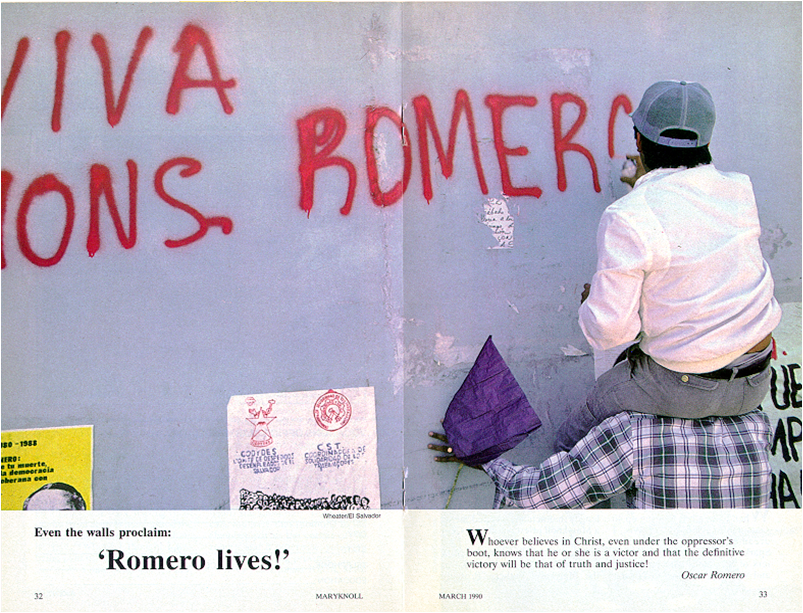
Graffiti also needs to be included in the art about Romero. Indeed, it is art of the people. I vividly recall riding in a van in 1989 on the way for my very first visit to the chapel where Romero was assassinated. Graffiti on the white walls sheltering the nearby homes proclaimed, “Romero vive!” (Romero lives!)[3]
[1] Post: Remembering Oscar Romero in Music (Oct. __, 2011); Post: Remembering Oscar Romero in Film (Oct. __, 2011).
[2] Post: Oscar Romero’s Last Homily (Oct. 7, 2011)(Romero mural near his apartment); Post: Oscar Romero’s Tomb (Oct. 10, 2011)(Romero’s tombs); Post: Oscar Romero’s Assassination Case in the Inter-American Commission on Human Rights (Oct. __, 2011)(Romero mural at San Salvador airport; 2010 Romero poster); Post: Remembering Oscar Romero in Music (Oct. __, 2011)(Romero assassination painting in church in Ciudad Barrios).
[3] Post: My Pilgrimage to El Salvador, April 1989 (May 25, 2011).
Oscar Romero is remembered in music.[1] So too is he remembered in three films.
Oliver Stone in his 1986 film Salvador stars actor James Wood as U.S. journalist Richard Boyle who goes to El Salvador to report on the violence of the early years of its civil war. It includes the famous portion of Oscar Romero’s homily of March 23, 1980. Woods was nominated for an Oscar for his role as were Stone and Boyle for their screenplay.[2]
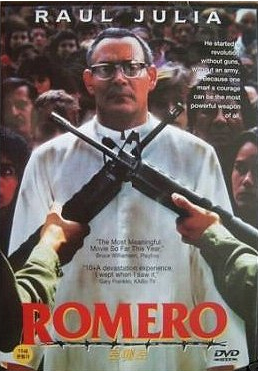
The biographical film Romero from 1989 was produced by the Paulist Fathers, and in one sense it is a Christian evangelical film designed to convert people to Christianity as lived by Romero.
Staring Raul Julia as Romero, the film accurately shows the new Archbishop in 1977 as a man singularly unsuited for high office, particularly in such a time of crisis. By nature timid, bookish, and retiring, he had no presence, no political instincts, no sense of moral authority. Romero, however, had one important “virtue” at the start of his service as Archbishop–in the eyes of El Salvador’s wealthy oligarchy, military officials and other Salvadoran bishops: he was noncontroversial.[3]
What no one anticipated — including Romero himself — was how he would respond when horrible things happened. Less than a month into his office, demonstrators in the main plaza of San Salvador were surrounded by police forces, and some were killed. Days later, Romero was stunned when his friend, Father Rutilio Grande, who was known for his advocacy of reform and social justice, was assassinated, along with an old man and a young boy accompanying him to Mass. The film shows Romero’s increasing courage in denouncing the human rights violations in his country and includes his homily asking President Jimmy Carter to stop military aid and the most famous homily in which he says to men in the military, “I beg you, I implore you. I order you in the name of God: Stop the repression!”[4]
"Romero" film in Plaza Libertad, March 2000
When I was in El Salvador for the 20th anniversary of Romero’s assassination in March 2000, the Romero film was being shown for the first time in the country. In Plaza Libertad in front of the Cathedral the film was playing in continuous loop on television monitors. Many people were watching the film as I walked through the plaza.
Rutilio Grande MemorialMisa para Rutilio Grande, March 2003
The mention of Father Grande reminds me that in March 2003 I attended his 25th memorial mass in the village of El Paisnal, where he served near the town of Aguilares. On the road to the village we stopped to pay our respects at the memorial where he was assassinated. Interestingly the priest at the church in 2003, Father Orlando, was a former banker and a relative of Grande’s.
A third film, a documentary, about Romero entitled “Romero by Romero” was premiered in San Salvador in March 2010 as part of the Romero anniversary celebration. I was especially touched to see scenes of Romero walking around a poor neighborhood and warmly greeting and touching the people he met without a lot of ceremony. This was the film promised by the Funes Administration at the November 2009 hearing at the Inter-American Commission on Human Rights. (Post: Oscar Romero’s Assassination Case in the Inter-American Commission on Human Rights (Oct. 13, 2011); Tim’s El Salvador Blog, Romero’s life documented in film and video, http://luterano.blogspot.com (Mar. 17, 2010) (includes YouTube trailer for the film).)
[1] Post: Remembering Oscar Romero in Music (Oct. 14, 2011).
One of the so-called Cuban Five recently completed his sentence in U.S. prison and is now on probation in the U.S. and not permitted by the court to return to Cuba.[1]
We now learn that the U.S. offered to allow this individual with dual U.S.-Cuban citizenship to return to Cuba in exchange for his renouncing his U.S. citizenship and Cuba’s release of imprisoned U.S. citizen, Alan Gross. Another part of the offer was U.S. stated willingness after the exchange of these two individuals to discuss certain other issues between the two countries, including removal of Cuba from the U.S. list of state sponsors of terrorism;[2] reducing spending on Cuban democracy promotion programs like the one that led to the U.S.’ hiring of Gross; authorizing U.S. companies to help Cuba clean up oil spills from Cuba’s planned offshore drilling; improving postal exchanges; ending a program that makes it easier for Cuban medical personnel to move to the U.S.; and licensing the French company Pernod Ricard to sell Havana Club rum in the United States.[3]
Cuba, however, rejected this offer on the ground that the Cuban now on probation had already served his prison sentence. Instead Cuba is reported to have counter-offered to release Gross in exchange for the U.S. pardoning some or all of the Cuban Five.[5]
This too is a positive development in keeping open the possibility of further negotiations between the two countries on the many accumulated issues burdening their relationship.
However, if the reports are correct that Cuba was seeking “pardons,” then it was asking for something that is not legally or politically possible. Federal pardons are theoretically available only to federal felons who have completed their sentences and are rarely granted as they involve collateral benefits under U.S. law. As the other four Cubans have not completed their sentences, they are not eligible for pardons. A commutation of sentence, on the other hand, reduces the period of incarceration; it does not imply forgiveness of the underlying offense, but simply remits a portion of the punishment. It has no effect upon the underlying conviction and does not necessarily reflect upon the fairness of the sentence originally imposed.The other four Cubans are eligible for clemency or commutations. [6]
I hope the U.S. and Cuba continue these preliminary discussions and reach an agreement on commuting the sentences of the Cuban Five and Alan Gross and allowing all of them to return to their home countries.
[1]See Post: Commutation and Release of Convicted “Spies” (Sept. 24, 2011); Post: Roots of Hope for U.S.-Cuba Relations (Sept. 27, 2011); Comment: Cuban Foreign Minister Attacks U.S. Policies (Sept. 28, 2011)(Comment to prior Post); Post: President Obama Is Wrong on Cuba (Sept. 29, 2011).
[2]See Post: The Ridiculous U.S. Designation of Cuba as a “State Sponsor of Terrorism” (May 20, 2011); Post: U.S. Repeats Its Ridiculous Designation of Cuba as a “State Sponsor of Terrorism” (Aug. 21, 2011).
[3] Assoc. Press, AP Sources–US Offered Cuba Swap for American, N.Y. Times (Oct. 14, 2011).
[4]See Post: The U.S. Should Pursue Reconciliation with Cuba (May 21, 2011).
In April 1989 I attended a service of solidarity in San Salvador for a Catholic priest who that week had received death threats. The service was in a screened recreational building next to a very dusty soccer field. As we entered, we were handed mimeographed sheets with words for hymns of the people about Archbishop Oscar Romero, who had been murdered nine years earlier. Thus began my learning about Romero.[1]
I returned to El Salvador for the 20th anniversary of Romero’s assassination in March 2000. One of the special events was a concert at the National University in the capitol to celebrate the release of a CD of music about Romero. Rock, pop and traditional styles of music were featured, and everyone enjoyed the music. The CD also contained an audio recorded extract from Romero’s famous homily of March 23, 1980. (See Post: Oscar Romero, A Saint for All People and All Time (Oct. 5, 2011).)
On this trip we visited Romero’s home town of Ciudad Barrios where we saw a dramatic painting of his assassination. We also spent time at the station of Radio Romero, which despite death threats broadcasts his words and music about him by a local group.
Romero painting, Ciudad Barrios Radio Romero, Ciudad BarriosRomero CD, 2010
For the 30th anniversary of Romero’s assassination in March 2010 I again was in El Salvador. A new CD of music about Romero was released similar to the earlier one.
[1] See Post: My Pilgrimage to El Salvador, April 1989 (May 25, 2011).
As previously mentioned, the Truth Commission for El Salvador named Alvaro Saravia, an aide to Roberto d’Aubuisson, as one of the participants in the plot to assassinate Archbishop Oscar Romero.[1]
When the Truth Commission report was released in March 1993, criminal charges against Saravia were being considered by the Salvadoran courts. Soon thereafter, however, those criminal charges were dismissed pursuant to the country’s hastily enacted General Amnesty Law.[2]
In September 2003, a U.S. human rights organization, the Center for Justice and Accountability, filed a civil lawsuit by a relative of Oscar Romero alleging that Saravia, then a California resident, as an aide to Roberto d’Aubuisson played a key role in organizing this assassination. The case sought money damages under two U.S. statutes, the Alien Tort Statute (ATS) and the Torture Victims Protection Act (TVPA).[3]
A year later, the court held that it had personal jurisdiction over Saravia as he was a resident of the California district and legally had been served with process to commence the case. The court also held that the case (initiated 13 years after the murder) was not barred by the U.S. 10-year statute of limitations under the U.S. equitable tolling doctrine because the plaintiff could not have obtained justice in Salvadoran or U.S. courts due to his legitimate fear of being killing for making such a claim and the Salvadoran government’s erection of roadblocks to Salvadoran judicial remedies. Similarly the lack of any effective Salvadoran judicial remedy meant that the plaintiff did not have to satisfy the TVPA requirement to have exhausted remedies in the foreign country.[4]
In this context, the U.S. court discussed the March 1993 El Salvador amnesty law and the invocation of that law to end the Salvadoran criminal case against Saravia. These actions were seen by the U.S. court as evidence of the plaintiff’s inability to obtain any judicial relief in that country, thereby eliminating any requirement for the plaintiff to have exhausted his Salvadoran remedies. The U.S. court apparently assumed that the Salvadoran amnesty law had no application to the U.S. case as that issue was not discussed.[5] However, the court did receive testimony that the Law was “directed to what the Salvadoran courts should do. It tells the Salvadoran courts how to deal with these cases” and that courts in other countries need not, and should not, take that Law into account.[6]
Saravia never responded to the civil complaint and did not participate in any way in this lawsuit. Even though this default constituted, by operation of law, an admission of all the well-pleaded allegations of the complaint and a conclusive establishment of his liability, the court conducted a five-day default hearing, and the plaintiff provided independent evidence in support of the claims, including the live testimony of the driver of the assassin’s car.[7]
The court then entered extensive findings of fact and conclusions of law holding Saravia liable and ordering him to pay $10 million of compensatory and punitive damages to the plaintiff. The court determined that the murder constituted a crime against humanity, because it was part of a widespread and systematic attack intended to terrorize a civilian population. As the court stated, “Here the evidence shows that there was a consistent and unabating regime that was in control of El Salvador, and that this regime essentially functioned as a militarily-controlled government.” The government perpetrated “systematic violations of human rights for the purpose of perpetuating the oligarchy and the military government.” The court also concluded that what happened in El Salvador was the “antithesis of due process” and that there could not be a better example of extrajudicial killing than the killing of Archbishop Romero.[8]
The court received into evidence the Truth Commission Report and relied extensively on it in reaching its findings.[9]
Because Saravia had not participated in this case in any way, there was no appeal, and the district court’s decision became the final judgment. Now Saravia is one of the “most wanted fugitives” for “human rights violations” by the U.S. Immigration and Customs Enforcement agency.[10]
In 2006 and again in 2010, Saravia was reported to be in an unidentified Latin American country for his personal security when he was interviewed by Salvadoran journalists and admitted to his involvement in the assassination plot. He appeared to be a tormented person barely getting by.[11] He has not paid any part of the $10 million judgment and undoubtedly never will.
Roberto d’Aubuisson, who was named as the “intellectual author” of the assassination by the Truth Commission, died of cancer in February 1992, just after the signing of the Peace Accords that created the Truth Commission.[12] He never was subjected to any criminal or civil charges for this horrific crime. Nor was anyone else other than Saravia.
[1] See Post: Oscar Romero’s Assassination (Oct. 8, 2011). Information about the Truth Commission’s creation and operations has been provided. (See Post: International Criminal Justice: The Jesuits Case in the Truth Commission for El Salvador (June 9, 2011).)
[2] See Post: International Criminal Justice: El Salvador’s General Amnesty Law and Its Impact on the Jesuits Case (June 11, 2011).
[3] CJA, Key Conspirator in Assassination of Salvadoran Archbishop Romero Faces Lawsuit in U.S. Court, Sept. 16, 2003, http://www.cja.org/cases/romero.shtmo; Chang, Modesto man accused in ’80 slaying of bishop, San. Fran. Chronicle, Sept. 17, 2003; Branigan, Suit Filed in ’80 Death of Salvadoran Bishop, Washington Post, Sept. 17, 2003.
[4]Doe v. Saravia, 348 F. Supp.2d 1112, 1118-19, 1142-43, 1147-48 (E.D. Cal. 2004). The roadblocks included the Salvadoran government’s thwarting Saravia’s extradition from the U.S. to El Salvador and the adoption and application of the amnesty law to the Salvadoran criminal case against Saravia. (Id. at 1148.)
[11] Reyesei, Conspirator in Romero assassination speaks out, Nuevo Herald (Mar. 24, 2006); Tim’s El Salvador Blog, Conspirator in Romero assassination speaks out (Mar. 24, 2006),http://luterano.blogspot.com; Dada, How we killed Archbishop Romero, (Mar. 25, 2010), http://www.elfaro.net.
[12] Severo, Roberto d’Aubuisson, 48, Far-Rightist in Salvador, N.Y. Times (Feb. 21, 1992).
San Salvador Cathedral, 1989San Salvador Cathedral, 1989
My first visit to Oscar Romero’s tomb in the Cathedral of San Salvador was in April 1989. The Cathedral is in el centro with all the noise and hurly-burly of buses and other traffic. The building was not finished. Steel rods protruded from the rough concrete shell of the building waiting for other parts of the structure. (Romero had halted all construction because he did not think it was right for the church to be spending money on its building when the people were suffering from poverty and human rights abuses.) On the steps were women from COMADRES with their bullhorns protesting against the latest wave of repression. Inside, scraps of linoleum were on the floor along with scattered plain wooden benches. In the right transept was Romero’s tomb–plain concrete covered with flowers and prayers of the people. As I stood there, the words “My body broken for you” from the Christian sacrament of communion echoed in my mind. Tears still come when I remember being in that place at that time. (See Post: My Pilgrimage to El Salvador, April 1989 (May 25, 2011).)
San Salvador Cathedral, 2000Oscar Romero Tomb, 2000
In March 2000 on the 20th anniversary of Romero’s assassination I visited the Cathedral again. The construction of the building had been completed. In a formal sense, the exterior was beautiful with ceramic tiles by the country’s great artist, Fernando Llort, surrounding the main entrance. The tomb had been moved to the crypt and was more formal and elegant. But it had lost its spiritual power for me.
March 2010 marked the 30th anniversary of the assassination when I returned to the Cathedral. The tomb had been moved again, now to a more central and prominent part of the crypt. It was totally covered with flowers, pictures and other things so that it was impossible to tell what the tomb itself looked like. Only when I found photographs on the Internet could I see the tomb itself. At the four corners of the bronze tomb, sculptured figures of Salvadorans are rising from the horizontal image of the dead Romero with his Archbishop’s Mitre. The artist apparently was inspired by Romero’s statement shortly before he was assassinated, “If they kill me, I will rise again in the Salvadoran people.” The separate elements of this tomb are beautifully executed, but as a whole it is depressing. All I could think, what an ugly brass four-poster bed. I extend my apologies to Romero and the artist.
Oscar Romero Tomb, 2010Oscar Romero Tomb, 2010President Obama @ Oscar Romero Tomb, 2011
On Palm Sunday, March 30, 1980, Oscar Romero’s funeral mass was held on the front steps of San Salvador’s Cathedral. In attendance were the Papal Nuncio to El Salvador, Cardinal Ernesto Corripio of Mexico and bishops from Belgium, Brazil, Canada, Ecuador, France, Ireland, Mexico, Panama, Peru, Spain, the United Kingdom and the United States. The mass was concelebrated by Cardinal Corripio; Father Miguel D’Escoto, who was the Foreign Minister of Nicaragua; Father Gustavo Gutierrez, the Peruvian liberation theologian; 30 bishops; and 300 Salvadoran priests.[1]
An estimated 250,000 people crowded into Plaza Libertad in front of the Cathedral, whose front steps held Romero’s coffin on an improvised alter. Many people carried photos of Romero with flowers and palms for Palm Sunday. They listened to the mass over loudspeakers.
Cardinal Corripio delivered the homily. In reference to one of Romero’s well-known teachings, “Violence cannot kill truth or justice,” Corripio said, “We cannot love by hating. We cannot defend life by killing.”
The Cardinal was interrupted by a loud explosion near a corner of the adjacent National Palace, which also fronted onto the plaza. It was a bomb. Soliders from the roof and windows of the National Palace started shooting into the crowd.
The people in the plaza starting running away. Many fled to the streets going away from the Cathedral. Others ran towards the Cathedral, but an iron fence prevented many of them from entering. Of the 40 who were killed that day, many had been trampled by others fleeing to safety.
People at Romero Funeral
Somehow Romero’s coffin was moved to the inside of the Cathedral, and Cardinal Corripio and others hastily buried Romero’s body in the tomb that had been prepared in the east transept of the Cathedral.
The Cathedral was packed with so many people they could hardly breathe for the next two hours until they thought it was safe to leave.
That afternoon the government released a statement blaming a popular organization (Coordinating Commission of the Masses) for the bomb and the violence and also alleging that the organization had tried to steal Romero’s body and had held people inside the Cathedral under the pretext of protecting them.
That evening a group of the foreign visitors at the funeral issued a statement that was signed by eight bishops and 16 others. They denied the accusations in the government’s statement and reported that witnesses said the bomb and shooting came from the National Palace.
These attacks on the people, in my opinion, were intended to frighten them from following Romero’s denouncements of human rights violations by the state and others.
[1] Treaster, 26 Salvadorans Die At Bishop’s Funeral, N.Y. Times (March 31, 1980); James Brockman, The Word Remains: A Life of Oscar Romero at 221-23 (Orbis Books 1982); Maria Lopez Vigil, Oscar Romero: Memories in Mosaic at 416-22 (EPICA; Washington, DC 2000). Romero’s funeral provides the opening scene for Sandra Benitez’s novel, The Weight of All Things (2000). The main character, a nine-year-old boy Nicolas Vereas, and his mother are in the crowd in the plaza to pay homage to Romero. When bullets fly, the mother throws herself on top of her son to protect him and is killed. Nicolas, however, believes she is only wounded, but cannot find her. The rest of the novel describes his perilous search for her.
Capilla de Hospital de la Divina ProvidenciaCapilla de Hospital de la Divina Providencia
On March 24, 1980, Monsignor Oscar Romero was delivering what turned out to be his last homily in the beautiful, intimate, modern chapel at a cancer hospital in San Salvador that was across the street from Romero’s small apartment.[1]
A red four-door Volkswagen drove up in front of the chapel. A man in the back seat of the car raised his rifle and fired a single shot through the open front door of the chapel. Romero fell and died behind the altar just after he had said, “May this body immolated and this blood sacrificed for humans nourish us also, so that we may give our body and our blood to suffering and to pain–like Christ, not for self, but to bring about justice and peace for our people.”
The Truth Commission for El Salvador, the U.S. District Court for the Eastern District of California and the Inter-American Commission on Human Rights have made the following findings regarding the assassination of Romero:[2]
On March 24, 1980, Roberto D’Aubuisson had a meeting with three members of his security team: Alvaro Saravia, Eduardo Avila and Fernando Sagrera. Avila said that later that day Romero would be celebrating mass at the Capilla and that this would be a good opportunity to kill him. D’Aubuisson ordered that this be done and put Saravia in charge of the operation. When someone said a sniper would be needed, Avila said he would contact one through Mario Molina, who was another member of D’Aubuisson’s security team. Yet another member of the team, Amado Antonio Garay, was assigned to be the driver for the assassin.
Later that same day in the parking lot of the Camino Real Hotel in San Salvador, according to the Truth Commission, the assassin (a bearded man) with a rifle got into a red, four-door Volkswagen that was driven by Garay. A different account of this meeting was provided by Garay himself in testimony in the U.S. federal court case. Upon instructions from Saravia, Garay testified that he drove the car to a house in San Salvador, where Saravia entered and brought out a tall bearded man carrying a long rifle with a telescopic lens. Before the car left, Saravia told the bearded man, “It is better to shoot in the head because maybe he [might] have a bulletproof vest. You have to be sure he got killed.” Saravia told Garay that he would be provided protection by men in another car.
The bearded man told Garay where to go, and on the way, the bearded one said, “I can’t believe it, I’m going to shoot a priest.”
Garay drove to the Capilla, and the bearded man told him to stop at its main entrance. Garay saw people sitting in the pews of the chapel and a priest speaking at the altar.
The assassin then fired a single high-velocity .22 caliber bullet from the rear seat of the Volkswagen through the open entrance door of the Capilla. The bullet hit and killed Romero.
Afterwards, upon D’Aubuisson’s order, another member of his security team, Walter Antonio “Musa” Alvarez, received 1,000 colones, and he and Saravia paid the assassin.
In the proceedings before these three institutions, the assassin himself was not identified.[3]
[1]See Post: Archbishop Oscar Romero’s Last Homily (Oct. 6, 2011).
[2] Commission for the Truth for El Salvador, Report: From Madness to Hope: The 12-year war in El Salvador at 127-31(March 15, 1993), http://www.derechos.org/nizkor/salvador/informes/truth.html%5B“Truth Commission Report”];Doe v. Saravia, 348 F. Supp.2d 1112, 1121-23(E.D. Cal. 2004)(Sararvia held liable to relative of Romero for $10 million of compensatory and punitive damages for crimes against humanity and extrajudicial killing for Saravia’s role in the assassination of Romero); Monsignor Romero v. El Salvador, Rep. No. 37/00 ¶¶ 53-54 (Inter-American Comm’n Human Rights, Case No. 11.481, April 13, 2000).
[3] Truth Commission Report at 130. A Salvadoran newspaper recently reported that the Romero assassin was at the time a deputy sergeant of the Salvadoran National Guard and a member of the security team for former Salvadoran President Arturo Molina. (Valencia, Gabriela & David, The sniper who killed Romero was a former National Guard, Diario Co Latino (Sept. 9, 2011).
Capilla de Hospital de la Divina ProvidenciaCapilla de Hospital de la Divina Providencia
At 6:00 p.m. on Monday, March 24, 1980, Monsignor Romero commenced his celebration of a memorial mass for the mother of the publisher and editor of a newspaper that was a voice for justice and human rights in El Salvador. The service was held in the beautiful, intimate, modern chapel at a cancer hospital in San Salvador that was across the street from Romero’s small apartment.[1]
In what turned out to be his last homily, Romero lead the people in Psalm 23: “The Lord is my shepherd . . . . Though I walk through the darkest valley, I fear no evil, for you are with me; your rod and your staff–they comfort me.” Romero then read the gospel text for the service, John 12: 23-26:
“Jesus [said], ‘The hour has come for the Son of Man to be glorified . . . . [U]nless a grain of wheat falls into the earth and dies, it remains just a single grain, but if it dies, it bears much fruit. Those who love their own life lose it; those who hate their life in this world will keep it for eternal life. Whoever serves me must follow me, and where I am, there will my servant be also. Whoever serves me, the Father will honor.'”
Romero Mural @ His Apartment
Romero said, “[E]very Christian ought to want to live intensely. Many do not understand; they think Christianity should not be involved in such things. But, to the contrary, you have just heard in Christ’s gospel than one must not love oneself so much as to avoid getting involved in the risks of life that history demands of us, and that those who try to fend off the danger will lose their lives, while those who act out of love for Christ give themselves to the service of others will live. . . .”
“We know that every effort to better society, especially when injustice and sin are so ingrained, is an effort that God blesses, that God wants, that God demands of us. . . . [W]e must try to purify these ideals, Christianize them, clothe them with the hope of what lies beyond. That makes them stronger, because it gives us the assurance that all that we cultivate on earth, if we nourish it with Christian hope, will never be a failure. We will find it in a purer form in that kingdom where our merit will be in the labor that we have done here on earth.”
“Dear brothers and sisters,” Romero continued, “let us all view these matters at this historic moment with that hope, that spirit of giving and sacrifice. Let us all do what we can. We can all do something . . . . We know that no one can go on forever, but those who have put into their work a sense of very great faith, of love of God, of hope among human beings, find it all results in the splendors of a crown that is the sure reward of those who labor thus, cultivating truth, justice, love, and goodness on the earth. Such labor does not remain here below, but purified by God’s Spirit, is harvested for our reward.”
“This . . . Eucharist is just such an act of faith. To Christian faith at this moment the voice of diatribe appears changed for the body of the Lord, who offered himself for the redemption of the world, and in this chalice the wine is transformed into the blood that was the price of salvation. May this body immolated and this blood sacrificed for humans nourish us also, so that we may give our body and our blood to suffering and to pain–like Christ, not for self, but to bring about justice and peace for our people.”
[1] Oscar Romero, The Violence of Love: The pastoral Wisdom of Oscar Romero at 242 (Harper & Row 1988); James Brockman, The Word Remains: A Life of Oscar Romero at 219-20 (Orbis Books 1982); Oscar Romero, Voice of the Voiceless: The Four Pastoral Letters and Other Statements at 191-93 (Orbis Books 1985); James Brockman, The Church Is All of You: Thoughts of Oscar Romero at 110 (Winton Press 1984).
In 1979-1980, Archbishop Oscar Romero was a passionate, persistent, public, brave critic of the human rights violations by the government and the paramilitary groups in El Salvador.[1]
Such conduct did not go unchallenged.
Many local newspapers criticized Romero in hostile terms. They called him “a demagogic and violent Archbishop . . . who preached terrorism from his cathedral.” Sometimes the newspapers even made veiled threats like “the armed forces should begin to oil their weapons [to kill Romero].”[2]
The right-wing civilian and military personnel were angry about Romero’s pronouncements and viewed him as a subversive. In a February 1980 television address in El Salvador, Roberto D’Aubuisson, a former military officer, founder of the ARENA political party and organizer of death squads, included Romero and Attorney General Zamora on a list of “subversives.” Before the month was over, Zamora had been assassinated, and the church’s radio transmitter that was used to carry Romero’s homilies throughout the country had been destroyed with a bomb.[3]
Romero also received anonymous letters threatening his life. On March 10th a brief case with an unexploded bomb was found behind the pulpit at the Basilica of the Sacred Heart where Romero had preached the prior day.[4]
Another major player in the Salvadoran drama of this period was the Carter Administration and the United States Government. U.S. officials, believing that left-wing repression inevitably would be worse than that of the right-wing, were worried about the July 1979 Sandinista victory in Nicaragua and about a possible left-wing FMLN takeover in El Salvador. As a result, the U.S. was providing financial and military support to the Salvadoran Junta. In addition, in February 1980, the U.S. helped to thwart a right-wing coup that was seeking backing from the U.S. The U.S. Embassy told “all conceivable participants in a rightist coup, particularly the military” that the U.S. supported the Junta and would terminate U.S. aid if there were a coup.[5]
Romero in February 1980 publicly asked President Carter for an end to U.S. military aid to El Salvador and for a pledge of non-intervention.[6]
The very next day, February 18th, a bomb destroyed the church’s radio transmitter that carried Romero’s homilies throughout the country. The same day Romero received news that this homily had caused a “furor” at the Vatican.[7] Later that same week a U.S. diplomat visited Romero and explained what the U.S. deemed to be the legitimate reasons for U.S. military aid to El Salvador. Romero, however, responded that any kind of military aid would cause greater repression of the people because it was controlled by the Minister of Defense. In addition, Romero suggested that any military aid be conditioned on the Salvadoran government’s beginning to carry out its promised reforms. There is even the suggestion that the U.S. diplomat said, “If a stick [Romero] doesn’t break, you have to break it.”[8]
The formal U.S. response to Romero’s plea came in a March 11, 1980, letter from Secretary of State Cyrus Vance. It rejected Romero’s plea for ending U.S. financial assistance to the Salvadoran government. Vance said the Junta had shown itself to be “moderate and reformist” and the “best prospect for peaceful change toward a more just society,” thereby justifying U.S. assistance to the Junta. The vast bulk of this assistance, Vance asserted, was economic support for reform efforts while the military assistance was “to enhance the professionalism of the Armed Forces so that they can fulfill their essential role of maintaining order with a minimum of lethal force” coupled with U.S. monitoring any misuse of the assistance to prevent injury to human rights of the people. [9]
Vance’s letter then made seeming compliments of Romero that, in my opinion, were veiled criticisms of the Archbishop’s actions. The U.S. hoped, Vance said, that Romero would “agree that aless confrontationalenvironment is necessary to implement the kind of meaningful reform program you have long advocated.” (Emphasis added.) Vance continued, “The great moral authority of the church, and your uncompromising defense of human rights and dedication to nonviolence, place you in a unique position to use your influence with other people of goodwill in a cooperative effort to quiet passions and find peaceful solutions. . . . You have a major role to play in helping your fellow countrymen find peaceful solutions to their problems. May God give you wisdom and strength in this difficult task.” (Emphasis added.)[10]
Meanwhile, the U.S. worked behind the scenes to try to get the Vatican to muzzle Romero. In January 1980 National Security Advisor Zbigniew Brzezinski noted that the U.S. already had contacted Pope John Paul II about Romero and had suggested that the Pope be urged to call Romero to Rome for consultations. The U.S. State Department then prepared a draft letter for Brzezinski to send to the Pope that said Romero had rejected prior U.S. requests for him to support the Junta and that asked for “the wise intervention of Your Holiness to ensure that the Church plays the responsible and constructive role on behalf of moderation and peaceful change.” Although it is unclear if this letter was ever sent, Brzezinski in early February 1980 had a personal communication with Pope John Paul II, his fellow Polish national, seeking help to restrain Romero and probably voiced some of the same sentiments. At about the same time President Carter had drafted a letter to the Pope about the more general U.S. concern that “[e]lements of the extreme left” in Central America were engaged in “violence and terrorism designed to destroy the existing order and replace it with a Marxist one which promises to be equally repressive and totalitarian.”[11]
Whether the Pope needed U.S. urging or not, the Vatican did attempt to restrain Romero’s public opposition to the Salvadoran government and military. On January 30, 1980, Romero was in Rome, where the Pope told him that although he understood the difficulties facing El Salvador and the need to defend social justice and love for the poor, Romero needed to be careful of ideologies that could produce greater violations of human rights in the long run. The next day the Vatican’s Secretary of State told Romero that the U.S. Ambassador to the Vatican (Robert Wagner, the former New York City Mayor) had expressed concern over Romero’s apparent support of a “revolutionary line of action.” In part, these Vatican actions stemmed from Pope John Paul II’s opposition to liberation theology and its assertion that economic justice required deep structural changes to increase the power of the poor; for the Pope such thinking was too secular, too reliant on Marxist concepts of class warfare and too challenging to the authority of the Pope.[12]
Even the Salvadoran Conference of [Roman Catholic] Bishops did not support Romero. They had complained to the Vatican that Romero was too political. On March 11, 1980, a representative of the Pope came to see Romero to discuss the need for greater unity among the Salvadoran bishops. When Romero talked about the difficulties facing El Salvador, the papal representative expressed fear that the country’s popular organizations were communists. Romero said that he would be glad to yield on minor issues, but “never in my convictions about faithfulness to the gospel, the new directions of the Church and my dear people.” The next day, March 12th, at a meeting of Salvadoran bishops with the papal representative, Romero set forth what he was trying to do, but the other bishops with the exception of Bishop Rivera, “were against the direction of [Romero’s] archdiocese.” And the other bishops surprised Romero by refusing to elect a Romero supporter (Bishop Rivera) as vice president of the conference and instead electing a Romero opponent (Bishop Aparicio), and by making what Romero saw as “aggressive” attacks on him.[13]
Romero, however, had the support of many Salvadoran people and of Christians from other countries. He received honorary degrees from Georgetown University, a Jesuit institution, in early 1978 despite opposition from the Vatican, and from Belgium’s University of Louvain, the oldest Catholic university in the world, in early February 1980. In addition, in early March 1980, he received an award from Sweden’s Ecumenical Action group.[14]
Nevertheless, Romero was increasingly threatened and isolated in early 1980. Yet he continued to speak out against the repression. He was not deterred by the death threats he had received. He said in early March 1980 to a Mexican journalist, “I’ve been threatened with death many times, but I should say that as a Christian, I don’t believe in death. I believe in resurrection. If they kill me, I will rise again in the Salvadoran people. . . . A bishop will die, but the Church of God, which is the people, will never perish.” Romero added, “Martyrdom is a grace of God that I do not believe I deserve. But if God accepts the sacrifice of my life, let my blood be a seed of freedom and the sign that hope will soon be reality.”[15]
[1] See Post: Archbishop Oscar Romero, A Saint for All People and All Time (Oct. 5, 2011).
[4]Id.; Oscar Romero, A Shepherd’s Diary at 441, 501 (St. Anthony Press 1993)[“Diary”]; Betty Glad, An Outsider in the White House: Jimmy Carter, His Advisors, and the Making of American Foreign Policy at 254 (Cornell Univ. Press 2009) [“Outsider”]; Maria Lopez Vigil, Oscar Romero: Memories in Mosaic at 298, 359-60, 382-84, 395-96 (EPICA 2000) [“Mosaic”].
[5] Outsider at 250-53; John A. Soares, Jr., Strategy, Ideology, and Human Rights: Jimmy Carter Confronts the Left in Central America, 1979-81, 8 J. Cold War Studies 57-67, 78-89 (No. 4 Fall 2006)[“Strategy”].
[6] See Post: Archbishop Oscar Romero, A Saint for All People and All Time (Oct. 5, 2011).
[7] Diary at 493; James Brockman, The Word Remains: A Life of Oscar Romero at 202-09 (Orbis Books 1982).