Oscar Romero, A Saint for All People and All Time


Archbishop Oscar Romero

In February 1977 Pope Paul VI appointed Monsignor Oscar Romero as the Archbishop of San Salvador. A priest for 35 years, Romero had experience in the bureaucracy of the Roman Catholic Church and was perceived as a quiet, bookish “safe” choice for this important position.[1]

His good friend and fellow Salvadoran priest, Rutilio Grande, had established Christian base communities in the countryside and trained ordinary people to be Delegates of the Word to lead them. Local landowners saw this organizing of the peasants as a threat to their power. Grande also challenged the government for its harassment and silencing fellow priests. About a month after Romero became Archbishop, Grande was murdered. In retrospect, many people see this murder as having a transformative effect on Romero as he increasingly spoke out against the repression of the people by the government and the military.

In October 1979 young reformist Salvadoran military officers carried out a coup and formed a new Revolutionary Governing Junta that promised democracy and land reform and dismantling of paramilitary forces that were attacking workers, peasants, priests, teachers, union leaders, doctors and other professionals. Yet the coup also unleashed a new period of intense violence. Thousands of people who were seen as supporters or members of the growing guerilla movement were murdered while increasing numbers of death squads were active.  In January 1980 the civilian members of the Junta resigned, and in early March 1980, six leading Christian Democrat members resigned from the Junta and their political party because they could not produce reforms and stop the repression. Jose Napoleon Duarte, another Christian Democrat, took over leadership of the Junta and immediately announced expropriation of large landholdings and nationalization of the banks.

The abuses of 1979-early 1980 were overwhelmingly committed by the paramilitary groups and death squads that were opposed to any reforms and that engaged in violent means to carry out their opposition to the Junta and its proposed reforms. One of the leaders of the opponents to reform was Roberto D’Aubuisson, a former military officer, founder of the ARENA political party and organizer of death squads.

Archbishop Oscar Romero in his Sunday homilies and other statements increasingly denounced the human rights abuses in the country. He also talked about spiritual issues for all people in all countries in all times. He is a saint.[2]

In his February 17, 1980, homily he read his letter to President Jimmy Carter that said U.S. military aid “will undoubtedly sharpen the injustice and the repression inflicted on the organized people, whose struggle has often been for respect for their most basic human rights.” Recent events, he said, had demonstrated that the Junta and the Christian Democrats “do not govern the country, but that political power is in the hands of unscrupulous military officers who know only how to repress the people and favor the interests of the Salvadoran oligarchy.” Therefore, Romero asked President Carter to end U.S. military aid and to pledge non-intervention in Salvadoran politics and life.

In this homily Romero also preached about the church’s special care for the poor. He said, “The existence of poverty as a lack of what is necessary is an indictment. Those who say the bishop, the church, and the priests have caused the bad state of the country want to paper over the reality. Those who have created the evil are those who have made possible the hideous social injustice our people live in. Thus, the poor have shown the church the way to go. A church that does not join the poor in order to speak out from the side of the poor against the injustices committed against them is not the true church of Jesus Christ.”  Therefore, he continued, “the church suffers the fate of the poor which is persecution. Our church glories that it has mingled the blood of its priests, its catechists, and its communities with that of the massacred people and has continually borne the mark of persecution. Because it disquiets, it is slandered, and its voice crying against injustice is disregarded.”

On March 23, 1980, Romero’s homily responded to criticism that he was preaching politics, not the Gospel. He said, “I have made an effort . . . [of] preaching the gospel as it should be preached for our people in this conflict-ridden reality. I ask the Lord during the week, while I receive the cries of the people and the sorrow of so much crime, the disgrace of so much violence, to give me the fitting word to console, to denounce, to call to repentance. And though I continue to be a voice that cries in the desert, I know that the church is making the effort to fulfill its mission.” He concluded the homily that day with these powerful words:

  • “I would like to make an appeal in a special way to the men of the army, and in particular to the ranks of the Guardia Nacional, of the police, to those in the barracks. Brothers, you are part of our own people. You kill your own campesino brothers and sisters. And before an order to kill that a man may give, the law of God must prevail that says: Thou shalt not kill! No solider is obliged to obey an order against the law of God. No one has to fulfill an immoral law. It is time to recover your consciences and to obey your consciences rather than the orders of sin. The church, defender of the rights of God, the law of God, of human dignity, the dignity of the person, cannot remain silent before such an abomination. We want the government to take seriously that reforms are worth nothing when they come about stained with so much blood. In the name of God, and in the name of this suffering people, whose laments rise to heaven each day more tumultuous, I beg you, I ask you, I order you in the name of God: Stop the repression!”


[1] Oscar Romero, A Shepherd’s Diary (St. Anthony Press 1993); Oscar Romero, The Violence of Love: The Pastoral Wisdom of Oscar Romero (Harper & Row 1988); Oscar Romero, Voice of the Voiceless: The Four Pastoral Letters and Other Statements (Orbis Books 1985); James Brockman, The Church Is All of You: Thoughts of Oscar Romero (Winton Press 1984); James Brockman, The Word Remains: A Life of Oscar Romero (Orbis Books 1982); Maria Lopez Vigil, Oscar Romero: Memories in Mosaic (EPICA 2000); Romero (Equipo Maiz 2000) (photographs of Romero); Romero (Equipo Maiz & Yolocamba I Ta Music 2000)(CD-ROM of music about Romero plus audio excerpt of his March 23, 1980 homily); Homenaje a Monsenor Romero 30 Aniversario Marzo 1980-2010 (Government of El Salvador 2010)(CD-ROM of music about Romero).

[2]  Romero touched my heart with his statement, “We cannot do everything, and there is a sense of liberation in realizing that. This enables us to do something, and to do it very well. It may be incomplete, but it is a beginning, a step along the way, an opportunity for the Lord’s grace to enter and do the rest.” This is one of the foundations of my Christian faith. (See Post: My Christian Faith (April 6, 2011).)


Memory and Human Rights: Latin America and the Iberian Peninsula

On September 29-October 1, 2011, the University of Minnesota Department of Spanish and Portuguese Studies will host an “International Symposium: Ongoing Dialogues about Memory and Human Rights: Latin America and the Iberian Peninsula.”[1]

The  symposium will address the role that literature, art and film have in the struggles against enforced disappearance, torture, degrading treatment, forced prostitution, human trafficking, violence against immigrants, gender violence, and feminicide. We seek to address the relations between artistic practices and struggles against impunity and between aesthetics and ethics, and to give visibility to current human rights concerns and to the design of practices of memory.

I will be presenting a paper, “The Interactive Global Struggle Against Impunity for Salvadoran Human Rights Violators.”[2]  Other participants and their topics are the following:

  • Jean Franco (Emeritus Professor, Columbia University),“The Ghostly Arts.”
  • David William Foster (Regents’ Professor of Spanish and Women and Gender Studies, Arizona State University), “Helen Zout’s Desapariciones: Shooting Death.”
  • Ileana Rodriguez (Humanities Distinguished Professor, Ohio State University),“ Operación Pájaro: Expediente 27, 1998. Obispo Gerardi: Enemigo del Estado.”
  • Horacio Castellanos Moya (Escritor, periodista), READING from “Insensatez (Senselessness) y Tirana memoria (Tyrant memory).”
  • Guillermina Wallas (Independent Scholar),“Ciudad y memoria: reclamos de justicia a través de las marcas testimoniales de La Plata (Argentina).”
  • Margarita Saona (Associate Professor, Department of Spanish, University of Illinois at Chicago), “Memory Sites: From Auratic Spaces to Cyberspace in Peruvian Embattled Memories.”
  • Amy Kaminsky (Professor, Department of Gender, Women and Sexuality Studies, University of Minnesota), “Memory, Postmemory, Prosthetic Memory: Reflections on the Holocaust and Argentina’s Dirty War.”
  • Hernán Vidal (Emeritus Professor, Department of Spanish and Portuguese Studies, University of Minnesota),“Verdad universal: notas jurídicas para una hermenéutica cultural basada en los derechos humanos.”
  • Alicia Kozameh (writer), READING from “Pasos bajo el agua, 259 saltos, uno inmortal, Mano en vuelo,y “Bosquejo de alturas.” Barbara Frey (Program director, Human Rights Program. University of Minnesota),”Forms and Practices of Human Rights Advocacy.”
  • Felix de la Concha (Artist),“Facing Memories: Portraits with Testimonies.”
  • Patrick J. McNamara, (Associate Professor, Department of History, University of Minnesota,“Memory Without Metaphor: Cognition and the Art of Human Rights in Mexico.”
  • Raul Marrero Fente, (Associate Professor, Department of Spanish and Portuguese Studies, University of Minnesota),”Ethics and Law in the Inter-American Human Rights System.”
  • Luis Martín Estudillo (Associate Professor, University of Iowa),“The Banality of Torture? Earning Democratic Credentials Under Franco.”
  • Miguel Rep (Artist, cartoonist),“Del derecho humano al humor.”
  • Regina Marques (Professor of Communication Science at the Polytechnic Institute of Setúbal (Portugal), Member MDM (Movimento Democrático de Mulheres) , CES (Conselho Económico e Social) and WIDF’s (Women’s International Democratic Federation) bureau), “ Women’s Rights as Human Rights. Vulnerabilities in Portugal and in Europe. The Gap Between the Law and Life.”
  • Javier Sanjinés (Professor, Department of Romance Languages and Literatures, University of Michigan),”Estética y Derechos Humanos bajo la Dictadura en Bolivia: el monumentalismo de Fernando Díez de Medina.”
  • Alicia Gaspar de Alba (Writer, Professor of Chicana and Chicano Studies, English, and Women’s Studies at UCLA), READING from “Desert Blood: The Juarez Murders.”
  • Leigh Payne, (Professor of Sociology and Latin American Studies, University of Oxford, Visiting Professor, Department of Political Sciences, University of Minnesota), “The Struggle Against Silence and Forgetting in Brazil.”
  • Alexis Howe, (Assistant Professor, Dominican University), “Madness and Disappearance: El infarto del alma” by Diamela Eltit and Paz Errázuriz.
  • Ofelia Ferrán, (Associate Professor, Department of Spanish and Portuguese, University of Minnesota), “Mala gente que camina, by Benjamín Prado: Uncovering the Plot of Franco’s ‘Stolen Children’ in Contemporary Spain.”


[1] Univ. Minnesota, Dep’t of Spanish & Portuguese Studies, International Symposium: Ongoing Dialogues about Memory and Human Rights: Latin America and the Iberian Peninsula, http://spanport.umn.edu/news/index.php?entry=297980. The Symposium will be held at the Maroon, Gold and the Gateway Rooms of the McNamara Alumni Center, 200 Oak St. SE, Minneapolis, MN 55455. For further information contact Professor Ana Forcinito (aforcini@umn.edu) or Jaime Hanneken (hanne045@umn.edu).

[2] An earlier version of this paper was presented at an October 2009 conference in Rio de Janeiro, Brazil and has been published (in Portuguese translation) in Memorie e Justica by Brazil’s Museau da Republica (Museum of the Republic).


Chosen To Be a Rhodes Scholar

Cecil John Rhodes

The Rhodes Scholarships were established by the will of Cecil John Rhodes (1853-1902), an Englishman who made a fortune in diamonds and gold in South Africa in the late 19th century. His will established the Rhodes Scholarships for English-speaking men from the British Commonwealth and the U.S. A codicil to the will added five scholarships for Germany because its Emperor recently had made the teaching of English mandatory in German schools. Rhodes had a vision of promoting international understanding and peace by providing the common broadening experience of an Oxford education to future leaders who were motivated to serve their contemporaries. [1]

In the U.S. in 1960 an individual to be eligible for the Scholarship had to be (a) a male U.S. citizen with at least five years’ domicile in the U.S. and unmarried; [2] (b) between the ages of 18 and 24; and (c) at least a junior at a recognized U.S. degree-granting university or college. The criteria for selection, as established by the will of Cecil Rhodes, were the following:

  • Literary and scholastic ability and attainments;
  • Qualities of manhood, truthfulness, courage, devotion to duty, sympathy for and protection of the weak, kindliness, unselfishness and fellowship;
  • Exhibition of moral force of character and of instincts to lead and to take an interest in his fellows; and
  • Physical vigor, as shown by fondness for and success in sports.[3]

The Rhodes Trust in 1960 added the following commentary on these criteria. “Some definite quality of distinction, whether intellect or character, is the most important requirement . . . . The Rhodes Scholar should not be a one-sided man. Thus special distinction of intellect should be founded upon sound character and special quality of character upon sound intellect. . . . Cecil Rhodes evidently regarded leadership as consisting of moral courage and interest in one’s fellow-man quite as much as in the more aggressive qualities. Physical vigor is an essential qualification . . . but athletic prowess is of less importance than the moral qualities that can be developed in sports.”[4]

Those requirements should have been enough to scare away any young man, but many applied even though only 32 are chosen each year in the U.S. In 1960 there were selection committees in every state, and a candidate could apply in his state of residence or the state in which he had received at least two years of his college education.  Each state then nominated two candidates to go to one of eight districts for another round of competition with each district selecting four Scholars.

As I was a resident of Iowa and had gone to college in Iowa, I applied for the Scholarship in Iowa, which was in a District with Minnesota, South Dakota, Nebraska, Missouri and Kansas. The application consisted of a written endorsement from the individual’s college or university; your college transcript; a personal essay; and letters of recommendation. I received counsel on my application from George Drake, a former Grinnell Rhodes Scholar (1957-59) who was teaching history at the College in 1960-61 while he was working on his B.D. and M.A. from the University of Chicago. (Later he received those degrees plus a Ph.D. from Chicago. From 1979 to 1991 he was the President of the College.)

My essay reviewed my academic work and extracurricular activities at Grinnell and American University and stated my desire to devote my life to politics and government. “I believe that engagement in the decision-making processes of our nation’s government is a high purpose in life and that educated, intelligent men have a responsibility to society, to their fellow men.” Reading Philosophy, Politics and Economics or PPE at Oxford, I continued, “would contribute to my personal development and to my preparation for a possible future career in government and politics.” (The essay, when read today, is not very scintillating.)

In early December 1960, the Iowa Rhodes Scholarship Selection Committee advised me that I was one of the candidates to be interviewed by the Committee on December 14th at an office in Des Moines. The Chairman of the Committee was Paul A. Thompson, who was a Des Moines businessman and not a former Rhodes Scholar. The other members of the Committee, however, were all former Scholars; they were R. B. Patrick, an insurance company executive; Virgil Hancher, the President of the University of Iowa; Dr. D. T. Nelson, Professor of English at Luther College; and Dr. Bille C. Carlson, Associate Professor of Physics at Iowa State University.

On December 14th I joined 10 or 11 other candidates for the interviews. I did not keep a journal of what happened that day, and I do not recall the details of the interview. I really regret this lacuna because this was an important piece of my life and because Rhodes interviews are often known for their off-beat questions. I only have a vague recollection of talking about my Washington Semester experience and learning about Impressionism at museums in Washington. At the end of the day the Committee met with all of the candidates and announced that Bill Hartmann from Iowa State University and I were nominated to go to the District competition.

Three days later Hartmann and I joined 10 other nominees from the other five states in the District for the final interviews. Again the interviews were held in Des Moines. The chairman of the committee and a non-former Rhodes Scholar was W. Harold Brenton, the founder of the Brenton Banks. The other members of the committee, all former Rhodes Scholars, were Mr. Patrick from the Iowa Committee, Professor Emory K. Lindquist of the University of Wichita, Professor Robert M. Muir of the University of Iowa, C. H. Riggs of Pierre, South Dakota, H. A. Gunderson of Fremont, Nebraska and Merrimon Cuninggim of St. Louis, Missouri. Again I do not recall the details of the interview other than the Committee’s announcement at the end of the day that David Ness from Minnesota and MIT,[5] Fred Morrison from Kansas and the University of Kansas,[6]Bill Hartmann[7] and I were chosen Rhodes Scholars.

Thereafter the other new Scholars and I advised the Warden of Rhodes House and Secretary of the Rhodes Trust, E.T. Williams, which Oxford colleges we wanted to attend. I believe I said I wanted to go to Balliol College, which was probably the most prestigious in Oxford. On February 20, 1961, Mr. Williams advised me that he failed to gain my admittance at my preferred college and instead had prevailed upon Worcester College to take me. Worcester, he assured me, would be a great place, and Virgil Hancher, then the President of the University of Iowa, had been there.

I advised President Hancher that I too would be a Worcester man, and he was delighted to receive that news. As I later discovered, I was also pleased to be at Worcester.[8]


[1] Philip Ziegler, Legacy: Cecil Rhodes, the Rhodes Trust and Rhodes Scholarships (New Haven; Yale Univ. Press 2008)[“Legacy“]; Anthony Kenny (ed.), The History of the Rhodes Trust 1902-1999 (Oxford; Oxford Univ. Press 2001)[“Kenny“]; Office of the American Secretary of the Rhodes Trust, http://www.rhodesscholar.org/home.

[2] In 1965 the Rhodes Trustees eliminated the ban on marriage for Scholars in their second year at Oxford, and in 1994, the marriage ban was eliminated altogether. (Legacy at 217-19, 222-23; Kenny at 58-60.) In 1975 the Rhodes Trustees prevailed upon Parliament to include a provision in the new Equal Opportunities Act that would allow the Rhodes Trustees to eliminate any discrimination against women. Immediately thereafter the Trustees asked the U.K. Secretary of State for Education for permission to do just that. The next year, 1976, permission was granted, and women became eligible for the Scholarships. (Legacy at 217-23; Kenny at 66-69.) Before 1975, I was a member of the Minnesota Rhodes Scholarship Selection Committee that held an informal interview with a female candidate and that thereafter wrote to the Trustees urging them to seek Parliamentary relief from the terms of the will regarding gender.

[3] Rhodes Trust, The Rhodes Scholarships–The United States of America, 1960 (April 1960).

[4] Id.

[5] David Ness obtained a B.A. (Oxon) in PPE in 1963. He then returned to MIT where he earned a Ph.D. and taught at its Sloan School of Management. While at MIT he worked on Project MAC, the pioneering research project that significantly advanced the development of computer operating systems. In 1973 he joined the faculty at the University of Pennsylvania’s Wharton School of Finance as a professor of management and later also of decision sciences. He retired from Wharton in the late 1980s and worked as a consultant until 1993. He was the author of books and articles about computer software. In 2006 he died of complications following surgery. (Rhodes Trust, Register of Rhodes Scholars 1903-1985, at 257 (1996)[“Register“]; Obituary:  David Ness, , U. Penn. Almanac (Feb. 28, 2006), http://www.upenn.edu/almanac/volumes/v52/n24/obit.html#dn.)

[6] Fred Morrison obtained a B.A. (Oxon) in Jurisprudence in 1963, a M.A. and Ph.D. in Political Science from Princeton University and a J.D. from the University of Chicago Law School. He is a Professor of Law at the University of Minnesota Law School after teaching at the University of Iowa School of Law. (Register at 256; Univ. Minnesota Law School, Fred L. Morrison, http://www.law.umn.edu/facultyprofiles/morrisonf.html. )

[7] Bill Hartmann obtained a D. Phil. (Oxon) in Physics in 1965. After being a Research Physicist at Argonne National Laboratory in Illinois, he joined the faculty at Michigan State University, where he is a Professor. Hartmann is a noted physicist, psychoacoustician, author, and former president of the Acoustical Society of America. His major contributions in psychoacoustics are in pitch perception,  binaural hearing, and sound localization. (Register at 255; Wikipedia, William M. Hartmann, http://en.wikipedia.org/wiki/William_M._Hartmann.)

[8] See Post: Sailing to Oxford (Aug. 29, 2011); Post: Reading PPE at Oxford (June 6, 2011); Post: PPE Examinations at Oxford (June 10, 2011); Post: Oxford’s Lord Franks (June 20, 2011); Post: Celebrating Oxford’s Worcester College’s 700th Anniversary (May 29, 2011); Post: Oxford in New York City (May 17, 2011); Post: Dinner at an Oxford High Table (May 18, 2011).

My Oxford University Years

Worcester College

As a Rhodes Scholar, I was a student at the University of Oxford’s Worcester College for two years, 1961-1963. I studied or “read” Philosophy, Politics and Economics (PPE).[1]

The University traces its beginnings to the late 12th century after foreign-born students were expelled from Paris and Britian’s King Henry II prohibited British students from leaving the country. Many of their teachers congregated in the city of Oxford. Halls like Gloucester Hall (Worcester’s predecessor) and colleges arose from the need for board and lodging for the students. The distinction of being the oldest Oxford college is usually given to Balliol College, which traces its history to 1263, when John Balliol, one of King Henry III’s most loyal Lords, rented a house in Oxford for poor students.

In the early 1960’s when I was there, the University was comprised of over 20 separate colleges. Each has its own history and endowment. Each has its own head and fellows or dons who instructed its students in tutorials. Worcester, for example, had a claim to a 700-year history.[2] Some colleges were wealthy; Christ Church College was, and still is, reputed to be the wealthiest. Others were not so well endowed. These colleges are spread out all over the city of Oxford, and their buildings are used for various university events.

Oxford’s academic calendar is very different from those for U.S. colleges and universities. Oxford has three academic terms, each eight weeks long: Michaelmas in the Fall; Hilary in the winter; and Trinity in the Spring. There are six-week vacations or “vacs” between Michaelmas and Hilary and between Hilary and Trinity Terms plus a 16-week vacation or “long vac” in the summer.

Radcliffe Camera

During the three academic terms, I was focused on preparing for, and attending, two tutorials per week. This meant spending a lot of time in some of Oxford’s many libraries. Most of my time was spent in the ugly New Bodleian Library which was built in the 1930’s and which had the collections focusing on the PPE syllabus. I also spent some time in the library in the beautiful mid-18th century Radcliffe Camera and Worcester College’s own library.

Christ Church Hall

I also went to some of the lectures on PPE subjects. These were held all over the city in different University and college buildings. I especially remember attending a lecture in the dining hall of the majestic Christ Church College or “The House” (The House of Christ). The portrait over the High Table at the end of the hall, where the lecturer stood, was of the College’s founder, King Henry VIII. On the side walls I noticed portraits of some of The House’s many famous “Old Members”(alumni): John Wesley, Charles Wesley, John Locke, William Gladstone and Anthony Eden.

Worcester College Dining Hall

My meals were in the Worcester’s Dining Hall. The food was not very creative or delectable English food. For dinner we were required to wear coat and tie and our academic gowns. When the Provost and dons marched into the hall to have their meal at the High Table, we all stood. Then one of the College’s Classics scholars said grace in Latin. There was a custom that if you talked too much about your work at dinner, you could be challenged or “sconced.” In response, you either had to give an oration in Latin or drink a pint of bitter beer in one gulping or pay for beers for everyone at your table. At most I observed this once in two years, and I was not the subject of the “sconce.” Once a week before I got to the hall for breakfast, I could smell kippers (smoked herring); I turned around and went back to my room.

Life at Oxford clearly centered around life in your college. But there were occasional social events for Rhodes Scholars at Rhodes House, and each Scholar had several one-on-one conversations each year with the Warden of Rhodes House, E.T. Williams. We would discuss how our studies were going and any particular problems we were encountering. The Warden obviously would dispense advice when needed. I often wondered what he noted in his file on me.

Turf Tavern
Trout Inn

Oxford is famous too for its many pubs, and I visited them on occasion. The Turf Tavern on Bath Street was my favorite; I went here for lunch when I was taking PPE Schools. Others in the City were the Mitre on High Street and the Bear near Merton College. Occasionally I went to the bar of the posh Randolph Hotel, which was close to Worcester. (Many years later when my wife and I returned to Oxford and stayed at the hotel, we noticed photographs in the bar of actor John Thaw who played Inspector Morse in the TV mystery series set in Oxford.) North of Oxford was The Trout Inn with views of the spires of the city from its gardens on the Isis River.

Oxford has an active sporting life during the three terms.

For the University teams, the most important accomplishment is playing against its main rival, the University of Cambridge, and earning an Oxford “Blue.” In December it was rugby with the match against Cambridge played at the 82,000-seat Twickenham Stadium in London. In the winter it is basketball. In the spring it is track, cricket and rowing. The Oxford-Cambridge Boat Race is on the Thames River in London in April. The big cricket match against Cambridge is played at Lord’s Cricket Ground near London in July. I am not sure about track, but the first ever four-minute mile was run by Oxford University’s Roger Bannister at the track in Oxford in 1954.

Each college also has its own athletic teams. In Michaelmas Term 1961 I played prop forward for Worcester’s second rugby team; this position is similar to an offensive/defensive lineman in U.S. football. I was not very good.

In Trinity Term 1962 I played cricket for Worcester’s casual team that played teams from nearby villages. I was not very good at cricket either. My most vivid cricket memory concerns driving to a match in an antique and, I am sure, very expensive sports car owned by a Scottish nobleman at the College. As he was turning from the High Street (a major street of Oxford) into a side street (Marsh Lane), a pedestrian who was obviously not a university student was hesitating on crossing the street. The driver stared at the pedestrian and disdainfully said, “Are you going to cross or not?” I cringed to witness this British class snobbery.

Punting on Cherwell River

Another quasi-athletic activity was punting on the Cherwell River before it empties into the Thames River in Oxford. A rather flat boat is propelled by manual use of a long pole, somewhat like the gondoliers in Venice. The punter stands at the back of the punt, half-facing to the side (probably the right). He holds the pole vertically against the side of the punt and lets the pole run through his hands until it touches the riverbed. The pole then is pushed downwards and backwards, gently at first, then more forcefully towards the end of the stroke (because, as your stroke “flattens” and the pole becomes closer to horizontal, less of your energy is going into pushing down into the riverbed, and more into pushing the punt forwards). After Mary Alyce arrived in Oxford in the Fall of 1962, we occasionally went punting.

During the three “vacs,” Oxford students were expected to continue their studies on their own, and I certainly did that. But the “vacs” also provided time to travel. I did that as well as will be discussed in future posts.

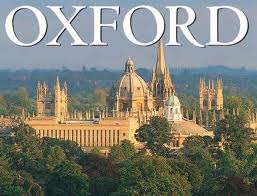
University of Oxford

After learning my way around the city of Oxford, I took special delight in just walking or biking in the midst of these glorious historic buildings and knowing how to get to different places in the lanes and byways. For two short years, I joined the thousands who can claim that they were privileged to have been students at the University of Oxford.


[1] See Post: Reading PPE at Oxford (June 6, 2011); Post: PPE Examinations at Oxford (June 10, 2011); Post: Oxford’s Lord Franks (June 20, 2011). See also Post: Oxford in New York City (May 17, 2011); Post: Dinner at an Oxford High Table (May 18, 2011); Post: Celebrating Oxford’s Worcester College’s 700th Anniversary (May 29, 2011); Post: Celebrating 80th Anniversary of Rhodes Scholarships (May 30, 2011); Post: Celebrating the Rhodes Scholarships Centennial (June 21, 2011).

[2] See Post: Celebrating Oxford’s Worcester College’s 700th Anniversary (May 29, 2011).

Sailing to Oxford

On September 27, 1961, almost all of the 31 other new American Rhodes Scholars and I gathered for a sailing luncheon at the University Club on 54th Street and Fifth Avenue in Manhattan. Our host was Courtney Smith, the American Secretary of the Rhodes Trust and the President of Swarthmore College. Mr. Smith wished us all well on this next stage of our journey, and we all met one another, most for the first time. (The only one of us who subsequently became well-known was David Souter as Justice of the U.S. Supreme Court.)

S.S. United States
Duane Krohnke on S.S. United States

The next day we all boarded the S.S. United States for our voyage to the United Kingdom. For the next five days we met one another one-on-one and in group social occasions and enjoyed the ocean-liner experience.

After a short call at Le Havre, France, we disembarked at Southampton on the south coast of England. We were met by E.T. Williams, the Secretary of the Rhodes Trust and the Warden of Rhodes House in Oxford. He directed us to the motor coach that took us to Oxford where we were dropped off at our respective colleges. Bob Orrill, a Rhodes Scholar from Purdue University, and I were the only ones for Worcester College.

On a beautiful moonlit night the College porter escorted me to my room in the Nuffield Building. He proudly said that Worcester was one of the oldest colleges in the University. This was my introduction to the Oxford and English respect for (and worship of?) antiquity, real or imagined.

Worcester College's 13th century cottages

I was amused by the porter’s comment because I knew from books that Worcester was not one of the oldest colleges. Yes, it still used 13th century Dominican monk cottages, but they were from Gloucester Hall, which was dissolved by King Henry VIII, and only later incorporated into Worcester College when it was founded in 1714.[1]

In Nuffield Building, which was built in 1950, I had a small room on the third floor. The next morning I met my “scout,” the college servant assigned to the men in the rooms on one of the staircases of the building. I now was situated in my home for the first academic year at the University of Oxford.


[1] See Post: Celebrating Oxford’s Worcester College’s 700th Anniversary (May 29, 2011).

My Grinnell College Years

Grinnell College          Residence Halls

I was financially able to attend Grinnell College, 1957-1961, because of its awarding me a full-tuition George F. Baker Scholarship.[1]

The first semester of my freshman year at the College was an intimidating experience. I had excellent, demanding professors: Harold Fletcher for “Introduction to Political Science;”  “Freshman English” with Norman Springer; and “Modern European History” with Samuel Baron. To let the freshmen know how we were doing, we all were given mid-term exams and grades. As a 4.0 valedictorian of my small Iowa high school,[2] I was shocked to have a C+ average at the mid-term. I also was surprised when Professor Baron refused to grant me honors for an extra paper in the history course; afterwards I realized he was correct.

Norbert Weiner

I also was stunned that first semester at the College’s Convocation, “American Culture at Mid-Century,” to hear a speech by MIT cyberneticist, Norbert Weiner. He talked about the parallels he saw in the history of mathematics, on the one hand, and of music and art, on the other hand. This was something I had never imagined. Another speaker was Joseph Welch, the Boston lawyer for the Army in the 1954 McCarthy Hearings. Welch, I discovered, was a Grinnell alumnus (1914) from another small town in Iowa, but I was too timid to approach him with questions.[3]

Outside the classroom that first semester I was in awe of classmates from large, metropolitan high schools (New Trier High School in suburban Chicago was one) and from prep schools who had a much more sophisticated preparation for college and who had been overseas. Gradually I came to realize that those advantages did not automatically make for a better college student and that I could successfully compete with them academically.

By the end of the first semester of the freshman year, I studied harder and significantly improved my grades and made the Dean’s List. I maintained this performance through the rest of my time at Grinnell and was elected to Grinnell’s senior men’s honorary society (the Friars) as well as Phi Beta Kappa.

I majored in history with minors in economics and political science, and I especially recall the excellent teaching and passion for their subjects by Historians Al Jones and Richard Westfall in addition to those mentioned elsewhere. I also took advantage of the College’s Program in Practical Politics to have an internship in the summer of 1960 with the Democratic Party of Iowa.[4] At the time, there was a requirement for two years of a foreign language; I took two years of German. There were also requirements for at least two science courses. In all of these courses, I had excellent professors and always was glad to be at a small college where you developed real, positive relationships with your professors.

John Maynard Keynes
John Kenneth Galbraith

The academic highlight of my Grinnell years was the senior-year Seminar in Political Economy.  A group of 10 students joined Professors John Dawson, Robert Voertman and Philip Thomas from the Economics Department, Harold Fletcher from Political Science and Joseph Wall from History. Together we read John Maynard Keynes’ magnum opus, The General Theory of Employment, Interest and Money, John Kenneth Galbraith’s The Affluent Society and a book by a Polish economist, Oskar Lange, The Economic Theory of Socialism. Another work on our agenda was Economics and Action by Pierre Mendes-France, the former French prime minister and a lecturer at Grinnell that semester.

In December 1960 I was chosen as one of 32 American Rhodes Scholars to go to the University of Oxford the following Fall which I will discuss in a separate posting. Just before this unexpected and thrilling honor, however, I had an embarrassing faux pas at the College’s special Boar’s Head Dinner. Modeled after such a dinner at Oxford’s Queen’s College, it featured a fake boar’s head brought into the dining hall on a silver platter by men dressed in red English garb and by special music from the men’s glee club (The Scarleteers). Before the dinner I had attended a cocktail party. At the dinner I felt the effects of the alcohol and just managed to rush to the kitchen where I vomited into an empty water pitcher. (When I returned to the College after the vacation, I was justly fined by the men’s governing council and chastised by the College President, Howard Bowen.)

My major extracurricular activity for my first three years of college was intercollegiate baseball. I was awarded a freshman numeral and letters for the other two years even though I was at best a mediocre player. When I returned for my 10th reunion, the baseball coach said that on the 1971 team I would be Mickey Mantle. This was a commentary on the poor quality of that year’s team, not my ability.

My sophomore year I was a member of the intercollegiate football squad, but I was not fast enough, tall enough or strong enough to have a real position. They tried me at offensive guard, but that meant I was supposed to block much bigger and stronger defensive tackles, something I could not do. I sat on the bench and played on the kickoff team. My accomplishment was lasting the season.

Otherwise I was a quiet, reserved student who was not well known on campus for the first two years. I still saw myself as an outsider.

I spent the next semester (the first of my junior year) on the Washington Semester Program at American University.[5] Enjoying life in a big city and spending time with students from other colleges from across the country boosted my confidence in my abilities to handle new and challenging situations.

Thus, when I returned to Grinnell for the second semester of my junior year, I decided to run for president of student government on a platform of our becoming involved in state and national policies and decisions affecting higher education. Foremost was going on record as opposed to the loyalty disclaimer affidavit for federal scholarships and loans and then advocating nationally for its repeal. I also suggested the student government should be concerned with the College’s admission policy and curriculum as well as changes in dormitory arrangements and adopting a student honor court and system. I won the election, 323 to 300. I then embarked upon one of the most rewarding experiences of my college days.

In the Fall of 1960, I welcomed the opportunity as president of student government to address the incoming freshmen class to let them know that they were an important part of this community going forward. I titled the speech “The Year of the Student.” After reviewing recent student protests around the world and the work of Grinnell’s student government, I challenged them. “Know thyself. Know, value, and honor freedom . . . . Accept others for what they are, accept non-conformists. Meet and get to know students from other lands. Forget exclusive thoughts of personal security and extend your horizons to include the international community of students and the whole world. Ask questions and seek answers. Do all that you can to make your and our education at Grinnell better and thus adopt your part of the burden in our national purpose, the pursuit of excellence.”

In my year as president, the student council adopted a resolution opposing the loyalty oath, and this action and the College’s refusal of funds under the National Defense Education Act of 1958 were recognized with an award from the Iowa Civil Liberties Union. We then advocated for repeal of the oath through letters to government officials, newspapers and other student governments and obtained a similar resolution from a meeting of the Midwest Conference student body presidents. Other important achievements were the following:

  • We formed a National Affairs Committee to coordinate various campus social-political action groups, to bring national issues before the student body and to take stands on such issues. This included study of our students’ interest in the Point-Four Youth Corps (later known as the Peace Corps).
  • We formed a Race Relations Committee to investigate problems encountered by American students taking part in “sit-down” strikes in the South; two members of that committee attended a national student conference on the “Sit-Down Movement.” We sponsored a rally to raise money for the Movement.
  •  We organized a new Faculty-Student Encampment to discuss issues at the College and make recommendations that resulted in the College’s purchase of a bus for student activities and the expansion of the recreation program and consideration of having a one-month reading period in the academic year.
  • We held a constitutional convention that, subject to approval by the College President and Trustees, substantially changed the structure of student government. During the convention, one of the speakers referred to me as “the passive voice” behind many of the suggested changes.

At the end of my year in office an editorial in the campus newspaper commended my “enthusiasm and true leadership qualities” and “the Krohnke spirit.” A columnist for the newspaper said, “A new spirit has entered Grinnell: a spirit of honest evaluation, constructive criticism, open-minded discussion, awareness of our good and bad points as Grinnellians and as people, and interest in the world beyond.” She attributed this new spirit, in part, to “an articulate and clear-thinking Student council president.”

The election of the next student council president started with a convention to select two candidates to run for the office. We had a time limit on nominating speeches. When one speaker had reached the limit, I said as the convention chair, “Just one more sentence.” The speaker was quick on the uptake; he kept talking with the repeated insertion of an emphatic “and” between what were clearly separate sentences. I had to chuckle in the background. Near the end of the convention, as the College annual for 1961 reported, one of the delegates stood and said that I had “done much for Grinnell by filling his office and filling it well.” The report continued, “A convention in standing ovation to our past president; here’s hoping we choose as wisely this time.”

On an October Saturday evening of 1958, after returning to the campus from an out-of-town football game, I went to the college union. I saw a group of freshmen women standing by the jukebox. I went over and asked one of them, a very attractive young woman, to dance. She accepted. Thus started my courtship of Mary Alyce. We dated for the rest of my time at the College. After her graduation in 1962, she came to England and found a research lab job in an Oxford hospital and an apartment with the fiancée of a Canadian Rhodes Scholar. In June 1963 after I finished my examinations, we were married at Oxford’s Manchester College Chapel.


[1] Post: Selecting a College (Aug. 10, 2011).

[2] Post: Growing Up in a Small Iowa Town (Aug. 23, 2011).

[3] Post: Adventures of a History Detective (April 5, 2011).

[4] Post: Encounters with Candidates JFK and LBJ (April 26, 2011).

[5] Post: The Washington Semester (July 11, 2011).

Employer’s Lawsuits Against Former Employees

Employers frequently get involved in lawsuits with former employees. That was not the primary focus of my legal practice, but I did represent former employees in two interesting cases. One was brought by  Green Tree Acceptance, Inc. of St. Paul, Minnesota. The other, by Surgidev Corporation of Goleta, California, already has been discussed.[1]

John Wheeler was an employee of Green Tree from 1977 through October of 1984. At the time, Green Tree was the largest U.S. company in the business of mobile home financing. Wheeler towards the end of his career with the company was its executive vice president and a member of its board of directors. In 1983 he entered into a written employment agreement and noncompetition agreement with the company, but in October 1984 he and the company agreed to a termination of his employment and, he testified, a release from the noncompetition agreement. In May 1986 Wheeler became the president and CEO of another company based in San Diego, California that was involved in financing mobile homes.[2]

In September 1986 Green Tree sued Wheeler for breach of the noncompetition agreement in Minnesota’s federal court.[3] In October 1986 the court denied the plaintiff’s motion for a preliminary injunction barring Wheeler from working for his new employer. The next month (November 1986) the case went to trial before Judge James Rosenbaum and a jury. The jury’s special verdict found that the noncompetition agreement had terminated before Wheeler went to work for his new employer. Accordingly the district court denied Green Tree’s motion for a new trial or judgment notwithstanding the verdict and entered judgment in favor of Wheeler.[4]

Green Tree then appealed, and in October 1987 the appellate court reversed the judgment because of its conclusion that the district court erroneously had submitted to the jury the issue of whether the noncompetition agreement was still in effect. Accordingly the appellate court remanded the case to the district court for a new trial.[5] Soon thereafter the case settled.

This was one of those unfortunately rare cases in which the opposing lawyers were professionally civil with each other while simultaneously vigorously contested the case. I, therefore, commend Green Tree’s lawyers, Peter Hendrixson and David Lauth of the Dorsey & Whitney law firm and Rick Evans, Green Tree’s General Counsel.


[1] See Post: Intraocular Lenses Litigation (Aug. 18, 2011).

[2] Green Tree Acceptance, Inc. v. Wheeler, 832 F.2d 116 (8th Cir. 1987).

[3]  See Post: Minnesota’s Federal Court (June 28, 2011).

[4]  832 F.2d 116.

[5]  Id.

Growing Up in a Small Iowa Town

In 1949 my parents and I moved to my Dad’s home town of Perry, Iowa– 6,000 population only 40 miles northwest of Des Moines. My Dad bought an interest in the Perry Granite Works. My Mother soon thereafter started working as an assistant librarian at the town’s Carnegie Library and later became its Head Librarian.

I finished my last two years of elementary school in Perry followed by six years of junior and senior high school. Although there were not many optional courses in the schools, I did have math through trigonometry, physics, chemistry, speech, American and English literature, world history and social studies. I also took typing and at least one shop class. (The only foreign language was Latin, which I did not take because I was confident I would go to nearby Iowa State University to become an engineer and have no need for the language and because I was scared of Latin.) I had some excellent teachers; the ones I especially recall are Emma Hepker, Charles Bennett, Elsa Hay, Gayle Junkin, David Evans and Leonard Rossman.

I always did well in school and finished as the 4.00 valedictorian of my high school class of 62 members and as a member of the National Honor Society. I was a finalist for a National Merit Scholarship and National Honorary Society Scholarship. (Close, but no cigar.) The local Elks Club named my best friend and me “The Most Valuable Students” of our class, and he and I were the town’s representative at Hawkeye Boys State where I was elected Secretary of the mock Iowa Senate.

I was active in the Speech Club and served as its president my senior year. I won top honors in state contests in radio speaking and extemporaneous speaking. (There was no debate program.)

I lettered in football my junior and senior years. I played offensive and defensive end even though I was not very big (155 lbs.), tall (5’10”), fast or strong. One of my favorite football stories is about tackling the star running back on the team from Winterset (John Wayne’s hometown); I did not tackle low like you are supposed to do; instead I tackled him straight up; he was carried him off the field on a stretcher while I put my helmet back on and continued playing. The captain of the team my senior year was my best friend, who played center at 135 pounds. (A medical problem prevented my playing my freshman and sophomore years.)

I also lettered in track as a member of relay teams, and in the summer I played shortstop or second base on a local town baseball team. The “Perry Wildcats” we were called. After finishing high school, I managed the team one summer.

Another extracurricular activity was concert and marching band. I played the alto saxophone and occasionally was a soloist in concerts and state music contest.

Playing the tenor saxophone with me in the band was Norman Lewiston, who was a year ahead of me and a tall, socially awkward, farm boy. He, however, excelled in the sciences and was the valedictorian of his class. Later he became a respected physician and Professor of Pediatrics at Stanford University School of Medicine. After he died in 1991, each of his three wives discovered the existence of the other two. This real-life drama was made into a movie–The Man with Three Wives–starring Beau Bridges as Norman. The concluding scene in the movie has one of the wives returning to the farm just east of Perry and throwing Norman’s ashes to the wind.[1]


Perry Methodist Church

The local Methodist Church was another center of activity. I was in the Youth Choir and a member of Methodist Youth Fellowship, and its president my senior year. I fondly remember when our church was visited by five college students on what they called a Youth Caravan to assist the MYF programming. The senior pastor was Rev. Arlie Krussell, who was reserved in what seemed like an English manner; he urged me to go into the ministry.

In junior high, I had a newspaper route for The Des Moines Register. Later for several summers I detasseled seed corn in the area. I also worked as a sales clerk at a local men’s clothing store and did all sorts of jobs at my Father’s monument store. After I had a driver’s license, I drove the Perry Granite Works truck to local cemeteries to deliver and often install the monuments. I also learned how to sandblast the names and dates of birth and death of the deceased into the granite stones.

On Saturday nights my friends and I frequently would “shoot the drag,” i.e., drive in one of our cars up and down the few main streets of the town. We also had pork tenderloin sandwiches at “Sam and Chuck’s” restaurant at the east end of town or a “Maid-Rite” sloppy-joe hamburger at the town’s only franchise operation. (We had no pizza restaurant. One had to drive to Des Moines to get this delicacy.)

There were many aspects to life in this small town that were enjoyable. I seized the many opportunities it offered.

I was interested in politics back then. For example, The Des Moines Register reported that a high school teacher in northern Iowa had been fired for assigning certain books to his students. My letter to the editor protesting his dismissal was published in the same newspaper. Soon thereafter I started receiving letters and materials from the Young Communist League in the U.S.S.R.

I was growing up during the presidencies of Harry Truman and Dwight Eisenhower. In the Fall of my senior year of high school I moderated a school assembly about the 1956 presidential election between Eisenhower/Nixon and Stevenson/Kefauver. As was true in Iowa and the U.S. as a whole, the Republican candidates won by a large margin in our mock election.

The Cold War overshadowed my high school years. The Korean Conflict ended in 1953 after “Ike” Eisenhower had pledged in his first campaign to go to Korea to end the war. Just before I entered high school, Joseph Stalin died, and Nikita Krushchev became the First Secretary of the Soviet Communist Party. Ethel and Julius Rosenberg were executed for transmitting U.S. atomic secrets to the U.S.S.R. J. Robert Oppenheimer was charged with possible treason. There was open-air testing of atomic and hydrogen bombs by the U.S. and the U.S.S.R. The Soviets crushed revolts in Poland and Hungary. The first nuclear-powered submarine and the first satellite–Sputnik–were launched.

In the U.S. civil rights issues were prominent. In 1954 the U.S. Supreme Court issued its school desegregation decision in Brown v. Board of Education. In 1956 Rev. Dr. Martin Luther King, Jr., then 27 years old, organized a boycott of public transportation in Montgomery, Alabama while in Arkansas Governor Orville Faubus challenged the Federal Government over school desegregation in Little Rock.

It is perhaps difficult to appreciate now that television was new in these years. I remember when my parents bought our first small, black-and-white TV set. The first World Series I watched was the 1950 Yankees-Phillies match with Joe DiMaggio, Yogi Berra, Phil Rizzuto and Whitey Ford of the Bronx Bombers and Richie Ashburn, Robin Roberts and Jim Konstanty of the Phillies. I also recall watching news of the Army-McCarthy Hearings of 1954 when the Boston lawyer, Joseph Welch, punctured McCarthy’s big ego.

Elvis Presley burst onto the national stage with such hits as “Love Me Tender,” “Hound Dog,” “Heartbreak Hotel” and “Jailhouse Rock.” I remember watching Elvis on the Ed Sullivan Show, when the TV cameras were not allowed to focus on his shaking pelvis. Little did we know at the time that we were witnessing the start of an American cultural phenomenon.

In this and other ways, television was just starting to break down the sense of social isolation I felt growing up as an only child in a small town in Iowa, far away from where things were really happening–Washington, D.C. and New York City. Europe and the rest of the world were even farther away, places that I never thought I would visit some day. Iowa, of course, was (and still is) primarily an agricultural state, which did not have much status in the larger world. Nor did my Dad’s business. I did not want to be trapped into taking over this business although this was never mentioned as something expected of me. All of this produced in me a sense of being an outsider. This sense of isolation also helped motivate me to work hard at school as my way to escape this small town and its life.[2]


[1] Paddock, Doctor Led Three Lives with Three Wives: Polygamy: Stanford Professor never divorced and kept households with each of the women. Truth emerged after his death in August, L.A. Times (Oct. 14, 1991); The Man With Three Wives, http://www.fandango.com/themanwiththreewives_v467704/plotsummary.

[2] I already have mentioned my visits to eastern universities in the summer before my senior year of high school to explore the possibility of going there for college before I decided to go to Grinnell College. (Post: Selecting a College (Aug. 10, 2011).)

Intraocular Lenses Litigation

IOL example

Intraocular lenses or IOLs are artificial lenses implanted by ophthalmologists in the human eye to correct vision loss resulting from removal of the eye’s natural crystalline lens during cataract surgery. Since at the least the mid-1950’s, IOLs have been an acceptable mode of treatment.[1]

As of 1985 there were 17 to 20 manufacturers of IOLs with the six largest having over 80% of the market. One of the leading competitors was Surgidev Corporation of Goleta, California near Santa Barbara.[2]

In 1985 five key employees of Surgidev left the company and soon thereafter organized a new company, (Eye Technology, Inc. (ETI)), to manufacture IOLs and compete with Surgidev and other such manufacturers.

Litigation ensued. Surgidev sued its former employees and ETI in Minnesota’s federal court.[3] It asserted claims for unfair competition, misappropriation of trade secrets, breach of contract, breach of fiduciary duty, conversion and wrongful interference with contractual relations and prospective economic advantage.[4]

The defendants retained Faegre & Benson to defend the case, and I was in charge of the team at the law firm.

We answered the complaint by denying its material allegations and asserting counterclaims for alleged wrongful interference with ETI’s public offering of securities, abuse of process, malicious prosecution, and defamation. The district court granted Surgidev’s motion to dismiss the counterclaim for abuse of process, but otherwise denied the motion, holding that the counterclaims were not a “sham” and were protected by Noerr-Pennington privilege from tort liability for filing suit and the defamation claim was one for “slander per se” rather than “trade libel,” and thus, special damages did not have to be pled.[5]

The parties later returned to the district court for a combined hearing and trial on Surgidev’s motion for preliminary and permanent injunction. The court concluded that there was no breach of the former employees’ contractual non-compete and non-disclosure provisions. [6] But the court held that they had engaged in wrongful interference with certain Surgidev agreements and, therefore, enjoined them from attempting to solicit through December 31, 1986, any Surgidev employees from joining ETI, from having four named doctors doing any work for ETI and from soliciting certain Surgidev customers to become ETI customers.[7]

The granting of the injunction was affirmed by the appellate court.[8]

I have three extraneous memories from this case.

Some of the depositions were taken in Santa Barbara and San Diego, California, and I remember opposing counsel and I split the cost of a rental car to drive to San Diego. I was the driver, and it was a harrowing drive on a very dark and very rainy night on Interstate 5.

Boston was the location for other depositions. On a day off in the midst of a heavy snow storm I had lunch in a Russian restaurant near Harvard Square with a Grinnell College contemporary to talk about our mutual interest in El Salvador.

The last memory is lunch at a Minneapolis hotel with an ophthalmologist who was involved in the case and who, out of the blue, offered to perform laser surgery on my eyes to correct my nearsightedness. I declined the offer.

In 1998 ETI was merged into Star Tobacco and Pharmaceuticals Inc. which was focused on developing a new, “less-harmful” cigarette. Now known as Star Scientific, Inc., it still is pursuing this cigarette goal and apparently no longer manufactures IOLs.[9]


[1]  Surgidev Corp. v. Eye Technology, Inc., 648 F. Supp. 661, 669 (D. MInn. 1986).

[2]  Id. at 671-73.

[3]  See Post: Minnesota’s Federal Court (June 28, 2011).

[4]  Surgidev Corp. v. Eye Technology, Inc., 625 F. Supp. 800, 801 (D. Minn. 1985).

[5]  Id.

[6] Surgidev Corp. v. Eye Technology, Inc., 648 F. Supp. 661, 696-99 (D. MInn. 1986).

[7] Id. at 700-04.

[8]  Surgidev Corp. v. Eye Technology, Inc., 828 F.2d 452 (8th Cir. 1987).

[9] Jones, Star Moves Toward Stock Market.  Eye Technology Deal Prepares Petersburg Company To Go Public, Richmond Times-Dispatch (Feb. 10, 1998); Star Scientific, Corporate Policy Statement, http://www.starscientific.com/about-star/corporate-policy-statement.

The Flight Transportation Corporation Litigation

In June 1982, all kinds of litigation erupted in Minnesota’s federal court[1] involving Flight Transportation Corporation (FTC), a Minnesota-based company that purported to provide small-aircraft charter service.

The first case was by the U.S. Securities and Exchange Commission (SEC) against FTC, its subsidiaries, and its CEO and Chairman of the Board, William Rubin. The SEC alleged that the defendants had violated and aided and abetted violations of antifraud, reporting, and record-keeping provisions of the federal securities laws. The SEC sought an injunction prohibiting further violations by the defendants of these provisions, the appointment of a receiver to take possession of and marshal the assets of FTC and its subsidiaries, an accounting of all proceeds of FTC’s allegedly fraudulent securities offerings, and an order of disgorgement of all funds received by FTC as a result of those sales of securities. With respect to Rubin, the SEC sought a temporary freeze of most of his personal assets, an accounting of all funds received from FTC and its subsidiaries, and disgorgement of such funds.[2]

Shortly thereafter, two underwriters of FTC securities, on their own behalf and on behalf of all persons who purchased FTC’s securities in the June 1982 offerings, commenced a class action seeking, among other things, imposition of a constructive trust on the $22 million in proceeds of the offerings.

Thereafter other private lawsuits were also commenced against FTC, its officers and others, including its external auditor and the New York City law firm for the underwriters of the public offerings of FTC securities.[3]

Norwest Bank Minnesota (n/k/a Wells Fargo Bank Minnesota) had been providing working capital financing to FTC and brought a claim against FTC to collect that debt, and I was in charge of the Faegre & Benson team for Norwest. Later some of the other plaintiffs asserted claims against the Bank because its collateral review personnel had discovered certain problems at FTC; later the Bank reached a settlement over all of these claims.

Because there were so many different kinds of claims against FTC and others, the attorneys for the plaintiffs concluded that they needed to stop fighting among themselves and instead focus their collective efforts in prosecuting the claims against the defendants. As a result, the plaintiffs negotiated a complex Sharing Agreement whereby any monetary recoveries would be shared among the plaintiffs. This agreement was approved by the court.[4]

The SEC’s request for the appointment of a receiver was granted. A Minnesota attorney, Thomas Bartsch, was so appointed. I participated in many meetings with him and thought he was doing an excellent job. I, therefore, was shocked later when he was convicted of stealing money from the FTC assets under his control as receiver and then disbarred as an attorney.

At the conclusion of the private litigation, the district court awarded the various plaintiffs’ law firms $7.8 million of attorneys’ fees. The court recognized the superlative work of the lawyers that resulted in recovering $52 million for the various plaintiffs.[5]

I also was the attorney for Norwest Bank in a related case where a co-founder, outside director, shareholder and director of FTC sued the Bank for collecting and paying a check that allegedly had his forged endorsement. The district court entered judgment in favor of the Bank, and the appellate court affirmed.[6]


Finally there were criminal prosecutions of FTC’s principal officers: William Rubin, Janet Karki, Brian Miller and James McGovern. Rubin, the CEO and Chairman of the Board, was convicted on 10 counts of securities fraud and two counts of filing a false securities registration statement with the SEC and sentenced to 35 years in prison plus a $120,000 fine. There also were convictions on similar charges against Karki, the Chief Financial Officer (20 years in prison); Miller, the Financial Controller (three years); and McGovern, a Minnesota lawyer and FTC’s General Counsel (six years).[7]

I still find it difficult to believe that two fellow Minnesota lawyers with whom I had professional dealings ended up in prison as convicted felons.

Two memories of this case stand out.

At a posh Beverly Hills hotel, I participated in the deposition of Michael Milken from a FTC underwriter (Drexel Burnham Lambert). Known in the securities industry at the time as the King of Junk Bonds, Milken later pled guilty to securities fraud and tax violations and was sentenced to imprisonment. After release, he has concentrated his efforts on philanthropy, especially research regarding prostate cancer and melanoma. (Wikipedia, Michael Milken, http://en.wikipedia.org/wiki/Michael_Milken.)

I attended the criminal trial of Rubin and Karki. I was there as an attorney for a Norwest banker who was testifying about the Bank’s relationship with FTC. During her testimony two prominent Minnesota criminal defense attorneys, Ron Meshbesher[8] and Joe Friedberg, objected to the receipt into evidence of certain Bank documents because they were photocopies and thus not the best evidence. While the attorneys had a sidebar conference with the judge regarding this objection, I went to the U.S. Attorney’s table and whispered to an FBI agent that the originals were in my office and were destroyed in the Northwestern National Bank fire on Thanksgiving Day 1982. The FBI agent then went to the sidebar conference and relayed the information to the U.S. Attorney, Tom Hefflefinger.

The judge then asked me to leave the courtroom, presumably while foundation questions were asked of the banker. I assume her examination went something like this: “Do you know Mr. Krohnke? (Yes.) Was he involved in any way with the Bank and FTC? (Yes.) How was he involved? (He was an attorney for the Bank regarding litigation over FTC.) Did he have any original Bank documents in his office? (Yes.)”

I was then readmitted to the courtroom and put on the witness stand. The U.S. Attorney asked me a few questions along the same lines and established that the original documents in question were destroyed in the fire. There was no cross-examination by Meshbesher or Friedberg. The photocopies of the Bank documents were received into evidence.


[1] See Post: Minnesota’s Federal Court (June 28, 2011).

[2]  SEC v. Flight Transportation Corp., 699 F.2d 943 (8thCir. 1983).

[3]  Id.; In re Flight Transportation Securities Litigation, 593 F. Supp. 612 (D. Minn. 1984).

[4] In re Flight Transportation Securities Litigation, 730 F.2d 1128 (8th Cir. 1984), cert. denied sub nom. Reavis & McGrath v. Antinore, 469 U.S. 1207 (1985); In re Flight Transportation Securities Litigation, 794 F.2d 318 (8th Cir.), cert. denied sub nom. Subclass IV v. Fox & Co., 481 U.S. 1013 (1987).

[5]  In re Flight Transportation Securities Litigation, 685 F. Supp. 1092 (D. Minn. 1987).

[6] Lund v. Norwest Bank, 669 F. Supp. 284 (D. Minn. 1985), aff’d, 825 F.2d 1249 (8th Cir. 1987), cert. denied, 485 U.S. 936 (1988).

[7] U.S. v. Rubin, 836 F.2d 1096 (8th Cir. 1988); U.S. V. McGovern, 822 F.2d 739 (8th Cir.), cert. denied, 484 U.S. 956 (1987). I knew McGovern; he was one of the attorneys for the Wisconsin breeders cooperative in a lawsuit in which I was an attorney on the other side of the case. (See Post: The Artificial Insemination of Cattle (Aug. 16, 2011).

[8] I once had a civil case in which Meshbesher was the opposing lawyer, and the case settled soon after I took his client’s deposition. The recent movie, A Serious Man, by Joel and Ethan Coen, takes place in the Minneapolis area. When a character needs a criminal defense lawyer, he is told to hire Ron Meshbesher. The line was inspired by the Coen brothers’ memories of growing up in St. Louis Park, Minnesota and seeing attorney ads for Meshbesher. (Wurzer, Twin Cities lawyer is a Coen brothers punch line, MPR News (Oct. 9, 2009), http://minnesota.publicradio.org/display/web/2009/10/07/meshbesher.)