Ecuador’s Dispute with the United Kingdom and Sweden Over Julian Assange: Granting Asylum to Assange

On August 16, 2012, the Government of Ecuador made its decision to grant the petition for diplomatic asylum submitted by Julian Assange, an Australian national temporarily residing at the Ecuadorian Embassy in London, United Kingdom (“the Decision”).[1] The U.K. and Sweden challenge the legitimacy of this action, and this post will explore the issues relating to this dispute.[2]

The Decision sets forth a list of what it describes as 12 “fundamental principles of general international law” regarding asylum that purportedly support its grant of asylum. These principles are said to be derived from, and supported by, Ecuador’s own laws regarding asylum and 16 international treaties and declarations.

The Decision also states what it deems to be the relevant facts for the application along with a summary of Ecuador’s efforts to cooperate with the governments of the U.K., Sweden and the U.S. and the measures Ecuador will seek from the U.K. regarding Assange.

Let us examine these legal and factual assertions.

The Relevant Law

In its extensive legal discussion, the Decision fails even to mention what, in my opinion, is the essential first step in any such analysis: the International Court of Justice’s  judgment in 1950 that diplomatic asylum was not part of general international law.

In Colombian-Peruvian Asylum Case, I.C.J. Rep. 1950, p. 266 (Nov. 20, 1950), the court concluded, “A decision to grant diplomatic asylum involves a derogation [or departure] from the sovereignty of [the territorial] . . .  State [where the diplomatic premises are located]. It withdraws the offender from the jurisdiction of the territorial State and constitutes an intervention in matters which are exclusively within the competence of that State. Such a derogation from territorial sovereignty cannot be recognized [as a matter of general international law] unless its legal basis is established in each particular case.” Moreover, if the State granting diplomatic asylum had the “unilateral and definitive” authority to determine whether the offense of the asylum-seeker was a political or common crime, it would “aggravate . . . the derogation” and is “not inherent in the institution of diplomatic asylum.” (In addition, Judge Alvarez from Chile, dissenting in this case, said there also was no customary American international law of diplomatic asylum.)

Seven months later in the same case the ICJ rendered another judgment that stated, “The safety that arises out of [diplomatic] asylum cannot be construed as a protection against the laws and against the jurisdiction of legally constituted tribunals [of the host state].” (Haya de La Torre Case, I.C.J. Rep. 1951, p. 71 (June 13, 1951).)

Nor did Ecuador’s Decision refer in any way to the unsuccessful effort by Latin American countries to overrule the I.C.J. judgments by having diplomatic asylum recognized in the 1961 Vienna Convention on Diplomatic Relations or the unsuccessful U.N. effort to prepare and adopt an international, multilateral treaty on the subject of diplomatic asylum. In 1977 the U.N.’s International Law Commission concluded that there was not sufficient interest to justify any further work on the subject.

Another response to these ICJ rulings was an Inter-American Conference in Caracas, Venezuela on March 28, 1954, that adopted the text of the Inter-American Convention on Diplomatic Asylum. Today it is the only such treaty in the world, and Ecuador is one of the only 14 of the 35 states of the Organization of American States that have ratified that treaty.[3] In other words, 179 of the 193 U.N. member states have not adopted this or any similar treaty. The U.K. and Sweden, which are not in the Inter-American system, obviously are not parties to this treaty; nor is the U.S., which was eligible to sign and ratify. As a result, this treaty cannot and does not impose any legal obligations on the U.K., Sweden or the U.S.

It, therefore, is not too surprising that Ecuador’s Decision does not analyze the terms of this treaty for the current dispute although it is on the list of 16 international treaties and declarations that purportedly support the Decision.

Even more damning, the Decision does not address the clear problem facing all instances of diplomatic asylum, as pointed out in the ICJ judgment. A decision like Ecuador’s to grant asylum to someone in one of its embassies in a foreign country is at least a potential infringement upon the competence of that foreign country. Such an infringement or derogation cannot be ignored. Indeed, as discussed in a prior post, Article 41(1) of the Vienna Convention on Diplomatic Relations states that “it is the duty of all persons enjoying such [diplomatic] privileges and immunities to respect the laws and regulations of the receiving State. They also have a duty not to interfere in the internal affairs of that State. . . .” In addition, Article 41(3) of that Convention provides that the “premises of the mission must not be used in any manner incompatible with the functions of the mission as laid down in the present Convention or by other rules of general international law or by any special agreements in force between the sending and the receiving State.”

Instead of focusing on these clearly relevant legal issues, Ecuador’s Decision merely lists 15 other treaties and declarations that mention asylum while not offering direct legal support for the Decision. They are the following:

  • All four of the countries involved in the current dispute are parties to the Convention Relating to the Status of Refugees, which is the major general treaty on refugees and asylum and which was discussed in a prior post. But it does not apply for various reasons. Assange cannot claim he has a “well-founded fear of persecution” on certain grounds in his home country of Australia, and the treaty excludes “any person with respect to whom there are serious reasons for considering that . . . [he] has committed a serious non-political crime [here, in Sweden]  outside the country of refuge prior to his admission to that country as a refugee . . . .”
  • Ecuador was a state party to five of the other cited treaties that mentioned asylum, but they are not relevant to the current application or grant of asylum.[4]
  • Another four treaties mention asylum, but they are from other regions of the world, and Ecuador is not, and could not be, a state party to them.[5]
  • One treaty does not mention asylum at all. Instead it is a treaty on the interpretation of treaties.[6]
  • The last four of the 16 cited sources are declarations, not treaties, and thus are not sources of binding international legal obligations on any state.[7]

Nor is the possibility of the U.S.’ seeking or imposing the death penalty on Assange for the crime of making public secret U.S. documents “persecution” under international law. Under Article 6 (2) of the International Covenant on Civil and Political Rights, “In countries which have not abolished the death penalty, sentence of death may be imposed only for the most serious crimes in accordance with the law in force at the time of the commission of the crime and not contrary to the provisions of the present Covenant . . . .  This penalty can only be carried out pursuant to a final judgment rendered by a competent court.” [8]

The U.K. and Sweden as well as other countries in Europe, however, have a different opinion regarding the propriety of the death penalty after initially permitting such in Article 2(1) of the European Convention for the Protection of Human Rights and Fundamental Freedoms of 1953. This changed in 1985, when Protocol No. 6 to this treaty went into force and provided in Article 1, “The death penalty shall be abolished. No one shall be condemned to such penalty or execution.” [9]

As a result, those 46 European states that have ratified Protocol No.6, including the U.K. and Sweden, routinely deny requests to extradite suspects to the U.S. when there are true risks of the imposition of the death penalty.

Indeed, the U.S.’ extradition treaty with the European Union, to which both the U.K. and Sweden belong, expressly provides that when an offense for which extradition is sought is punishable by death under the law of the requesting state [here theoretically, the U.S.] but not under the law in the requested state [here theoretically, the U.K. or Sweden], the requested state may grant the extradition on condition that the death penalty shall not be imposed or if imposed shall not be carried out. A similar provision is included in the recent extradition treaty between the U.S. and the U.K.

Assange, therefore, cannot have a “well-founded fear” of imposition of the death penalty even if it were regarded as “persecution,” which it is not.

Perhaps Ecuador was implicitly suggesting that the 11 of the 16 listed instruments that occurred after the previously mentioned ICJ decision of 1950 changed the general international law regarding diplomatic asylum. The Decision hints at this when it said, “The lack of international convention or internal legislation of the States cannot be legitimately claimed to limit, impinge or deny the right to asylum.” But a recent  treatise on public international law asserts that this type of asylum is not part of general international law as does a recent thesis at the University of Leiden,  a contemporary expert and London’s Economist.  Ecuador’s veiled contrary suggestion, I submit, is patently ridiculous.

The U.K. certainly disagrees with Ecuador’s legal argument.

On August 17th (the day after the grant of asylum), the U.K.’s Foreign Secretary William Hague stated that the U.K. “was disappointed” in this decision and would not allow Assange safe passage out of the country. “The UK does not accept the principle of diplomatic asylum. It is far from a universally accepted concept: the [U.K.] is not a party to any legal instruments which require us to recognize the grant of diplomatic asylum by a foreign embassy in this country. Moreover, it is well established, even for those countries which do recognize diplomatic asylum, it should not be used for the purposes of escaping the regular processes of the courts.” In addition, the U.K. has “painstakingly explained the extensive human rights safeguards built into our law.”

These points were reiterated at the August 24th OAS meeting by the UK’s Permanent Observer, Philip Barton. He said the U.K. was not party to the Inter-American Convention on Diplomatic Asylum, and “there is no legal basis for the [U.K.] to meet the request of . . . Ecuador to grant safe passage for Mr. Assange out of the [U.K.].” He also said the U.K. has advised Ecuador about “the safeguards in place under the European Convention on Human Rights, international law, European Union law and [U.K.] law [that] fully address the concerns raised by Mr. Assange and by . . . Ecuador.”

Observer Barton further told the OAS meeting representatives that the purported concern about Assange’s human rights upon extradition to Sweden was “completely unfounded,” and an “argument to this effect was comprehensively rejected by the courts in the UK.” The U.K. and Swedish courts “robustly implement and adhere to the highest standards of human rights protection.”

In any event, the Decision’s legal argument, in my opinion, is not persuasive.

The Relevant Facts

The Decision starts its statement of the relevant facts with the noncontroversial: Assange is a communication professional with international awards for his struggle for freedom of expression, freedom of press and human rights, and through WikLeaks he has publicized documents from different sources. The Decision then provides more contentious, and I think unfounded, assertions.

According to Ecuador’s Decision, the U.S. and other countries that produced these documents have threatened retaliation risking Assange’s safety, integrity and even his life and have refused to provide guarantees to protect his life and safety. Extradition of Assange to a third country outside the European Union [the U.S.] is feasible without the proper guarantees for his safety and personal integrity. If extradited to the U.S., Assange would not have a fair trial; he could be judged by a special or military court; and he probably would receive cruel and demeaning treatment and be condemned to a life sentence or the death penalty.

Other than stating the U.S. is not a party to the Inter-American Convention on Diplomatic Asylum and does not recognize the concept of diplomatic asylum, the U.S. has declined to comment on the merits of the dispute and has urged trilateral negotiations by the parties to resolve the dispute. There, however, is no credible evidence for Assange and Ecuador’s impugning the independence of fairness of the U.S. federal judicial system, and any risk of capital punishment in the U.S. would be eliminated by the European practice and law forbidding extradition to other countries where there is a risk of such punishment.

Any accusation against the independence and honesty of the U.K. courts is absurd. Indeed, Assange in 2011-2012 challenged his extradition to Sweden on the merits in the U.K. courts (magistrate’s court, High Court and Supreme Court) without any objection to the procedural rights he was accorded.

Ecuador’s Decision also has harsh allegations against the Swedish prosecutor’s office with respect to its ongoing investigation of Assange on criminal sexual charges. That office allegedly has prevented Assange from the total exercise of his legitimate right to defense to criminal charges. His procedural rights allegedly have been infringed during that investigation. Pretrial detention of Assange in Sweden would facilitate his extradition to a third country, i.e., the U.S.

Sweden has strongly rejected these charges. It did so at meetings with Ecuador’s Ambassador in Stockholm shortly after June 19th (when Assange arrived at the Ecuadorian Embassy in London) and on August 16th. This rebuttal, in part, emphasized that in the last months of 2010 Assange challenged the European Arrest Warrant on the merits in Swedish courts (district court, court of appeal and Supreme Court) without any objection to the procedural protections of Swedish law.

In addition, after Assange was in temporary “residence” at the Ecuadorian Embassy, Sweden rejected his offer to be interrogated at that Embassy with respect to the Swedish investigation. Sweden did so because it wanted to confront Assange in Sweden with the existing evidence and conduct supplementary interviews of others depending upon what Assange had to say. The Swedish prosecutors also wanted him in their country to assure his presence at any criminal trial that might result from the investigation, as required by their law.

At the OAS meeting on August 24th, a Swedish diplomat stressed that Sweden had an independent judiciary that needed to proceed with investigation of Assange’s alleged sexual offenses. There had been no request to Sweden for extradition to a third country, she added, but European and Swedish law prohibits extradition when there is a risk of capital punishment.

The Decision also says the governments of the U.K., Sweden and the U.S. will “not respect the international conventions and treaties and would give priority to internal laws of secondary hierarchy, contravening explicit norms of universal application.” It is difficult to understand exactly what Ecuador means by this allegation. If it means that the U.K., Sweden and the U.S. do not agree with Ecuador’s legal argument, then that is certainly correct.

In summary, there is no credible evidence to support the extreme accusations against the judicial systems of the U.K., Sweden and the U.S.

Conclusion

Ecuador’s granting of asylum to Assange, in my opinion, is wrong on the law and wrong on the facts. Indeed, there is speculation in the press that the real reason for President Correa’s deciding to grant “asylum” in this case was to enhance his own political standing in his own country for next year’s presidential election.

Other than litigating these issues before the International Court of Justice or arbitrating or mediating them before a neutral third party, the only other peaceful way to resolve this dispute is for the parties to do so through diplomatic negotiations, as recommended by the OAS on August 24th.

——————————————————-

[1] According to the Decision, Assange’s written asylum application was submitted on June 19th with a June 25th written supplement, but neither of these documents is publicly available. This secrecy seems more than ironic for the self-proclaimed advocate for public transparency and disclosure. It also is ironic for Ecuadorian President Correa, who is known for his hostility to the press, to be the defender and protector of Assange.

[2] A prior post set forth the background for this dispute, and another post discussed the issue of the inviolability of the Ecuadorian Embassy in London.

[3]  The other 13 parties to the Inter-American Convention on Diplomatic Asylum are Argentina, Brazil, Costa Rica, Dominican Republic, El Salvador, Guatemala, Haiti, Mexico, Panama, Paraguay, Peru, Uruguay and Venezuela.

[4] U.N. Charter, Art. 1(3) (one of U.N. purposes is achieving “universal cooperation in . . . promoting and encouraging respect for human rights”); American Convention on Human Rights, Art. 22.7 (“Every person has the right to seek and be granted asylum in a foreign territory, in accordance with the legislation of the state and international conventions, in the event he is being pursued for political offenses or related common crimes”); Inter-American Convention for Extradition (no extradition when “the person sought has been tried or sentenced or is to be tried before an extraordinary or ad hoc tribunal of the requesting State” (Art. 4.3) or when “the offense for which the person is sought is a political offense, an offense related thereto, or an ordinary criminal offense prosecuted for political reasons” (Art. 4.4) or when “persecution for reasons of race, religion or nationality is involved, or that the position of the person sought may be prejudiced for any of these reasons” (Art. 4.5): and Convention may not “be interpreted as a limitation on the right of asylum when its exercise is appropriate” (Art. 6)); Inter-American Convention on Territorial Asylum, (“Every State has the right, in the exercise of its sovereignty, to admit into its territory such persons as it deems advisable” (Art. I); this includes persons who “are persecuted for their beliefs, opinions, or political affiliations, or for acts which may be considered as political offenses” (Art. II); no “obligation to surrender to another State, or to expel from its own territory, persons persecuted for political reasons or offenses” (Art. III); no extradition of persons “sought for political offenses, or for common offenses committed for political ends, or when extradition is solicited for predominantly political motives” (Art. IV)); Geneva Convention [IV] Relative to Protection of Civilian Persons in Time of War, Art. 45 (“In no circumstances shall a protected person be transferred to a country where he or she may have reason to fear persecution for his or her political opinions or religious beliefs”).

[5] African Charter on Human and Peoples’ Rights, Art. 12.3 (“Every individual shall have the right, when persecuted, to seek and obtain asylum in other countries in accordance with laws of those countries and international conventions”); European Union Charter of Fundamental Rights, Art. 46 (“Every citizen of the [European] Union shall, in the territory of a third country in which the Member State of which he or she is a national is not represented, be entitled to protection by the diplomatic or consular authorities of any Member State, on the same conditions as t he nationals of that Member State”); European Convention on the Suppression of Terrorism, Art. 5 (“no obligation to extradite if the requested State has substantial grounds for believing that the request for extradition . . . has been made for the purpose of prosecuting or punishing a person on account of his race, religion, nationality or political opinion, or that that person’s position may be prejudiced for any of these reasons”); European Extradition Treaty, Art. 3.1 (“Extradition shall not be granted if the offence in respect of which it is requested is regarded by the requested Party as a political offence or as an offence connected with a political offence”).

[6] Vienna Convention on the Law of Treaties, Art. 53 (“treaty is void if . . . it conflicts with a peremptory norm of general international law . . . . [i.e.,] a norm accepted and recognized by the international community of States as a whole as a norm from which no derogation is permitted and which can be modified only by a subsequent norm of general international law having the same character”), Art. 64 (“If a new peremptory norm of general international law emerges, any existing treaty which is in conflict with that norm becomes void and terminates”), Art. 66(b) (A party to a “dispute concerning the application or the interpretation of article 53 or 64 may . . .submit it to the International Court of Justice for a decision”).

[7]  Universal Declaration of Human Rights, Art. 14 (“Everyone has the right to seek and to enjoy in other countries asylum from persecution. This right may not be invoked in the case of prosecutions genuinely arising from non-political crimes or from acts contrary to the purposes and principles of the [U.N.]”);U.N. Declaration on Territorial Asylum (recommends territorial asylum practices include asylum for “persons struggling against colonialism” (Art. 1.1) , non-rejection of persons at the frontier and non-explusion to state where person may be subjected to persecution (Art. 3.1)); American Declaration of the Rights and Duties of Man, Art. 27 (“Every person has the right, in case of pursuit not resulting from ordinary crimes, to seek and receive asylum in foreign territory, in accordance with the laws of each country and with international agreements”); Cartegena Declaration (at 1984 meeting to discuss protection of refugees in Central America, Mexico & Panama, reiteration of “importance of non-refoulement (including the prohibition of rejection at the frontier)”).

[8]  In addition, Article 1 (1) of the Convention Against Torture and Other Cruel, Inhuman or Degrading Treatment or Punishment states that “torture” “does not include pain or suffering arising from, inherent in or incidental to lawful sanctions.”

[9]  It should be noted that Protocol No. 6 had an exception that allowed the death penalty in times of war, but in 1988, Protocol No. 13 to the European Human Rights Convention eliminated this exception. Both the U.K. and Sweden have ratified Protocol No. 13.

Ecuador’s Dispute with the United Kingdom and Sweden over Julian Assange: The Inviolability of Ecuador’s Embassy in London

OAS Meeting, 8/24/12

As noted in a prior post, on August 24, 2012, the Organization of American States (OAS) held a full-day Meeting of Consultation of Foreign Ministers at its headquarters in Washington, D.C.

It was called at the request of the government of Ecuador to discuss certain issues in its dispute with the United Kingdom (and Sweden) regarding Julian Assange.[1] The central issue was the “inviolability” of Ecuador’s Embassy in London or its not being subjected to violation or invasion by U.K. officials.[2]

All of the states represented at the meeting, including observers representing the U.K. and Sweden, agreed that such inviolability has been a long-established practice and principle of international law, as expressed in the Vienna Convention on Diplomatic Relations, to which 187 of the 193 U.N. members are parties. Its Article 22 states:

  • “1. The premises of the mission shall be inviolable. The agents of the receiving State may not enter them, except with the consent of the head of the mission.
  • 2.The receiving State is under a special duty to take all appropriate steps to protect the premises of the mission against any intrusion or damage and to prevent any disturbance of the peace of the mission or impairment of its dignity.
  • 3. The premises of the mission, their furnishings and other property thereon and the means of transport of the mission shall be immune from search, requisition, attachment or execution.”

Mention was also made at the meeting to the strong endorsement of this principle of international law by the International Court of Justice [3] and the U.N. Security Council.[4]

Ecuador’s Foreign Minister, Ricardo Patino

The Foreign Minister of Ecuador, Ricardo Patino, introduced the draft resolution that reiterated this principle and called for a conclusion that the U.K. had threatened to enter the Ecuadorian Embassy in London and thus violated this principle. The draft resolution also would have the meeting endorse Ecuador’s granting of asylum to Assange.

U.K. Permanent Observer to OAS, Philip Barton

Toward the end of the meeting, the U.K.’s observer, Philip Barton, responded to Ecuador’s charges. He stressed the U.K.’s “absolute commitment to the principles of the Vienna Convention” and to its “always act[ing] in full compliance with [its] provisions.” He also stated that “at no time has the UK government made any threat against the Embassy of Ecuador.”

On the other hand, Barton implied, there obviously could be situations where the host country (or receiving state) will need to enter the diplomatic premises of other countries. This is alluded to in the obligations imposed on the sending State (here, Ecuador) in Article 41 of the Vienna Convention. That Article states, in part:

  • “1.Without prejudice to their privileges and immunities, it is the duty of all persons enjoying such privileges and immunities to respect the laws and regulations of the receiving State. They also have a duty not to interfere in the internal affairs of that State. . . .
  • 3. The premises of the mission must not be used in any manner incompatible with the functions of the mission as laid down in the present Convention or by other rules of general international law or by any special agreements in force between the sending and the receiving State.”

Barton added, “The rights of diplomatic missions conferred by the Vienna Convention comes with responsibilities. Article 41 of the Vienna Convention sets out the obligations of diplomatic missions to respect the laws and regulations of the receiving State [here, the U.K.]. And these include the duty not to impede the due legal process of that State.” Ecuador, however, according to the U.K. observer, had improperly failed to respect U.K. laws and regulations and impeded the due process and legal obligations of the U.K. to extradite Assange to Sweden by the Embassy’s providing refuge to Assange, who was a “fugitive from justice” and thereby denying “the women who have made serious allegations against him the right to have their own voices heard.”

These concerns by the U.K. were echoed by the representatives of Canada, Panama and St. Lucia.

This Vienna Convention and its parallel Vienna Convention on Consular Relations were mentioned in the preamble of the U.K.’s 1987 Diplomatic and Consular Premises Act, one of whose stated purposes was to “give certain [of their]provisions . . . the force of law in the [U.K.].”

Presumably the concerns expressed in Article 41 of the Vienna Convention were behind this U.K. statute, which was referenced in its August 15th communication to Ecuador and which in section 1(3) gives the government the power to withdraw recognition from diplomatic premises and thereby permit police to enter and arrest people on the premises. That section states, in part:

  • “In no case is land to be regarded as a state’s diplomatic or consular premises for the purposes of any enactment or rule of law unless it has been so accepted or the secretary of state has given that state consent under this section in relation to it; and if —
  • (a) a state ceases to use land for the purposes of its mission or exclusively for the purposes of a consular post; or
  •  (b) the secretary of state withdraws his acceptance or consent in relation to land, ii thereupon ceases to be diplomatic or consular premises for the purposes of all enactments and rules of law.”

However, the U.K. Act of 1987 goes on to state in section 1(4), “The secretary of state shall only give or withdraw consent or withdraw acceptance if he is satisfied that to do so is permissible under international law,” while section 1(5) states that in deciding whether to withdraw consent, the minister “shall have regard to all material considerations, and in particular, but without prejudice to the generality of this subsection —

  • (a) to the safety of the public;
  • (b) to national security; and
  • (c) to town and country planning.”

These U.K. statutory considerations or limitations were highlighted at the OAS meeting by the representative of St. Vincent and the Grenadines, a former British colony and a self-proclaimed “proud” member of the British Commonwealth of Nations. He said these provisions should bar the U.K. from withdrawing its consent to the presence of the Ecuadorian embassy and thereby permitting entry of British police because there could be no threat by Assange to the U.K. public safety in light of his having been free on bail in the country for a long period of time, because there is no basis for alleging he is a threat to U.K. national security and because there was no issue of U.K. town and country planning. A similar opinion on the non-applicability of this statute to the current situation was expressed in the press by an English attorney.

These provisions of the Vienna Convention and the U.K. statute were the legal framework for the discussion at the OAS meeting as to whether the U.K. in its August 15th letter to Ecuador or otherwise had threatened the inviolability of the Ecuadorian Embassy over its providing refuge to Assange. As mentioned above, Ecuador strongly asserted that there had been such a threat while the U.K. strongly disagreed with support from the U.S., Canada and Panama. The purpose of the meeting, however, was not to make findings of fact and conclusions of law on this and other issues.

Instead, at the conclusion of the meeting, the OAS member states unanimously adopted the following resolution:

  • “1. To reiterate the full validity of the principles and standards that govern diplomatic relations among states, especially those that concern full respect for the inviolability of the premises of diplomatic missions and consular offices, as recognized in the 1961 Vienna Convention on Diplomatic Relations and the 1963 Vienna Convention on Consular Relations.
  • 2. To reaffirm that those principles and standards constitute fundamental rules for ensuring the peaceful coexistence of all the countries that comprise the international community.
  • 3. To reiterate the full validity of the principles enshrined in international law, such as respect for sovereignty, faithful compliance with international treaties, peaceful settlement of disputes, peaceful coexistence among states, and rejection of the threat or use of force to settle disputes.
  • 4. To reject any attempt that might put at risk the inviolability of the premises of diplomatic missions, to reiterate the obligation / of all states not to invoke provisions of their domestic law to justify noncompliance with their international obligations, and, in this context, to express its solidarity and support for the Government of the Republic of Ecuador.
  • 5.To urge the Governments of Ecuador and the United Kingdom of Great Britain and Northern Ireland to continue to engage in dialogue in order to settle their current differences in accordance with international law, taking into account the statements made recently by authorities of both governments.
  • 6. To entrust the Permanent Council [of the OAS]with the due follow-up of this matter.”

In so doing, the meeting refused to adopt other parts of Ecuador’s draft resolution that mentioned and quoted the August 15th U.K. communication and that stated that there had been a threat by the U.K. on the inviolability of the Ecuadorian Embassy in London.[5]

Ecuadorian President Rafael Correa

On August 25th (the day after the OAS meeting), Ecuador’s government announced it had received “a communication from the British Foreign Office which said that there was no threat to enter the embassy.” In addition, Ecuador’s President Rafael Correa said in his weekly media address on Saturday, “We consider this unfortunate incident over, after a grave diplomatic error by the British in which they said they would enter our embassy.”

In fact, before, and at, the OAS meeting the U.K. had been reiterating that it had not and was not threatening the inviolability of the Ecuadorian Embassy. Ecuador’s sudden reversal on this issue suggests that all along it intentionally had exaggerated the U.K. August 15th communication in order to make a big splash in the international arena. Now I imagine some of the other Latin American foreign ministries will believe they were hoodwinked by Ecuador into agreeing to the extraordinary OAS meeting and will be more skeptical of any future Ecuadorian cries of alarm.


[1] I watched and listened to most of the live streaming video of this meeting, which is now archived on the OAS website. A press release and articles about the meeting are available in the OAS, the New York Times and the Guardian. The photographs of the meeting in this post are from the OAS website. Under Article 61 of the OAS Charter, such meetings of the foreign ministers are “to be held in order to consider problems of an urgent nature and of common interest to the American States,” and this was only the 27th such meeting in the 64-year history of the OAS.

[2] Also discussed at the meeting was Ecuador’s grant of asylum to Assange, a subject which will be addressed in a subsequent post.

[3] U.S.A. v. Iran, ICJ Reports 1980 3 (I.C.J. May 24, 1980), http://www.icj-cij.org/docket/files/64/6291.pdf.

[4]  U.N. Sec. Council Res. 457 (Dec. 4, 1979) (with respect to the Iranian takeover of the U.S. Embassy, the Council reaffirms “the solemn obligation of all States parties to the Vienna Convention on Diplomatic Relations . . . to respect the inviolability of diplomatic personnel and the premises of their missions”), http://daccess-dds-ny.un.org/doc/RESOLUTION/GEN/NR0/370/75/IMG/NR037075.pdf?OpenElement; UN Security Council strongly condemns attacks against British Embassy in Tehran, (Nov. 30, 2011), http://english.peopledaily.com.cn/90777/7661653.html (Council “condemned in the strongest terms the [Iranian] attacks against [U.K.’s] embassy in Tehran, . . . which resulted in intrusions into diplomatic and consular premises causing serious damage;” the Council emphasized “the fundamental principle of the inviolability of diplomatic and consular premises, and the obligations on host governments, including under the [two Vienna Conventions mentioned here], to take all appropriate steps to protect diplomatic and consular premises against any intrusion or damage”).

[5] The meeting also refused to adopt Ecuador’s draft resolution’s endorsement of Ecuador’s grant of asylum to Assange.

Ecuador’s Dispute with the United Kingdom and Sweden over Julian Assange: Background

Assange @                      Ecuadorian Embassy
Ecuadorian Embassy, London

On August 16, 2012, the Government of Ecuador granted the petition for asylum submitted by Julian Assange, an Australian national temporarily residing at the Ecuadorian Embassy in London, United Kingdom.[1]

Assange, of course, is the individual behind WikiLeaks, the international, online, self-described not-for-profit organization publishing submissions of private, secret, and classified media from anonymous news sources, news leaks and whistleblowers. In 2010 it obtained many secret U.S. documents and released them to the world through various media outlets.[2]  No U.S. criminal charges have been publicly filed against Assange with respect to the releases of these U.S. government documents, but he fears that such charges secretly have been filed or will be filed and that such charges may seek life imprisonment or the death penalty.[3]

In August 2010 Assange was visiting Sweden, where he allegedly had certain sexual encounters with two Swedish women, who subsequently filed some kind of complaint about these encounters with Swedish authorities. As a result, these authorities have been investigating whether Assange committed rape or some other kind of sexual assault on these women. To pursue that investigation the authorities obtained an European Arrest Warrant to extradite Assange to Sweden for questioning.

In December 2010 Assange, then in Britain, learned about the European Arrest Warrant and voluntarily went to a British police station to advise them of his whereabouts. He immediately was arrested and taken into custody. After a short stay in prison, Assange was freed on bail of  £340,000 (nearly $540,000), of which £ 200,000 was deposited with the court, plus his being confined to  a specific site in Norfolk, England, fitted with an electronic tag and ordered to report to police daily.

Assange then went to the U.K. courts to challenge his extradition to Sweden.  In February 2011, however, a U.K. court upheld the Swedish request, which was affirmed nine months later (November) by the U.K.’s High Court and in May 2012 by the U.K.’s Supreme Court (5 to 2). In addition, that Supreme Court on June 14th denied Assange’s request for a rehearing and ordered that he be extradited to Sweden by July 7th.

Thereafter (on June 19th) Assange somehow violated the terms of his bail and managed secretly to enter the Ecuadorian Embassy in London, where he filed his claim for asylum.

In the roughly two months between June 19th and Ecuador’s August 16th’s granting of asylum, the governments of Ecuador and the U.K. apparently had private diplomatic exchanges and public sparring over this situation. Especially significant in light of later developments were the following incidents:

  • On August 15th, the U.K. Embassy in Quito apparently delivered a letter to Ecuador’s Ministry of Foreign Affairs that said: “You need to be aware that there is a legal base in the UK, the Diplomatic and Consular Premises Act 1987, that would allow us to take actions in order to arrest Mr Assange in the current premises of the Embassy.” The letter purportedly also stated, “We need to reiterate that we consider the continued use of the diplomatic premises in this way incompatible with the Vienna Convention [on Diplomatic Relations] and unsustainable and we have made clear the serious implications that this has for our diplomatic relations.”  The latter added, “”We sincerely hope that we do not reach that point, but if you are not capable of resolving this matter of Mr. Assange’s presence in your premises, this is an open option for us.”
  • The Ecuadorian government immediately and publicly disclosed some of the contents of the August 15th letter and characterized the statements just quoted as “threats against the sovereignty of the Ecuadorean embassy” and as “a clear breach of international law and the protocols set out in the Vienna Convention [on Diplomatic Relations].”
  • In response, the U.K. Foreign Office stated, “The UK has a legal obligation to extradite Mr. Assange to Sweden to face questioning over allegations of sexual offences and we remain determined to fulfill this obligation.” Therefore, “it is only right that we give Ecuador the full picture. Throughout this process we have drawn the Ecuadorians’ attention to relevant provisions of our law, whether, for example, the extensive human rights safeguards in our extradition procedures, or the legal status of diplomatic premises in the UK.” Moreover, the U.K. stated its continued commitment “to reaching a mutually acceptable solution.”
OAS Building, Washington, D.C.

On August 24th, at Ecuador’s request, the Organization of American States (OAS) held an extraordinary Meeting of Consultation of Ministers of Foreign Affairs, to discuss the dispute. This meeting concluded with a unanimous resolution focused on the inviolability of diplomatic missions under international law. A subsequent post will review this OAS meeting and the legal issue of the status of diplomatic missions in host countries.

Another subsequent post will examine the merits of the Assange asylum claim.

In the meantime, Assange continues to be a full-time “guest” at the Ecuadorian Embassy in London.


[1] This post is drawn from caches of articles about all of these events in the New York Times and the Guardian.

[2] By happenstance, as reported in a prior post, some of the U.S. government documents released by WikiLeaks were cables from the then U.S. Ambassador to Ecuador, Heather Hodges, to the U.S. State Department in Washington, D.C. asserting that there were multiple reports of illegal activities by Ecuador’s national police chief and that Ecuador’s President Correa might use these activities to manipulate the police chief. After these cables became public, President Correa called these statements “unacceptable, malicious and imprudent” and expelled Hodges. In retaliation, the U.S. expelled the Ecuadorian Ambassador to the U.S., Luis Gallagos. Both Hodges and Gallagos, in my opinion, are honorable professional diplomats, and neither one did anything wrong.

[3] A U.S. national and member of the U.S. Armed Forces, Bradley Manning, allegedly participated in obtaining these documents for WikiLeaks, and he currently is in U.S. custody facing criminal charges for that alleged conduct. Discussion of the many issues relating to his case is beyond the scope of this post.

Letter to President Obama Regarding Cuba

On August 13, 2012, I sent the following letter regarding Cuba to U.S. President Barack Obama.[1]

Many of the United States’ policies regarding Cuba are not in our national interest and should be changed. I write specifically about (1) the U.S. embargo of Cuba, (2) the U.S. designation of Cuba as a “State Sponsor of Terrorism,” (3) the U.S. denigration of religious freedom on the island and (4) our refusal to enter into negotiations with Cuba on the broad range of issues that have accumulated since the Cuban Revolution of 1959 without Cuba’s satisfying various U.S. preconditions.

1. U.S. Embargo of Cuba

The U.S. embargo of Cuba, in my opinion, is an out-of-date relic of the days of U.S. hostility toward, and fear of, the Cuban Revolution. Today Cuba poses no serious threat to the U.S. Cuba’s regrettable human rights violations are understandable and could be more successfully addressed in bilateral negotiations. Normalizing relations, including rescinding the embargo, would be in the economic interest of the U.S. by creating export and investment opportunities for U.S. businesses. Moreover, ending the embargo would be in the overall interests of the U.S., especially with respect to our relations with other countries in the Western Hemisphere. This is examined more fully in my blog posts: “The U.S. Should Pursue Reconciliation with Cuba,” (May 21, 2001); and “U.N. General Assembly Again Condemns  U.S. Embargo of Cuba,” (Oct. 25, 2011),

The U.S. should end its embargo of Cuba.

2. U.S. Designation of Cuba as a “State Sponsor of Terrorism”

The U.S. State Department’s Country Reports on Terrorism 2011 (July 31, 2012), assert two grounds for designating Cuba as a “State Sponsor:” (a) its being an alleged safe haven for certain ETA and FARC terrorists and U.S. fugitives; and (b) its alleged financial system deficiencies relating to money laundering and financing of terrorism.

Neither ground withstands serious analysis as shown by my blog posts: “Yet Another Ridiculous U.S. Designation of Cuba as a State Sponsor of Terrorism,” (Aug. 7, 2012) and “Additional Thoughts on the Ridiculous U.S. Designation of Cuba as a “State Sponsor of Terrorism,” (Aug. 9, 2012).

The U.S. should rescind this designation.

3. U.S. Denigration of Cuban Religious Freedom

The U.S. State Department’s 2011 Report on International Religious Freedom (July 30, 2012), had many positive things to say about the status of this important freedom in Cuba in 2011 that is confirmed by my personal experience with the subject. The report also has certain negative comments on the subject with which I do not disagree.

The resulting question, I believe, is “Is the glass half empty or half full?” I believe it is more than half full of this important freedom. The U.S. needs to remember that Cuban society and history is very different from the U.S. and humbly recognize that those differences do not mean that its religious freedom is fundamentally flawed.

My real complaint here is with the U.S. Commission on International Religious Freedom’s unrealistic overstatement of the negative aspects of Cuban religious freedom and its continued placement of Cuba on its Watch List.

My views on this subject are fully explained in my blog posts, “Cuban Religious Freedom According to the Latest U.S. Report on International Religious Freedom,” (Aug. 3, 2012) and “The Cuban Revolution and Religion,” (Dec. 30, 2011).

The U.S. should cease denigrating Cuban religious freedom and instead explore through respectful bilateral negotiations whether there are ways for the U.S. to assist Cuba in further expansion of such freedom on the island.

4.  U.S. Negotiations with Cuba

In addition to the issues discussed in this letter, there are many others that need discussion, negotiation and resolution. They include Cuban compensation for expropriated property in the Cuban Revolution, enhancement of human rights on the island, emigration and immigration between the two countries, the status of Cuba’s lease of Guantanamo Bay to the U.S., the continued U.S. imprisonment of four of the so called “Cuban Five,” Cuba’s continued imprisonment of Alan Gross, the status of U.S. fugitives in Cuba, exploration and drilling for oil in the Caribbean Sea between the two counties, Cuba’s re-entry into the Organization of American States and re-establishment of full diplomatic relations.

Perhaps such negotiations would be assisted by having the two countries agree to the appointment of a respected international mediator/conciliator to supervise the negotiations.

Cuba repeatedly has said that it is willing to engage in respectful negotiations with the U.S. on all issues. Most recently on July 26th (Revolution Day marking the 59th anniversary of the Cuban uprising against former President Batista), Cuban President Raul Castro in a public speech reiterated his country’s willingness to engage in negotiations with the U.S. as equals. He said no topic was off limits, including U.S. concerns about democracy, freedom of the press and human rights in Cuba so as long as the U.S. was prepared to hear Cuba’s own complaints. (Assoc. Press, Cuban president Raúl Castro willing to hold no-limits talks with America, Guardian (July 26, 2012); Assoc. Press, Cuba–An Impromptu Invitation, N.Y. Times (July 27, 2012).)

The U.S. should accept Cuba’s offer to engage in broad-scale negotiations over all issues between the two countries.


[1] Copies of the letter were sent to Hillary Rodham Clinton, United States Secretary of State; David Benjamin, United States Ambassador-at-Large and Coordinator for Counterterrorism; Suzan Johnson Cook, United States Ambassador-at-Large for International Religious Freedom; Dr. Katrina Lantos Swett, Chair, United States Commission on International Religious Freedom; John F. Kerry, United States Senator and Chairman of the Senate Foreign Relations Committee; Amy Klobuchar, United States Senator from Minnesota; Al Franken United States Senator from Minnesota; and Keith Ellison, United States Representative from Minneapolis, Minnesota.

The American Revolutionary War’s Campaign for New York and New Jersey, March 1776–January 1777

On March 17, 1776, the 11-month colonists’ Siege of Boston ended when the British troops and their dependants evacuated the town of Boston. A fleet of 120 British ships set sail for a British military base in Halifax, Nova Scotia with nearly 10,000 British troops and over 1,000 dependants. This was discussed in a prior post.

New York City, 1776
New York City area, 1776

Both sides’ attention next turned to New York City, which then was a town of 25,000 at the southern tip of the island of Manhattan (then known as York Island). This post will review what is known as the Campaign for New York and New Jersey, March 18, 1776, through January 1777.[1]

For the British, the City was an obvious strategic target. It had a large harbor from which the vastly superior British navy could easily command the area and be a base to conquer the middle colonies to the south and west. The terminus of the Hudson (or North) River into that harbor would provide the British with a route north to connect with British forces in what is now Canada and thereby potentially separate New England from the other colonies. Moreover, many British Loyalists lived in the City and thus made it a friendlier host for British troops than Boston had been.

General George Washington

The strategic importance of the City also was obvious to General George Washington. Not knowing that the British troops were going from Boston to Nova Scotia, he was worried that they would instead be sent directly to New York. Therefore, Washington immediately after the British evacuation of Boston sent some colonial regiments from Boston to New York to join the colonial forces already there under the command of General Charles Lee. Thereafter other colonial troops were sent from Boston, including my 5th maternal great-grandfather, Perley Brown, and his brothers William and Benjamin. Perley and his comrades arrived in New York City in late July on a ship from New Haven, Connecticut.[2]

These transfers of troops from Boston were not easy. The men first had to march 100 to 120 miles over five to seven days to the Connecticut ports of New Haven or New London, where they boarded sailing ships to take them via Long Island Sound to New York City.

Archibald Kennedy Mansion

General Washington himself arrived in the City on April 13th and established his headquarters in the Archibald Kennedy Mansion at No. 1 Broadway.[3]

Washington soon discovered that much work still needed to be done to finish the construction of fortifications in Brooklyn on Long Island and on York Island. He was kept busy supervising their continued construction, inspecting the troops and deciding on command assignments and troop deployments.

Another problem faced Washington in the City. The soldiers were growing sickly. Smallpox appeared causing the deaths of several of the men. In the summer heat, “camp fever” became epidemic, and poor sanitation caused dysentery. At least 3,000 to 6,000 men were ill at one time or another, and many died. One of the victims of these illnesses was William Brown (Perley’s brother), who died in a City hospital on August 27th after being sick for eight days. Also sick at this time was brother Benjamin, but his health improved so he could return to active duty.[4]

New York Harbor & Sandy Hook

The long anticipated arrival in New York of the British troops began on June 29th when 120 British ships arrived at Sandy Hook, a barrier spit jutting northward into Lower New York Bay from the New Jersey shore. Three days later (July 2nd) 9,000 British troops from their Nova Scotia base left these ships to establish their new base on the unguarded Staten Island southwest across the harbor from York Island and directly west of the present-day southern part of Brooklyn.

British fleet @ Staten Island, July 1776

And the British ships kept coming with another 15,000 British and Hessian soldiers soon thereafter. On August 13th 96 more ships entered the harbor plus 20 more the next day. That summer more than 400 British ships with 1,200 cannon and 10,000 sailors under the command of Admiral Lord Richard Howe were anchored in the harbor, and more than 32,000 British and Hessian troops under the command of his brother, General Sir William Howe, were on the nearby land. This turned out to be the largest expeditionary force of the 18th century.

Admiral Lord Richard Howe
General Sir  William Howe

The British, however, did not launch an immediate attack.

Instead General Howe, on July 14th sent a messenger from Staten Island to York Island with a letter addressed to “George Washington, Esq.” conveying an offer to meet and discuss ending the rebellion. Washington’s assistant rejected the letter because it was not addressed to “General George Washington” and because there was no one there by the letter’s simple title. Three days later (July 17th) a second letter was sent; this one was addressed to “George Washington, Esq., etc.,” which also was rejected for the same reason. The next day (July 18th) the British returned to York Island to ask if General Washington would meet with Adjutant General Patterson, and Washington said “yes.”

On July 20th such a peace conference was held at the Kennedy Mansion on York Island. In the midst of polite formalities Washington said he understood that General Howe only had authority to grant pardons, but that those who had committed no wrongs wanted no pardons. This ended these British peace efforts.

In the meantime, General Washington had 19,000 colonial troops in the area, but did not know where the British planned to attack. Therefore, Washington split the Continental Army into fortified positions in Brooklyn on Long Island and in Manhattan with some held in a reserve so-called “Flying Camp” in northern New Jersey to be deployed when they knew where the British were going to attack.

The fighting phase of the campaign for New York and New Jersey began on August 22nd when the British troops invaded Long Island. Thus began what turned out to be the largest battle of the War (the Battle of Long Island or the Battle of Brooklyn) that lasted until August 30th with a British victory.

Staten Island Peace Conference

Soon thereafter– on September 11th (an ironic date in light of its 225th anniversary falling on the day of  the 9/11 attacks of 2001)–another attempt was made to end the rebellion peacefully at the Staten Island Peace Conference.

The Conference participants were Admiral Lord Howe and Continental Congressmen John Adams, Benjamin Franklin and Edward Rutledge. The Americans insisted on British recognition of their recently declared independence. Admiral Lord Howe said he could not do that. Howe was also pressed to repeal the Prohibitory Act that authorized a blockade of the colonies, but he said he could not do that either. Instead, Howe offered to suspend execution of the blockade if the Americans agreed to end hostilities and make fixed financial contributions to Britain. This offer was rejected by the Americans. There was no peace agreement. The War continued.

With the exception of an American victory at Harlem Heights on York Island,  the British won all the military encounters of this campaign through Christmas Eve Day (December 24, 1776) and forced General Washington and the Continental Army to retreat from New York into New Jersey and then from New Jersey into Pennsylvania. Future posts will review the Battles of Long Island (Brooklyn), Harlem Heights and White Plains.

The British victory in this campaign looked secure at that time. But on Christmas Day (December 25th) Washington and 2,400 of his troops made their now famous “crossing the Delaware River” maneuver. They crossed the partially frozen river from Pennsylvania to return to New Jersey to make their successful surprise attack on British and Hessian troops at Trenton, New Jersey. This was followed on January 3rd with another successful colonial attack at Princeton, New Jersey and Washington’s establishing his winter headquarters in Morristown, New Jersey.

Fighting essentially ceased in January 1777 due to winter conditions.

Nevertheless, it has to be said that the British won the Campaign for New York and New Jersey and that the British occupied New York City for the duration of the War.


[1]  In addition to the hyperlinked sources in this post, it also draws from David McCullough, 1776 at 110-154 (New York; Simon & Schuster 2005). See also, e.g., T. Harry Williams, Richard N. Current & Frenk Freidel, A History of the United States [To 1876], at 151 (New York: Alfred A. Knopf 1959); Henry Steele Commager & Richard B. Morris, The Spirit of ‘Seventy-Six: The Story of the American Revolution as Told by Participants, Ch. Eleven (New York: Harper & Row, 1967). From July 1966 through March 1970, I worked for a New York City law firm with offices in the Wall Street district at the southern end of Manhattan.As a result, I frequently walked around the area where General Washington and the Continental Army troops lived and worked 190 years earlier, but unfortunately I did not scout out where things happened in the Revolutionary War.

[2] Carol Willits Brown, William Brown–English Immigrant of Hatfield and Leicester, Massachusetts, and His Descendants c. 1669-1994 at 18-19 (Gateway Press; Baltimore, MD 1994) (letter, Perley Brown to his wife Elizabeth Brown (Aug. 1, 1776)).

[3]  By July 1776, Washington moved his abode and headquarters to City Hall because it was deemed to be more secure. By the way, No. 1 Broadway now is the location of an office building known as “1 Broadway.” Facing Battery Park, it was built in 1884 and extensively remodeled in 1921.

[4]  Carol Willits Brown, William Brown–English Immigrant of Hatfield and Leicester, Massachusetts, and His Descendants c. 1669-1994 at 7, 20-21, 24-25, 31-32, 210-11 (Gateway Press; Baltimore, MD 1994) (letters, Perley Brown to his wife Elizabeth Brown (Aug. 1, 1776; Sept. 9, 1776; Oct. 4, 1776).


A Powerful Prayer

Last Sunday (August 5th) at Minneapolis’ Westminster Presbyterian Church I heard the following powerful prayer as the text of an anthem ,”God Be in My Head:”

  • God be in my head,

    Westminster Presbyterian Church
  • And in my understanding;
  • God be in my eyes
  • And in my looking;
  • God be in my mouth
  • And in my speaking;
  • God be in my heart
  • And in my thinking;
  • God be at my end,
  • And at my departing.

(A video of this worship service is available on the web.)

Sarum Primer, title page, 1555

I was surprised I had never heard this prayer or anthem before. The church bulletin said this text was from the Sarum Primer of 1514, which meant nothing to me.

After I returned home and goggled “Sarum Primer,” I discovered that it was a book of prayers and Christian worship resources in the Roman Catholic Church that was collected by the clergy at Salisbury Cathedral in the south central part of England. It was published in 1514 in the “Book of Hours” (Cambridge) and republished as the “Sarum Primer” in Salisbury in 1558. (“Sarum” is the abbreviation for Sarisburium, the Latin word for Salisbury, which was and is both a city and a diocese in England. “Primer” is the Middle English term for a Book of Hours.)

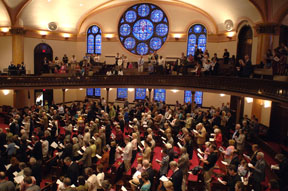
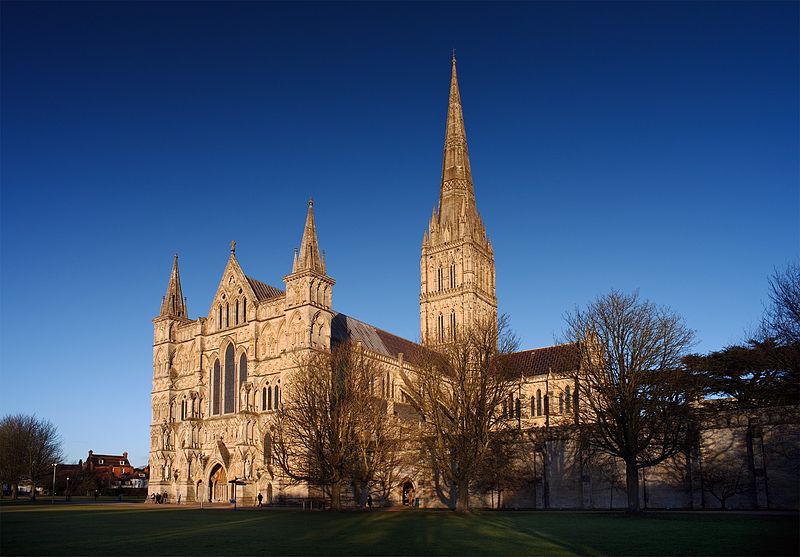
I remember the beautiful Salisbury Cathedral from a visit in 1962. To the right are photographs of its interior and exterior.

David Evan Thomas

The composer of the anthem is David Evan Thomas, who was born in Rochester, New York in 1958 and holds degrees from Northwestern University (B.A.) the Eastman School of Music of the University of Rochester (M.A.) and the University of Minnesota (Ph.D.). He lives in Minneapolis and in addition to composing sings in the city’s Plymouth Congregational Church Choir. I was surprised to discover that he had been a composer in residence at my church (Westminster Presbyterian Church).

I pray that God will be in my head, understanding, eyes, looking, mouth, speaking, heart and thinking. And eventually in my end and departing.

Additional Thoughts About the Ridiculous U.S. Designation of Cuba as a “State Sponsor of Terrorism”

A prior post discussed the July 31, 2012 U.S. report on international terrorism that was followed by another post with an extensive analysis of what I believe to be the ridiculous U.S. designation of Cuba as a “State Sponsor of Terrorism.”

At least one of the Cuban-Americans in Congress, however, strongly defends that designation.

U.S. Rep. Ileana Ros-Lehtinen (Republican of Miami, Florida), Chairman of the House Foreign Affairs Committee, said this designation “reaffirms . . . [Cuba’s] threat to our national security. The Castro brothers are well known for their avid and long-term support for radical insurgent groups throughout Latin America, including their close ties to fellow despots in Iran, Syria, and Sudan who are also state sponsors of terrorism.” She continued, “It is disconcerting that this Administration is hell-bent on engaging the dictators in Havana despite its own reports illustrating the threat posed by the Castro regime. These thugs in Cuba have never and will never respond to friendly diplomatic gestures and continue to work to spread their anti-American propaganda worldwide.” She urged “President Obama to realize the failure of his Cuba policy and to stop appeasing the Castro brothers. It has not worked and it will not work. The suffering of an entire nation demands a change of course.”

Representative Ros-Lehtinen’s comments, I submit, are not persuasive for the reasons provided in the prior post.

Moreover, the U.S. population of 313.8 million is over 28 times larger than Cuba’s of 11.1 million. Our Gross Domestic Product (purchasing power) of $ 15.3 trillion is 134 times as large as Cuba’s of $114.1 billion. Our annual defense expenditures of $703 billion (purchasing power) is over 134 times larger than Cuba’s of $ 4.3 billion, and Cuba’s military equipment suffers from lack of replacement parts while we all know about U.S. military capabilities’ exceeding the rest of the world combined. And our land mass is over 88 times larger than Cuba’s (9,827,000 sq. km. vs. 111,000 sq. km.). (These comparisons are based on public statistics published by our CIA.)

Cuba is not a threat to U.S. national security. Congresswoman Ros-Lehtinen, your saying so does not make it so.

The Congresswoman’s comments, however, do underscore the political problems associated with rescinding the designation of Cuba as a “State Sponsor.” In a presidential election year in which the State of Florida is an important factor, the conventional political wisdom is that Cuban-Americans in Florida are very important to the election results in that state and that they (like their Congresswoman) support harsh measures against Cuba. Although there are signs that many younger Cuban-Americans in Florida and elsewhere do not agree with such harsh measures, it certainly would be more politically difficult this year for the Obama Administration to rescind the “State Sponsor” designation of Cuba.

Such a decision is made even more difficult by provisions of Section 6 (j) (4) of the Export Administration Act (50 U.S.C. § 2405(j)(4)) that impose restrictions on any Administration’s rescission of any such designation:

  • The President may rescind such a designation by submitting a report to Congress certifying that there has been a fundamental change in the leadership and policies of the country’s government, that its government is not supporting acts of international terrorism and that its government is providing assurances that it will not support such acts in the future.
  • Alternatively the President may rescind such a designation by submitting a report to Congress, at least 45 days in advance, justifying the rescission and certifying that the government has not provided any support for international terrorism during the preceding six-months and has provided assurances that it will not support such acts in the future.

If Congress disagrees with the President’s decision to remove a country from the list, of course, it could seek to block the rescission through legislation.

Perhaps this blog’s previous fact-based analysis of the absurdity of the continuation of the Cuba designation is beside the point. Perhaps the continuation is yet another sign of the dysfunctionality of the U.S. Government.


Yet Another Ridiculous U.S. Designation of Cuba as a “State Sponsor of Terrorism”

On July 31, 2012, the U.S. Department of State issued its annual report on terrorism in the world: Country Reports on Terrorism 2011. A prior post reviewed the report as a whole.

U.S. Flag
Cuba Flag

We now examine this report‘s designation of Cuba as a “State Sponsor of Terrorism,” i.e., as a country that has “repeatedly provided support for acts of international terrorism.” This post’s analysis is also informed by the previous U.S. reports on terrorism for 1996, 1997, 1998, 1999, 2000, 2001, 2002, 2003, 2004, 2005, 2006, 2007, 2008, 2009 and 2010.[1] Earlier posts analyzed and criticized the reports for 2009 and 2010.

Preliminarily I note that the latest report says that 480 of the 10,283 terrorist attacks in 2011 occurred in the Western Hemisphere and that “the vast majority of . . . [these] were ascribed to the Revolutionary Armed Forces of Colombia (FARC).” There is no mention of Cuba in this statistical summary.

Nor is there any mention of Cuba in the latest report’s “Strategic Assessment” that puts all of its discussion into a worldwide context. Instead this section of the report highlights the death of Osama bin Laden and other top leaders of al-Qa’ida as putting its “network on a path of decline that will be difficult to reverse.” Others specifically mentioned in this Assessment were Iran, terrorists groups in South-Asia, the Kurdistan Workers Party in Turkey, anarchists in Greece and Italy, dissident Republican groups in Northern Ireland and Anders Behring Breivik (the Norwegian right-wing extremist who killed 77 people last July).

Cuba As an Alleged Safe Haven for Terrorists 

The first stated basis for designating Cuba as a “State Sponsor of Terrorism” is its allegedly providing safe havens to individuals associated with two U.S.-designated Terrorist Organizations–Spain’s Basque Fatherland and Liberty (ETA) and the Revolutionary Armed Forces of Colombia (FARC)–and to certain fugitives from U.S. criminal proceedings. Here are direct quotations of the report on these points:

  • “Current and former members of . . . ETA continue to reside in Cuba. Three suspected ETA members were arrested in Venezuela and deported back to Cuba in September 2011 after sailing from Cuba. One of them, Jose Ignacio Echarte, is a fugitive from Spanish law and was also believed to have ties” to the FARC.
  • “Press reporting indicated that the Cuban government provided medical care and political assistance to the FARC.”
  • “The Cuban government continued to permit fugitives wanted in the United States to reside in Cuba and also provided support such as housing, food ration books, and medical care for these individuals.”

Before we examine some details about these charges, it must be said that the speciousness of this charge about ETA and FARC is shown by the latest U.S. terrorism report itself. It has a separate chapter on the legitimate international problem of terrorist safe havens as “ungoverned, under-governed, or ill-governed physical areas where terrorists are able to organize, plan, raise funds, communicate, recruit, train, transit, and operate in relative security because of inadequate governance capacity, political will, or both.” The report then identifies such havens in different parts of the world. For the Western Hemisphere, it discusses Colombia, Venezuela and the Tri-Border Area (where Argentina, Brazil and Paraguay come together). But there is no mention whatsoever of Cuba.

Earlier U.S. reports provide another reason for discounting these charges. They admit that “Cuba no longer supports armed struggle in Latin America and other parts of the world” (1996, 1997, 1998, 2008, 2009 reports) and that there was no evidence that Cuba had sponsored specific acts of terrorism (1996, 1997 reports). They also report that in 2001(after 9/11) Cuba “signed all 12 UN counterterrorism conventions as well as the Ibero-American declaration on terrorism” (2001, 2002, 2003 reports).

Let us now examine details about each of these specific assertions about alleged safe haven which have been made by the U.S. since at least 1996.

1. ETA

The weakness of the U.S. charge regarding ETA implicitly is admitted by the latest report itself when it states there “was no indication that the Cuban government provided weapons or paramilitary training for” ETA.  Similar admissions were made in the U.S. reports for 2005 (“no information concerning terrorist activities of [ETA] on Cuban territory”); 2008 (“no evidence of . . . terrorist financing activities”); 2009 (“no evidence of direct financial support”); 2010 (“no evidence of direct financial or ongoing material support”).

In addition, the latest U.S. report adds that there is evidence”[suggesting ] that the Cuban government [in 2011] was trying to distance itself from ETA members living on the island by employing tactics such as not providing services including travel documents to some of them.”

Earlier U.S. reports also reflect the limited nature of this charge. There allegedly were only 20 ETA members living in Cuba (2001 report), some of whom may be there in connection with peace negotiations with Spain (2009 report). In May 2003, Cuba publicly asserted that the “presence of ETA members in Cuba arose from a request for assistance by Spain and Panama and that the issue is a bilateral matter between Cuba and Spain” (2003 report). In March 2010 Cuba “allowed Spanish Police to travel to Cuba to confirm the presence of suspected ETA members” (2010 report).

Moreover, in March 2011 the Spanish Ambassador to Cuba told former U.S. President Jimmy Carter that Spain was “not concerned about the presence of members of . . .  ETA . . . in Cuba.” Indeed, the Ambassador maintained that this enhances his country’s ability to deal more effectively with ETA.  In fact, the Ambassador added, some ETA members are there at the request of the Spanish government.

2. FARC

Again the new U.S. report implicitly admits the weakness of its FARC allegations by the report’s stating there “was no indication that the Cuban government provided weapons or paramilitary training for” FARC.  Similar admissions were made in the U.S. reports for 2005 (“no information concerning terrorist activities of [FARC] on Cuban territory”); 2008 (“no evidence of . . . terrorist financing activities”); 2009 (“no evidence of direct financial support”); 2010 (“no evidence of direct financial or ongoing material support”).

In addition, the 2008 report said in July of that year “former Cuban President Fidel Castro called on the FARC to release the hostages they were holding without preconditions. He has also condemned the FARC’s mistreatment of captives and of their abduction of civilian politicians who had no role in the armed conflict.”

There is no indication in the reports of the number of FARC members allegedly in Cuba, but some may be there in connection with peace negotiations with Colombia (2009 report).

Moreover, in March 2011 the Colombian Ambassador to Cuba told former U.S. President Jimmy Carter that Colombia was “not concerned about the presence of members of FARC . . . in Cuba.” Indeed, the Ambassador maintained that this enhances their ability to deal more effectively with FARC.

3. U.S. fugitives

There apparently were or are over 70 individuals living in Cuba who are fugitives from criminal charges in U.S. relating to violent acts in the 1970’s purportedly committed to advance political causes, but pursuant to a 2005 Cuban government statement, no additional U.S. fugitives have been permitted on the island. In a few instances Cuba has extradited such fugitives to the U.S. (2001, 2003, 2004, 2005, 2006, 2007, 2008, 2009 reports).

None of these fugitives apparently is affiliated with U.S.-designated terrorist organizations. The issue of whether or not they will be extradited to the U.S. is an appropriate issue for bilateral negotiations between the two countries. But, in my opinion, it is not a legitimate basis for designating Cuba as a “State Sponsor of Terrorism.”

Cuba’s Alleged Financial System Deficiencies

The other asserted ground in the latest U.S. report for the designation of Cuba as a “State Sponsor of Terrorism” is new.

This other ground is Cuba’s having been identified by the Financial Action Task Force (FATF) as “having strategic AML/CFT [Anti-Money Laundering/Combating the Financing of Terrorism] deficiencies.  Despite sustained and consistent overtures, Cuba has refused to substantively engage directly with the FATF.  It has not committed to FATF standards and it is not a member of a FATF-style regional body.”

According to its website, FATF “is an inter-governmental body established in 1989 by the Ministers of its Member jurisdictions. [Its] . . . objectives . . .  are to set standards and promote effective implementation of legal, regulatory and operational measures for combating money laundering, terrorist financing and other related threats to the integrity of the international financial system. The FATF is therefore a ‘policy-making body’ which works to generate the necessary political will to bring about national legislative and regulatory reforms in these areas.” Thus, it apparently is a voluntary international organization, not one established by a multilateral treaty.

FATF currently has 34 member jurisdictions (or only about 18% of the U.N. member states) plus 2 regional organizations (the European Council and the Gulf Co-Operation Council) representing most major financial centers in all parts of the globe.

Starting in 1990,”FATF has developed a series of Recommendations that [it claims] are now recognised as the international standard for combating of money laundering and the financing of terrorism and proliferation of weapons of mass destruction. They form the basis for a co-ordinated response to these threats to the integrity of the financial system and help ensure a level playing field. First issued in 1990, the FATF Recommendations were revised in 1996, 2001 [additional measures regarding terrorist financing], 2003 and 2012 to ensure that they remain up to date and relevant, and they are intended to be of universal application.”

To this end, FATF promotes the global adoption and implementation of the FATF Recommendations.

In June 2012 FATF issued a Public Statement that identified Iran and the Democratic Republic of Korea [North Korea] as jurisdictions “subject to a FATF call on its members and other jurisdictions to apply counter-measures to protect the international financial system from the on-going and substantial money laundering and terrorist financing (ML/TF) risks emanating from [these] . . . jurisdictions.”

The June 2012 Statement also listed 18 other countries, including Cuba, as jurisdictions “with strategic AML/CFT deficiencies that have not made sufficient progress in addressing the deficiencies or have not committed to an action plan developed with the FATF to address the deficiencies. The FATF calls on its members to consider the risks arising from the deficiencies associated with each jurisdiction.”

The latest U.S. terrorism report made an important concession on this point by noting that in 2011 Cuba “did attend a [FATF] meeting on Money Laundering in South America meeting as a guest and prepared an informal document describing its anti-money laundering/counterterrorist financing system.” But this U.S. concession did not go far enough, for the June 2012 FATF Statement said, “Since February 2012 Cuba has officially engaged with the FATF and has also attended [the meetings of the relevant regional organizations] CFATF [Caribbean Financial Action Task Force] and GAFISUD [Financial Action Task Force on Money Laundering in Latin America] . . . . The FATF urges Cuba to continue its engagement with the FATF, and to work with the FATF to develop and agree on an action plan in order to implement an AML/CFT regime in line with international standards.”

I assume that the issues being addressed by the FATF are important ones for the international community and that its Recommendations are reasonable ones to address the real problems of money laundering and financing of terrorism. I also assume that the Cuban financial system is not as sophisticated as those in the U.S. and other international money centers and that it along with at least 17 other countries that are not “State Sponsors of Terrorism” is not in compliance with the FATF Recommendations.

But these facts, in my opinion, do not support designating Cuba as a “State Sponsor of Terrorism.” If it were, then the 17 other countries on the two FATF lists should be added to the U.S. list of “State Sponsors of Terrorism.” (Of the 20 countries on the two FATF lists, only Iran, Syria and Cuba are now U.S.-designated “State Sponsors.”)

Moreover, as noted above, the U.S. terrorism reports have indicated there was no evidence of Cuban financing of terrorism in the covered years. In addition, some of the reports reference Cuban laws permitting the tracking, blocking, or seizing terrorist assets (Cuba’s Law 93 Against Acts of Terrorism and Instruction 19 of the Superintendent of the Cuban Central Bank) (2005, 2006, 2007, 2008 reports). In addition, in its response to this latest U.S. report, Cuba has asserted that it “regularly provides precise, truthful information to the appropriate United Nations bodies charged with addressing these issues and others related to confronting terrorism.”

The whole FATF issue raised in the U.S. terrorism report, in my opinion, is a “red herring.”

Conclusion

In summary, the U.S. designation of Cuba as a “State Sponsor of Terrorism” is ridiculous. This conclusion is shared, in less colorful language, at least by the U.S. Central Intelligence Agency; the U.S. Council on Foreign Relations; the Center for International Policy; the Latin American Working Group; the Center for Democracy in the Americas; The Atlantic magazine’s national correspondent (Jeffrey Goldberg) and a retired U.S. Army Brigadier General (John Adams).

Not surprisingly the Cuban government comes to the same conclusion. It says “the only reason Cuba is kept on this list is exposed as an attempt to justify the U.S. blockade of our country, as well as the adoption of new measures to limit our financial and commercial transactions, to strangle the Cuban economy and impose a regime which responds to U.S. interests.”

Whatever legitimate issues are raised by these U.S. reports, I submit, are appropriate subjects, among many, for the bilateral negotiations that a prior post recommended should occur between the U.S. and Cuba to the end of reconciliation and restoration of normal relations. As Cuba pointed out after this U.S. report was released, Cuba repeatedly has proposed that the two countries “agree upon a bilateral program to confront terrorism,” but the U.S. government has not responded.

More generally, Cuban President Raul Castro on July 26, 2012 (the 59th anniversary of the Cuban Revolution) reiterated his country’s willingness to engage in negotiations with the U.S. as equals. He said no topic was off limits, including U.S. concerns about democracy, freedom of the press and human rights in Cuba so as long as the U.S. was prepared to hear Cuba’s own complaints. In response the U.S. repeated its prior position: before there could be meaningful talks, Cuba had to institute democratic reforms, respect human rights and release Alan Gross, an American detained in Cuba.

———————————————————-

[1] Cuba has been so designated since March 1982.The U.S. terrorism reports listed above are those that are accessible on the U.S. State Department’s website. I would appreciate detailed comments from anyone with knowledge about the reports for 1982-1995 although they are less relevant due to the passage of time.

The Latest U.S. Report on International Terrorism

 On July 31, 2012, the U.S. Department of State issued its latest annual report on terrorism in the world: Country Reports on Terrorism 2011. This post will review the report as a whole.

This report was submitted in compliance with 22 U.S.C. § 2656f, which defines “terrorism” for this purpose as ” premeditated, politically motivated violence perpetrated against non-combatant targets by subnational groups or clandestine agents” while the term  “international terrorism” means “terrorism involving citizens or the territory of more than one country.”

The report included the following statistics on terrorists attack during the year:

Area Number of Attacks
Near East & South Asia    7,721
Africa       978
Europe & Eurasia       561
East Asia & Pacific       543
Western Hemisphere       480
     TOTAL   10,283

The report’s “Strategic Assessment ” section puts all of this into a worldwide context. It highlights the death of Osama bin Laden and other top leaders of al-Qa’ida as putting its “network on a path of decline that will be difficult to reverse.” However, its affiliated groups around the world increased their impact. Iran was also criticized for its lethal support of terrorism in Iraq and Palestine. Others specifically mentioned in this Assessment were certain terrorist groups in South-Asia, the Kurdistan Workers Party in Turkey, anarchists in Greece and Italy, dissident Republican groups in Northern Ireland and Anders Behring Breivik (the Norwegian right-wing extremist who killed 77 people last July).

The statutory authorization of this report requires the Department of State to identify countries that have “repeatedly provided support for acts of international terrorism” as “State Sponsors of Terrorism.” This year the following four countries were so designated: Iran, Sudan, Syria and Cuba. A subsequent post will examine this designation of Cuba.

A wide range of sanctions may be imposed as a result of a State Sponsor of Terrorism designation, including: (a) a ban on arms-related exports and sales; (b) controls over exports of dual-use items, requiring 30-day Congressional notification for goods or services that could significantly enhance the terrorist-list country’s military capability or ability to support terrorism: (c) prohibitions on economic assistance; and (d) imposition of miscellaneous financial and other restrictions.

Cuban Religious Freedom According to the Latest U.S. Report on International Religious Freedom

On July 30, 2012, the U.S. Department of State released its latest report on the status of religious freedom around the world; this report was discussed in a prior post. Now we analyze that report’s evaluation of religious freedom in Cuba. The previous U.S. State Department report on this subject was discussed in a prior post.

Versalles Church, Matanzas, Cuba

This analysis is based upon my personal involvement in helping to establish and manage a partnership between my church (Minneapolis’ Westminster Presbyterian Church) and Iglesia Presbiteriana-Reformada en Versalles (Versalles Presbyterian-Reformed Church in Matanzas, Cuba); my going on three church mission trips over the last 10 years to visit that congregation; my visits to the ecumenical seminary–Seminario Evangelico de Teologia (SET)–in Matanzas and other churches and religious organizations on these mission trips;  my hearing reports about other trips to our Cuban partner from fellow members of my church; my conversations with Cuban Christians at their church and when they have visited my church in Minneapolis; and my extensive reading about Cuba and specifically religious freedom on the island.

Cuban Religious Makeup

First, however, we review the religious makeup of the Cuban population of roughly 11,000,000. According to the report, an estimated 60 to 70 percent (or 6,600,000 to 7,700,000) is believed to be Roman Catholic although only 4 to 5 percent regularly attend mass. Membership in Protestant churches is estimated at 5 percent of the population (or 550,000):  Baptists and Pentecostals are probably the largest Protestant denominations; Jehovah’s Witnesses, 94,000; Seventh-day Adventists, 30,000; Methodists, 30,000; Anglicans, 22,000; Presbyterians, 15,000; Quakers, 300; and The Church of Jesus Christ of Latter-day Saints (Mormons), 50. The Jewish community is estimated at 1,500 members, of whom 1,200 reside in Havana. There are approximately 6,000 to 8,000 Muslims, although only an estimated 1,000 are Cubans. Other religious groups include the Greek and Russian Orthodox churches, Buddhists and Baha’is.

In addition, many Cubans consult with practitioners of religions with roots in West Africa and the Congo River basin, known as Santeria. These religious practices are commonly intermingled with Catholicism, and some even require Catholic baptism for full initiation, making it difficult to estimate accurately the total membership of these syncretistic groups. (I have visited the Slave Route Museum in the city of Matanzas, Cuba that has a room devoted to Santeria and Havana’s Callejon de Hamel, an alley with  Santeria murals and other things.)

Positive Aspects of Religious Freedom in Cuba

The report had many good things to say about religious freedom in Cuba.

The Cuban “constitution protects religious freedom.” After the 1989 collapse of the U.S.S.R, the Cuban constitution was amended to eliminate “[scientific materialism or] atheism as the state creed” and to declare “the country to be a secular state” with “separation of church and state. The government does not officially favor any particular religion or church.” Moreover, says the U.S., “there were no reports of societal abuses or discrimination based on religious affiliation, belief, or practice.”

The Cuban “government’s respect for religious freedom improved” in 2011, declares the report.

“Religious organizations reported significant ability [in 2011] to attract new members without government interference. Many churches reported increased participation in religious instruction for children because government schools no longer scheduled competing activities on Saturdays or Sundays. The majority of religious groups reported little interference from the government in conducting their services and saw improvement in their ability to import religious materials, receive donations from overseas, and travel abroad to attend conferences and religious events. Some religious groups found it easier to bring in foreign religious workers. . . .”

“Religious organizations reported increased ability to conduct educational programs over the year. The Catholic Church and the Jewish Community Center offered courses on lay subjects such as computers and foreign languages. In September the Catholic Church opened a cultural center in Havana as a space for art exhibits, debates, and small classes, including a business training program. The Church’s business program was offered with the cooperation of the San Antonio University of Murcia, Spain for a master’s degree in business.”

Some religious groups “operated afterschool programs and weekend retreats for primary and secondary students and higher education programs for university graduates. The Catholic Church held twice yearly teaching workshops for public school teachers. Although not sanctioned by the government, these programs operated without interference.”

“Religious groups reported they were able to continue to provide community service programs with little interference from the government. These programs included providing assistance to the elderly, after school tutoring for children, clean water, and health clinics. International faith-based charitable operations, such as Caritas and the Salvation Army, had local offices in Havana.”

Indeed, not mentioned in the report is the de facto pharmacy for the neighborhood that is operated by our partner church in Matanzas with over-the-counter medicines donated by visitors from Westminster and by the Matanzas church’s plan to provide one free meal per week to neighborhood residents, many of whom are not members of the church.

SET Chapel, Matanzas
Luyano Presbyterian-Reformed Church, Havana

In addition, the nearby seminary in Matanzas (SET) now has a clean-water system that was installed by Westminster members and that now provides clean water to SET and to people in the surrounding neighborhood, and SET also provides vegetables from its beautiful gardens to people in the neighborhood. Another clean-water system was installed by Westminster members in Havana’s Iglesia Presbiteriana-Reformada en Luyano (Luyano Presbyterian-Reformed Church), which shares the clean water with people in its neighborhood.

During the year the report says “the Catholic Church and some other churches were able to print periodicals and operate their own Web sites with little or no censorship. The Catholic Church’s periodicals sometimes included criticism of official social and economic policies. As in previous years, the Catholic Church also received permission to broadcast Christmas and Easter messages on state-run radio stations and, in 2011, a televised mass on September 8, the feast day of the Virgin of Charity of El Cobre, the country’s patron saint. The [Cuban] Council of Churches, the government-recognized Protestant umbrella organization, was authorized to host monthly two hour-long radio broadcasts. ”

The report’s referencing the Cuban Council of Churches, however, did not mention that the it was founded in 1941 (long before the Cuban Revolution), and its members now include 22 churches, 12 ecumenical movements, and seven associate organizations. The Council, whose offices I have visited, promotes unity among the Christian Churches of Cuba and helps link these churches with other churches around the world. The Council also encourages dialogue between different movements and institutions as a means for Cuban churches to expand their ecumenical vocation of service, thus deepening their responsibilities towards society and all of God’s creation. Finally the Council promotes study, dialogue, and cooperation among Christians to increase Christian witness and enhance life in Cuba.

The U.S. government’s report continued, “Religious groups . . . reported it was easier to obtain government permission to maintain and repair existing places of worship and other buildings.” Moreover, the government “frequently granted permission to repair or restore existing temples, allowing significant expansion of some structures and in some cases allowing essentially new buildings to be constructed on the foundations of the old. Numerous houses of worship were expanded or repaired.” (In a prior year our partner church in Matanzas obtained such permission to expand its facilities for children’s Sunday School programming, and Westminster members helped build  that expansion.)

Even though some religious organizations and “house churches” have not been officially recognized by the government, as required by Cuban law, in practice, most unregistered organizations and “house churches” operated with little or no interference from the government.

Both the Catholic Church and the Cuban Council of Churches reported improved access to prisoners during the year, with services offered in prisons and detention centers in most, if not all, provinces. (According to the report, however, some prison authorities did not inform inmates of their right to religious assistance, delayed months before responding to such requests, and limited visits to a maximum of two or three times per year.)

The government worked with the Catholic Church to facilitate the public procession of an icon honoring the Virgin of Charity to mark the 400th anniversary of her appearance in Cuba. The procession concluded in December with a public open-air mass in Havana attended by over 3,000 citizens as well as by government officials. It was the first country-wide religious procession permitted since the Cuban revolution.

Although there is no official law of policy for conscientious objection to military service, since 2007 the government has unofficially allowed a period of civilian public service to substitute for military service for men who object on religious grounds. The leadership of Jehovah’s Witnesses and Seventh-day Adventists stated that their members usually were permitted to participate in social service in lieu of military service.

The leadership of Jehovah’s Witnesses and Seventh-day Adventists stated that mistreatment and job discrimination, which had been particularly harsh in the past, were now rare and that their members were usually exempted from political activities at school. Seventh-day Adventist leaders stated that their members employed by the state usually were excused from working on Saturdays.

Pope Benedict XVI @ Plaza de Revolucion

Not included in the report for 2011 was the late March 2012 visit to Cuba by Pope Benedict XVI. During a mass in Havana’s Plaza de Revolucion before a crowd of thousands, the Pope called for “authentic freedom.”

Negative Aspects of Religious Freedom in Cuba

The report also commented on what it saw as negative aspects of religious freedom in Cuba.

The report notes that obtaining government permission for construction of new religious buildings remained difficult. This may well be true, but, in my opinion, this difficulty springs from the government’s attempts to regulate the allocation of scarce resources in a relatively poor country and to allocate more resources to other purposes it deems more important.

By law religious groups “are required to apply to the Ministry of Justice for official recognition. The application procedure requires religious groups to identify the location of their activities and their source of funding, and requires the ministry to certify that the group is not ‘duplicating’ the activities of another recognized organization in which case, recognition is denied. A number of religious groups, such as the Jehovah’s Witnesses and the Mormons, have been waiting for years for a decision from the Ministry of Justice on their pending applications for official recognition.” (However, the report said that unrecognized religious groups reported they were able to conduct religious activities, hold meetings, receive foreign visitors, and send representatives abroad. In addition, I believe that the government’s official requirement that such applications indicate it is not “duplicating” another organization’s activities is due to the previously mentioned desire to conserve scarce resources.)

Once the Ministry of Justice grants official recognition, religious organizations have to request permission from the Cuban Communist Party, through its Office of Religious Affairs, to hold meetings in approved locations, to receive foreign visitors, and to travel abroad. Religious groups indicated that while many applications were approved within two to three years from the date of the application, other applications received no response or were denied. Some religious groups were only able to register a small percentage of their “house churches.”

The report states that religious groups may not establish schools. This is true because the Cuban Revolution nationalized all private schools–religious and nonreligious– and instead emphasized public education for all children.

The report also says, “Except for two Catholic seminaries and several interfaith training centers throughout the island, religious schools were not permitted.”

This is an erroneous or misleading statement about religious education in Cuba as shown by the report’s own acknowledgement that in 2011 religious organizations had increased ability to conduct their own educational programs and by the following facts not mentioned in the report:

  • Since 1946 there has been an ecumenical Protestant Christian seminary in the city of Matanzas — Seminario Evangelico de Teologia (SET)–that was founded by the Methodist, Presbyterian, and Episcopal Churches. It has a full curriculum for various degrees as well as other non-degree programs, some of which are offered in other cities on the island.
  • The Methodists recently withdrew from SET to start their own seminary in Havana.
  • SET and the Martin Luther King, Jr. Center at Ebenezer Baptist Church in Havana are developing a program for education of prospective owners and operators of private businesses on the island under the government’s announcement allowing such activities. The MLK Center, by the way, was founded in 1987 to provide training and education in King’s philosophy of nonviolence for Cuban religious and community leadership.
  •  In the last several summers young people from Westminster have conducted a vacation Bible school at our partner church in Matanzas.
MLK Center, Havana

“A license from the Office of Religious Affairs is necessary to import religious literature and other religious materials.” (Yet, as previously mentioned, the report itself states there were fewer restrictions on such importation.)

Printing press, Versalles Church, Matanzas
Church bulletins for distribution, Versalles Church, Matanzas

The report also states that “the government owns nearly all printing equipment and supplies and tightly regulates printed materials, including religious literature.” This, in my opinion, is an overstatement. Our partner church in Matanzas owns old-fashioned printing presses and at least one specialized computer printer and that the church prints and distributes religious bulletins and journals for most, if not all, of the Protestant churches on the island. A photo of the covers of some of the religious publications that are printed here appears in my 12/30/11 post, “The Cuban Revolution and Religion.”

The report states that “most religious leaders reported they exercised self-censorship in what they preached and discussed during services. Many feared that direct or indirect criticism of the government could result in government reprisals, such as denials of permits from the Office of Religious Affairs or other measures that could stymie the growth of their organizations.”

The government took “measures to limit support to outspoken religious figures that it considered a challenge to its authority.”I have no basis to challenge that statement or the following specifics cited by the report on this point:

  • On June 26, police arrested 23 people and detained them for five hours to prevent them from attending a Sunday prayer session in support of a Methodist minister who was removed from his post by his superiors, partly because of his outspoken criticism of the government.
  • On October 19, police stopped Baptist pastor Mario Felix Lleonart, a vocal critic of the authorities in the province of Santa Clara, and detained him for 10 hours.
  • In February Pastor Omar Perez Ruiz (aka Omar Gude Perez), a leader of the Apostolic Reformation, an association of independent nondenominational churches, was released after serving almost three years of a six-year prison sentence for illicit economic activities and falsification of documents. Perez maintained his innocence and claimed his incarceration was due to his religious activities. Perez’s release was conditioned on his refraining from preaching and from leaving the city of Camaguey. Although Perez and his family were granted refugee status in the United States, they were unable to leave because the government did not grant them an exit permit.
  • As part of its campaign of repression of human rights activists, the government prevented many Catholics from attending religious services. Members of the Ladies in White (Damas de Blanco) group were routinely prevented from attending church, a practice that was particularly pronounced in the eastern provinces of Holguin and Santiago. The government prevented Adisnidia Cruz, mother of political prisoners Marcos and Antonio Lima-Cruz, from leaving her house in Holguin on Sundays to attend mass on dozens of occasions. In other instances the government harassed human rights activists immediately after religious services. On September 8, for example, members of the Damas de Blanco were arrested after attending mass in Santiago to celebrate the day of Cuba’s patron saint.

Conclusion

Is the glass half empty or half full? This is the question for all human activities since none of us is perfect, and it is the legitimate question about religious freedom in Cuba.

In the opinion of a respected Cuban Protestant leader, the glass of such freedom in Cuba is more than half full, and there is no basis whatsoever  for the U.S. government or her citizens to castigate Cuban religious institutions or leaders or members. I concur. As Jesus said to the scribes and Pharisees when they asked him if they should stone a woman who had committed adultery, “Let anyone among you who is without sin be the first to throw a stone at her.” All of the questioners then silently departed without throwing any stones. (John 8: 3-11.)

I, therefore,  am glad that this U.S. government report does not designate Cuba as a “Country of Particular Concern,i.e., a country which has “engaged in or tolerated particularly severe violations of religious freedom,” or the ” systematic, ongoing, egregious violations of religious freedom, including violations such as torture, degrading treatment or punishment, prolonged detention without charges, abduction or clandestine detention, or other flagrant denial of the right to life, liberty, or the security of persons.” There is no basis for any such designation, in my opinion.

Nor do I think there is any basis for the quasi-independent  U.S. Commission on International Religious Freedom to have put Cuba on its “Watch List of countries where the serious violations of religious freedom engaged in or tolerated by the governments do not meet the [Commission’s] . . .  threshold [for designation as a Country of Particular Concern], but require close monitoring.” The Commission should cease making such a designation in its next report.