U.S.-Cuba Relations Discussed in U.N. Proceedings

During the week of September 18-22, U.S.-Cuba relations was one of many topics of discussion at the U.N. General Assembly and the U.N. Security Council. Here are those details.

U.S. Statements

 As discussed in a prior post, on September 19, U.S. President Donald Trump delivered a lengthy speech to the General Assembly that, in part, criticized Cuba. He said,

  • The U.S. “ has stood against the corrupt and destabilizing regime in Cuba and embraced the enduring dream of the Cuban people to live in freedom.  My administration recently announced that we will not lift sanctions on the Cuban government until it makes fundamental reforms.”
  • “From the Soviet Union to Cuba to Venezuela, wherever true socialism or communism has been adopted, it has delivered anguish and devastation and failure.  Those who preach the tenets of these discredited ideologies only contribute to the continued suffering of the people who live under these cruel systems.”

The next day (September 20) U.S. Vice President Mike Pence appeared at the Security Council to support reform of the U.N. peacekeeping function and to vote in favor of a resolution to that effect that was adopted that day.[1] Here is a photograph of the Vice President and U.S. Ambassador Nikki Haley at the Council.

He also said the following about Cuba:[2]

  • To “keep the peace most effectively, this body must have the credibility to pursue peace by advancing the cause of human rights. It’s no coincidence that some of the most dangerous regimes in the world are also some of the worst abusers of human rights.”
  • “That was the purpose under which the U.N. Human Rights Council was formed. But the truth is, the Human Rights Council doesn’t deserve its name. As we look at the membership of the council today, we see nations that betray these timeless principles upon which this institution was founded. Today, the United Nations Human Rights Council actually attracts and welcomes many of the worst human rights violators in the world. A clear majority of the Human Rights Council’s members fail to meet even the most basic human rights standards. [One of them is Cuba,] an oppressive regime that has repressed its people and jailed political opponents for more than half a century.” (Emphasis added.)

The Vice President added that the Security Council “must reform the Human Rights Council’s membership and its operation. . . .   [The U.S. calls] on the Security Council and this entire body to immediately embrace reforms of the membership and practices of the Human Rights Council and end the [latter’s] blatant bias against our cherished ally Israel.”[3]

Cuba’s Response

The Cuban response to both of these U.S. statements was provided in a speech at the General Assembly on September 22 by Cuba’s Foreign Minister, Bruno Rodriguez Parrilla, as shown in the following photograph. [4]

The following are his lengthy comments about these speeches and other aspects of the U.S.-Cuba relationship:

  • The U.N.’s “2030 Agenda for Sustainable Development lacks the means for its implementation, due to the egoism and lack of political will of the [U.S.] and other industrialized countries.”
  • “What is the miraculous recipe that President Donald Trump recommends to us in the absence of the financial flows of the Marshall Plan? Who will contribute the resources for that? How can this be reconciled with the ‘America First’ idea advanced by Presidents Reagan and Trump?”
  • “President Trump ignores and distorts history and portrays a chimera as a goal to be pursued. The production and consumption patterns . . . of neoliberal capitalism are unsustainable and irrational and will inexorably lead to the destruction of the environment and the end of the human species.”
  • “Can anyone forget about the consequences of colonialism, slavery, neocolonialism and imperialism?”
  • “Could the several decades of bloody military dictatorships in Latin America be referred to as an example of a successful capitalism? Does anyone know of any recipe of neoliberal capitalism that has been better applied than those which destroyed the Latin American economies in the 1980s?”
  • “It is both indispensable and urgent for the [U.N.] to work in order to establish a new participatory, democratic, equitable and inclusive international economic order, as well as a new financial architecture that take into account the needs and peculiarities of developing countries and the asymmetries that exist in world trade and finances as a result of centuries of exploitation and plundering”
  • “Industrialized countries have the moral duty, the historical responsibility as well as sufficient financial and technological means for that.”
  • “Not even the rich will enjoy the announced prosperity if climate change is not stopped. Cuba regrets the decision taken by the government of the [U.S.], which has been historically the principal greenhouse-gas emitting government in the planet, to withdraw its country from the Paris Agreement.”
  • “The U.S. government has come here to tell us that, in addition to prosperity, the other two ‘beautiful pillars’ of international order are sovereignty and security.”
  • “We all share the common responsibility to preserve the existence of human beings in the face of a nuclear threat. An important contribution to the achievement of that goal was the historical adoption of the Treaty on the Prohibition of Nuclear Weapons . . . , which proscribe the use and the threat of use of those weapons that have the capacity to annihilate the human species. Obviously, the [U.S.] strongly opposed this treaty. It announced that it will invest 700 billion dollars in military expenditures and is developing an extremely aggressive nuclear and military doctrine based on the threat to use and the use of force.”
  • “NATO member States [act] against international peace and security and International Law by promoting military interventions and non-conventional wars against sovereign States.”
  • “The illegal imposition of unilateral coercive measures and the use of financial, legal, cultural and communicational instruments to destabilize governments as well as the denial of peoples’ right to self-determination have become customary.”
  • “The covert use of . . . [Information and Communications Technology] to attack other States increases, while several developed countries strongly oppose the adoption of international treaties that would regulate cooperation in order to achieve a safe cyberspace.”
  • “The U.S. President manipulates the concepts of sovereignty and security to his exclusive benefit and to the detriment of all others, including his allies. The attempt to resort to military threats and force to stop the irreversible world trend to multi-polarization and polycentrism will seriously jeopardize international peace and security, which should be defended and preserved through international mobilization.”
  • “The principles of sovereign equality, respect for the territorial integrity and non-interference in the internal affairs of States should be observed. The UN Charter and International Law admit no re-interpretation.”
  • “The [U.N.] reform should pursue the principal goal of responding to the pressing needs of peoples and the great disadvantaged majorities. Multilateralism should be protected and reinforced in the face of the imperialist interests of domination and hegemony.The democratization of the Security Council, both in terms of its composition and its working methods, is a most urgent task. The strengthening of the General Assembly and the recovery of the functions that have been usurped from it are indispensable.”
  • “The ‘patriotism’ invoked in the U.S. statement is a perversion of humanism, the love and loyalty to the homeland and of the enrichment and defense of national and universal culture. It embodies an exceptionalist and supremacist vision of ignorant intolerance in the face of diverse political, economic, social and cultural models.”
  • “In developed countries, the loss of legitimacy of political systems and parties worsens and electoral abstentionism is on the rise. Corruption, whether legal or illegal, has turned into metastasis. So is the extreme case of the so-called ‘special interests’ or corporate payments in exchange for benefits in the country that spends the highest amount of money in electoral campaigns and where, paradoxically, a candidate with the lowest number of popular votes can be elected or entitled to govern with a negligible support by voters.”
  • There has been an increasing and unheard-of use of science and technology to exercise hegemony, mutilate national cultures and manipulate human behavior, as is the case of the so-called ‘big data’ or psychometry, used for political and advertising purposes. Seven consortia keep a strict control of whatever is read, watched or heard in the planet. Technologies are being monopolized. The governance of digital networks is dictatorial and discriminatory and, despite appearances, the digital divide between rich and poor countries is increasing.”
  • “The opportunities and rights of youths, migrants and workers are curtailed and their human rights are openly and systematically violated”
  • On September 20, “U.S. Vice-President, Michael Pence, ridiculously ignoring the functions of the Security Council and attempting to establish new prerogatives, said that [the Security Council] should modify the composition and methods of the U.N. Human Rights Council, which ‘doesn’t deserve its name’ because ‘a clear majority of the Human Rights Council members fail to meet even the most basic human rights standards.’ I suppose he is not including, in this case, his own country, which will in fact deserve to be included because of its pattern of systematic violations of human rights, namely the use of torture, arbitrary detentions and imprisonment–as occurs at the Guantanamo Naval Base–, the assassination of African-Americans by law enforcement agents, the killing of innocent civilians perpetrated by its troops and the xenophobia and repression against immigrants –including minors– as well as its scarce adherence to international instruments.”
  • “On June 16, . . . President Trump announced the new Cuba policy of his administration, which is a setback in U.S.-Cuba bilateral relations and undermines the bases established two years ago to advance towards a new type of relation between our countries, characterized by respect and equality. The U.S. Government has decided to tighten the economic, commercial and financial blockade by imposing new obstacles to the already limited possibilities its business community had to trade with and invest in Cuba as well as additional restrictions on U.S. citizens willing to travel to our country.”
  • “Those decisions ignore the support from broad sectors in the U.S., including the majority of Cuban émigrés, to the lifting of the blockade and the normalization of relations. They only serve the interests of a group of Cuban origin, based in South Florida, which is an ever more isolated and minoritarian group that insists in harming Cuba and its people for having decided to defend, at all costs, the right to be free, independent and sovereign. Today we reiterate our condemnation of the measures aimed at tightening the blockade and reaffirm that any strategy intended to destroy the Revolution will fail.”
  • “Likewise, we reject the manipulation of the human rights issue against Cuba, which has a lot to be proud of and has no need to receive lessons from the [U.S.] or anyone.”
  • We “express our strongest condemnation of the disrespectful, offensive and interventionist statement against Cuba and the Cuban government, made [by President Trump]. We remind him that the [U.S.], where flagrant human rights violations are committed, which raise deep concern among the international community, has no moral authority to judge my country. We reaffirm that Cuba will never accept any preconditions or impositions, nor will it ever renounce any of its principles.”
  • “Regarding the alleged incidents that. . . have affected U.S. diplomatic officials in Havana we categorically affirm that the Cuban government rigorously and seriously abides by its obligations under the Vienna Convention on Diplomatic Relations in relation to the protection and the integrity of all diplomats without any exception, including those from the [U.S.] Cuba has never perpetrated nor will it ever perpetrate actions of this sort. Cuba has never allowed nor will it ever allow its territory to be used by third parties with that purpose. The Cuban authorities, based on the preliminary results of the priority investigation that is being carried out with a high technical component, following instructions from the top level of our government, has taken into account the data contributed by the U.S. authorities and so far has found no evidence whatsoever that could confirm the causes or the origin of the health disorders referred to by U.S. diplomats and their relatives. The investigation to clarify this issue continues, and in order to be able to arrive to a conclusion, it will be crucial to count on the cooperation of the U.S. authorities. It would be unfortunate if a matter of this nature is politicized.”
  • “As was expressed by the Cuban President Raul Castro Ruz, Cuba is willing to continue negotiating all pending bilateral issues with the United States, on the basis of equality and absolute respect for the sovereignty and independence of our country; and maintaining a respectful dialogue and cooperation in areas of common interest with the U.S. government.”
  • “Cuba and the [U.S.] can cooperate and coexist, respecting their differences and promoting everything that benefits both countries and peoples, but no one should expect Cuba to make concessions that affect its sovereignty and independence.”
  • “The Cuban people will not cease in their legitimate claim for the lifting and total elimination of the economic, commercial and financial blockade and will continue to denounce the strengthening of that policy. In November Cuba will once again present to the [U.N.] General Assembly [a resolution for ending the U.S. blockade of Cuba]. “

Conclusion

The above comments by President Trump and Vice President Pence, while not surprising from their administration, are a most unfortunate retreat from the efforts by President Obama and President Castro to normalize the two countries’ relations and abandon U.S. hostility towards the island.

The U.N. Human Rights Council was created by the U.N. General Assembly on March 15, 2006, by resolution 60/251. Therefore, it seems unlikely that the U.N. Security Council has any authority to make changes in the structure of the Human Rights Council, and Vice President Pence’s suggestion that this be done seems inappropriate unless it was intended as a call for the Security Council to recommend that this be done.

The lengthy comments by Cuba’s Foreign Minister Rodriguez are also not surprising with perhaps one exception. With respect to the medical problems of some U.S. diplomats stationed in Cuba, he said, “The investigation to clarify this issue continues, and in order to be able to arrive to a conclusion, it will be crucial to count on the cooperation of the U.S. authorities. It would be unfortunate if a matter of this nature is politicized.” All reports to date have indicated that the two countries are cooperating on investigating these issues, and the Foreign Minister’s comment seems to suggest that future U.S. cooperation was questionable. Is this so? If so, that would be most unfortunate and inadvisable for many reasons. The statement about  the possible U.S. politicization of this issue is also surprising unless it was an indirect reference to the letter to the Trump Administration by five Republican U.S. Senators led by Senator Marco Rubio (FL) that called for several U.S. actions against Cuba over this problem, including closure of the U.S. Embassy in Havana, as was discussed in an earlier post.

This coming November there will be a General Assembly debate and vote on Resolution A/72/50 42: Necessity of ending the economic, commercial and financial embargo imposed by the United States of America against Cuba.[5] It is widely assumed that this will be adopted by an overwhelming margin; the similar resolution last year passed, 191-0 (with two abstentions by the U.S. and Israel), as discussed in a prior post.

===========================================

[1] U.N. Security Council, Resolution 2378 (2017).

[2] White House, Remarks by the Vice President to the UN Security Council (Sept. 20, 2017); Assoc. Press, Pence Applauds UN Resolution on Peacemaking Reform, N.Y. Times (Sept. 20, 2017); Reuters, Pence Tells U.N. That America First Does Not Mean America Alone, N.Y. Times (Sept. 20, 2017).

[3] The same day (September 20) the U.N. Human Rights Council in Geneva, Switzerland issued a reprimand of Cuba while U.S. and Cuba representatives traded comments on Cuban human rights. This will be discussed in a subsequent post.

[4] Rodriguez, Cuba will never accept any preconditions or impositions (+ Video), Granma (Sept. 22, 2017); Reuters, Cuba Urges U.S. Not to Politicise Allegations of Harmed Diplomats, N.Y. Times (Sept. 22, 2017); Assoc. Press, Cuban Official: Still No Clue on US Diplomat Health Issue, N.Y. [InformationTimes (Sept. 22, 2017).

[5] U.N., Report of the Secretary-General, Necessity of ending the economic, commercial and financial embargo imposed by the United States of America against Cuba, No. A/72/94  (July 26, 2017)
Developments Regarding U.S. Diplomats Serving in Cuba

On September 19, the U.S.-Cuba Bilateral Commission held its sixth meeting, this time in Washington, D.C. The official statements about the closed meeting do not reveal much of the substance of the discussion.[1]

One of the subjects of the meeting was the medical incidents involving U.S. diplomats in Cuba.

The U.S. statement about the meeting stated there was discussion regarding “the incidents affecting diplomatic personnel at the U.S. Embassy in Havana. The [U.S.] reiterated its deep concern for the safety and security of the U.S. Embassy community in Havana and the urgent need to identify the cause of these incidents and to ensure they cease.”[2]

According to Cuban Foreign Ministry, the Cuban delegation also addressed the alleged incidents. They “reiterated that Cuba is strictly complying with its obligations as regards the protection of diplomats, which has never . . . perpetrated actions of this nature, nor has it permitted its territory to be used by third parties for that purpose.” Finally, the Cuban delegation “emphasized that the Cuban authorities have a great interest in clarifying this matter and concluding the investigation that is underway, at the suggestion of the highest level of government, for which the cooperation of the American authorities is essential.”

In addition, the Cuban statement said its delegation “reiterated its rejection of the backwardness of bilateral relations, measures to intensify the blockade and interference in internal affairs; confrontational rhetoric and political manipulation of the human rights issue that was used as a pretext to justify them, as well as the constraints that seek to condition an improvement in bilateral ties to the realization of changes in our constitutional order.”  It also “referred to the consequences of this change in the [U.S.] policy for relations between the two countries, including the effects it causes to various sectors in the [U.S.].”. (Emphasis added.)

Nevertheless, the Cuban delegation reportedly reaffirmed “their willingness to continue a respectful dialogue with the US government, . . . to actively implement the bilateral agreements signed in the last two years.” They alsotransferred concrete actions proposals from several Cuban entities to advance cooperation in areas of mutual benefit such as environmental protection, law enforcement, health, agriculture, hydrography and geodesy, among others.” (Emphasis added.)

The U.S. statement also said the U.S. “reviewed the Administration’s priorities and areas for engagement in the interests of the [U.S.] and the Cuban people, including human rights; implementation of the Migration Accords; and protecting the national security and public health and safety of the [U.S.].”

This meeting occurred simultaneously with President Trump’s speech at the U.N. General Assembly that included brief comments about Cuba and that will be discussed in a subsequent post. However, at the Bilateral Commission meeting the Cuban delegation registered a “strong protest;” about what it termed the “disrespectful, intrusive and unacceptable . . . speech.”

===========================================

[1] U.S. State Dep’t, United States and Cuba Hold Sixth Bilateral Commission Meeting in Washington, D.C. (Sept. 20, 2017); Cuban Foreign Ministry, Held in Washington VI Meeting of the Bilateral Commission Cuba-United States (Sept. 19, 2017); Assoc. Press, Cuba Again Denies Role in ‘Health Attacks’ on US Diplomats, N.Y. Times (Sept. 19, 2017); Assoc. Press, US to Press Concerns Over Incidents in Meeting with Cubans, N.Y. Times (Sept. 18, 2017). The so-called “Bilateral Commission” sessions were started as part of the process of normalization between the two countries since December 17, 2014, and have been discussed in prior posts: U.S.-Cuba Bilateral Commission Sets Agenda for Future Discussion of Remaining Issues (Sept. 12, 2015); Results of Second Meeting of U.S.-Cuba Bilateral Commission (Nov. 11, 2015); United States-Cuba Bilateral Commission Meets To Review Normalization Status (May 18, 2016); U.S. and Cuba Hold Another Meeting of the Bilateral Commission (Sept. 30, 2016).

[2] CBS News reported that one of the Americans suffering from an incident was the Regional Security Officer, who was the head of security at the U.S. Embassy in Havana. It also said closure of the Embassy was unlikely although there could be reductions of personnel. (CBS News, Investigation continues into attacks on State Dept. officials in Havana (Sept. 18, 2017).


U.S. Evaluating Whether To Close Embassy in Cuba 

On the September 17 “Face the Nation” television show on CBS, U.S. Secretary of State Rex Tillerson was asked by John Dickerson, “Some senators suggested closing down the embassy there [in Cuba]. Should that happen?” Tillerson’s answer: “We have it under evaluation. It’s a very serious issue with respect to the harm that certain individuals have suffered. We’ve brought some of those people home. It’s under review.”[1] (Emphasis added.)

Nearly simultaneous reports indicate that U.S. investigators are pursuing various theories about what caused medical problems in some U.S. diplomats stationed in Cuba, including sonic attack, electromagnetic weapon or flawed spying device. Each theory seems to fit some, but not all, of what has happened. The perpetrator is also a mystery. “Suspicion has centered on Cuba’s government, a rogue faction of its security services or an outsider like Russia.”[2]

Conclusion

 With the five Republican senators on Friday, September 15, suggesting closure as the last potential action for the U.S. to take against Cuba, as discussed in a prior post, the question put to Secretary Tillerson on Sunday about closure was hardly surprising, but as it was the last question posed in the interview, there was no time for any follow-up questions.

Here are some of the unasked questions: Is the U.S. considering a temporary closure while the medical incidents are under investigation? If so, what are the details about such a possible temporary cloture? Or a permanent closure? What are the details about such a permanent closure? By the way, what is the status of the U.S. investigation? The Cuban investigation? Are there now more than the 21 U.S. individuals involved? Are they all Foreign Service officers? Are any members of their families? Where did the incidents occur? At the Embassy? At hotels? Which hotels? At their residences? Where are the residences located?

In any event, it should not be surprising that the State Department has closure “under evaluation” or “under review.” That would only be prudent under the circumstances. Assuming the reports about continuing, inconclusive investigations about the cause of the incidents are true along with Cuban cooperation in the investigations, however, permanent closure would not be prudent.

Once again, anyone interested in seeing the U.S. and Cuba continue their efforts at normalizing relations, as does this blogger, needs to closely follow developments in this mysterious story.

=====================================

[1] CBS Face the Nation, Transcript, U.S. Secretary of State Rex Tillerson on “Face the Nation,” Sept/ 17, 2017; Reuters, Tillerson Says U.S. Weighing Closing Embassy in Cuba Over Sonic Attacks, N.Y. Times (Sept. 17, 2017); Assoc. Press, Top US Diplomat Says Closing Embassy in Cuba ‘Under Review,’ N.Y. Times (Sept. 17, 2017).

[2]  Assoc. Press, Cuba Mystery: What Theories US Investigators Are Pursuing, N.Y.Times (Sept. 16, 2017).

More Mystery Surrounding “Medical Attacks“ on U.S. Diplomats in Cuba       

On September 14, the Associated Press reports an additional wrinkle to the mysterious medical attacks on U.S. diplomats in Cuba.[1]

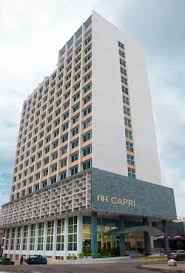
One of the diplomats was sleeping in a room at the recently renovated, luxurious Hotel Capri, a 60-year-old concrete tower steps from the Malecon. He was awakened by a “blaring, grinding noise.” He climbed out of bed, got up and moved a few feet away to silence. He returned to the bed, but immediately was hit by the “agonizing sound.” Soon thereafter he experienced hearing loss and speech problems. Below are photographs of the hotel and one of its rooms.


Now it has been discovered by the AP that some of the earlier incidents in Havana “were confined to specific rooms or even parts of rooms with laser-like specificity.” In addition, some of the victims are having “problems concentrating or recalling specific words.”

Indeed, the cases have shown “different symptoms, different recollections of what happened. . . . In several episodes victims knew it was happening in real time, and there were strong indications of a sonic attack. Some felt vibrations, and heard sounds — loud ringing or a high-pitch chirping similar to crickets or cicadas. Others heard the grinding noise. Some victims awoke with ringing in their ears and fumbled for their alarm clocks, only to discover the ringing stopped when they moved away from their beds. The attacks seemed to come at night. Several victims reported they came in minute-long bursts. Yet others heard nothing, felt nothing. Later, their symptoms came.”

These cases continue to baffle U.S. and Cuban officials. “Investigators have tested several theories about an intentional attack — by Cuba’s government, a rogue faction of its security forces, a third country like Russia, or some combination thereof. Yet they’ve left open the possibility an advanced espionage operation went horribly awry, or that some other, less nefarious explanation is to blame.”

“Sound and health experts are equally baffled. Targeted, localized beams of sound are possible, but the laws of acoustics suggest such a device would probably be large and not easily concealed. Officials said it’s unclear whether the device’s effects were localized by design or due to some other technical factor.”

=========================================

[1] Assoc. Press, New Details Deepen Mystery of US Diplomats’ Illness in Cuba , N.Y. Times (Sept. 14, 2017). Previous posts have discussed these issues regarding U.S. diplomats in Cuba: U.S. and Cuba Have Diplomatic Dispute (Aug. 10, 2017); Another State Department Briefing Regarding Cuban Diplomatic Dispute (Aug. 10, 2017); Update on U.S.-Cuba Diplomatic Dispute Over Health  Conditions of U.S. Diplomats Stationed in Cuba (Aug. 23, 2017); At Least 16 U.S. Diplomats Who Had Served In Cuba Have Medical Problems (Aug. 24, 2017) (comment on 8/23/17 post); Washington Post Editorial Blames Cuba for Americans Medical Problems in Cuba (Aug. 25, 2017) (comment on 8/23/17 post); News About Cuba-Related Medical Problems from Canada and London (Aug. 26, 2017) (comment on 8/23/17 post); In August, New Cases of Injured U.S. Diplomats in Cuba (Sept. 2, 2017); Two More U.S. Diplomats Serving in Cuba Have Medical Problems (Sept. 13, 2017) (comment on 9/2/17 post).


In August, New Cases of Injured U.S. Diplomats in Cuba 

Previous posts have discussed the recent news that starting in late 2016 through March 2017 several U.S. diplomats stationed in Cuba had been suffering various medical problems apparently associated with some kind of sonic device, that the U.S. with Cuban cooperation has been investigating these incidents and that the U.S. was not accusing the Cuban government of being responsible.[1]

On September 1, the U.S. State Department revealed that last month (this August) additional U.S. diplomats were suffering symptoms from a sonic “incident” in Cuba. The Department’s spokesperson, Heather Nauert, said that 19 Americans are now confirmed to have been affected, up from 16 reported last month. But the Department did not say exactly when last month the incidents took place or provide other details while also cautioning, “We can’t rule out new cases as medical professionals continue to evaluate” diplomats and their families. The U.S. investigation of these incidents is continuing and to date the Trump administration has not blamed the Cuban government.[2]

Also on September 1 the American Foreign Service Association, the labor union representing U.S. Foreign Service officers, said that based upon its contacts with 10 of the U.S. diplomats suffering from medical problems associated with their having served in Cuba the Association believes that they have been subjected to mysterious “sonic harassment attacks” that have caused  “mild traumatic brain injury [concussions]and permanent hearing loss, with such additional symptoms as loss of balance, severe headaches, cognitive disruption, and brain swelling.” Therefore, the Association “strongly encourages the Department of State and the U.S. Government to do everything possible to provide appropriate care for those affected, and to work to ensure that these incidents cease and are not repeated.”[3]

On August 30 CBS News reported that U.S. intelligence analysts believe the cause of the acoustic attack on U.S. and Canadian diplomats in Havana starting late last year was an inaudible sound (ultra and infrasonic waves), and a Georgetown University ear surgeon said such sounds can damage hearing. Medical records show that U.S. victims have been diagnosed with hearing loss, mild traumatic brain injury and likely nerve damage. CBS also reported that the two Cuban diplomats earlier expelled from the U.S. were intelligence officials.[4]

Although the U.S. Government to date has not blamed Cuba for these incidents, a Washington Post editorial has strongly suggested that Cuba is responsible, and Roberto Alvarez Quińones, a Cuban-American journalist, economist and historian living in Los Angeles, asserts that however the attacks occurred, Raúl Castro is responsible.[5]

=============================================

[1] Posts to dwkcommentaries.com: U.S. and Cuba Have Diplomatic Dispute (Aug. 10, 2017); Another State Department Briefing Regarding Cuban Diplomatic Dispute (Aug. 10, 2017); Update on U.S.-Cuba Diplomatic Dispute Over Health Conditions of U.S. Diplomats Stationed in Cuba (Aug. 23, 2017); At Least 16 U.S. Diplomats Who Had Served in Cuba Have Medical Problems (Aug. 24, 2017) (comment to 08/23/17 post); Washington Post Editorial Blames Cuba for American Medical Problems in Cuba (Aug. 25, 2017) (comment to 08/23/17 post); News About Cuba-Related Medical Problems from Canada and London (Aug. 26, 2017) (comment to 08/23/17 post).

[2] Gearan, State Department reports new instance of American diplomats harmed in Cuba, Wash. Post (Sept. 1, 2017); Lederman (Assoc. Press), U.S.: Another health attack on diplomats in Cuba last month, Wash. Post (Sept. 11, 2017).

[3] Gearan, American diplomats suffered traumatic brain injuries in mystery attack in Cuba, union says, Wash. Post (Sept. 1, 2017); Assoc. Press, US Diplomats Union: Attacks in Cuba Caused Mild Brain Injury, N.Y. Times (Sept. 1, 2017).

[4] Dorsey, Infra- and ultrasonic waves thought to be responsible for Cuba attacks, CBS News (Aug. 30, 2017); CBS: US Intelligence points out that diplomats in Cuba were affected by ‘an inaudible sound,’ Diario de Cuba (Aug. 30, 2017).

[5]   Editorial, Don’t play down a sinister attack on diplomats in Cuba, Wash. Post (Aug. 24, 2017); Alvarez Quińones, Acoustic attack or not, Raul Castro is to blame, Diario de Cuba (Aug. 31, 2017).


Another State Department Briefing Regarding Cuban Diplomatic Dispute 

At an August 10 State Department press briefing, the Spokesperson Heather Nauert discussed the ongoing U.S.-Cuba diplomatic dispute about U.S. diplomats in Cuba who have had medical problems.[1]  

Emphasizing that there was an ongoing U.S. investigation of this matter, she said that the U.S. was still trying to determine the cause of the ailments, that it was too soon to blame any government or other person for the problems, that she has no knowledge of a country other than Cuba being the potential cause of the problems and that she was not aware of the U.S. having experienced the same problem in other countries.

She also said that the two Cuban diplomats in the U.S. had been expelled in May because Cuba had breached its obligation under the Vienna Convention on Diplomatic Relations, whose Article 29 states: “The person of a diplomatic agent shall be inviolable. He shall not be liable to any form of arrest or detention. The receiving State [here, Cuba] shall treat him with due respect and shall take all appropriate steps to prevent any attack on his person, freedom or dignity.” (Emphasis  added.)

There have been reports that at least one Canadian diplomat has been treated in hospital in Cuba afar suffering headaches and hearing loss and that the Canadian and Cuban governments are investigating the problem. Global Affairs Canada spokeswoman Brianne Maxwell said Thursday that agency officials “are aware of unusual symptoms affecting Canadian and US diplomatic personnel and their families in Havana. The government is actively working — including with US and Cuban authorities – to ascertain the cause.”[2] U.S. State Department spokesperson Heather Nauert could neither confirm nor deny such reports.

Ms. Nauert also asserted that the U.S. Embassy in Havana is fully staffed and operational.

=================================

[1] A prior post discussed the issue of medical problems of some U.S. diplomats in Cuba.

[2] Canadian diplomat in Cuba treated for hearing loss, CBCnews (Aug. 10, 2017); Assoc. Press, Canadian Diplomat in Cuba Treated for Hearing Loss, N.Y. Times (Aug. 10, 2017).

U.S. and Cuba Have Diplomatic Dispute  

On August 9, it became publicly known that the U.S. and Cuba had been and still are engaged in a diplomatic dispute. Is it a spat or something more serious? Here are details about what started becoming publicly known only yesterday.[1]

  • In the fall of 2016, several U.S. diplomats at the U.S. Embassy in Havana began suffering unexplained losses of hearing, and some of the diplomats’ symptoms were so severe that they were forced to cancel their tours early and return to the U.S.
  • On February 17, 2017, the U.S. informed Cuba about these medical problems.
  • Apparently sometime in or about May 2017, the U.S. investigation of these medical problems concluded that the diplomats had been exposed to a device that operated outside the range of audible sound and had been deployed either inside or outside their residences. It was not immediately clear if the device was a weapon used in a deliberate attack, or had some other purpose.
  • On May 23, the U.S. asked two Cuban diplomats at the Cuban Embassy in Washington, D.C. to leave the U.S., and they did so.
  • On August 9, the U.S. State Department reported that the U.S. had expelled two Cuban diplomats at its Embassy in Washington, D.C. for unspecified “incidents” in Havana.
  • At a press briefing the same day (August 9), the S. State Department spokeswoman Heather Nauert said the exact nature of the incidents was unclear, but Americans serving in Cuba had returned to the U.S. for non life-threatening “medical reasons.” Moreover, she said, “We don’t have any definitive answers about the source or the cause of what we consider to be incidents. It’s caused a variety of physical symptoms in these American citizens who work for the U.S. government. We take those incidents very seriously, and there is an investigation currently under way. What this requires is providing medical examinations to these people. Initially, when they’d started reporting what I will just call symptoms, it took time to figure out what it was, and this is still ongoing. So we’re monitoring it.”
  • In response later the same day, Cuba’s Foreign Ministry released a statement that the expulsion of the Cuban diplomats was “unjustified and unsubstantiated” and that : “Cuba has never, nor would ever, allow the Cuban territory to be used for any kind of action against accredited diplomats or their families.” In addition, it said, “It reiterates its willingness to cooperate in the clarification of this situation” and had started a “comprehensive, high-priority and urgent investigation” into the alleged incidents after it had been informed of them by the embassy in February. The statement also reported that Cuba had reinforced security around the U.S. embassy and U.S. diplomatic residences.
  • Apparently also on August 9, a U.S. government official said several colleagues at the U.S. embassy in Havana had been evacuated back to the U.S. for hearing problems and other symptoms over the past six months (February-July?). Some subsequently got hearing aids, said the official, who spoke on condition of anonymity. U.S. officials also told the Associated Press that about five diplomats, several with spouses, had been affected and that no children had been involved and that the FBI and Diplomatic Security Service are investigating. The officials also stated that investigators were looking into the possibilities that the incidents were carried out by a third country such as Russia, possibly operating without the knowledge of Cuba’s formal chain of command.

Conclusion

Everyone needs to stay tuned for further developments and hope that this does not lead to a further deterioration of relations between the two countries.

The apparent medical problems experienced by spouses of U.S. diplomats suggests that if the problems were caused by some kind of electronic device, the devices were located at the diplomats’ homes, not the Embassy. Especially with the current legitimate concern over the U.S. avoiding provocative statements about North Korea, both the U.S. and Cuba need to exercise restraint, to work together to solve these problems and to avoid jumping to conclusions before the results of investigations are known.

Senator Marco Rubio has not exercised such restraint with his August 9 press release: “The Cuban government has been harassing U.S. personnel working in Havana for decades. This has not stopped with President Obama’s appeasement. Personal harm to U.S. officials shows the extent the Castro regime will go and clearly violates international norms.”[2] Calm down, Marco.

=================================

[1]  Reuters, Cuba Denies Involvement in Incidents Concerning U.S. Diplomats, N.Y. Times (Aug. 10, 2017); Reuters, Cuba Says Investigating ‘Incidents’ Concerning U.S. Diplomats in Havana, N.Y. Times (Aug. 10, 2017); Assoc. Press, Hearing Loss of US Diplomats in Cuba Blamed on Covert Device, N.Y. Times (Aug. 10, 2017); U.S. State Dep’t, Press Briefing (Aug. 9, 2017); Gearan, U.S. expelled two Cuban diplomats after embassy employees in Cuba developed unexplained ailments, Wash. Post (Aug. 9, 2017); Cuban Foreign Ministry, Statement (Aug. 9, 2017); Cuba Foreign Ministry, Cuban Ministry of Foreign Affairs issues statement addressing allegations by the U.S., Granma (Aug. 10, 2017).

[2] Rubio Statement on Castro Regime Harming U.S. Diplomats in Cuba (Aug. 9, 2017).

White House Press Secretary and Senate Majority Leader Offer Conflicting Comments About U.S.-Cuba Relations

Josh Earnest
Josh Earnest

On the afternoon of July 1, 2015, Josh Earnest, White House Press Secretary, held a press gaggle (an informal on-the-record briefing) en route to Nashville, Tennessee that involved many comments about U.S.-Cuba relations. The next day the U.S. Senate Majority Leader, Mitch McConnell, addressed the same subject with conflicting comments. [1]

White House Press Secretary

1. Congressional Repeal of the Embargo Against Cuba

With respect to prospects for congressional repeal of the U.S. embargo of Cuba, Earnest said, “I haven’t done any whip counts, but I do think that there is, at minimum, strong . . . bipartisan support in the [U.S.] Congress for lifting the embargo on Cuba.  This is a policy that the President is encouraging Congress to pursue, and I think it’s worth noting how misplaced the opposition to doing so is.”

“We actually see, based on publicly available data about the preferences and views of the Cuban people, that the overwhelming majority of them strongly support normalizing relations with the [U.S.] and deepening their engagement with the [U.S.]  And that takes a variety of forms.  That’s everything from establishing an embassy there, which we’ve obviously taken steps to do, but it involves expanded commerce between our two countries; it involves more Americans traveling to Cuba; and it involves Cubans having more access to information.”

“This is something that the Cuban people are hungry for.  And so all of those who claim to have the interests of the Cuban people at heart should be strongly supportive of a policy that the President has implemented that we know that the Cuban people overwhelmingly support.”

2.Conditions for U.S. Diplomats Travel in Cuba

After deferring to the State Department for details on the agreed-upon conditions for U.S. diplomats traveling in Cuba, Earnest did say, “We believe that sufficient progress was made in resolving some of those concerns to move forward with the opening of the [U.S.] embassy in Cuba.”

3. Response to Critics of Restoring Diplomatic Relations

With respect to critics of the restoration of diplomatic relations, Earnest said Senator Robert Menendez’s was wrong when he stated “that democracy and human rights take a backseat to a legacy initiative. . . .  The fact is the President has been very clear since mid-December when this was originally announced about what the goal of this policy change actually is.”

“For more than 50 years, the U.S. policy toward Cuba was an effort to isolate Cuba in the hopes that that isolation would bring about better protections for human rights, for basic personal liberties related to freedom of expression, freedom of religion, freedom of assembly, freedom of speech.  But yet, we saw very little change over the last [50-plus] years.  And the President believed it was time for us to consider a new approach, and to try a new strategy for bringing about the kind of change that we would like to see in Cuba.”

“[T]hose who are concerned about ensuring that the rights and preferences of the Cuban people are protected and even advanced should be strongly supportive of the President’s policy, because the Cuban people are strongly supportive of the President’s policy. . . .  Every available shred of evidence indicates that the overwhelming majority of the Cuban people actually do support this policy change and that the vast majority of the Cuban people actually do believe that it will allow their ambitions to be realized, and that by having greater engagement with the American people, having greater access to the U.S. government, having greater access to publicly available information — this is what the Cuban people believe is in their best interest.”

“The President believes that this also happens to be a policy that has important benefits for the [U.S.].  There are important economic opportunities for U.S. businesses on the island nation of Cuba.  We have seen that the change in our policy toward Cuba has strengthened our relations with other countries in the Western Hemisphere.  For a long time, we saw that the U.S. policy of isolation toward Cuba was actually an impediment to our ability to build strong relations with other nations in the Western Hemisphere, and we’ve actually seen that by removing that impediment, we’ve been able to deepen our ties with other countries in the Western Hemisphere and, as a consequence, actually increase international attention on the failures of the Cuban government to protect the basic human rights of the Cuban people.”

“The President believes strongly that this approach is clearly within the best interest of the United States, but also in the best interest of the Cuban people in allowing them to achieve their ambition of having a country that is integrated, that is free, where they can freely express their political views.”

4. Appointment of U.S. Ambassador to Cuba

“We haven’t laid out a timeline yet for when an announcement of an ambassadorial nomination would be made.  But obviously that would be another step in normalizing our relations with Cuba, would be to appoint an ambassador to lead the U.S. Embassy in Havana…. I’m confident that will be a venue for robust debate about how the policy changes that the President announced back in December aren’t just clearly in the best interests of the American people, they’re clearly in the best interests of the Cuban people, as well.”

“For obvious reasons, it would be our strong preference that once an ambassador has been nominated, for that individual to be treated fairly by the [U.S.] Senate and confirmed in bipartisan fashion so that they can represent the interests of the United States on the island nation of Cuba.”

Senate Majority Leader

Senator Mitch McConnell

On July 2, U.S. Senator Mitch McConnell (Rep., KY), the Senate Majority Leader, gave a speech to a local chamber of commerce in his home state of Kentucky in which he made negative comments about President Obama’s rapprochement with Cuba and promised Senate resistance to that policy.

He called Cuba “a thuggish regime” that is “a haven for criminals” fleeing prosecution in the United States. “I’m having a hard time figuring out what we got out of this, you know? You would think that the normalization of relations with Cuba would be accompanied by some modification of their behavior. I don’t see any evidence at all that they are going to change their behavior. So I doubt if we’ll confirm an ambassador, they probably don’t need one.”

Moreover, McConnell noted that many of the restrictions placed on Cuba would require congressional legislation, “and we’re going to resist that.”

His negative views were echoed by some of his fellow Republican Senators, especially Cuban-Americans Marco Rubio (FL) and Ted Cruz (Tex.), by John Boehner (Rep., OH), the Speaker of the House of Representatives, and by Republican presidential candidates, especially Jeb Bush.

==================================================

[1] This post is based upon White House, Press Gaggle by Press Secretary Josh Earnest en route Nashville, TN, 7/1/15; Fran, Top Republican doubts Senate will confirm ambassador to Cuba, Wash. Post (July 2, 2015); Carney, Cruz: Cuba embassy a ‘slap in the face’ to Israel, The Hill (July 1, 2015).