Joseph Welch After the Army-McCarthy Hearings

Joseph Welch’s participation in the televised Army-McCarthy hearings in 1954 brought him national prominence. We have seen a summary of those hearings and his performance as the U.S. Army’s lawyer.

As a result, Welch became a celebrity. His career expanded to do new things.

Television Commentator

Welch appeared on various national television programs, most notably talking about the U.S. Constitution on the Omnibus program. A book of those commentaries was published.

Welch,The Constitution
Leonard Bernstein
Marian Anderson

In 1959 Welch provided commentary during intermissions of several televised concerts by the New York Philharmonic Orchestra, then under the baton of Leonard Bernstein.  After Bernstein apparently had called Welch a “great American,” Welch responded, “I suspect you are a better judge of good music than you are of what could truly be called great Americans. Do not think for a moment, however, that it is not music to me to have you say of me what you do.”  Welch added that for him to accept money for being on a Christmas concert with Bernstein and soprano Marian Anderson was “just barely distinguishable from cheating.”

Correspondent with Groucho Marx

Groucho Marx

Welch’s television appearances had an impact on comedian Groucho Marx. In a serious article in TV Digest about the status of television programming, he said, “[I]t speaks very well of television and its audience that the man so constantly in demand for more TV appearances after the Army-McCarthy Hearings was not Senator McCarthy, but Joseph Welch.”

This article came to Welch’s attention, and he wrote to Groucho on his law firm’s letterhead that listed the names of all the 40 or so lawyers in the firm. Welch said that it had not been necessary to hire extra help “to hold at bay swarms of people anxious to get me to appear on television or in the movies.” He then expressed admiration for Groucho’s work and said it “must be wonderful to be (a) Rich, (b) Intelligent, and (c) Funny. I trust I list them in their correct order.”

Groucho responded that he was not rich, but “rich enough . . . to know that inflation is knocking hell out of what I have.”  He also said he was a “little frightened” by the imposing list of 40 lawyers on Welch’s law firm’s letterhead. Groucho said he had been sued over the years on most of the “minor charges—rape, larceny, embezzlement and parking in front of a fire plug,” but those law firms never had more than four lawyers. Groucho then asked a series of questions about life in such a large law firm.

Welch could not let this Marx missive go unnoticed. Welch told Groucho that he had misunderstood the letterhead: “All the names below the first line are the name of our professional witnesses. They hang around street corners and turn up unexpectedly as witnesses in all the automobile cases we try.”  Welch then answered Groucho’s questions about the firm:

  • Q: How do you get along in the office?
  • A:  By leaning on each other heavily and on our secretaries.
  • Q:  Do you trust each other? 
  • A:  In every area except money, property and women.
  • Q:  Does each one have a separate safe for his money?
  • A:  Yes, except I have so much money I have two safes.
  •  Q: Isn’t there some danger that you and one of your partners could both be in a courtroom, representing opposing clients?
  • A: Damned if there isn’t and every now and then somebody takes in a case where the client is against the client of another guy in this office and there is hell to pay and no foolin’.
  • Q: Do you have one community storage room for your briefcases? Or does each one sit on his own case?
  • A: I do not understand this question. I sit on what you sit on only I do more of it than you do.”

While Welch said he hoped that Groucho would visit him in Boston, Welch advised him to keep it quiet because “a highly numerous and vocal collection of people in Boston thought and still think that hanging is too good for me.”

Welch indeed matched wits with Groucho.

Movie Actor
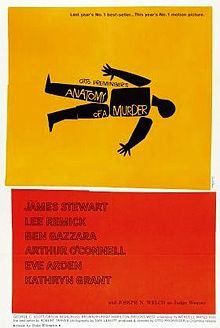
In 1959 Welch became a movie actor when Director Otto Preminger picked him to play Judge Weaver, a Michigan trial-court judge, in the film, Anatomy of a Murder, which is still an entertaining movie.

The basic plot concerns an Army Lieutenant, Frederick Manion  (played by Ben Gazarra), who is accused of murdering a man, Barney Quill, for allegedly raping his beautiful wife, Laura Manion (played by Lee Remick). Manion’s lawyer, Paul Biegler (played by Jimmy Stewart), is assisted by his friend, Parnell McCarthy (played by Paul O’Connell), an alcoholic lawyer. They oppose the district attorney, Mitch Lodwick, and a state assistant attorney general, Claude Dancer (played by George C. Scott). Judge Weaver (Joseph Welch) presides over the trial. Several interesting issues of legal ethics are posed by the trial, which is a subject for another day.

Joseph Welch as Judge Weaver
Jimmy Stewart as Biegler
Lee Remick as Laura Manion
Duke Ellington & Jimmy Stewart

Filmed in a small, apparently all white, county seat in the Upper Peninsula of Michigan, the movie has an enjoyable digression. Duke Ellington, the great jazz musician, appears in one scene as Pie-Eye, a musician playing the piano with a black jazz band, at a roadhouse. Joining him on the piano is the defense attorney (Jimmy Stewart), who is a jazz aficionado.

The movie received many Oscar nominations, but lost “Best Picture” to Ben-Hur while Stewart lost “Best Actor” to Charlton Heston in the latter movie.

During the filming, Welch became a good friend of John Voelker, the author of the film script and of the  novel of the same title and a fellow attorney and a former member of the Michigan Supreme Court. They discussed the possibility of Voelker’s assisting Welch in writing an autobiography, but that never happened. In their extensive correspondence over the last 18 months of Welch’s life, Welch compared his wordsmithing as “counterfeit” coins to Voelker’s “complete access to, if not ownership of, the First National Bank of Words.”

Law Firm Partner

Welch’s graciousness, so evident in the Army-McCarthy hearings, also was present in Welch as a law firm partner.

In 1952 the Hale and Dorr law firm was faced with an issue of whether it should make a claim on the estate of a deceased partner who had paid himself more than he was entitled to, i.e., who had embezzled law firm funds. The firm adopted Welch’s proposal to make a claim for one-half the amount. Said Welch, “Let him pay for his choice of life style. But because of the nature of the partnership and because we truly liked him at his best, let us forgive a half.”

In addition, presumably in the late1950’s Welch wrote a letter to his partners at Hale and Dorr, “This is like my will to you. I have lived a successful, rewarding and happy life. I believe that I owe the firm money rather than visa-versa. In any event, since my second wife does not need any money, any moneys owing to me by the firm upon my death should be paid to you [the partners], not to my family.”

Welch also prepared what he called an “office will:” It stated, “All the rest and residue and remainder of me as a lawyer I leave to all those in Hale and Dorr that I have loved. To a very large degree they . . . have made me what I am. Such success as I have attained I owe largely to them. I have lived my whole professional life in an office free from grief, envy, and jealousy. Few lawyers have been so blessed in their associations continually all through life. For the serenely happy life I have had with all of you, I say a simple and inadequate thank you.” Welch concluded: “this is my office will and is undated. The identity of the typist is to remain a secret. It is not witnessed. But even so—no fooling. Joseph N. Welch.”

The author in his years as a practicing lawyer in large law firms has never heard of anything like these gracious comments from a partner to his or her fellow partners.

Conclusion

Welch’s first wife, Judith Lyndon Welch, died in 1956, and he was remarried to Agnes Rodgers Brown Welch.

Welch died on October 6, 1960, just weeks before his 70th birthday.

President Dwight D. Eisenhower’s Involvement in the Army-McCarthy Hearings

Dwight D. Eisenhower

Prior posts have examined the substance of the Army-McCarthy hearings of 1954, the performance of Joseph Welch, the Army’s lawyer, in the hearings, and the Army’s hiring of Welch for this purpose.  Now we look at the role of President Dwight D. Eisenhower in these events.

During the hearings, President Eisenhower maintained his public distance from the battle between Senator Joseph McCarthy and the Army. The President believed that any public criticism of McCarthy by the President would merely enhance the Senator’s publicity value without achieving any positive purpose and that it was the Senate’s constitutional responsibility, not the President’s, to curb the Senator.

George C. Marshall

Eisenhower did so despite having an intense dislike of McCarthy and his methods. This stemmed from the Senator’s past attacks on George C. Marshall, who was Eisenhower’s friend and Army colleague and who was the former Secretary of State in the Truman Administration. The dislike was exacerbated by McCarthy’s attacks on several of Eisenhower’s top-level nominees in 1953, the first year of the Eisenhower Administration, and by McCarthy’s investigation of the Army starting in 1953. Eisenhower said privately, “I just won’t get into a pissing contest with that skunk.”

We now know, however, that the President was active behind the scenes to fight McCarthy.

Though his Chief of Staff, Sherman Adams, Eisenhower selected Welch as the Army’s attorney. Before and during the hearings, privately within the White House, Eisenhower expressed his extreme displeasure with McCarthy and was active in various ways regarding the hearings.

Robert Stevens

Moreover, Eisenhower wanted to give McCarthy enough rope to hang himself even though the Army would suffer in the short run. When the initial hearings went badly for McCarthy, the Senator suggested that there be no more television coverage. Army Secretary Robert Stevens discussed this proposal with the President, who rejected the idea, saying, “Now we have the bastard right where we want him!” The proposal was rejected. Television coverage continued. McCarthy destroyed himself.

As another example of the “hidden hand” of the Eisenhower presidency, the President invited television-journalist, Edward R. Murrow, to the White House to congratulate him for his television program’s exposure of McCarthy’s methodology.

When the hearings were over, the Army’s lawyers, Joseph Welch and James St. Clair, had a private meeting at the White House with the President. The President congratulated them on their presentation of the Army’s case and agreed with Welch that the main effect of the hearings had been to expose McCarthy’s disgraceful tactics before a national audience and that this exposure would ultimately benefit the country.1[1]


[1] Subsequent posts will review Welch’s activities after the hearings and his background. I interviewed Fred Fisher and James St. Clair in 1986 and have reviewed many source materials that document the assertions in this post. If anyone wants to see the bibliography of these sources, I will do so in another post at the conclusion of this series. Just make such a request in a comment to this or the other posts in this series.  By the way, after the hearings, Welch and St. Clair also had a private meeting with Supreme Court Justice Felix Frankfurter, who had been one of Welch’s law school professors at Harvard.

The U.S. Army’s Hiring of Attorney Joseph Welch for the Army-McCarthy Hearings

The Army had many lawyers of its own, and it had a call on lawyers from the Department of Justice. Why then did the Army decide to hire a private attorney? The answer has not been discovered. One reason could be that the Army’s chief legal Counsel, John G. Adams, was included in the charges of improper conduct by McCarthy, and this presented a conflict of interest that prevented his representing the Army and other officials.

In any event, the Army did search for a private attorney. Its first choice, an unnamed prominent Washington, D.C. lawyer, declined the request because he had been associated with a person who might be vulnerable to a McCarthy smear.

Sherman Adams
Thomas E. Dewey
Bruce Bromley


Welch apparently was number two on the Army’s list. He was retained, pro bono publico (without fee), for the Army by Sherman Adams, President Eisenhower’s Chief of Staff, upon the recommendation of two Wall Street lawyers: Thomas E. Dewey, the former Republican Governor of New York and the Party’s presidential nominee in 1944 and 1948, and Bruce Bromley, a former New York State judge (appointed by Governor Dewey) and a senior litigation partner in the law firm of Cravath, Swaine & Moore.[i]

Bromley knew Welch and his reputation as an exceptional trial lawyer with the eminent Boston law firm of Hale and Dorr (now WilmerHale), where since 1919 he had been handling all kinds of commercial civil litigation in courts in New England. Bromley introduced Welch to Dewey, who after an interview joined in a joint recommendation of Welch. But Welch had no experience with national security or political matters, and like almost all lawyers of the time no experience in congressional hearings, especially those on national television. These facts, however, did not disqualify him and indeed may have been seen as qualifying characteristics.

Perhaps one reason for Welch’s selection was his being from Boston as was the first outside lawyer for the Committee, Samuel Sears, who immediately withdrew because of public comments he had made in favor of McCarthy. Before Sears’ withdrawal, however, Welch told him, “I want to talk with complete frankness. You and I can’t afford to have any holding out on the other. I want your confidence, and I want you to have my confidence, and I want to come out of this with each of us the friend of each other.”

Edward R. Murrow

Bromley’s recommendation of Welch suggests another possible connection between the two men. At the time, Bromley and his firm had been retained by the CBS television network to help it prepare for the anticipated counterattack by Senator McCarthy in response to programs attacking the Senator by Edward R. Murrow. Given how practicing lawyers operate, based upon personal experience, Bromley and Welch probably exchanged information and suggestions about doing battle against the Senator.

David Stratheim as Murrow
George Clooney as Friendly


By the way, Murrow’s programs about McCarthy were at the center of the recent film, Good Night, and Good Luck. The film has a scene of Murrow (played by David Strathairn)and his show’s producer ,  Fred Friendly (played by George Clooney), watching a video clip of the famous 1954 clash between Senator McCarthy and Welch.

Before Welch accepted the offer to be counsel for the Army, he told his law firm partners that he had been asked “to undertake a grueling assignment. It will be long drawn out. I shall have to stay in Washington and I must take two of our best Juniors with me. In exchange, the Army will pay no fee and will not even pay travel and hotel expenses. Also, it is a dangerous assignment. Senator McCarthy is a powerful antagonist. If we have any skeletons in our closets let us say ‘No’ at once.” The partners then unanimously voted to accept the case. One partner ironically observed that another partner, Reginald Heber Smith, who was a national leader for legal aid, had “talked Legal Aid all his life, and now he has a Legal Aid client in the person of the Army of the United States.”

Although I have not found information as to why the Army apparently insisted on a private attorney’s undertaking this representation on a pro bono basis, the Army (and the Eisenhower Administration) may have wanted to avoid criticism by the public and Senator McCarthy of large fees being charged by a private law firm.

In any event, Hale and Dorr accepted the pro bono status. The firm regarded the matter as important for the public, but undoubtedly did not expect the hearings to last as long as they did. Their length obviously increased the cost to the firm; it had to have been a major drag on the firm’s finances for 1954. As Reginald Heber Smith later observed, “The cost was very heavy.”  This engagement, however, subsequently added to the firm’s professional luster and undoubtedly helped in its recruitment of new lawyers and perhaps its retention by some clients.

Another reason for the firm’s pro bono role was not wanting to get sued by a McCarthy supporter in Boston over any fees it would have received if it were fee-for-service.  After all, McCarthy was an Irish Catholic, and there were many of those in Boston, including the patriarch of the Kennedy clan (Joseph Kennedy), who was a McCarthy supporter, and his son, Robert F. Kennedy, was a lawyer for the Democratic members of the McCarthy committee.

Hale and Dorr thus entered the fray as a matter of public service. Reginald Heber Smith said at the time to Welch: “This is your most important case in your professional life; it is the most important case entrusted to the firm . . . . You were exactly right to accept it without pay. . . . Your opening statement to the press was perfect. Get the facts without fear or favor,  present them in that same spirit. The American people are not frightened by mistakes because we all make them; but they are dismayed by what looks like lack of candor and double talk. You can remove this fog of miasma and doubt.  Let the fresh wind of truth come in and do not be disturbed if it blows hard. After that the sun will shine.”


[i]  From 1966 through early 1970, the author was a law clerk and associate attorney at the Cravath firm and worked with Judge Bromley. But I was unaware of the Bromley-Welch connection and thus never interviewed Bromley about his recommending Welch for this important engagement.

Attorney Joseph Welch’s Performance at the Army-McCarthy Hearings

Joseph Welch

Attorney Joseph Welch’s legal representation of the Army in the Army-McCarthy hearings was a very difficult assignment. It was not a trial in a court with established procedural and evidentiary rules to resolve a dispute under known substantive legal principles before an independent judge or jury. That is where Welch had many years of experience. Instead it was a congressional hearing without such rules or substantive law and without an independent trier of fact under the lights of television cameras before a jury of millions of fellow citizens. That is something for which Welch had no experience. Nor did any other lawyer at the time. As a result, it is difficult to evaluate Welch’s performance as a lawyer in the hearings.

As we have seen in a prior post, Welch ultimately was successful in showing the nation the bad side of McCarthy’s personality and tactics and in helping to undermine the Senator’s influence and power. Welch’s folksy,understated manner played  an important part in this TV drama. In that most important test of performance, Welch was successful. [1]

During the first weeks of the hearings, however, Life Magazine said, “many television viewers felt sorry for [Welch]—and even sorrier for anyone who was relying on his advice and assistance. He simply sat there, looking terribly tired and half asleep, and when he did speak up it was in a mild and apologetic tone of voice that seemed pathetically inadequate.”

John G. Adams

Moreover, one of Welch’s clients, John G. Adams, who as an Army attorney had been personally attacked by McCarthy, thought that Welch was not doing a good job in defending him before the committee. Adams was being excluded from the daily meetings to prepare for the hearings, and Welch allegedly was making deals with committee counsel without Adams’ approval. In addition, Adams thought Welch was too much of a gentleman to conduct a rigorous cross-examination of McCarthy’s female secretary.

As a result, during the hearings Adams met with attorney Edward B. Burling of the eminent Covington & Burling law firm to see if it could represent Adams. Burling had Adams meet with one of the firm’s other partners, who said that Adams probably not want the firm to represent him because it was subject to potential smearing by McCarthy. One of its partners (Donald Hiss) was the brother of Alger Hiss, who had been convicted in 1950 for providing classified government documents to an admitted Communist, Whitaker Chambers.

After the hearings were over, Welch thought that he had made many mistakes and that the Army had not proved its case in the hearings. He privately said to fellow attorney Bruce Bromley, who had recommended him for this assignment, “Don’t think for a moment that I didn’t make bad mistakes because I did. Don’t think for a moment that I didn’t have gigantic anxieties that you were not aware of.”[1] Edward Bennett Williams, the noted trial attorney and legal counsel for McCarthy, opined that the Army did not put forth a convincing case on the evidence.

In addition, in an October 1954 speech, Welch publicly admitted, “There were many times when I sat stunned and speechless, and [the public] said, ‘What patience the man has.’ When I sat in an agony of indecision, [the public] said, ‘How wise he is. . . .’ Sometimes I was so weary my mind was almost blank, and then some of [the public] would say, ‘How witty he is!’”

Welch also said after the hearings that he had been hampered by the setting: the palpable fear and hate in the room, the crowded hearing room, the TV cameras, being forced to be seated and being far from the witness. For one watching the videotape of the hearings today, it is difficult to appreciate the fear and the hate that were present in the country and in the hearing room.

It is also difficult today to grasp the importance of the hearings because the issues that were being debated seem trivial: whether McCarthy tried to pressure the Army to give special favors to David Schine; whether a photograph of Shine and the Secretary of the Army had been cropped and by whom; and whether a purported letter from the FBI was authentic. Welch’s notes of levity in the hearings makes one wonder whether this was his way of signaling to the public that these issues were not really that important.

At one of the hearings, Welch was questioning a McCarthy investigator on how a photograph of Schine had been cropped to show only Schine and Army Secretary Stevens. Welch asked the investigator, “Do you think this came from a pixie?” McCarthy interrupted to ask Welch what a “pixie” was. Welch retorted: a “pixie is a close relative of a fairy.”

Al Pacino as Roy Cohn

At the time this was seen as an example of Welch’s clever wit. But it really was a double-entendre warning that McCarthy did not catch. Welch really was hinting that Cohn was a homosexual who was having an affair with Schine or maybe even with Senator McCarthy himself. (In the more recent Mike Nichols’ production of Tony Kushner’s Angels in America, Al Pacino plays Roy Cohn as a closeted homosexual dying of AIDS.)

Welch closed the hearings with these remarks: “I, alone, came into this room from deep obscurity. I, alone, will retire to obscurity.  As it folds about me softly, as I hope it does quickly, the lady who listened and is called Judith Lyndon Welch [his wife] will hear from me a long sigh of relief. . . . I can say, as I have already indicated, that I could do with a little serenity. I will allow myself to hope that soon there will come a day when there will, in this lovely land of ours, be more simple laughter.”

Thereafter Welch wrote the Subcommittee’s lawyer, Roy Jenkins, “I think I cherish most the few words at the end of the hearing when you and I agreed that we had never had any really difficult moment. We did not always agree completely, but we seldom seriously disagreed and we never fought. To achieve that result in a room full of tensions required graciousness and good will; and while I would like to think my contribution approached half, I would be quick to say yours exceeded half.” (In response, Jenkins said, “I am going to write the lexicographers . . . so that the word ‘Welchian’ be incorporated as another synonym for the word ‘graciousness.’”)

Welch also wrote after the close of the hearings to Senator Karl Mundt of South Dakota, who chaired the subcommittee. Welch said Mundt “had an incredibly difficult assignment and there was no hope that you would please everyone. I do not claim I was always happy with what you did, but I do claim I was happy with every personal contact and proud to have the feeling that you and I are really good friends. I could not bear to have it any other way.”

During and immediately after the hearings Welch was always circumspect in what he said about McCarthy.

In 1959, however, Welch said that McCarthy was “the most completely fraudulent man I ever knew…. But for the life of me I never could figure out what he was up to. He seemed to me just a planless adventurer who seemed to me to get some sort of an adolescent joy out of thrashing around, making a loud noise, wounding people, and embarrassing the hell out of highly placed individuals. He seemed to me to take a sort of maniacal delight in selecting some highly honorable and dignified person in some high position, and at the lowest just scaring the hell out of him, and at the highest or at the worst destroying him.”

And in a 1957 speech Welch spoke out about the fear engendered by McCarthy and the appropriate remedy for same. “Eccentric conduct,” Welch said, “which ought only to produce a tolerant smile has instead provoked fear. Thoughts and words not in conformity with those of the great majority of our people have often brought a dissenter into hatred, ridicule, and contempt, or worse dangers.” Welch continued, “Fear is a painful and contagious disease. It is also a cumulative disease. A society beset by fear develops no immunity to fear. Instead it becomes more and more vulnerable, and fresh waves of fear sweep over the enfeebled patient, whose resistance to disease diminishes with each new attack.” Welch finished, “The cure for the malady of fear is found only in the sweet medicine of reason. And reason at its finest social form is law.”


[1] Subsequent posts will review President Eisenhower’s participation in the hearings, the Army’s hiring of Welch as its attorney, Welch’s activities after the hearings and his background. I interviewed Fred Fisher and James St. Clair in 1986 and have reviewed many source materials that document the assertions in this post. If anyone wants to see the bibliography of these sources, I will do so in another post at the conclusion of this series. Just make such a request in a comment to this or the other posts in this series.

U.S. Senator Joseph McCarthy’s Nemesis: Attorney Joseph Welch

Senator Joseph McCarthy

In 1953 U.S. Senator Joseph McCarthy, Republican of Wisconsin, targeted Langston Hughes, a black writer, over his alleged communism.

Later that same year, McCarthy’s attention shifted to the U.S. Army when the Senator’s Senate Permanent Subcommittee on Investigations began an investigation focused on an alleged spy ring at the Army Signal Corps laboratory at Fort Monmouth, New Jersey.  Those accusations, however, were not sustained, so McCarthy went after the left-wing affiliations of an Army dentist, Irving Peress, who had declined to answer McCarthy’s questions and who had been promoted to Major. After his commanding officer, Brigadier General Ralph Zwicker, a World War II hero, had given Peress an honorable discharge, McCarthy attacked Zwicker, but he  refused to answer some of McCarthy’s questions, and the Senator verbally abused the General at the hearing.  Army Secretary Robert Stevens then ordered Zwicker not to return to McCarthy’s hearing for further questioning. In an attempt to mediate this dispute, a group of Republican Senators, including McCarthy, met with the Secretary, who capitulated to virtually all of McCarthy’s demands. Afterwards the Secretary was a subject of public ridicule.

G. David Schine
Roy Cohn

In early 1954 the battle between the Army and McCarthy continued when the Army accused McCarthy and his chief counsel, Roy Cohn, of improperly attempting to pressure the Army to give favorable treatment to G. David Schine, a former aide to McCarthy and a friend of Cohn’s and who was then serving in the Army as a private. McCarthy claimed that the accusation was made in bad faith, in retaliation for his questioning of Zwicker. The Senate Permanent Subcommittee on Investigations was given the task of adjudicating these conflicting charges. Republican Senator Karl Mundt, Republican of South Dakota, was appointed to chair the committee for this purpose, and what were known as the Army-McCarthy hearings convened on April 22, 1954.

Joseph Welch

This is when Boston attorney Joseph Welch entered the drama as the lead attorney for the Army and ultimately proved to be the Senator’s nemesis.

The hearings lasted for 36 days and were broadcast on live television by two networks to an estimated 20 million viewers. After hearing 32 witnesses and two million words of testimony, the committee concluded that McCarthy himself had not exercised any improper influence on Schine’s behalf, but that Cohn had engaged in “unduly persistent or aggressive efforts” in that regard. The committee also concluded that Army Secretary Stevens and Army Counsel John Adams “made efforts to terminate or influence the investigation and hearings at Fort Monmouth”, and that Adams “made vigorous and diligent efforts” to block subpoenas for members of the Army Loyalty and Screening Board “by means of personal appeal to certain members of the [McCarthy] committee.”

Of far greater importance to McCarthy than the committee’s inconclusive final report was the negative effect that the extensive exposure had on his popularity. Many in the audience saw him as bullying, reckless, and dishonest, and the daily newspaper summaries of the hearings were also frequently unfavorable.

Joseph Welch and Senator McCarthy

The most famous incident in the hearings was an exchange between McCarthy and Welch on June 9, the 30th day of the hearings. Welch was cross examining Roy Cohn and challenging him to provide the U.S. Attorney General with McCarthy’s list of alleged Communists or subversives in defense plants “before the sun goes down.” McCarthy interrupted to say that if Welch was so concerned about persons aiding the Communist Party, he should check on a man in his Boston law office named Fred Fisher, who had once belonged to the National Lawyers Guild, which the Attorney General had called “the legal mouthpiece of the Communist Party.”

In an impassioned defense of Fisher, Welch immediately responded, “Until this moment, Senator, I think I never really gauged your cruelty or your recklessness …” When McCarthy resumed his attack, Welch interrupted him: “Let us not assassinate this lad further, Senator. You’ve done enough. Have you no sense of decency, sir, at long last? Have you left no sense of decency?” When McCarthy once again persisted, Welch cut him off and demanded the chairman “call the next witness.” At that point, the gallery erupted in applause and a recess was called.

The issue of Fisher’s membership in the National Lawyers Guild was not a surprise to Welch.

When Welch went to Washington, D.C. to start his work for the Army in April 1954, he took along two young associate attorneys, Fisher and James St. Clair. At an initial press conference, Welch unexpectedly mentioned their names while announcing that Welch himself was “a registered Republican and a trial lawyer. I am just for facts.”

That night over dinner, Welch asked Fisher and St. Clair if there was anything in their past that could embarrass them if they were to be involved in the matter. St. Clair had nothing to be concerned about. Fisher, however, told Welch that he had been a member of the National Lawyers’ Guild while in law school and that the group had been criticized for alleged links to communists. Welch immediately was worried and called President Eisenhower’s Press Secretary, James Hagerty, to alert him to the issue. Later that night, Welch and St. Clair met with Hagerty at a home in Georgetown, and they all concluded that Fisher should not be a member of the team. As a result, Fisher ceased work on the matter and returned to Boston. (Before the decision was made that Fisher should leave the team, Welch and others discussed the possibility of Fisher’s remaining on the team and if McCarthy attacked Fisher, Welch’s becoming outraged and turning the attack on McCarthy.)

Thereafter, St. Clair was essentially Welch’s only assistant. (St. Clair later became a leading partner at the same law firm and represented President Nixon in the litigation over the White House tapes.)

The next day Welch made a public announcement that Fisher was no longer involved and the reason for his withdrawal in an attempted preemption of any attack by McCarthy on Fisher and Welch. The New York Times reported this statement.

Soon thereafter, Senator McCarthy included the Fisher issue in the Senator’s “indictment” about the Army. It stated, “a law partner of Mr. Welch has, in recent years, belonged to an organization found by the House Un-American Activities Committee to be the ‘legal bulwark’ of the Communist party, and referred to by the Attorney General as the ‘legal mouthpiece’ of the Communists. This same law partner was selected by Mr. Welch to act as his aide in this matter, and was discharged only when his Communist-front connection became publicly known.” The Senator also let it be known that he planned to attack Fisher at the hearings. Thus, the issue did not die.

During the course of the hearings, Welch and St. Clair apparently had discussions with McCarthy’s representatives about McCarthy’s not mentioning the Fisher issue in exchange for Welch’s not discussing the non-existent military record of McCarthy’s aide, Roy Cohn. Welch and St. Clair say there was no agreement to such effect while Cohn and the Army’s regular attorney (John Adams) said there was. At least, it seems to me, there was an informal understanding between the two sides that there might be adverse consequences to the party that first raised one of these issues.

In any event, the night before the cross-examination of Cohn, Welch and St. Clair considered going into the issue of Cohn’s military record, but decided against it because it would be similar to McCarthy’s personal attacks. The next morning, before the hearing started, Welch or St. Clair told Cohn that he would not be examined about his military record.

Later that morning during Welch’s cross-examination of Cohn, McCarthy interrupted to raise the Fisher issue. Cohn apparently tried to signal McCarthy to stop talking about Fisher. Even though McCarthy persisted, Welch did not retaliate by going into Cohn’s military record. He did not do so, St. Clair says, because they did not want to stoop to McCarthy’s level and tactics. Instead, as previously mentioned, Welch made a vigorous defense of Fisher.

Welch maintained that he was surprised by the McCarthy attack on Fisher and that Welch had not prepared his response. However, given the prominence of the Fisher issue and the bullying tactics of McCarthy, Welch must have thought that such an attack was possible. Moreover, during the course of the hearings before the actual attack on Fisher, Welch and St. Clair called Fisher from time to time to say that McCarthy had said he would tell “the Fisher story” and that Fisher should be prepared for same.

Any competent lawyer in that situation would have contingency plans at least in the lawyer’s own mind about what to do if the attack came. The videotape of this famous exchange shows an unperturbed Welch delivering his oft-quoted remarks without apparent emotion, supporting the notion, in my judgment, that Welch was not surprised and had prepared his remarks.

Indeed, some of the participants thought that Welch’s questioning of Cohn was designed to goad McCarthy into talking about Fisher and that Welch had rehearsed his defense of Fisher.  For example, Roy Cohn said Welch’s conduct that day was “an act from start to finish.” It started with Welch’s “sarcastic, sneering, coaxing, taunting” insistence that Cohn and McCarthy rush to find communists “before the sun goes down.” McCarthy’s raising the Fisher issue, Cohn insisted, “played squarely into Joe Welch’s hands.” And one of Welch’s clients, John Adams, agreed: “Welch was a master actor. He was  . . . conducting a theatrical performance.” Immediately after the hearing that day, Welch was overheard saying to another lawyer, “How did it go?”

Later that same day, Welch was observed crying outside the hearing room. Some thought it was provoked by the attack on Fisher. Cohn thought it was an act to engender sympathy for Fisher and the Army. I wonder whether they were genuine tears of anguish for Welch’s possibly baiting McCarthy to tell “the Fisher story,” i.e., for using Fisher to make a point for the client. There is no evidence to support any of these interpretations.

Soon after this encounter, Welch wrote to Fisher, “I have an agony of apprehension that I did less for you than should have been done. [But] I did all in my power. I allow myself to hope [the attack] did you little, if any harm. It could even be that it will do you good. I pray it does.”

Fisher subsequently issued a public statement acknowledging his membership in the National Lawyers’ Guild from 1947 through February 1950, when he resigned because of disagreement with its activities. He also expressed his concern over the possible effect of the attack on his reputation and his ability to make a living for himself and his family. (In fact, the attack toughened Fisher, and he went on to a distinguished legal career at the same law firm, eventually specializing in bankruptcy law. He was active in the American and Massachusetts bar associations, serving the latter as president in 1973, and in the Republican party.)

Near the end of that same year, the Senate passed a resolution condemning the Senator’s conduct, and Welch often was credited with hastening the downfall of McCarthyism.

Subsequent posts will review other aspects of Welch’s representation of the Army in the hearings, President Eisenhower’s participation in the hearings, the Army’s hiring of Welch as its attorney, Welch’s activities after the hearings and his background.[1]


[1] I interviewed Fred Fisher and James St. Clair in 1986 and have reviewed many source materials that document the assertions in this post. If anyone wants to see the bibliography of these sources, I will do so in another post at the conclusion of this series. Just make such a request in a comment to this or the other posts in this series.

U.S.Senator Joseph McCarthy Encounters Langston Hughes at Minneapolis’ Guthrie Theater

Senator Joseph McCarthy

In 1953 the U.S. Senate Permanent Subcommittee on Investigations of the Committee on Government Operations, chaired by Wisconsin Republican Senator Joseph McCarthy, purportedly was investigating the legitimacy or prudence of purchases of certain books by the U.S. Information Agency for overseas U.S. informational offices. This investigation did so, at least in part, by subpoenaing the authors of some of the books that Senator McCarthy did not like.

Langston Hughes

One of the authors who was caught in this investigation was Langston Hughes, an African-American poet, social activist, novelist, playwright, and columnist.

Hughes’ appearance before an executive (or non-public) session of the Subcommittee has been dramatized by Carlyle Brown, an African-American playwright, in the play “Are You Now or Have You Ever Been . . .”

The play opens in Hughes’ Harlem apartment the night before his congressional appearance. Hughes cannot sleep as he fitfully tries to write a new poem on his typewriter. He also recites from memory some of his earlier poems. Fearful of the next day, he talks through how he might answer the Subcommittee’s questions regarding whether he is now, or has ever been, a Communist.

Senator                  Everett Dirksen
Roy Cohn

The last half of the play is the encounter at the Subcommittee hearing between Hughes and McCarthy, another member of the Subcommittee (Illinois Republican Senator Everett Dirksen) and its Chief Counsel, Roy Cohn. Hughes naively keeps attempting to answer the argumentative questions, primarily from Roy Cohn, on the mistaken assumption that the Subcommittee really wants to obtain complete and honest answers to impossible questions. In fact, the questions are intended to pillory Hughes as a Communist or Communist-sympathizer.

Others in the cast with few, if any lines, are David Schine, a friend of Roy Cohn’s and the Subcommittee’s Consultant, and Frank Reeves, the attorney for Hughes. Not in the play are the other Republican Subcommittee members (Senators Karl E. Mundt of South Dakota and Charles E. Potter of Michigan) or one of its assistant counsels, Robert F. Kennedy.  The Democratic members (Senators John L. McClellan of Arkansas, Henry M. Jackson of Washington and Stuart Symington of Missouri) resigned from the Subcommittee in July 1953 to protest McCarthy’s hiring staff without consultation and are not in the play.

Guthrie Thester
Gavin Lawrence as   Langston Hughes

Through May 20th the play is being produced at the Dowling Studio of Minneapolis’ Guthrie Theater. Gavin Lawrence gives an electrifying performance as Langston Hughes. During the first half of the play, he keeps throwing away drafts of the new poem ripped from the typewriter. He declaims his prior poems with passionate intensity while simultaneously the words are flashed on a screen for the audience. Minneapolis’ StarTribune and weekly City Pages gave the production superlative reviews.

The Guthrie Theater website for this play contains a Resource Guide that includes Huhges’ biographical chronology and bibliography; one of his articles and one of his poems; the introduction to the Senate’s release in 2003 of transcripts of the previously sealed records of the 1953 executive sessions of the Subcommittee; and other materials.[1]

See this play before it closes after its performance on May 20.


[1] One of the other materials is an extract from the 1954 Army-McCarthy hearings in which the attorney for the Army, Joseph Welch, asked Senator McCarthy, “Have you no sense of decency?” after McCarthy had attacked a young lawyer at Welch’s Boston law firm. This exchange is often seen as the beginning of the end for McCarthy, who later that year was censured by the Senate. I have done a lot of research about Joseph Welch’s role in that hearing and will make postings of summaries of that research.

My Grinnell College Years

Grinnell College          Residence Halls

I was financially able to attend Grinnell College, 1957-1961, because of its awarding me a full-tuition George F. Baker Scholarship.[1]

The first semester of my freshman year at the College was an intimidating experience. I had excellent, demanding professors: Harold Fletcher for “Introduction to Political Science;”  “Freshman English” with Norman Springer; and “Modern European History” with Samuel Baron. To let the freshmen know how we were doing, we all were given mid-term exams and grades. As a 4.0 valedictorian of my small Iowa high school,[2] I was shocked to have a C+ average at the mid-term. I also was surprised when Professor Baron refused to grant me honors for an extra paper in the history course; afterwards I realized he was correct.

Norbert Weiner

I also was stunned that first semester at the College’s Convocation, “American Culture at Mid-Century,” to hear a speech by MIT cyberneticist, Norbert Weiner. He talked about the parallels he saw in the history of mathematics, on the one hand, and of music and art, on the other hand. This was something I had never imagined. Another speaker was Joseph Welch, the Boston lawyer for the Army in the 1954 McCarthy Hearings. Welch, I discovered, was a Grinnell alumnus (1914) from another small town in Iowa, but I was too timid to approach him with questions.[3]

Outside the classroom that first semester I was in awe of classmates from large, metropolitan high schools (New Trier High School in suburban Chicago was one) and from prep schools who had a much more sophisticated preparation for college and who had been overseas. Gradually I came to realize that those advantages did not automatically make for a better college student and that I could successfully compete with them academically.

By the end of the first semester of the freshman year, I studied harder and significantly improved my grades and made the Dean’s List. I maintained this performance through the rest of my time at Grinnell and was elected to Grinnell’s senior men’s honorary society (the Friars) as well as Phi Beta Kappa.

I majored in history with minors in economics and political science, and I especially recall the excellent teaching and passion for their subjects by Historians Al Jones and Richard Westfall in addition to those mentioned elsewhere. I also took advantage of the College’s Program in Practical Politics to have an internship in the summer of 1960 with the Democratic Party of Iowa.[4] At the time, there was a requirement for two years of a foreign language; I took two years of German. There were also requirements for at least two science courses. In all of these courses, I had excellent professors and always was glad to be at a small college where you developed real, positive relationships with your professors.

John Maynard Keynes
John Kenneth Galbraith

The academic highlight of my Grinnell years was the senior-year Seminar in Political Economy.  A group of 10 students joined Professors John Dawson, Robert Voertman and Philip Thomas from the Economics Department, Harold Fletcher from Political Science and Joseph Wall from History. Together we read John Maynard Keynes’ magnum opus, The General Theory of Employment, Interest and Money, John Kenneth Galbraith’s The Affluent Society and a book by a Polish economist, Oskar Lange, The Economic Theory of Socialism. Another work on our agenda was Economics and Action by Pierre Mendes-France, the former French prime minister and a lecturer at Grinnell that semester.

In December 1960 I was chosen as one of 32 American Rhodes Scholars to go to the University of Oxford the following Fall which I will discuss in a separate posting. Just before this unexpected and thrilling honor, however, I had an embarrassing faux pas at the College’s special Boar’s Head Dinner. Modeled after such a dinner at Oxford’s Queen’s College, it featured a fake boar’s head brought into the dining hall on a silver platter by men dressed in red English garb and by special music from the men’s glee club (The Scarleteers). Before the dinner I had attended a cocktail party. At the dinner I felt the effects of the alcohol and just managed to rush to the kitchen where I vomited into an empty water pitcher. (When I returned to the College after the vacation, I was justly fined by the men’s governing council and chastised by the College President, Howard Bowen.)

My major extracurricular activity for my first three years of college was intercollegiate baseball. I was awarded a freshman numeral and letters for the other two years even though I was at best a mediocre player. When I returned for my 10th reunion, the baseball coach said that on the 1971 team I would be Mickey Mantle. This was a commentary on the poor quality of that year’s team, not my ability.

My sophomore year I was a member of the intercollegiate football squad, but I was not fast enough, tall enough or strong enough to have a real position. They tried me at offensive guard, but that meant I was supposed to block much bigger and stronger defensive tackles, something I could not do. I sat on the bench and played on the kickoff team. My accomplishment was lasting the season.

Otherwise I was a quiet, reserved student who was not well known on campus for the first two years. I still saw myself as an outsider.

I spent the next semester (the first of my junior year) on the Washington Semester Program at American University.[5] Enjoying life in a big city and spending time with students from other colleges from across the country boosted my confidence in my abilities to handle new and challenging situations.

Thus, when I returned to Grinnell for the second semester of my junior year, I decided to run for president of student government on a platform of our becoming involved in state and national policies and decisions affecting higher education. Foremost was going on record as opposed to the loyalty disclaimer affidavit for federal scholarships and loans and then advocating nationally for its repeal. I also suggested the student government should be concerned with the College’s admission policy and curriculum as well as changes in dormitory arrangements and adopting a student honor court and system. I won the election, 323 to 300. I then embarked upon one of the most rewarding experiences of my college days.

In the Fall of 1960, I welcomed the opportunity as president of student government to address the incoming freshmen class to let them know that they were an important part of this community going forward. I titled the speech “The Year of the Student.” After reviewing recent student protests around the world and the work of Grinnell’s student government, I challenged them. “Know thyself. Know, value, and honor freedom . . . . Accept others for what they are, accept non-conformists. Meet and get to know students from other lands. Forget exclusive thoughts of personal security and extend your horizons to include the international community of students and the whole world. Ask questions and seek answers. Do all that you can to make your and our education at Grinnell better and thus adopt your part of the burden in our national purpose, the pursuit of excellence.”

In my year as president, the student council adopted a resolution opposing the loyalty oath, and this action and the College’s refusal of funds under the National Defense Education Act of 1958 were recognized with an award from the Iowa Civil Liberties Union. We then advocated for repeal of the oath through letters to government officials, newspapers and other student governments and obtained a similar resolution from a meeting of the Midwest Conference student body presidents. Other important achievements were the following:

  • We formed a National Affairs Committee to coordinate various campus social-political action groups, to bring national issues before the student body and to take stands on such issues. This included study of our students’ interest in the Point-Four Youth Corps (later known as the Peace Corps).
  • We formed a Race Relations Committee to investigate problems encountered by American students taking part in “sit-down” strikes in the South; two members of that committee attended a national student conference on the “Sit-Down Movement.” We sponsored a rally to raise money for the Movement.
  •  We organized a new Faculty-Student Encampment to discuss issues at the College and make recommendations that resulted in the College’s purchase of a bus for student activities and the expansion of the recreation program and consideration of having a one-month reading period in the academic year.
  • We held a constitutional convention that, subject to approval by the College President and Trustees, substantially changed the structure of student government. During the convention, one of the speakers referred to me as “the passive voice” behind many of the suggested changes.

At the end of my year in office an editorial in the campus newspaper commended my “enthusiasm and true leadership qualities” and “the Krohnke spirit.” A columnist for the newspaper said, “A new spirit has entered Grinnell: a spirit of honest evaluation, constructive criticism, open-minded discussion, awareness of our good and bad points as Grinnellians and as people, and interest in the world beyond.” She attributed this new spirit, in part, to “an articulate and clear-thinking Student council president.”

The election of the next student council president started with a convention to select two candidates to run for the office. We had a time limit on nominating speeches. When one speaker had reached the limit, I said as the convention chair, “Just one more sentence.” The speaker was quick on the uptake; he kept talking with the repeated insertion of an emphatic “and” between what were clearly separate sentences. I had to chuckle in the background. Near the end of the convention, as the College annual for 1961 reported, one of the delegates stood and said that I had “done much for Grinnell by filling his office and filling it well.” The report continued, “A convention in standing ovation to our past president; here’s hoping we choose as wisely this time.”

On an October Saturday evening of 1958, after returning to the campus from an out-of-town football game, I went to the college union. I saw a group of freshmen women standing by the jukebox. I went over and asked one of them, a very attractive young woman, to dance. She accepted. Thus started my courtship of Mary Alyce. We dated for the rest of my time at the College. After her graduation in 1962, she came to England and found a research lab job in an Oxford hospital and an apartment with the fiancée of a Canadian Rhodes Scholar. In June 1963 after I finished my examinations, we were married at Oxford’s Manchester College Chapel.


[1] Post: Selecting a College (Aug. 10, 2011).

[2] Post: Growing Up in a Small Iowa Town (Aug. 23, 2011).

[3] Post: Adventures of a History Detective (April 5, 2011).

[4] Post: Encounters with Candidates JFK and LBJ (April 26, 2011).

[5] Post: The Washington Semester (July 11, 2011).

Practitioner in Residence

University of Iowa College of Law

For three days in February 1986 I was the practitioner in residence at the University of Iowa College of Law. I helped teach a class, made a presentation to a faculty seminar, gave a speech to an assembly of students and faculty and talked to a student group and a legal clinic seminar.[1]

Professor Patrick Bauer, a friend and former colleague at the Faegre & Benson law firm in Minneapolis, taught a first-year civil procedure class that I joined. The topic was Rule 11 of the Federal Rules of Civil Procedure that requires an attorney who submits a pleading, written motion or other paper to a federal district court to make an implicit representation that it was not presented for an “improper purpose,” that is was “warranted by existing law or by a nonfrivolous argument” for changing the law and that its factual contentions had or were likely to have “evidentiary support.” [2]

The problem for the class that day was posed by a recent case in which the court had denied a defense motion to dismiss a complaint and had directed defense counsel to submit a brief as to why they should not be subject to Rule 11 sanctions for their dismissal motion. The court thereafter decided that such sanctions were appropriate and imposed a fine on the defense counsel (in an amount to be determined).  The violation of Rule 11, according to the court, occurred because the dismissal motion was not warranted by existing law and because the lawyers had not made a reasonable inquiry to determine if the motion was warranted by existing law.[3]

In the civil procedure class, I played the role of a law firm partner soliciting input and advice from his associate lawyers (played by the students) on preparing a complaint for a new civil lawsuit. Professor Bauer at the blackboard wrote down Rule 11 issues that were created by the ideas put forward by the associates.

“Sue the Bastard! Ruminations on American Litigiousness” was the title of my presentation to a faculty seminar. I had prepared this paper while on my sabbatical leave at Grinnell College. I discussed what I saw as the causes and effects of such litigiousness and suggested changes in our legal system and national psyche.[4]

An assembly of faculty and students was the forum for my speech, “The Pilgrimage of a Hired Gun–The First Twenty Years.” Accepting the challenge of Judge Frank M. Coffin for lawyers and judges to make “interiorly revealing” comments about their professional lives,[5] I discussed my first 20 years of practicing law and my search for meaning and spiritual values in a litigator’s life.

  • The first five years were my apprenticeship period when I was learning how to be a litigator and how to function in two large law firms in two new cities while also becoming a father to two sons. The self-sufficient, inner-directed person I thought I was had found a home in the well-paid, high-powered, eminently secular law firm.
  • The next five years I saw as my yuppie period. I was becoming more proficient as a lawyer. I advanced to partner at Faegre & Benson. We bought an upper-middle-class home. Still no room for a spiritual, religious life.
  •  The next four or five years or so, in retrospect, was a time of mid-life crisis. I was increasingly skeptical of the significance of what I was doing for a living while facing personal challenges.
  • I started to sort out these problems over the next five years and started to integrate the various aspects of my life. In 1981 I joined Minneapolis’ Westminster Presbyterian Church and started to re-discover a spiritual life.[6] In 1982 I took a sabbatical leave from my law firm to teach at Grinnell College.[7] In 1984, I organized a liberal arts seminar for lawyers at the College.[8] I started to do research about two lawyers whom I admired: Joseph Welch and Edward Burling.[9] Being a practitioner in residence also gave me the opportunity to reflect on these issues and to share these thoughts with others.

I concluded my “Pilgrimage” speech by saying, “I embrace the tools of the trade [and] the craftsman’s pride in a job well done and let go of the omni-competent, omnipotent attitude of the successful lawyer.”

Little did I know at the time of this speech that my then just-starting involvement in the Sanctuary Movement case[10] would be an integrative experience that would lead to my becoming a pro bono asylum attorney,[11] my making a life-changing pilgrimage to El Salvador[12] and my becoming an adjunct professor of international human rights law at the University of Minnesota Law School.[13]

While a practitioner in residence at the Iowa College of Law in February 1986, I also spoke to a meeting of the Christian Legal Society on “Legal Issues Arising Out of the Sanctuary Movement and Government Infiltration of the Churches.” This was an account of the federal criminal case against leaders of the Sanctuary Movement and the Government’s disclosure that it had sent under-cover agents into worship services and Bible-study meetings at Arizona churches involved in the Movement. I also discussed the just-filed civil case against the U.S. Government over “the spies in the churches” by the American Lutheran Church and the Presbyterian Church (U.S.A.).[14]

Another activity at the Iowa College of Law was attending a legal clinic seminar. I talked about the American Bar Association’s Model Rules of Professional Conduct for lawyers and legal malpractice.[15] I shared my opinion that legislatures and courts were in the process of altering the balance between a lawyer’s role as advocate and the role as officer of the court to give greater importance to the latter. One example was the previously mentioned court’s imposing sanctions on lawyers for arguments that were not deemed in accordance with established law. I attributed this shift to increasing legal fees and the costs of litigation, the public perception that litigation processes had been abused and the knowledge that some lawyers are dishonest. This rebalancing carried with it a risk of diminishing a lawyer’s responsibilities to a client and hence an increased risk of malpractice. I concluded with this quotation: “Clients are entitled to much. They are entitled to dedication, diligent preparation, undivided loyalty, superb research, the most zealous advocacy and even sleepless nights; but they are not entitled to the corruption of our souls . . . . We do not lie, we do not cheat, we do not suborn,  and we do not fabricate. We do not lie to clients. We do not lie for clients.”[16]


[1] Duane Krohnke Is First Daum Practitioner in Residence, Iowa Advocate, Fall/Winter 1985-86, at 15. The widow of F. Arnold Daum, a 1934 graduate of the Iowa College of Law and a senior partner in a Wall Street law firm, established the F. Arnold Daum Visiting Practitioner’s Program in the Law College to support bringing leading practitioners to the law school to appear in classes and exchange ideas with faculty and students. I was the first such practitioner to participate in this program.

[2] Fed. R. Civ. Pro. 11.

[3] Golden Eagle Distributing Corp. v. Burroughs Corp., 103 F.R.D. 124 (N.D. Cal. 1984).

[4]  Post: A Sabbatical Leave from Lawyering (May 26, 2011).

[5]  Post: A Liberal Arts Seminar for Lawyers (May 28, 2011).

[6]  Post: Minneapolis’ Westminster Presbyterian Church (April 6, 2011).

[7]  Post: A Sabbatical Leave from Lawyering (May 326, 2011).

[8]  Post: A Liberal Arts Seminar for Lawyers (May 28, 2011).

[9]  Post: Adventures of a History Detective (April 5, 2011).

[10]  Post: The Sanctuary Movement Case (May 22, 2011).

[11] Post: Becoming a Pro Bono Asylum Lawyer (May 24, 2011).

[12]  Post: My Pilgrimage to El Salvador, April 1989 (May 25, 2011).

[13] Post: My First Ten Years of Retirement (April 23, 2011).

[14]  Post: The Sanctuary Movement Case (May 22, 2011)(account of the churches’ completed case against the Government).

[15] Krohnke, A Litigator’s Comments on the ABA Model Rules of Professional Conduct and Attorney Malpractice (Feb. 1986).

[16]  Miller, A Report on the Morals and Manners of Advocates, 29 Cath. Law. 103, 108 (1984).

My First Ten Years of Retirement

It is hard to believe that the 10th anniversary of my retirement from the practice of law is nearly here. I have no regrets. I made the correct decision. Here is my own grading of how I have met my retirement goals that I set 10 years ago.[1]

Being a good Grandfather. I now have four grandchildren, two in Minnesota and two in Ecuador. My wife and I obviously spend more time with the Minnesota kids, and our Ecuadorian grandson spent last Fall in Minnesota going to school with his cousins. We also frequently have traveled to Ecuador to see our family there although we have decided not to spend significant amounts of time there. I recently took my 10-year old Minnesota grandson to visit two federal judges and some friends at my former law firm and to observe parts of a trial and a court hearing.[2] I leave it to the grandkids to judge me on this goal, but I think I have done a pretty good job. I know I enjoy being a grandfather.

Being a good Father and Husband. I also have been making an effort to be a good father and husband. I am still working at it.

Learning Spanish. I have not taken the time to improve my very limited Spanish ability. I still wish that I were fluent in that language, but do not see myself taking the time to do this. Sorry.

Law Teaching. I had a goal of teaching law in Ecuador. I was interviewed by a university in Quito about teaching law in the English language, but I was not offered a position. My son who lives there went to the interview with me in case I needed an interpreter, and afterwards he said he thought that my positive comments about liberation theology may not have been appreciated by the university officials. In retrospect, I am not unhappy with this result. I would have had to work very hard to organize and teach one or more courses in this foreign country.

Moreover, this development opened the door for my having the opportunity to co-teach one course (international human rights law) at the University of Minnesota Law School for nine years (2002-10). This built on my experience as a federal court litigator and as a pro bono asylum lawyer. It also allowed me to work with, and become friends of, other professors at the Law School and many U.S. and foreign students. One of the foreign students was a Hubert Humphrey Fellow from Brazil who was a Professor of Law and Criminology at the Catholic university in Rio de Janeiro, and at her subsequent invitation, I presented a paper on the Truth Commission for El Salvador at a conference in Rio in 2009. In addition, through my work at the University of Minnesota I developed a strong interest in, and some expertise about, the International Criminal Court, and I have made many presentations about the ICC and have served as the Provisional Organizer for the Minnesota Alliance for the ICC.[3]

I recently decided that I would retire from this teaching job even though I have thoroughly enjoyed it. I wanted to have more time for writing as discussed below.

Human rights legal work. Without the support of a law firm, including its professional liability insurance, I decided I was not able to do pro bono legal work in retirement. But as mentioned above, I have been able to teach human rights and learn more about the subject myself. I also have developed an interest in the ICC and found a way to make use of that interest.

News “distributor.” Although not one of my goals from 2001, I have developed a practice in retirement of regularly reading many news sources online (New York Times, Washington Post, Huffington Post (Politics page), Wall Street Journal, Guardian (from the U.K.) and Granma (English translation of Cuba’s major national newspaper) and occasionally others (New York Review of Books, Atlantic and Harpers). After doing this for a while, I started sending by email interesting articles on human rights, the ICC, immigration, Cuba and Africa to friends who were interested in these subjects.

Arbitrator. Another retirement activity I had not anticipated in 2001 was being an arbitrator. But I have done so for disputes between investors and financial firms through the Financial Institutions Regulatory Authority (FINRA; f/k/a National Association of Securities Dealers), usually as chair of a panel of three arbitrators, and I have enjoyed this challenge. I try to act like the arbitrators and judges I respected in my practice: fair, impartial, respectful of the law, organized, decisive and clear (unlike some of the judges on the TV show “The Good Wife”).

Recently, however, I decided that I no longer wanted to spend my time working on other people’s problems and will not take any more cases. Sounds like my 2001 decision to retire from practicing law.

Obituary writer. Yet another surprising development over the last half-year has been being an obituary writer. As a member of my Grinnell College class’ 50th reunion committee, I have been responsible for writing or commissioning obituaries for our 53 deceased classmates. This used my factual research and writing skills from lawyering. I also came to see this activity in some cases as one of pastoral care for the families of the departed.

International travel. In addition to many trips to Ecuador and my trip to Brazil, my wife and I have been on many other fascinating international trips in the last 10 years. They include an Elder Hostel trip about Mozart to the Czech Republic and Austria, Turkey, Spain, England and Scotland, South Africa, Namibia, Botswana, Canada, Mexico, El Salvador and Peru plus my church mission trips to Cuba and Cameroon. These were great, educational experiences.  I was really glad that I was in good health to be able to take these trips. I also have been able to chair a committee that supervises the global partnerships of Westminster Presbyterian Church.

Historical research and writing. I wanted to conclude my research about Joseph Welch and Edward Burling and write articles about them. I have done so, as was mentioned in a prior post.[4] I will share some of the key points of that research in future posts. On the other hand, I have not yet been able to do additional research on two of my ancestors, but it is still a goal.

Personal journal and memoirs. I have not been able to make much progress on the goal of writing a personal journal and memoirs. I was hung up on the issue of how do I organize or structure such a writing project. Recently, however, I started this blog and have found it a great way to do the writing that I wanted to do. I do not have to worry about how I might organize all of these thoughts. It is really exciting to be able to write this blog.

Physical exercise. I have been more diligent in my personal exercise program although I should be doing more.

Financial planning and management. With the assistance of an able investment professional, I have developed appropriate methods for financial planning and management for retirement. Like nearly everyone else, we suffered financially in the recent deep recession, but we have made progress since then. I know that I am fortunate when I read articles about the many people who have not saved enough for retirement or who lost their pensions or retirement savings in the recent deep recession or through collapse of their former employers or financial fraud or who struggle to survive with investments in bank CD’s or federal securities that now pay virtually nothing in interest.

In short, I am happy with my efforts to meet my retirement goals over the last 10 years. Now I need to continue my pursuit of these now modified goals during the next phase of my life.


[1] Post: Retiring from Lawyering (4/22/11).

[2] This trip to the federal courthouse and my former law firm was inspired, in part, by recent comments of Mary Robinson, the former U.N. High Commissioner for Human Rights. Post: Tip for Grandparents (4/11/11).

[3] The Minnesota Alliance is part of the American NGO Coalition for the International Criminal Court or AMICC, http://www.amicc.org.

[4] Post: Adventures of a History Detective (4/5/11).


Retiring from Lawyering

Ten years ago I was contemplating early retirement from the practice of law. I systematically tried to analyze the pros and cons of such a decision and summarized these thoughts in an essay that a friend used in a seminar for other lawyers.[1] I discussed the issues with friends at college and law school reunions.

I was inclined to continue my legal career because it was the more financially secure option, because I enjoyed (for the most part) the challenges presented to a lawyer that were discussed in a prior post and because it was difficult to give up the status and sense of identity of being a lawyer.[2]

On the other hand, the previously discussed negative aspects of practicing law said, “retire.” So too did the increasing stresses of the lawyer’s life.[3]

This thinking and these discussions lead to my decision to retire 10 years ago. Most important for me were two points. First was the realization that the longer you worked, the shorter would be your life after full-time working along with the greater risk that you would not be in as good as health later. Second was the question: what do you want to do with the rest of your life? Continue focusing as a lawyer on trying to help others with their problems? Or focus on your own life? Clearly I wanted to focus on my own life while I still had good health.

My decision to retire was confirmed at a worship service at Fourth Presbyterian Church of Chicago on North Michigan Avenue immediately after my law school reunion. The topic of the sermon “Called” by Rev. John Buchanan was vocation. The Biblical texts were Jeremiah 1:4-10 [4]and Mark 1:16-20.[5] Throughout our lives, Rev. Buchanan said, we should strive to discern what God is calling us to do with our lives, and then we need to respond to that call.

Here are the personal retirement goals I set for myself 10 years ago:

  • Be a good grandfather to a grandson in Minnesota and a grand-daughter (and another grandchild on the way) in Ecuador.
  • Be a good father to two adult sons and a good husband.
  • Learn Spanish.
  • Teach law in Ecuador in the English language and spend more time in that country.
  • Do more international travel.
  • Continue to do human rights legal work in some way.
  • Conclude my research about Joseph Welch and Edward Burling and two of my ancestors and write articles about them, as was mentioned in a prior post.[6]
  • Write a personal journal and memoirs.
  • Be more disciplined in physical exercise.
  • Develop appropriate financial planning and management for retirement.

In making this decision, I recognized that I was very fortunate to be in a position where I could afford to retire. I did not have to continue working in order to be able to put food on the table and have a roof over our heads.


[1] Krohnke, Who, me, retire? A Recently Retired Lawyer’s Reflections on Retirement (June 2001), http://www.acrel.org/Documents/Seminars/Whome.htm. I hope this essay is helpful for lawyers and others who are contemplating retirement.

[2]  Post: Ruminations on Lawyering (4/20/11).

[3]  Id.

[6]  Post: Adventures of an History Detective (4/5/11).