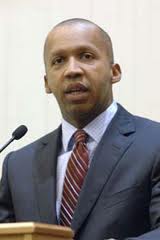
Bryan Stevenson’s Amazing Advocacy for Justice      


Bryan Stevenson
Bryan Stevenson

Now based in Montgomery, Alabama, Bryan Stevenson is conducting amazing advocacy for racial justice in many different ways: as an attorney for individuals who have been victimized by the U.S. criminal justice system; as the founder of a non-profit human rights organization (the Equal Justice Initiative (EJI)) devoted to those causes; as an author and speaker; and as the creator of various ways to honor his predecessors who strove for justice and the victims of injustice. Let us review these ways in which Stevenson demonstrates his advocacy after looking at his biography.

Stevenson’s Biography

 He was born in 1959 in Milton, Delaware and grew up in a poor rural community. Attending a “colored school” for his early years, he graduated from a racially integrated public high school and then Eastern College (now Eastern University), a Philadelphia “Christian university dedicated to the preparation of . . . students for thoughtful and productive lives of Christian faith, leadership and service.” He then attended and obtained a J.D. degree from the Harvard Law School; and a Masters in Public Policy degree from Harvard’s John F. Kennedy School of Government.

Stevenson is an attorney and the Founder and Executive Director of EJI, which specializes in advocacy for children in adult prisons, death-row inmates, prison and sentencing reform and combating race and poverty (. He also is a Professor of Clinical Law at NYU School of Law.

In 1995 he received a “genius” grant from the MacArthur Foundation, which said that in his “drive to expose biases under which capital punishment is imposed, Stevenson has articulated how its use is linked to race and class discrimination and to systemic defects in criminal procedures.”

In 2000 Stevenson was awarded Sweden’s Olof Palme Prize. The award stated he is “a courageous representative of all the individuals, women and men from the entire world, who have maintained tirelessly that the right to life cannot be controverted, that the death penalty is an ultimate form of torture, and that the state does not have the right to kill its citizens.”

Stevenson, the Attorney

In 2015 EJI attorneys won the release of innocent people on death row or in prison for life. They also were successful in obtaining new trials for people illegally convicted and relief for those unfairly sentenced. They have documented and challenged abusive conditions of confinement in state jails and prisons. They have continued to fight against prosecution of children in adult courts and to obtain new sentences for individuals who have been sentenced to life in prison for crimes committed when they were children.

EJI’s work does not end when a client is released from prison. It provides them with re-entry assistance, including housing, employment, training and support. Its Post-Release Education and Preparation Program has been recognized as a model for such programs by various state officials.

Stevenson The Author

 Stevenson’s 2014 best-selling book, “Just Mercy: A Story of Justice and Redemption,” provides interesting accounts of some of the significant cases in which he and EJI have been involved to provide context for a general discussion of particular problems in the American criminal justice system.

For example, Chapter Sixteen, “The Stonecatchers’ Song of Sorrow,” opens with brief discussions of Stevenson’s 2010 victory in the U.S. Supreme Court, when it decided that it was unconstitutional to impose life sentences without parole on children convicted of non-homicide crimes, and in 2012 when the Court held the same was the case when the crime was homicide. The chapter’s footnotes provide citations to these Supreme Court decisions and other mentioned cases.

Chapter Twelve, “Mother, Mother,” is another example. It recounts the trial and unjust conviction of a mother for murdering her stillborn child and sentenced to life without parole. Stevenson and EJI then entered her case and eventually obtained her release from prison. This case is then used as a platform to discuss the many problems created by incarcerating women with more details in footnotes.

The book also tells of instances in which Stevenson is touched, emotionally and spiritually, by clients who are in prison.

In the Introduction, for instance, Stevenson as a 23-year old law student was panicked and nervous when he visited a Georgia death-row inmate, who was immediately happy to learn that he would not have an execution date the next year and then gently led Stevenson into a three-hour general conversation. When the inmate was being returned to his cell, he started singing a black spiritual hymn: “I’m pressing on, the upward way. New heights I’m gaining, every day. Still praying as, I’m upward bound. Lord, plant my feet on higher ground.” Stevenson confesses that this hymn was “a precious gift” and that the prisoner gave him “an astonishing measure of his humanity” and an altered “understanding of human potential, redemption, and hopefulness.”

This and other experiences with death-row prisoners that summer constituted “proximity to the condemned and incarcerated [that] made the question of each person’s humanity more urgent and meaningful” and led to Stevenson’s being “committed to helping the death row prisoners.”

In addition, the book concludes with the “Author’s Note,” in which Stevenson seeks to recruit others to the cause of racial justice, He says, “there are endless opportunities for you to do something about criminal justice policy or help the incarcerated or formerly incarcerated.” An invitation then is extended for the reader to contact EJI for more information.

This book has received great reviews, has been a New York Times Bestseller and has won the Andrew Carnegie Medal for Excellence, an NAACP Image Award and the Dayton Literary Prize for Nonfiction.

Stevenson The Speaker

A prior post mentioned Stevenson’s then forthcoming presentation at Minneapolis’ Westminster Town Hall Forum. I attended this event even though I had never heard of him and thought his presentation would be a legal analysis of the changes needed in the American criminal justice system. Instead it was an emotional, passionate call for such reform and more of a sermon than a legal discussion. At the halfway point, the moderator, Rev. Timothy Hart-Andersen, said that in his many years as the moderator of the Forum he had never heard such a moving presentation.

Nine months later I watched his televised conversation with Charlie Rose. “An Hour with Bryan Stevenson,” Charlie Rose Show (Aug. 19, 2015), when he was just as impressive. Here are some of his pithy, insightful comments:

  • “Everyone is more than the worst thing he or she has ever done.”
  • “No matter what you’ve done, your life matters or has value.”
  • “All lives matter.”
  • “All lives have equal value.”

Another example of Stevenson as a speaker is his TED Talk of March 2012,“We need to talk about an injustice.”

EJI’s Other Racial Justice Efforts

Over the last four years EJI has published major reports about the domestic slave trade, Slavery in America; and racial lynchings, Lynching in America; its third report was released in late 2015:The Anti-Civil Rights Movement. Excerpts from all of these reports are provided in EJI’s educational 2016 Calendar. For example, the month of October focuses on “Racial Terror Lynchings” with a large photograph of a crowd watching an 1893 Texas lynching and with this comment on October 5th: “1920: A mob lynches four black men in Macclenny, Florida, seizing three from the county jail and shooting the fourth dead in the woods.” EJI also has produced a film, From Slavery to Mass Incarceration.[1]

In addition, EJI has erected historic markers about the domestic slave trade in its home base in Montgomery, Alabama and is working on a national memorial in the city about American racial inequality and lynchings. Its first historical marker about Lynching in America recently was erected in Brighton, Alabama pursuant to a plan to place such markers at every lynching site in the country.

EJI’s office building in Montgomery is the site of a former slave prison and close to the city’s slave market. In late 2016 it plans to convert part of its building to a museum about the history of racial inequality in America and the connections between slavery and mass incarceration. EJI also uses its building to host programs and presentations about its work and the need for reforming the criminal justice system while similar presentations are made by its staff at colleges, universities, churches, community groups, high schools and conferences.

An insight to such programs has been provided by Jim Wallis, the leader of Sojourners, a Christian social justice organization, who along with 50 other faith leaders attended a two-day program at EJI in December 2015. Stevenson emphasized to this group these preconditions for reforming the American criminal justice system: (1) proximity to those most impacted by the system; (2) changing the narrative; (3) replacing hopelessness with hope; and (4) committing ourselves to uncomfortable things.[2]

These messages were made flesh by the Wallis group’s making pilgrimages to two sites where black men had been lynched, digging up dirt from those sites and placing the dirt in glass jars marked with the individuals’ names, birth and death years and the names of the lynching sites (part of EJI’s Soil Collection Project) and then holding prayer services in memory of the individuals. Another moving experience for the Sojourners group was spending time with Mr. Anthony Ray Hinton, who had spent 30 years in solitary confinement on death row in Alabama for a crime he did not commit. Stevenson’s concluding message for the group: “I have always had to believe in things I haven’t seen.”

Conclusion

What an amazing human being! What amazing efforts for social justice! I give thanks to God for this amazing servant!

=============================================

[1] EJI, Annual Report 2015.

[2] Wallis, It’s Never Too Late to Do Justice, Sojourners (Dec. 17, 2015) EGI, EGI Hosts Sojourners Faith Table Retreat (Dec. 16, 2015). Willis was a speaker at the Westminster Town Hall Forum in 2010 and will be returning on February 4, 2016 to discuss “America’s Original Sin: Racism and White Privilege,” the title of his book being published today. In a Foreward to the book, Stevenson says , “the mainstream church has been largely silent or worse“ to “our nation’s historical failure to address the legacy of racial inequality, the presumption of guilt and the racial narrative that created it.” Moreover, the church has been complicit in the refusal “to commit ourselves to a process of truth and reconciliation” and the emergence of “new forms of racial subordination.” Indeed, according to Stevenson, “Christianity is directly implicated when we Christians fail to speak more honestly about the legacy of racial inequality.”


Reflections on Learning and Teaching

As a student of history, economics, political science, law and other humanities courses at six colleges and universities[1] and as an instructor at three such institutions,[2] I have participated in different ways of instructing and learning such bodies of knowledge and skills: college and university lectures, other lectures; seminars, research and writing; tutorials; the Socratic method; and role-playing. Similar methods were used in my practice as a litigating attorney and now as a blogger and ordinary citizen. Underlying all of them, of course, are reading and studying. Here are a septuagenarian’s lessons in life-long learning.

My thinking about this subject and writing this blog post were prompted by a recent article about the lecture as a mode of instructing and learning. That article by Molly Worthen, an Assistant Professor of History at the University of North Carolina, Chapel Hill, was put into a broader context by her quoting John Henry Newman’s “The Idea of a University,” where he said the humanities taught a student “to disentangle a skein of thought, to detect what is sophistical, and to discard what is irrelevant.” Such a student learns “when to speak and when to be silent. He is able to converse, he is able to listen.”[3]

College and University Lectures

“A good lecture class,” Worthen says, teaches “comprehension and reasoning” by keeping “students’ minds in energetic and simultaneous action.” It does so by emphasizing “the art of attention, the crucial first step in … ‘critical thinking.’” She quotes Monessa Cummins, the Chair of the Classics Department at Grinnell College, my alma mater, as saying the lecture places “a premium on the connections between individual facts . . . [and] the building of an argument.”

This is “hard work” for the students, Worthen adds, requiring them “to synthesize, organize and react as they listen.” Indeed, students need to be taught how to listen, and lecture courses are exercises in “mindfulness and attention building.” This skill cannot be assumed, but must be taught. One way of doing so, in Professor Cummins’ classes, is to assign one student in each session to present a critique of her argument at the subsequent small discussion section.

Such a lecture course teaches that “listening is not the same thing as thinking about what you plan to say next–and that critical thinking depends on mastery of facts, not knee-jerk opinions.“

This is enhanced, Worthen argues, by requiring the students to take notes by hand, not by typing them into a computer. The former makes it impossible for them to make verbatim transcripts of the lecture, but instead to synthesize as they listen. That may be true, in my opinion, when the lecturer does not provide the students or audience with an outline of the lecture.

Lecturing, on the other hand, with a PowerPoint outline and providing the students or audience members with the Notes Page version of the outline enables the student to glance at the entire presentation in advance and see how the individual points fit into the entire lecture or presentation and then add his or her notes to individual pages as the lecture proceeds. PowerPoint also facilitates the use of graphs, maps and photographs in the lecture. [4]

Worthen also recognizes the utility of combining a large lecture session with small discussions sections and thereby obtain the reactions and comments of the students.

My memories of my first exposure as a student to lecturing 58 years ago as a freshman at Grinnell College are fuzzy at best, but I do not recall being provided with tips on how to take full advantage of this form of instruction. I now wish I had been told how to listen, to be mindful and to synthesize as I listened. I wish I had had a professor assign one student in each session to present a critique of the lecture’s argument at the next class session. Of course, then all notes of a lecture were handwritten.

As a student of Philosophy, Politics and Economics (PPE) at the University of Oxford, 1961-1963, attendance at university lectures on these subjects, often by world-famous scholars, was optional. I attended some primarily to see and hear such people as philosophers A. J. Ayer and Gilbert Ryle, economist J. R. Hicks and legal philosopher H. L. A. Hart, but regrettably I did not regularly do so. (Instead my attention was focused on tutorials as discussed below.)

As a law student at the University of Chicago, 1963-1966, the Socratic method was the dominant form of instruction, not lectures. The latter instead were formal occasions for all the students and faculty, usually provided by visiting scholars and judges. (The Socratic method also will be discussed below.)

In addition, I was a lecturer when I taught a course on the American Civil Law System at Grinnell while on sabbatical leave from my law firm, when I was a Practitioner in Residence at the University of Iowa College of Law, when I was an Adjunct Professor at the University of Minnesota Law School and when I was on the faculty of various continuing legal education courses while I was a practicing lawyer. That experience required me to review the material to be covered, to conduct any additional research I deemed necessary, to determine the main points to emphasize, to construct an outline for what I wanted to cover in the lecture and, in some cases, to prepare a PowerPoint presentation for use at the lecture.

Other Lectures

All of us obtain information and are educated, or not, in other oral presentations throughout our lives. I think of major political speeches like the State of the Union and Inaugural Addresses; other speeches at public events; and sermons at churches.

When, for example, I listen to speeches or presentations at the Westminster Town Hall Forum, I sometimes take handwritten notes and submit proposed questions for the moderator to ask the speaker. Later I also can go to the Forum’s website to re-listen to the speech. I also have written blog posts about some of these presentations. Another recent source of lectures for me is those offered by the Osher Lifelong Learning Institute (OLLI) of the University of Minnesota.

For sermons at Westminster Presbyterian Church, I sometimes make handwritten notes of some of the points on the church bulletin in my hands while the morning prayer, hymns and choral anthems usually emphasize some of the sermon’s main points. I also have found that I learn more about the sermon’s lesson by reading its text when it is subsequently posted on the church’s website and by reading and reflecting on the Scripture passages for the sermon; additional insight is often providing by writing a blog post about a sermon.

Seminars

My best educational experience at Grinnell College was taking the Political Economy Seminar my senior year with nine other students and with faculty from the economics, history and political science departments. We read important books in the field, not textbooks, and wrote and presented our papers on the former for discussion by all.

The Washington Semester at American University in the Fall of 1959 provided another type of seminar experience as a group of students from all over the U.S. met with politicians, government officials and others to learn about the operations of the U.S. government and political process.

I also organized and led a liberal arts seminar for lawyers at Grinnell in 1984. After reading various materials, we gathered at the College to discuss American legal history, alternative dispute resolution (ADR), jurisprudence and the lives and challenges of being humane judges and lawyers. Our leaders were a federal appellate judge, a national ADR scholar, an American history professor, a jurisprudence professor and a practicing lawyer.

Being in a book group, for me at Westminster Presbyterian Church, is another seminar experience for groups of 12 or smaller. Reading an assigned book and then gathering for a discussion of the book led by one of the group usually leads to a greater understanding of the book and its issues. For example, I recently led my group in discussing David Brooks’ “The Road to Character” after I had written about the book in this blog.[5]

Research and Writing

During my student years I conducted factual and other research about various subjects and in the process learned a lot about those subjects as well as research skills. The task of then reducing that research into a paper on the subject provided more learning about the subject plus the process of writing such papers. Later as a practicing lawyer these skills were further developed with the aid of the legal process for obtaining evidence in lawsuits, including the examination of witnesses, and the writing of briefs and other legal papers under rules for their contents and length.

The student research paper I best recall was at American University. The topic was how political interest groups participate in important cases in the U.S. Supreme Court and more specifically in contempt-of-congress cases in that court. I identified such cases, read the Court’s opinions in the cases, interviewed staffers at the relevant congressional committees (especially the House Un-American Activities Committee) and at the relevant political interest groups (especially the American Civil Liberties Union and the American Association of University Professors) and then spent a lot of time at the Supreme Court’s Library reading the briefs in the case, including those from the ACLU and the AAUP as amici curiae (friends of the court). The paper summarized this research and conclusions.

My enjoyment of research and writing continued as a practicing lawyer, both in my work as a lawyer and as a putative scholar. For example while at Harvard Law School for a short summer course, I spent time in its library doing research about Joseph Welch and Edward Burling, both prominent attorneys who were graduates of that Law School and of Grinnell College, and interviewing attorneys at Welch’s Boston law firm, about his representation of the U.S. Army in the McCarthy hearings of 1954. Later I wrote articles about both of them for the Grinnell Magazine [6] and even later with excerpts from the Welch article in this blog.[7]

A similar process was involved as a law student in researching and writing comments for the law review and as a lawyer in writing briefs.

Grinnell College recently has enhanced its use of research and writing as an educational method by adding a public website, The Grinnell Post, that hosts student essays about current events, public debates, and issues of interest to the Grinnell community. Its mission is to allow students to share their work in a public forum and foster conversations with a diverse readership and solicit their comments and criticism.

Another Grinnell effort to incorporate digital technology in the liberal arts is a website, Ashplan, initially devoted to James Joyce’s Ulysses. It seeks to foster the inheritance of classroom culture; that is, it forges connections among students studying the same material at different times, allowing new students to benefit from, remix, and add to the work of their predecessors.

Tutorials

As discussed in a prior post, the tutorial was the primary mode of undergraduate education at Oxford. During each week of the three terms of the academic year, I would have two tutorials, usually with only one other student and the tutor and sometimes only by myself with the tutor. The assignment was always in the form of a question with the tutor’s suggestions of books and articles one should read.

As a result, most of my time each week at Oxford was spent in the university libraries reading those sources and other relevant materials, figuring out how I would answer the assigned question and writing an essay setting forth that answer and analysis. Then I would see the tutor again and read my essay for critiquing and discussion.

I loved the independence of this system and being “forced” to come to a conclusion on an issue and to construct my own analysis and documentation for my conclusion. This was exactly the skill that was tested in Oxford’s university-wide examinations at the conclusion of my student-years, as also discussed in a prior post.

Grinnell College now has a First-Year Tutorial for all freshmen in groups of about 12 students that are led by “faculty members . . . from all academic departments . . . in more than 35 topics.” For the Fall of 2015 these include “Crisis, Liberation, Justice, and Leadership;“ “Racism: Color, Culture, Class; “ and “The Origins of Capitalism.” Every tutorial emphasizes writing, critical thinking and analysis, and oral presentation and discussion skills. The tutorial professors also serve as the advisers to their tutorial students until they declare a major field of study.

Socratic Method

After the treasured independence of the Oxford undergraduate experience, I initially was shocked in my first weeks in the Fall of 1963 as a student at the University of Chicago Law School. Now I was in large classes with daily assignments of certain pages in our large casebooks. The professors did not lecture. Instead they cross-examined individual students, one-by-one, about what the holding of a particular case was and what the result should be in a hypothetical case. We were being taught, we were told, how to think like a lawyer.

This method clearly taught you how to read a judicial opinion very carefully (and very painfully and slowly during that first semester of law school), to analyze that opinion to determine what its holding was and to think about the arguments that could be raised in similar, but different, hypothetical cases. Then in class you had to learn how to think on your feet and respond to questions from the professor as you would later do as a lawyer when questioned by a judge.

Reading and analyzing constitutions, statutes and regulations are also important for a lawyer, but I do not have clear memories of how that was done in my law student years. Of course, many judicial opinions concern judicial interpretations of such materials, and the overall law-school emphasis on reading and analyzing judicial opinions covered that methodology.

Learning how to do legal research and write legal briefs is another important part of law school. In addition, being a member of a law review staff and editorial board gives experience in writing and editing articles about legal topics.

Role-Playing

Participating in moot courts and playing the role of a lawyer making an argument to a court is another prominent method of legal education. I did not take advantage of this opportunity in law school as I was busy working on the law review doing legal research and writing and editing articles for the journal.

I, however, employed this method when I taught for one semester at Grinnell while on sabbatical leave from my law firm. I acted as a trial court judge hearing arguments by students as lawyers on a motion to compel production of a college tenure committee records in a hypothetical lawsuit brought by a professor against a college for denial of tenure. A different kind of role playing in that course was having the students, in lieu of a final examination, play the role of a justice of the Iowa Supreme Court and write an opinion deciding a case after reading the briefs in the case along with my memoranda summarizing some of the legal issues and after hearing the case argued before the actual Court.

I also used the moot-court method when I was an adjunct professor at the University of Minnesota Law School; I acted as a federal district court judge hearing arguments on a motion to dismiss a complaint under U.S. federal statutes (the Alien Tort Statute and the Torture Victims Protection Act) alleging a corporate defendant’s violations of human rights in other countries. I also acted as a judge of an immigration court to hear arguments on whether the court should grant an application for asylum by someone who allegedly had a well-founded fear of persecution in his or her home country due to political opinion or other protected ground.

I used a different kind of role-playing when I was a Practitioner in Residence at the University of Iowa College of Law. In a first-year civil procedure class, I played the role of a law firm partner while the students played the roles of associate attorneys working for me as we collectively identified issues, potential arguments and additional legal research needed for preparing a civil complaint under the strictures of Rule 11’s requiring such a pleading to be warranted by existing law or a non-frivolous argument for changing the law and by evidentiary support.

In such role-playing exercises, the student learns about procedural and substantive law, identification of legal and evidentiary issues and how to write and analyze briefs and make oral arguments.

In my experience, this is an effective way of learning several areas of law plus the skills of advocacy, and most students appreciate these opportunities to have a taste of what it is like to be a lawyer.

Conclusion

I am fortunate to have experienced different methods of teaching and learning from able practitioners of the different methods. I have learned in each of these settings and cannot say one is better than another. A lot depends on the size of the audience and the stage of your educational career. Seminars and tutorials require a small number of students while lectures are more appropriate, if not required, for a large number of students. I hope that I have been able to convey the same excitement of learning when I have been the instructor.

==============================================

[1] Grinnell College, 1957-1961; American University (Washington Semester), 1959; University of Oxford, 1961-1963; University of Chicago Law School, 1963-1966; Harvard Law School (Summer Program), 1986; and University of Minnesota Law School, 2001.

[2] Grinnell College, 1982, 1984; University of Iowa College of Law, 1986; and University of Minnesota Law School, 2002-2010.

[3] Worthen, Lecture Me. Really, N.Y. Times Sunday Review (Oct. 18, 2015).

[4] Aaron Fichtelberg, an associate professor of criminal justice at the University of Delaware, strongly disagrees on the value of PowerPoint. Indeed, he argues that it “turns good teachers into mediocre ones and mediocre lectures into a sludge of unengaging facts.” According to him, it “forces rigidity on the content of the course and passivity onto the students.” I agree that sometimes such use is boring. But as with all of these modes of teaching, there are the good and the bad. Other opinions?

[5] The Important Moral Virtues in David Brooks’ “The Road to Character” (May 1, 2015); David Brooks’ Moral Exemplar (May 2, 2015); David Brooks Speaks on the Role of Character in Creating an Excellent Life (May 16, 2015).

[6] Good Night, and Good Luck: The Movie’s Offstage Hero, Joseph Welch, Grinnell Magazine, Summer 2006, at 12; Edward Burnham Burling, Grinnell’s Quiet Benefactor, Grinnell Magazine, Summer 2009, at 21.

[7] Joseph Welch Before the Army-McCarthy Hearings (June 14, 2012); The U.S. Army’s Hiring of Attorney Joseph Welch for the Army-McCarthy Hearings (June 8, 2012); Attorney Joseph Welch’s Performance at the Army-McCarthy Hearings (June 6, 2012); U.S. Senator Joseph McCarthy’s Nemesis: Attorney Joseph Welch (June 4, 2012); President Dwight D. Eisenhower’s Involvement in the Army-McCarthy Hearings (June 10, 2012); Joseph Welch After the Army-McCarthy Hearings (June 12, 2012); Legal Ethics Issues in the “Anatomy of a Murder” Movie (June 12, 2012).


David Brooks Speaks on “The Role of Character in Creating an Excellent Life”

Westminster Presbyterian Church
David Brooks @ Westminster

This was the title of David Brooks’ May 14th presentation at Minneapolis’ Westminster Presbyterian Church’s Town Hall Forum. An appreciative audience of over 3,000 filled the Sanctuary and other rooms at the church to hear the talk and demonstrated why he called Westminster his “favorite venue.”[1]

Both the talk and his recent book, “The Road to Character,”[2] emphasize “modesty and humility” and assert that “human beings are blessed with many talents but are also burdened by sinfulness, ignorance and weakness” and that “character emerges from the internal struggles against one’s own limitations.” This at least is what the Syllabus for his “Humility” course at Yale University states. Or as he said in his talk, we are “splendidly endowed, but deeply broken.”

Brooks recalled with gratitude three personal uplifting moments. One was observing his then three young children playing on a beautiful day. Another was watching women in Maryland teaching English to immigrants. The last was sitting at a luncheon next to the Dali Lama and experiencing his inner joy and laughter. These moments produced David’s overwhelming sense of gratitude to have experienced these moments of higher joy, an enlargement of his own heart and an acknowledgement that these had happened to him by the grace of God.

Because issues of morals and character in western culture have been discussed by Christian theologians, his book uses their vocabulary. We need to recover and perhaps modernize that vocabulary, said Brooks, especially to recover the meaning and importance of the concept of sin.

He also mentioned that many contemporary U.S. politicians feel compelled to promote and advertise themselves and as a result start to believe their own propaganda. Exceptions of politicians of modesty and honesty are former Vice President Walter Mondale, a Westminster member who was in the audience; Minnesota’s former U.S. Senator David Durenberger; and current U.S. Senator Amy Klobuchar.

His book provides biographical sketches of how 10 different people in different ways created disciplines that built character. He mentioned the following six of them in his talk.

Ida Stover by age 11 had lost both of her parents and then was an overworked indentured servant in another household, but at age 15 she left to be on her own, to get a job and an education. Later she married David Eisenhower, became Ida Eisenhower and raised five sons, one being Dwight D. Eisenhower. After Ike threw a temper tantrum at age 10, Ida paraphrased Proverbs 16:32 to him: “He that conquereth his own soul is greater that he who taketh a city.”[3] In other words, the central drama of your life is fighting against your own sinfulness and weaknesses. Many years later Ike said this was one of the most valuable moments of his life that helped him to recognize his temper as a weakness and to develop techniques to prevent it from interfering with his leading others.

Frances Perkins was a genteel graduate of Mount Holyoke College who found her vocation of improving worker safety by happening to be a witness to the Triangle Shirt Factory Fire in Manhattan, in which many workers lost their lives. She responded to what the world was demanding of her.

Augustine for many years resisted his mother’s efforts to become a Christian, but after he had done so, the two of them shared a beautiful moment in a garden just before she died when “all the clamors of the world slipped into silence” and were “hushed.”

Dorothy Day, a social activist, near the end of her life started to write her “life remembered,” but could not do so. Instead she “thought of our Lord [Jesus], and His visit to us all those centuries ago, and I said to myself that my great luck was to have had Him on my mind for so long in my life!” Day’s “The Long Loneliness” shows her intense self-criticism, her discovery of her vocation and her humility. It is one of Brooks’ favorite books and also of the students in his Yale course on humility.[4]

George Eliot (born Mary Anne Evans) obtained character through her love for George Lewes, and such love, according to Brooks, humbles a person, making you realize you are not in control of your own life; allows you to express tenderness and vulnerability; de-centers your self; and fuses two individuals together.

Brooks advised the high school students in the audience to make the following commitments by the time they were at least in their mid-30’s: adopting an existing faith or philosophy of life; choosing a vocation; getting married; and choosing a community in which to live. Although he did not say so, these commitments may change during your life.

With respect to the marriage commitment, Brooks quoted this beautiful excerpt from a beautiful wedding toast that was offered by his friend and noted American author, Leon Weiseltiere, to an unnamed couple:

  • “Brides and grooms are people who have discovered, by means of love, the local nature of happiness. Love is a revolution in scale, a revision of magnitudes; it is private and it is particular; its object is the specificity of this man and that woman, the distinctness of this spirit and that flesh. Love prefers deep to wide, and here to there; the grasp to the reach. It will not be accelerated, or made efficient: love’s pace is its pace, one of the fundamental temporalities of mortal existence, and it will not be rushed or retarded by even the most glittering pressures of service or success. Love is, or should be, indifferent to history, immune to it — a soft and sturdy haven from it: when the day is done, and the lights are out, and there is only this other heart, this other mind, this other face, to assist one in repelling one’s demons or in greeting one’s angels, it does not matter who the president is. When one consents to marry, one consents to be truly known, which is an ominous prospect; and so one bets on love to correct for the ordinariness of the impression, and to call forth the forgiveness that is invariably required by an accurate perception of oneself. Marriages are exposures. We may be heroes to our spouses, but we may not be idols.”

The unnamed couple who were thus toasted were (a) Samantha Power, the U.S. Ambassador to the United Nations, the author of the award-winning book, A Problem from Hell: America and the Age of Genocide, and a former Harvard Law School Professor and (b) Cass Sunstein, a Harvard Law School Professor, an acclaimed author and a former aide to President Obama.

======================================================

[1] The audio recording of the speech is available online and later the video of same will be added. . Brooks’ prior appearances at the Forum, also to overflow audiences, are also available online: “The Historic Election of Barack Obama” (Nov. 13, 2008) and “The Social Animal: Hidden Sources of Love, Character, and Achievement” (Mar. 31, 2011).

[2] The recent book was discussed in the following prior posts: The Important Moral Virtues in David Brooks’ “The Road to Character “ (May 1, 2015) and David Brooks’ Moral Exemplar (May 2, 2015). Brooks has created a website about the new book to foster readers’ comments about character.

[3] The Authorized King James Version of Proverbs 16:32 states: “He that is slow to anger is better than the mighty; and he that ruleth his spirit than he that taketh a city.”

[4] The Dorothy Day book is on the 2013 edition of the Syllabus for Brooks’ “Humility” seminar at Yale. The other books on the syllabus as well as the topics covered in the seminar make one wish to be a student again. In light of Brooks’ recent book’s not including biographical sketches of any Jewish people and his comments on that omission to a Jewish critic, it is noteworthy that the Syllabus describes one seminar session as being devoted to Moses, the “most humble man on earth;” the “Jewish formula of character building through obedience to the law;” the “way the rabbinic tradition has interpreted the struggle between internal goodness and the evil urge;” and the Book of Exodus as the reading. The Yale seminar has prompted comments by a student who was in the seminar, criticism of the Syllabus and Brooks’ defense of the seminar.


TODAY on Minnesota Public Radio: Bryan Stevenson’s “Just Mercy: Reforming the Criminal Justice System”

Bryan Stevenson
Bryan Stevenson

Today (November 26th) Minnesota Public Radio will broadcast at Noon (CST) and 9:00 p.m. (CST) Bryan Peterson’s presentation yesterday at the Westminster Town Hall Forum, “Just Mercy: Reforming the Criminal Justice System.” It is great! Listen![1]

I was at the Forum yesterday and heard one of the most inspiring and articulate presentations I have ever heard on any subject. I was expecting to hear a detailed agenda for making legal changes in our criminal justice system. Instead, Stevenson delivered this powerful message to every citizen in this country:

  1. Everyone needs to get closer to the poor people and the incarcerated.
  2. Everyone needs to reflect on the history of racial injustice in our country and change the narrative on race. We need truth and reconciliation on race.
  3. Everyone has to find a way to stay hopeful about changing this injustice. It is not easy. It requires a reorientation of the spirit.
  4. Everyone needs to choose to do uncomfortable things. Go inside prisons, for example. The opposite of poverty is justice, not wealth. The quality of a society is judged by how it treats the poor.

Book

Bryan Stevenson is a public-interest lawyer and founder of the Equal Justice Initiative, which is committed to eliminating bias against the poor and people of color in the criminal justice system. A professor at New York University Law School and a graduate of Harvard Law School, he argued for and won the historic ruling in the U.S. Supreme Court that mandatory life-without-parole sentences for children 17 or younger are unconstitutional. His new book, Just Mercy, profiles the lives of men, women, and children who are at the mercy of a broken criminal justice system.

Stevenson grew up in Alabama. He started school in a “colored school” and only after desegregation of his town’s schools was he able to obtain a high school education. His great-grandparents were slaves, and his parents daily were subjected to humiliation because of their race.

Thank you, Bryan Stevenson for inspiring and challenging us.

[1] An oral recording of the Town Hall presentation is available on the web.


Joseph Welch Before the Army-McCarthy Hearings

Joseph Welch

Joseph Welch suddenly appeared on the national stage in 1954 at the age of 63. Where did he come from? Who was he?

Upbringing

Welch was born on October 22, 1890, on a farm near the tiny Iowa town of Primghar, the youngest of seven children. His parents were poor English immigrants who came to Iowa in a covered wagon from Illinois. As a boy, he often watched trials in the county courthouse and was impressed with a lawyer’s ability to say “Strike that out” and eliminate what had been said. He worked in a real estate office for two years after completing high school to save money for college.

Education

Welch was the straight-A valedictorian of the Primghar High School class of 1908.

Primghar High School
Grinnell College

Welch attended Iowa’s Grinnell College, my alma mater, from 1910 through 1914, obtaining a Bachelor of Arts degree, Phi Beta Kappa (1914). [1]  He majored in economics and political science. He was active in debate and tennis and served as Editor-in-Chief of the College’s annual yearbook.  Welch later observed that Grinnell gave him four important things—an appreciation of literature and the beauty of words, development of speaking abilities, appreciation of music and a chance to dream and explore spiritual issues.

Austin Hall,                  Harvard Law School

Welch then went on to Harvard Law School, 1914 to 1917, receiving a LL.B. degree in 1917.  Welch was second in his class and a member of the staff of the Harvard Law Review and its Book Review Editor. Also on the Review with him were Dean Acheson, later a partner of Edward B. Burling (Grinnell, 1890) and U.S. Secretary of State, and Archibald MacLeish, later known for his poetry.

Legal Career

After a brief period as a private in the Army near the end of World War I and as a lawyer for the U.S. Shipping Board in Washington, D.C., where Mr. Burling was his supervisor, Welch started practicing law with the Boston firm of Hale and Dorr in 1919. He became a junior partner almost immediately and soon was the firm’s primary trial attorney. He handled all kinds of civil cases in state and federal courts in New England. He particularly liked antitrust cases (for the defense), libel cases (for the plaintiff), will and estate cases and tax cases. He came to be known as a “lawyer’s lawyer” and for his skill in cross-examination.

The Sacco-Venzetti Case

Vanzetti & Sacco

The public emotions over Senator McCarthy were presaged for Welch by the Sacco-Vanzetti case in Boston just as Welch was starting the practice of law in that city. In 1920-21, two Italian anarchists living in Boston, Nicola Sacco and Bartolomeo Vanzetti, were indicted, tried, convicted and sentenced to death by a Massachusetts trial court for murdering a factory paymaster and his guard. There was a widespread belief that they were convicted because of their political opinions, rather than committing the murders. As a result, there were protests in the U.S. and throughout the world. Such protests continued until and after their executions in 1927. It was the cause célèbre of the time.

Prof. Felix Frankfurter

Felix Frankfurter, then Professor at the Harvard Law School, chaired the Sacco-Vanzetti Defense Fund, and Welch as a young lawyer in Boston apparently helped to raise money for the fund.  In the year before the executions, Welch’s friend and law firm colleague, Herbert Ehrmann, became one of the lawyers representing Sacco and Vanzetti, and Welch also knew another of their attorneys as well as the trial judge. As a result, Welch was very close to the case although he did not participate himself.

This case, Welch later said, “tortured” him. The trial judge was “an awful damned fool.” Sacco and Vanzetti, in Welch’s opinion, had not received a fair trial, and Welch had grave doubts about their guilt. The night the two men were executed shattered him, and the case tormented him for the rest of his life. As a result, Welch became an opponent of capital punishment.

Family Life

In September 1917 Welch married Judith Lyndon. They had two sons, Joseph Nye, Jr. and Lyndon, both of whom became engineers.


[1] I heard Welch speak at Grinnell College in the Fall of 1957, but I was too shy to introduce myself to him and engage him in conversation. Later I conducted research about Welch. Two of Grinnell’s other notables—Hallie Flanagan, the Director of the Federal Theatre Project in the New Deal, and Harry Hopkins, the head of the Works Progress Administration in the New Deal and an aide to President Franklin D. Roosevelt—were also Grinnell students at the same time as Welch. It would be interesting to find out whether Welch had any contacts with Hopkins or Flanagan during their college years or afterwards.