A prior post discussed the July 31, 2012 U.S. report on international terrorism that was followed by another post with an extensive analysis of what I believe to be the ridiculous U.S. designation of Cuba as a “State Sponsor of Terrorism.”
At least one of the Cuban-Americans in Congress, however, strongly defends that designation.
U.S. Rep. Ileana Ros-Lehtinen (Republican of Miami, Florida), Chairman of the House Foreign Affairs Committee, said this designation “reaffirms . . . [Cuba’s] threat to our national security. The Castro brothers are well known for their avid and long-term support for radical insurgent groups throughout Latin America, including their close ties to fellow despots in Iran, Syria, and Sudan who are also state sponsors of terrorism.” She continued, “It is disconcerting that this Administration is hell-bent on engaging the dictators in Havana despite its own reports illustrating the threat posed by the Castro regime. These thugs in Cuba have never and will never respond to friendly diplomatic gestures and continue to work to spread their anti-American propaganda worldwide.” She urged “President Obama to realize the failure of his Cuba policy and to stop appeasing the Castro brothers. It has not worked and it will not work. The suffering of an entire nation demands a change of course.”
Representative Ros-Lehtinen’s comments, I submit, are not persuasive for the reasons provided in the prior post.
Moreover, the U.S. population of 313.8 million is over 28 times larger than Cuba’s of 11.1 million. Our Gross Domestic Product (purchasing power) of $ 15.3 trillion is 134 times as large as Cuba’s of $114.1 billion. Our annual defense expenditures of $703 billion (purchasing power) is over 134 times larger than Cuba’s of $ 4.3 billion, and Cuba’s military equipment suffers from lack of replacement parts while we all know about U.S. military capabilities’ exceeding the rest of the world combined. And our land mass is over 88 times larger than Cuba’s (9,827,000 sq. km. vs. 111,000 sq. km.). (These comparisons are based on public statistics published by our CIA.)
Cuba is not a threat to U.S. national security. Congresswoman Ros-Lehtinen, your saying so does not make it so.
The Congresswoman’s comments, however, do underscore the political problems associated with rescinding the designation of Cuba as a “State Sponsor.” In a presidential election year in which the State of Florida is an important factor, the conventional political wisdom is that Cuban-Americans in Florida are very important to the election results in that state and that they (like their Congresswoman) support harsh measures against Cuba. Although there are signs that many younger Cuban-Americans in Florida and elsewhere do not agree with such harsh measures, it certainly would be more politically difficult this year for the Obama Administration to rescind the “State Sponsor” designation of Cuba.
Such a decision is made even more difficult by provisions of Section 6 (j) (4) of the Export Administration Act (50 U.S.C. § 2405(j)(4)) that impose restrictions on any Administration’s rescission of any such designation:
The President may rescind such a designation by submitting a report to Congress certifying that there has been a fundamental change in the leadership and policies of the country’s government, that its government is not supporting acts of international terrorism and that its government is providing assurances that it will not support such acts in the future.
Alternatively the President may rescind such a designation by submitting a report to Congress, at least 45 days in advance, justifying the rescission and certifying that the government has not provided any support for international terrorism during the preceding six-months and has provided assurances that it will not support such acts in the future.
If Congress disagrees with the President’s decision to remove a country from the list, of course, it could seek to block the rescission through legislation.
Perhaps this blog’s previous fact-based analysis of the absurdity of the continuation of the Cuba designation is beside the point. Perhaps the continuation is yet another sign of the dysfunctionality of the U.S. Government.
On July 31, 2012, the U.S. Department of State issued its annual report on terrorism in the world: Country Reports on Terrorism 2011. A prior post reviewed the report as a whole.
U.S. FlagCuba Flag
We now examine this report‘s designation of Cuba as a “State Sponsor of Terrorism,” i.e., as a country that has “repeatedly provided support for acts of international terrorism.” This post’s analysis is also informed by the previous U.S. reports on terrorism for 1996, 1997, 1998, 1999, 2000, 2001, 2002, 2003, 2004, 2005, 2006, 2007, 2008, 2009 and 2010.[1] Earlier posts analyzed and criticized the reports for 2009 and 2010.
Preliminarily I note that the latest report says that 480 of the 10,283 terrorist attacks in 2011 occurred in the Western Hemisphere and that “the vast majority of . . . [these] were ascribed to the Revolutionary Armed Forces of Colombia (FARC).” There is no mention of Cuba in this statistical summary.
Nor is there any mention of Cuba in the latest report’s “Strategic Assessment” that puts all of its discussion into a worldwide context. Instead this section of the report highlights the death of Osama bin Laden and other top leaders of al-Qa’ida as putting its “network on a path of decline that will be difficult to reverse.” Others specifically mentioned in this Assessment were Iran, terrorists groups in South-Asia, the Kurdistan Workers Party in Turkey, anarchists in Greece and Italy, dissident Republican groups in Northern Ireland and Anders Behring Breivik (the Norwegian right-wing extremist who killed 77 people last July).
Cuba As an Alleged Safe Haven for Terrorists
The first stated basis for designating Cuba as a “State Sponsor of Terrorism” is its allegedly providing safe havens to individuals associated with two U.S.-designated Terrorist Organizations–Spain’s Basque Fatherland and Liberty (ETA) and the Revolutionary Armed Forces of Colombia (FARC)–and to certain fugitives from U.S. criminal proceedings. Here are direct quotations of the report on these points:
“Current and former members of . . . ETA continue to reside in Cuba. Three suspected ETA members were arrested in Venezuela and deported back to Cuba in September 2011 after sailing from Cuba. One of them, Jose Ignacio Echarte, is a fugitive from Spanish law and was also believed to have ties” to the FARC.
“Press reporting indicated that the Cuban government provided medical care and political assistance to the FARC.”
“The Cuban government continued to permit fugitives wanted in the United States to reside in Cuba and also provided support such as housing, food ration books, and medical care for these individuals.”
Before we examine some details about these charges, it must be said that the speciousness of this charge about ETA and FARC is shown by the latest U.S. terrorism report itself. It has a separate chapter on the legitimate international problem of terrorist safe havens as “ungoverned, under-governed, or ill-governed physical areas where terrorists are able to organize, plan, raise funds, communicate, recruit, train, transit, and operate in relative security because of inadequate governance capacity, political will, or both.” The report then identifies such havens in different parts of the world. For the Western Hemisphere, it discusses Colombia, Venezuela and the Tri-Border Area (where Argentina, Brazil and Paraguay come together). But there is no mention whatsoever of Cuba.
Earlier U.S. reports provide another reason for discounting these charges. They admit that “Cuba no longer supports armed struggle in Latin America and other parts of the world” (1996, 1997, 1998, 2008, 2009 reports) and that there was no evidence that Cuba had sponsored specific acts of terrorism (1996, 1997 reports). They also report that in 2001(after 9/11) Cuba “signed all 12 UN counterterrorism conventions as well as the Ibero-American declaration on terrorism” (2001, 2002, 2003 reports).
Let us now examine details about each of these specific assertions about alleged safe haven which have been made by the U.S. since at least 1996.
1. ETA
The weakness of the U.S. charge regarding ETA implicitly is admitted by the latest report itself when it states there “was no indication that the Cuban government provided weapons or paramilitary training for” ETA. Similar admissions were made in the U.S. reports for 2005 (“no information concerning terrorist activities of [ETA] on Cuban territory”); 2008 (“no evidence of . . . terrorist financing activities”); 2009 (“no evidence of direct financial support”); 2010 (“no evidence of direct financial or ongoing material support”).
In addition, the latest U.S. report adds that there is evidence”[suggesting ] that the Cuban government [in 2011] was trying to distance itself from ETA members living on the island by employing tactics such as not providing services including travel documents to some of them.”
Earlier U.S. reports also reflect the limited nature of this charge. There allegedly were only 20 ETA members living in Cuba (2001 report), some of whom may be there in connection with peace negotiations with Spain (2009 report). In May 2003, Cuba publicly asserted that the “presence of ETA members in Cuba arose from a request for assistance by Spain and Panama and that the issue is a bilateral matter between Cuba and Spain” (2003 report). In March 2010 Cuba “allowed Spanish Police to travel to Cuba to confirm the presence of suspected ETA members” (2010 report).
Moreover, in March 2011 the Spanish Ambassador to Cuba told former U.S. President Jimmy Carter that Spain was “not concerned about the presence of members of . . . ETA . . . in Cuba.” Indeed, the Ambassador maintained that this enhances his country’s ability to deal more effectively with ETA. In fact, the Ambassador added, some ETA members are there at the request of the Spanish government.
2. FARC
Again the new U.S. report implicitly admits the weakness of its FARC allegations by the report’s stating there “was no indication that the Cuban government provided weapons or paramilitary training for” FARC. Similar admissions were made in the U.S. reports for 2005 (“no information concerning terrorist activities of [FARC] on Cuban territory”); 2008 (“no evidence of . . . terrorist financing activities”); 2009 (“no evidence of direct financial support”); 2010 (“no evidence of direct financial or ongoing material support”).
In addition, the 2008 report said in July of that year “former Cuban President Fidel Castro called on the FARC to release the hostages they were holding without preconditions. He has also condemned the FARC’s mistreatment of captives and of their abduction of civilian politicians who had no role in the armed conflict.”
There is no indication in the reports of the number of FARC members allegedly in Cuba, but some may be there in connection with peace negotiations with Colombia (2009 report).
Moreover, in March 2011 the Colombian Ambassador to Cuba told former U.S. President Jimmy Carter that Colombia was “not concerned about the presence of members of FARC . . . in Cuba.” Indeed, the Ambassador maintained that this enhances their ability to deal more effectively with FARC.
3. U.S. fugitives
There apparently were or are over 70 individuals living in Cuba who are fugitives from criminal charges in U.S. relating to violent acts in the 1970’s purportedly committed to advance political causes, but pursuant to a 2005 Cuban government statement, no additional U.S. fugitives have been permitted on the island. In a few instances Cuba has extradited such fugitives to the U.S. (2001, 2003, 2004, 2005, 2006, 2007, 2008, 2009 reports).
None of these fugitives apparently is affiliated with U.S.-designated terrorist organizations. The issue of whether or not they will be extradited to the U.S. is an appropriate issue for bilateral negotiations between the two countries. But, in my opinion, it is not a legitimate basis for designating Cuba as a “State Sponsor of Terrorism.”
Cuba’s Alleged Financial System Deficiencies
The other asserted ground in the latest U.S. report for the designation of Cuba as a “State Sponsor of Terrorism” is new.
This other ground is Cuba’s having been identified by the Financial Action Task Force (FATF) as “having strategic AML/CFT [Anti-Money Laundering/Combating the Financing of Terrorism] deficiencies. Despite sustained and consistent overtures, Cuba has refused to substantively engage directly with the FATF. It has not committed to FATF standards and it is not a member of a FATF-style regional body.”
According to its website, FATF “is an inter-governmental body established in 1989 by the Ministers of its Member jurisdictions. [Its] . . . objectives . . . are to set standards and promote effective implementation of legal, regulatory and operational measures for combating money laundering, terrorist financing and other related threats to the integrity of the international financial system. The FATF is therefore a ‘policy-making body’ which works to generate the necessary political will to bring about national legislative and regulatory reforms in these areas.” Thus, it apparently is a voluntary international organization, not one established by a multilateral treaty.
FATF currently has 34 member jurisdictions (or only about 18% of the U.N. member states) plus 2 regional organizations (the European Council and the Gulf Co-Operation Council) representing most major financial centers in all parts of the globe.
Starting in 1990,”FATF has developed a series of Recommendations that [it claims] are now recognised as the international standard for combating of money laundering and the financing of terrorism and proliferation of weapons of mass destruction. They form the basis for a co-ordinated response to these threats to the integrity of the financial system and help ensure a level playing field. First issued in 1990, the FATF Recommendations were revised in 1996, 2001 [additional measures regarding terrorist financing], 2003 and 2012 to ensure that they remain up to date and relevant, and they are intended to be of universal application.”
To this end, FATF promotes the global adoption and implementation of the FATF Recommendations.
In June 2012 FATF issued a Public Statement that identified Iran and the Democratic Republic of Korea [North Korea] as jurisdictions “subject to a FATF call on its members and other jurisdictions to apply counter-measures to protect the international financial system from the on-going and substantial money laundering and terrorist financing (ML/TF) risks emanating from [these] . . . jurisdictions.”
The June 2012 Statement also listed 18 other countries, including Cuba, as jurisdictions “with strategic AML/CFT deficiencies that have not made sufficient progress in addressing the deficiencies or have not committed to an action plan developed with the FATF to address the deficiencies. The FATF calls on its members to consider the risks arising from the deficiencies associated with each jurisdiction.”
The latest U.S. terrorism report made an important concession on this point by noting that in 2011 Cuba “did attend a [FATF] meeting on Money Laundering in South America meeting as a guest and prepared an informal document describing its anti-money laundering/counterterrorist financing system.” But this U.S. concession did not go far enough, for the June 2012 FATF Statement said, “Since February 2012 Cuba has officially engaged with the FATF and has also attended [the meetings of the relevant regional organizations] CFATF [Caribbean Financial Action Task Force] and GAFISUD [Financial Action Task Force on Money Laundering in Latin America] . . . . The FATF urges Cuba to continue its engagement with the FATF, and to work with the FATF to develop and agree on an action plan in order to implement an AML/CFT regime in line with international standards.”
I assume that the issues being addressed by the FATF are important ones for the international community and that its Recommendations are reasonable ones to address the real problems of money laundering and financing of terrorism. I also assume that the Cuban financial system is not as sophisticated as those in the U.S. and other international money centers and that it along with at least 17 other countries that are not “State Sponsors of Terrorism” is not in compliance with the FATF Recommendations.
But these facts, in my opinion, do not support designating Cuba as a “State Sponsor of Terrorism.” If it were, then the 17 other countries on the two FATF lists should be added to the U.S. list of “State Sponsors of Terrorism.” (Of the 20 countries on the two FATF lists, only Iran, Syria and Cuba are now U.S.-designated “State Sponsors.”)
Moreover, as noted above, the U.S. terrorism reports have indicated there was no evidence of Cuban financing of terrorism in the covered years. In addition, some of the reports reference Cuban laws permitting the tracking, blocking, or seizing terrorist assets (Cuba’s Law 93 Against Acts of Terrorism and Instruction 19 of the Superintendent of the Cuban Central Bank) (2005, 2006, 2007, 2008 reports). In addition, in its response to this latest U.S. report, Cuba has asserted that it “regularly provides precise, truthful information to the appropriate United Nations bodies charged with addressing these issues and others related to confronting terrorism.”
The whole FATF issue raised in the U.S. terrorism report, in my opinion, is a “red herring.”
Conclusion
In summary, the U.S. designation of Cuba as a “State Sponsor of Terrorism” is ridiculous. This conclusion is shared, in less colorful language, at least by the U.S. Central Intelligence Agency; the U.S. Council on Foreign Relations; the Center for International Policy; the Latin American Working Group; the Center for Democracy in the Americas; The Atlantic magazine’s national correspondent (Jeffrey Goldberg) and a retired U.S. Army Brigadier General (John Adams).
Not surprisingly the Cuban government comes to the same conclusion. It says “the only reason Cuba is kept on this list is exposed as an attempt to justify the U.S. blockade of our country, as well as the adoption of new measures to limit our financial and commercial transactions, to strangle the Cuban economy and impose a regime which responds to U.S. interests.”
Whatever legitimate issues are raised by these U.S. reports, I submit, are appropriate subjects, among many, for the bilateral negotiations that a prior post recommended should occur between the U.S. and Cuba to the end of reconciliation and restoration of normal relations. As Cuba pointed out after this U.S. report was released, Cuba repeatedly has proposed that the two countries “agree upon a bilateral program to confront terrorism,” but the U.S. government has not responded.
More generally, Cuban President Raul Castro on July 26, 2012 (the 59th anniversary of the Cuban Revolution) reiterated his country’s willingness to engage in negotiations with the U.S. as equals. He said no topic was off limits, including U.S. concerns about democracy, freedom of the press and human rights in Cuba so as long as the U.S. was prepared to hear Cuba’s own complaints. In response the U.S. repeated its prior position: before there could be meaningful talks, Cuba had to institute democratic reforms, respect human rights and release Alan Gross, an American detained in Cuba.
———————————————————-
[1] Cuba has been so designated since March 1982.The U.S. terrorism reports listed above are those that are accessible on the U.S. State Department’s website. I would appreciate detailed comments from anyone with knowledge about the reports for 1982-1995 although they are less relevant due to the passage of time.
On July 31, 2012, the U.S. Department of State issued its latest annual report on terrorism in the world: Country Reports on Terrorism 2011. This post will review the report as a whole.
This report was submitted in compliance with 22 U.S.C. § 2656f, which defines “terrorism” for this purpose as ” premeditated, politically motivated violence perpetrated against non-combatant targets by subnational groups or clandestine agents” while the term “international terrorism” means “terrorism involving citizens or the territory of more than one country.”
The report included the following statistics on terrorists attack during the year:
Area
Number of Attacks
Near East & South Asia
7,721
Africa
978
Europe & Eurasia
561
East Asia & Pacific
543
Western Hemisphere
480
TOTAL
10,283
The report’s “Strategic Assessment ” section puts all of this into a worldwide context. It highlights the death of Osama bin Laden and other top leaders of al-Qa’ida as putting its “network on a path of decline that will be difficult to reverse.” However, its affiliated groups around the world increased their impact. Iran was also criticized for its lethal support of terrorism in Iraq and Palestine. Others specifically mentioned in this Assessment were certain terrorist groups in South-Asia, the Kurdistan Workers Party in Turkey, anarchists in Greece and Italy, dissident Republican groups in Northern Ireland and Anders Behring Breivik (the Norwegian right-wing extremist who killed 77 people last July).
The statutory authorization of this report requires the Department of State to identify countries that have “repeatedly provided support for acts of international terrorism” as “State Sponsors of Terrorism.” This year the following four countries were so designated: Iran, Sudan, Syria and Cuba. A subsequent post will examine this designation of Cuba.
A wide range of sanctions may be imposed as a result of a State Sponsor of Terrorism designation, including: (a) a ban on arms-related exports and sales; (b) controls over exports of dual-use items, requiring 30-day Congressional notification for goods or services that could significantly enhance the terrorist-list country’s military capability or ability to support terrorism: (c) prohibitions on economic assistance; and (d) imposition of miscellaneous financial and other restrictions.
On July 30, 2012, the U.S. Department of State released its latest report on the status of religious freedom around the world; this report was discussed in a prior post. Now we analyze that report’s evaluation of religious freedom in Cuba. The previous U.S. State Department report on this subject was discussed in a prior post.
Versalles Church, Matanzas, Cuba
This analysis is based upon my personal involvement in helping to establish and manage a partnership between my church (Minneapolis’ Westminster Presbyterian Church) and Iglesia Presbiteriana-Reformada en Versalles (Versalles Presbyterian-Reformed Church in Matanzas, Cuba); my going on three church mission trips over the last 10 years to visit that congregation; my visits to the ecumenical seminary–Seminario Evangelico de Teologia (SET)–in Matanzas and other churches and religious organizations on these mission trips; my hearing reports about other trips to our Cuban partner from fellow members of my church; my conversations with Cuban Christians at their church and when they have visited my church in Minneapolis; and my extensive reading about Cuba and specifically religious freedom on the island.
Cuban Religious Makeup
First, however, we review the religious makeup of the Cuban population of roughly 11,000,000. According to the report, an estimated 60 to 70 percent (or 6,600,000 to 7,700,000) is believed to be Roman Catholic although only 4 to 5 percent regularly attend mass. Membership in Protestant churches is estimated at 5 percent of the population (or 550,000): Baptists and Pentecostals are probably the largest Protestant denominations; Jehovah’s Witnesses, 94,000; Seventh-day Adventists, 30,000; Methodists, 30,000; Anglicans, 22,000; Presbyterians, 15,000; Quakers, 300; and The Church of Jesus Christ of Latter-day Saints (Mormons), 50. The Jewish community is estimated at 1,500 members, of whom 1,200 reside in Havana. There are approximately 6,000 to 8,000 Muslims, although only an estimated 1,000 are Cubans. Other religious groups include the Greek and Russian Orthodox churches, Buddhists and Baha’is.
In addition, many Cubans consult with practitioners of religions with roots in West Africa and the Congo River basin, known as Santeria. These religious practices are commonly intermingled with Catholicism, and some even require Catholic baptism for full initiation, making it difficult to estimate accurately the total membership of these syncretistic groups. (I have visited the Slave Route Museum in the city of Matanzas, Cuba that has a room devoted to Santeria and Havana’s Callejon de Hamel, an alley with Santeria murals and other things.)
Positive Aspects of Religious Freedom in Cuba
The report had many good things to say about religious freedom in Cuba.
The Cuban “constitution protects religious freedom.” After the 1989 collapse of the U.S.S.R, the Cuban constitution was amended to eliminate “[scientific materialism or] atheism as the state creed” and to declare “the country to be a secular state” with “separation of church and state. The government does not officially favor any particular religion or church.” Moreover, says the U.S., “there were no reports of societal abuses or discrimination based on religious affiliation, belief, or practice.”
The Cuban “government’s respect for religious freedom improved” in 2011, declares the report.
“Religious organizations reported significant ability [in 2011] to attract new members without government interference. Many churches reported increased participation in religious instruction for children because government schools no longer scheduled competing activities on Saturdays or Sundays. The majority of religious groups reported little interference from the government in conducting their services and saw improvement in their ability to import religious materials, receive donations from overseas, and travel abroad to attend conferences and religious events. Some religious groups found it easier to bring in foreign religious workers. . . .”
“Religious organizations reported increased ability to conduct educational programs over the year. The Catholic Church and the Jewish Community Center offered courses on lay subjects such as computers and foreign languages. In September the Catholic Church opened a cultural center in Havana as a space for art exhibits, debates, and small classes, including a business training program. The Church’s business program was offered with the cooperation of the San Antonio University of Murcia, Spain for a master’s degree in business.”
Some religious groups “operated afterschool programs and weekend retreats for primary and secondary students and higher education programs for university graduates. The Catholic Church held twice yearly teaching workshops for public school teachers. Although not sanctioned by the government, these programs operated without interference.”
“Religious groups reported they were able to continue to provide community service programs with little interference from the government. These programs included providing assistance to the elderly, after school tutoring for children, clean water, and health clinics. International faith-based charitable operations, such as Caritas and the Salvation Army, had local offices in Havana.”
Indeed, not mentioned in the report is the de facto pharmacy for the neighborhood that is operated by our partner church in Matanzas with over-the-counter medicines donated by visitors from Westminster and by the Matanzas church’s plan to provide one free meal per week to neighborhood residents, many of whom are not members of the church.
SET Chapel, MatanzasLuyano Presbyterian-Reformed Church, Havana
In addition, the nearby seminary in Matanzas (SET) now has a clean-water system that was installed by Westminster members and that now provides clean water to SET and to people in the surrounding neighborhood, and SET also provides vegetables from its beautiful gardens to people in the neighborhood. Another clean-water system was installed by Westminster members in Havana’s Iglesia Presbiteriana-Reformada en Luyano (Luyano Presbyterian-Reformed Church), which shares the clean water with people in its neighborhood.
During the year the report says “the Catholic Church and some other churches were able to print periodicals and operate their own Web sites with little or no censorship. The Catholic Church’s periodicals sometimes included criticism of official social and economic policies. As in previous years, the Catholic Church also received permission to broadcast Christmas and Easter messages on state-run radio stations and, in 2011, a televised mass on September 8, the feast day of the Virgin of Charity of El Cobre, the country’s patron saint. The [Cuban] Council of Churches, the government-recognized Protestant umbrella organization, was authorized to host monthly two hour-long radio broadcasts. ”
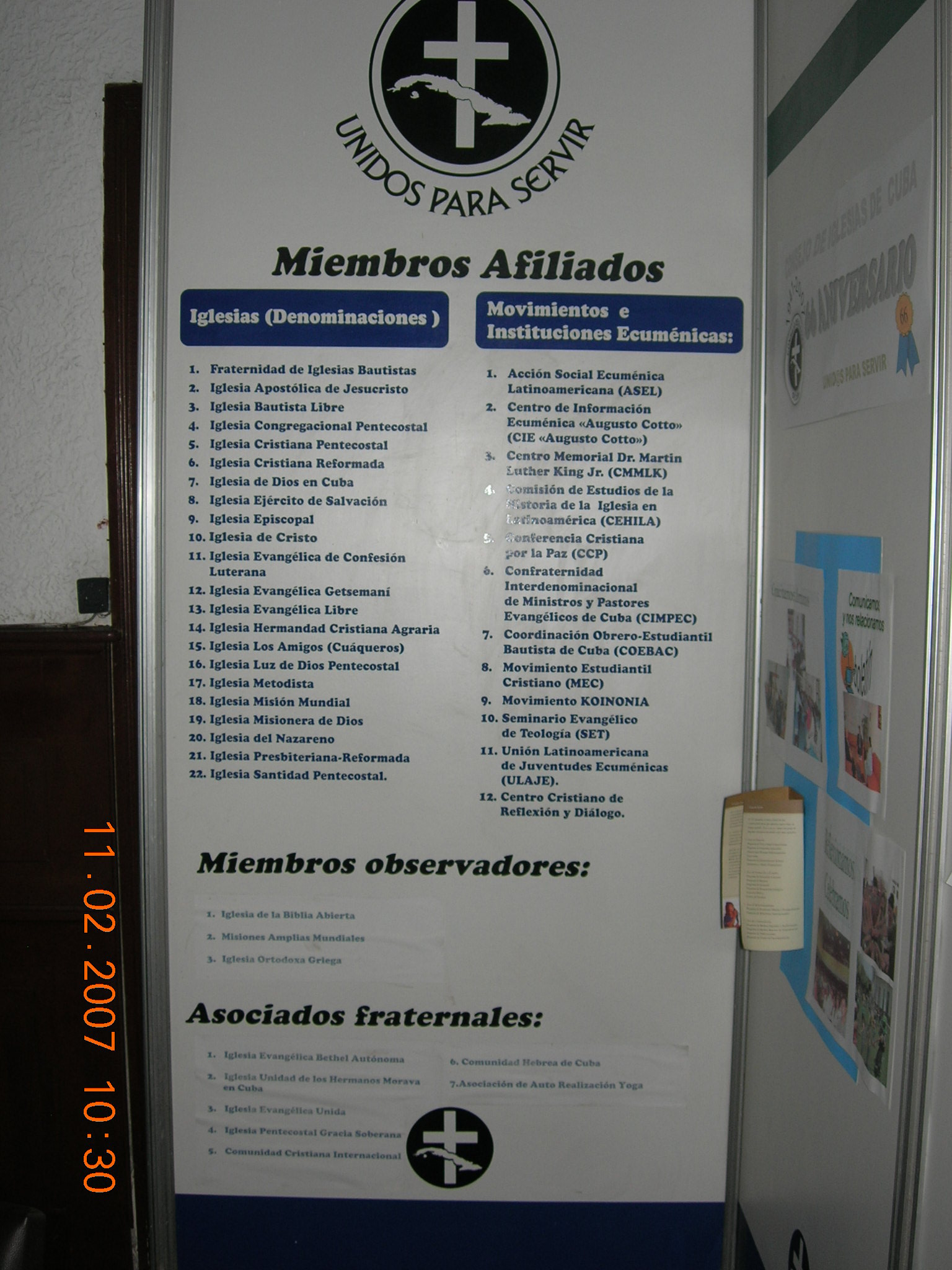
The report’s referencing the Cuban Council of Churches, however, did not mention that the it was founded in 1941 (long before the Cuban Revolution), and its members now include 22 churches, 12 ecumenical movements, and seven associate organizations. The Council, whose offices I have visited, promotes unity among the Christian Churches of Cuba and helps link these churches with other churches around the world. The Council also encourages dialogue between different movements and institutions as a means for Cuban churches to expand their ecumenical vocation of service, thus deepening their responsibilities towards society and all of God’s creation. Finally the Council promotes study, dialogue, and cooperation among Christians to increase Christian witness and enhance life in Cuba.
The U.S. government’s report continued, “Religious groups . . . reported it was easier to obtain government permission to maintain and repair existing places of worship and other buildings.” Moreover, the government “frequently granted permission to repair or restore existing temples, allowing significant expansion of some structures and in some cases allowing essentially new buildings to be constructed on the foundations of the old. Numerous houses of worship were expanded or repaired.” (In a prior year our partner church in Matanzas obtained such permission to expand its facilities for children’s Sunday School programming, and Westminster members helped build that expansion.)
Even though some religious organizations and “house churches” have not been officially recognized by the government, as required by Cuban law, in practice, most unregistered organizations and “house churches” operated with little or no interference from the government.
Both the Catholic Church and the Cuban Council of Churches reported improved access to prisoners during the year, with services offered in prisons and detention centers in most, if not all, provinces. (According to the report, however, some prison authorities did not inform inmates of their right to religious assistance, delayed months before responding to such requests, and limited visits to a maximum of two or three times per year.)
The government worked with the Catholic Church to facilitate the public procession of an icon honoring the Virgin of Charity to mark the 400th anniversary of her appearance in Cuba. The procession concluded in December with a public open-air mass in Havana attended by over 3,000 citizens as well as by government officials. It was the first country-wide religious procession permitted since the Cuban revolution.
Although there is no official law of policy for conscientious objection to military service, since 2007 the government has unofficially allowed a period of civilian public service to substitute for military service for men who object on religious grounds. The leadership of Jehovah’s Witnesses and Seventh-day Adventists stated that their members usually were permitted to participate in social service in lieu of military service.
The leadership of Jehovah’s Witnesses and Seventh-day Adventists stated that mistreatment and job discrimination, which had been particularly harsh in the past, were now rare and that their members were usually exempted from political activities at school. Seventh-day Adventist leaders stated that their members employed by the state usually were excused from working on Saturdays.
Pope Benedict XVI @ Plaza de Revolucion
Not included in the report for 2011 was the late March 2012 visit to Cuba by Pope Benedict XVI. During a mass in Havana’s Plaza de Revolucion before a crowd of thousands, the Pope called for “authentic freedom.”
Negative Aspects of Religious Freedom in Cuba
The report also commented on what it saw as negative aspects of religious freedom in Cuba.
The report notes that obtaining government permission for construction of new religious buildings remained difficult. This may well be true, but, in my opinion, this difficulty springs from the government’s attempts to regulate the allocation of scarce resources in a relatively poor country and to allocate more resources to other purposes it deems more important.
By law religious groups “are required to apply to the Ministry of Justice for official recognition. The application procedure requires religious groups to identify the location of their activities and their source of funding, and requires the ministry to certify that the group is not ‘duplicating’ the activities of another recognized organization in which case, recognition is denied. A number of religious groups, such as the Jehovah’s Witnesses and the Mormons, have been waiting for years for a decision from the Ministry of Justice on their pending applications for official recognition.” (However, the report said that unrecognized religious groups reported they were able to conduct religious activities, hold meetings, receive foreign visitors, and send representatives abroad. In addition, I believe that the government’s official requirement that such applications indicate it is not “duplicating” another organization’s activities is due to the previously mentioned desire to conserve scarce resources.)
Once the Ministry of Justice grants official recognition, religious organizations have to request permission from the Cuban Communist Party, through its Office of Religious Affairs, to hold meetings in approved locations, to receive foreign visitors, and to travel abroad. Religious groups indicated that while many applications were approved within two to three years from the date of the application, other applications received no response or were denied. Some religious groups were only able to register a small percentage of their “house churches.”
The report states that religious groups may not establish schools. This is true because the Cuban Revolution nationalized all private schools–religious and nonreligious– and instead emphasized public education for all children.
The report also says, “Except for two Catholic seminaries and several interfaith training centers throughout the island, religious schools were not permitted.”
This is an erroneous or misleading statement about religious education in Cuba as shown by the report’s own acknowledgement that in 2011 religious organizations had increased ability to conduct their own educational programs and by the following facts not mentioned in the report:
Since 1946 there has been an ecumenical Protestant Christian seminary in the city of Matanzas — Seminario Evangelico de Teologia (SET)–that was founded by the Methodist, Presbyterian, and Episcopal Churches. It has a full curriculum for various degrees as well as other non-degree programs, some of which are offered in other cities on the island.
The Methodists recently withdrew from SET to start their own seminary in Havana.
SET and the Martin Luther King, Jr. Center at Ebenezer Baptist Church in Havana are developing a program for education of prospective owners and operators of private businesses on the island under the government’s announcement allowing such activities. The MLK Center, by the way, was founded in 1987 to provide training and education in King’s philosophy of nonviolence for Cuban religious and community leadership.
In the last several summers young people from Westminster have conducted a vacation Bible school at our partner church in Matanzas.
MLK Center, Havana
“A license from the Office of Religious Affairs is necessary to import religious literature and other religious materials.” (Yet, as previously mentioned, the report itself states there were fewer restrictions on such importation.)
The report also states that “the government owns nearly all printing equipment and supplies and tightly regulates printed materials, including religious literature.” This, in my opinion, is an overstatement. Our partner church in Matanzas owns old-fashioned printing presses and at least one specialized computer printer and that the church prints and distributes religious bulletins and journals for most, if not all, of the Protestant churches on the island. A photo of the covers of some of the religious publications that are printed here appears in my 12/30/11 post, “The Cuban Revolution and Religion.”
The report states that “most religious leaders reported they exercised self-censorship in what they preached and discussed during services. Many feared that direct or indirect criticism of the government could result in government reprisals, such as denials of permits from the Office of Religious Affairs or other measures that could stymie the growth of their organizations.”
The government took “measures to limit support to outspoken religious figures that it considered a challenge to its authority.”I have no basis to challenge that statement or the following specifics cited by the report on this point:
On June 26, police arrested 23 people and detained them for five hours to prevent them from attending a Sunday prayer session in support of a Methodist minister who was removed from his post by his superiors, partly because of his outspoken criticism of the government.
On October 19, police stopped Baptist pastor Mario Felix Lleonart, a vocal critic of the authorities in the province of Santa Clara, and detained him for 10 hours.
In February Pastor Omar Perez Ruiz (aka Omar Gude Perez), a leader of the Apostolic Reformation, an association of independent nondenominational churches, was released after serving almost three years of a six-year prison sentence for illicit economic activities and falsification of documents. Perez maintained his innocence and claimed his incarceration was due to his religious activities. Perez’s release was conditioned on his refraining from preaching and from leaving the city of Camaguey. Although Perez and his family were granted refugee status in the United States, they were unable to leave because the government did not grant them an exit permit.
As part of its campaign of repression of human rights activists, the government prevented many Catholics from attending religious services. Members of the Ladies in White (Damas de Blanco) group were routinely prevented from attending church, a practice that was particularly pronounced in the eastern provinces of Holguin and Santiago. The government prevented Adisnidia Cruz, mother of political prisoners Marcos and Antonio Lima-Cruz, from leaving her house in Holguin on Sundays to attend mass on dozens of occasions. In other instances the government harassed human rights activists immediately after religious services. On September 8, for example, members of the Damas de Blanco were arrested after attending mass in Santiago to celebrate the day of Cuba’s patron saint.
Conclusion
Is the glass half empty or half full? This is the question for all human activities since none of us is perfect, and it is the legitimate question about religious freedom in Cuba.
In the opinion of a respected Cuban Protestant leader, the glass of such freedom in Cuba is more than half full, and there is no basis whatsoever for the U.S. government or her citizens to castigate Cuban religious institutions or leaders or members. I concur. As Jesus said to the scribes and Pharisees when they asked him if they should stone a woman who had committed adultery, “Let anyone among you who is without sin be the first to throw a stone at her.” All of the questioners then silently departed without throwing any stones. (John 8: 3-11.)
I, therefore, am glad that this U.S. government report does not designate Cuba as a “Country of Particular Concern,” i.e., a country which has “engaged in or tolerated particularly severe violations of religious freedom,” or the ” systematic, ongoing, egregious violations of religious freedom, including violations such as torture, degrading treatment or punishment, prolonged detention without charges, abduction or clandestine detention, or other flagrant denial of the right to life, liberty, or the security of persons.” There is no basis for any such designation, in my opinion.
Nor do I think there is any basis for the quasi-independent U.S. Commission on International Religious Freedom to have put Cuba on its “Watch List of countries where the serious violations of religious freedom engaged in or tolerated by the governments do not meet the [Commission’s] . . . threshold [for designation as a Country of Particular Concern], but require close monitoring.” The Commission should cease making such a designation in its next report.
On July 30, 2012, the U.S. Department of State released its 2011 Report on International Religious Freedom.
The operating definition for this purpose is found in Article 18 of the Universal Declaration of Human Rights that was approved by the United Nations General Assembly in 1948. It states, “Everyone has the right to freedom of thought, conscience and religion; this right includes freedom to change his religion or belief, and freedom, either alone or in community with others and in public or private, to manifest his religion or belief in teaching, practice, worship and observance.” Similar provisions are found in several multilateral human rights treaties.
Introducing the report, U.S. Secretary of State Hilary Clinton placed the subject in a broader context. She said, “religious freedom is both an essential element of human dignity and of secure, thriving societies. It’s been statistically linked with economic development and democracy stability.” Without such freedom, she continued, there can be “a climate of fear and suspicion that weakens social cohesion and alienates citizens from their leaders” and thereby “make it more difficult to solve national problems.” Indeed, she asserted that “the absence of religious freedom . . . is correlated with religious conflict and violent extremism.” As a result, the Obama Administration has made such freedom a diplomatic priority.
This report highlights what it sees as key trends in the year 2011: (a) the impact of political and demographic transitions on religious minorities; (b) the effects of conflict on religious freedom; (c) expanded use and abuse of blasphemy laws; and (d) the rising tide of anti-Semitism;
This annual report reviewing the worldwide status of religious freedom is mandated by the International Religious Freedom Act of 1988, which also requires the report to designate countries as “Countries of Particular Concern” when they have “engaged in or tolerated particularly severe violations of religious freedom,” i.e., ” systematic, ongoing, egregious violations of religious freedom, including violations such as torture, degrading treatment or punishment, prolonged detention without charges, abduction or clandestine detention, or other flagrant denial of the right to life, liberty, or the security of persons.”
In this latest report covering 2011, the following eight countries were so designated: Burma, China, Eritrea, Iran, North Korea, Saudi Arabia, Sudan and Uzbekistan.
With respect to China, the report said in 2011 there was a “marked deterioration . . . in the government’s respect for and protection of religious freedom.” It cited specific restrictions In the Tibetan Autonomous Region and other Tibetan areas. The report noted that only “groups belonging to one of the five state-sanctioned ‘patriotic religious associations'(Buddhist, Taoist, Muslim, Roman Catholic, and Protestant) . . . [could] register with the government and legally hold worship services.” Moreover, “Proselytizing in public or unregistered places of worship is not permitted” and some “religious and spiritual groups are outlawed.” Finally according to the report “Chinese Communist Party (CCP) members are required to be atheists and are generally discouraged from participating in religious activities.”
Not too surprisingly China immediately rejected the report’s comments. China said the report was “full of prejudice, arrogance and ignorance” and was “a political tool used by the U.S. Government to exert pressure on other countries, mostly deemed its rivals.”
The importance of religious freedom for the U.S. is evidenced by the U.S. Constitution’s First Amendment stating “Congress shall make no law respecting an establishment of religion, or prohibiting the free exercise thereof” and by the U.S. Supreme Court’s broad interpretation of those provisions. This importance also has been demonstrated by the following more recent events:
The 1988 enactment of the previously mentioned International Religious Freedom Act, which In addition to requiring the annual reports on the subject, created in the Department of State the Office of International Religious Freedom headed by an Ambassador at Large for International Religious Freedom.
That same Act also created the quasi-independent U.S. Commission on International Religious Freedom that is required to issue separate annual reports on such freedom. In addition, it is charged to “consider and recommend options for policies of the [U.S.] Government with respect to each foreign country the government of which has engaged in or tolerated violations of religious freedom, including particularly severe violations of religious freedom, including diplomatic inquiries, diplomatic protest, official public protest demarche of protest, condemnation within multilateral fora, delay or cancellation of cultural or scientific exchanges, delay or cancellation of working, official, or state visits, reduction of certain assistance funds, termination of certain assistance funds, imposition of targeted trade sanctions, imposition of broad trade sanctions, and withdrawal of the chief of mission.”
On October 18, 2011, the Department of State established the Working Group on Religion and Foreign Policy that includes representatives of religious groups and other members of civil society. Its mission is to engage in “a continuing dialogue with religious leaders and other members of civil society that informs U.S. foreign policy and fosters common partnerships with the NGO community, including faith-based groups, in support of conflict mitigation and development as well as efforts to promote human rights, including religious freedom.”
I have developed a special interest in Cuban religious freedom, and a subsequent post will review this report’s section on Cuba.
The American Revolutionary War with Great Britain started on April 19, 1775, with fighting in Lexington and Concord, Massachusetts. Immediately thereafter, the colonists commenced a siege of the town of Boston, where the British troops were quartered. For nearly the first two months of the siege, there were only minor skirmishes between the two forces as the British soldiers were confined within Boston.
The British, however, wanted to break out of their confinement and to protect Boston against colonial attacks from the hills overlooking the town.[1]
On May 25th, the immediate events leading to the Battle of Bunker Hill commenced. On that date British generals began developing a plan to break out and protect Boston from attack from the adjacent hills. On June 12th they finalized a plan to take the Boston and Dorchester Necks (narrow strips of land separately connecting the town of Boston and Dorchester Heights to the mainland), fortify the Dorchester Heights to the southeast of the town and then attack the colonial forces stationed in Roxbury to the south of the town.
Boston map 1775Map of Charleston & Breed’s & Bunker HIlls, 1775
Once the British southern flank had been secured, the British plan called for having troops cross the Harbor north of the town to take the two hills behind the town of Charlestown (Breed’s Hill, 62 feet above sea level, and Bunker Hill,110 feet above sea level). These hills overlooked both Boston and its harbor and thus were critical vantage points. Assuming these objectives were secured, the plan was then to attack the colonial forces in Cambridge. The British attack was set for June 18th.
On June 13th (the day after these plans were finalized), however, the colonial forces received intelligence about the plans. As a result, the colonials decided that additional defenses needed to be erected on the Charlestown Peninsula, specifically on Bunker Hill. After a prayer service led by Harvard College President Langdon, 1,200 colonial troops In the dark of the night on June 16th stealthily occupied Bunker Hill and the adjacent lower Breed’s Hill. They constructed an earthen redoubt or wall on Breed’s Hill (not Bunker Hill), probably because Breed’s Hill was closer to where the British ships were positioned allowing the colonists a better attacking position than at Bunker Hill. That night the colonists also built lightly fortified lines across most of the Charlestown Peninsula.
At sunrise the next day (June 17) the British were surprised to discover the new colonial positions on the two hills, and some of the British ships in the Harbor started shelling those positions with little effect. Although Bunker Hill was the original objective of both British and colonial troops and is the name of the battle, most of the actual fighting later that day took place on the shorter hill closer to the Harbor (Breed’s Hill).
British 1st assault, Breed’s HillBritish 1st assault, Breed’s Hill (H. Pyle)
The initial British attack did not take place until after 3:00 that afternoon due to a shortage of boats to bring the British troops from Boston, poor navigational maps and tides. They landed east of the town of Charleston. When colonial snipers began firing, the British had the town set afire by cannon shots from their ships. The British continued their assault. The British just expected to march up the hill and scare the colonists away. The British troops advanced with bayonets fixed; many of their muskets were not even loaded. The British troops, wearing their bright red wool jackets and weighed down by heavy equipment, marched up hill over farm fields and low stone walls hidden in the tall grass.
As the colonists saw this massive red line approach slowly and steadily, they remained calm and did not open fire. Once the British came within range, the colonists began firing, and the British soldiers started to fall rapidly. This resistance and resulting casualties forced the British to retreat.
British 2nd assault, Breed’s HillBritish 3rd assault, Breed’s Hill
The British immediately regrouped and started a second assault. Again they suffered heavy casualties and retreated.
The third assault, however, was successful with the British taking control of both hills. The colonial troops were running out of ammunition and were forced to retreat to Cambridge, suffering their most significant losses on Bunker Hill.This assault and the Battle were over by approximately 6:00 p.m.
While the result was a victory for the British, they suffered heavy losses: 828 wounded and 226 killed (nearly a third of the deployed forces of 3,000), including a notably large number of officers. The battle is seen as an example of a Pyrrhic victory because the immediate gain (the capture of Bunker Hill) was modest and did not significantly change the state of the siege, while the cost was high. Meanwhile, colonial forces were able to retreat and regroup in good order, having suffered few casualties (115 wounded and 305 killed). Furthermore, the battle demonstrated that relatively inexperienced colonial forces were willing and able to stand up to regular army troops.
Perley Brown (my maternal fifth great-grandfather) and three of his brothers–John, Benjamin and William Brown–were members of the colonial forces at the Battle of Bunker Hill.[2]
Their regiment left their camp in Cambridge around noon that day and for unknown reasons halted about an hour at Lechmere Point (near the eastern edge of present-day Cambridge). When they arrived later at the northern base of Bunker Hill, they were met by a man who said that additional troops had been ordered to halt. But the regiment’s commander said those were “Tory orders” and instead ordered the men to follow him into combat. They actually arrived at the hostilities just before the colonial retreat was ordered at the end of the battle.
During the colonial retreat, John Brown was shot in the left thigh near the bone and in his right heel, rendering him unable to walk. The regiment’s captain took Brown under one arm and their two muskets under the other and moved Brown out of immediate danger. The captain then found Brown’s brother, Perley Brown (my maternal fifth great-grandfather), who carried John the rest of the way to safety.
John was unable to go to a hospital or home and remained at a nearby residence to recuperate. That October he finally was able to return home to Leicester, Massachusetts. In April 1777 the Massachusetts legislature granted him a pension of 20 shillings per month for his disability, and in 1786 the new nation awarded him a pension. He died in 1821 at the age of 87.
As I was researching for this post, I had three unanswered questions. First, why did the British not execute their plan to take control of the Dorchester Heights? Second, given the obvious strategic importance of Breed’s and Bunker Hills, why had the colonists not constructed fortifications before June 16th and why had they not stationed troops there? Third, given that same strategic importance, why did the British not maintain their victorious positions on the two hills? I would greatly appreciate comments with answers to these questions and any corrections to the above account of the Battle of Bunker Hill.
[1]E.g., T. Harry Williams, Richard N. Current & Frenk Freidel, A History of the United States [To 1876], at 150 (New York: Alfred A. Knopf 1959); Henry Steele Commager & Richard B. Morris, The Spirit of ‘Seventy-Six: The Story of the American Revolution as Told by Participants, Ch. Four (New York: Harper & Row, 1967) (collection of original documents).
[2] Carol Willits Brown, William Brown–English Immigrant of Hatfield and Leicester, Massachusetts, and His Descendants c. 1669-1994 at 6, 11-27, 31-41, 50 (Gateway Press; Baltimore, MD 1994); Emory Washburn, Topographical and historical sketches of the town of Leicesterin the Commonwealth of Massachusetts (1826); Emory Washburn, Historical sketches of the town of Leicester, Massachusetts, during the first century from its settlement (1860.
After the April 19, 1775 Battles of Lexington and Concord, Massachusetts, the 1,700 British soldiers returned to their quarters in Boston, then a town of approximately 15,500 people in addition to the British troops. The colonial Minute Men, numbering at least 14,000 to 16,000, were gathered four miles to the west in Cambridge.
Geography is the key to understanding this American use of the military tactic of siege, i.e., militarily surrounding a town or other place with the intent of preventing free movement to or from the place or conquering by attrition rather than by attack.
The town of Boston then was located on a peninsula surrounded on virtually all sides by the Charles River and the Boston Harbor and connected to the south mainland only by a narrow strip of land (“The Boston Neck”). (Today landfill has eliminated the Boston Neck.) Although British ships controlled the water and thus were able to resupply the British troops in the town, as they did in May 1775 with an additional 4,300 troops (for a total force of 6,000), these troops essentially were land locked.
Siege of Boston map, 1775-1776
The Americans obviously understood the British predicament, and with the Americans having the larger number of troops and not wanting to wage war in Boston, they imposed a siege of the town of Boston by stationing the militia men in a line starting in Chelsea to the northeast of Boston, going west to Charlestown and then south to Roxbury. This siege line was able to prevent the British troops from leaving Boston and engaging in war against the Americans. The Siege was an American offensive maneuver implemented for defensive purposes until the very end of the siege.
Among those participating in the Siege were Perley Brown (my maternal fifth great-grandfather) and three of his brothers–John, William and Benjamin. All four apparently had enlisted for eight months or through the balance of the year of 1775, and all except for John presumably were engaged in the Siege at least until then. John’s service unfortunately ended on June 17, 1775, when he was wounded in the Battle of Bunker Hill as we will see in a subsequent post.[1]
For most of the 11 months of siege, there were relatively minor skirmishes between the two forces except for the just mentioned Battle of Bunker Hill.
One of the skirmishes occurred in May of 1775 on Noddle’s and Hog Islands in the Harbor northeast of Boston (near today’s Boston Logan International Airport). Because of their domination of the sea, the British were using the farmers and livestock on the island to supply the British troops with fresh meat. In addition, the British were storing some naval supplies there. The colonists responded by removing livestock and hay from the islands or by killing the livestock and burning the hay and barns. On May 27 and 28, 1775, the opposing forces fought the Battle of Chelsea Creek, which was a creek between the two islands and the mainland.
The colonists without suffering any fatalities were successful in forcing the retreat of the British troops in this battle. In addition, the colonists’ cannons were able to capture and sink the British ship, HMS Diana, the first such accomplishment in the war and a big boost to their morale. One of the colonists in this military engagement was Benjamin Brown.
General George WashingtonGeneral Washington’s Headquarters, Cambridge, 1775-1776
Nearly three weeks after the Battle of Chelsea Creek, on June 14, 1775, the Second Continental Congress voted to establish the Continental Army for purposes of common defense by incorporating the 16,000 or so militia men already in action in the Boston area plus the 5,000 other men in New York. The next day (June 15th) the Congress unanimously elected George Washington as the Commander-in-Chief of the Army.
On July 3, 1775, General Washington arrived in Cambridge, Massachusetts to take command of the troops in the field. He established his headquarters and abode in a beautiful house in Cambridge that later in the 19th century was owned by the American poet, Henry Wadsworth Longfellow. (The house is now open to the public as a National Historic Site.)
On January 24, 1776, the colonists obtained a major strategic advantage with the arrival in Cambridge of over 50 heavy cannons that had been seized eight months earlier (on May 10, 1775) from the British Fort Ticonderoga at the southern end of Lake Champlain in present-day upstate New York. (The reconstructed Fort is now open to the public.)
The successful capture of the Fort was led by Ethan Allen and the Green Mountain Boys and Colonel Benedict Arnold. (Arnold in 1780 defected to the British and thereby became an infamous American traitor.)
Artillery for Boston, 1775
Between November 1775 and January 24, 1776, in a remarkable logistical operation Colonel Henry Knox and a team of engineers used boats, horse and ox-drawn sledges and manpower to transport the heavy cannons nearly 250 miles over poor roads, forest, swamps and the frozen Hudson and Connecticut Rivers to Cambridge.
Once in Cambridge, the canons were moved to Dorchester Heights overlooking Boston from the southeast. In early March 1776, the Americans started to bombard Boston with the cannons, killing some British soldiers and destroying some houses. The British returned artillery fire, but their cannons could not reach the colonists’ weapons.
British Evacuation of Boston, 1776
After a planned British assault on the Dorchester Heights was cancelled due to a storm, the British decided to leave Boston. On March 8th General Washington received an anonymous letter saying the British would not destroy the town of Boston if they were permitted to depart without attack. Washington formally rejected the letter, but on March 17th the British evacuated Boston without hostile fire and without any destruction.
A British fleet of 120 ships with 9,906 British troops plus 1,220 women and children left Boston for the 400 mile northeastern sail to the unused British military base in Halifax, Nova Scotia.
Now in Boston March 17th is celebrated as Evacuation Day.
[1] Carol Willits Brown, William Brown–English Immigrant of Hatfield and Leicester, Massachusetts, and His Descendants c. 1669-1994 at 6, 11-27, 31-41, 50, 308-12(Gateway Press; Baltimore, MD 1994). This account of the Brown brothers’ participation is based upon two secondary sources about the town of Leicester written in the 19th century by Emory Washburn: (a) Topographical and historical sketches of the town of Leicester in the Commonwealth of Massachusetts at 49-50 (1826); and (b) Historical sketches of the town of Leicester, Massachusetts, during the first century from its settlement at 296-99(1860).
On April 19, 1775, the opening battles of the American Revolutionary War occurred in Lexington and Concord, Massachusetts and along the road from those villages to Boston.
Minute Man statue, Lincoln, MA
Battles There was no organized colonial army at the time. Instead, the Americans who fought the British that day were “Minute Men,” who were volunteers committed to being ready to fight on a minute’s notice and who had been mustered into service that day by warnings that the British were coming.
A concrete example of the mustering of the Minute Men can be seen by what happened that same day (April 19th) in Leicester, Massachusetts, a village 30 miles west of Concord.
Early that same afternoon a messenger on horseback arrived in Leicester. He stopped in front of the blacksmith shop of the captain of the local unit of the Minute Men. The messenger yelled, “The war has begun! The British are marching to Concord!”[1]
The blacksmith immediately stopped working on the ploughshare he was sharpening. He grabbed his loaded musket. He rushed into the street and fired the musket in the air. This was the agreed upon signal for the Minute Men to assemble. Some who previously had been appointed as messengers went through the town and adjoining countryside to spread the news.
By 4:00 p.m. all the Minute Men had assembled in the town Common. No one had a uniform. But everyone had his musket, powder horn and bullet pouch along with a few necessities. Among those present were Perley Brown (my maternal fifth great-grandfather) and two of his brothers–John and William. They all apparently enlisted for eight months or through the balance of the year of 1775.
Watching the Leicester men assemble were family and friends. To provide the men with shot for their muskets the lead weights of one family’s valuable clock were melted down and cast into bullets. Rev. Conklin, the local clergyman, prayed for their protection and safe return. The mother of the unit’s captain approached him to give him a hug. He responded by saying for all to hear, “Mother, pray for me, and I will fight for you.”
Just before sundown that same day, 80 Minute Men from the town, including the three Brown brothers, marched east approximately 24 miles through Worcester to Marlborough, Massachusetts, a village of 1,500 people. There upon hearing the news that the British had retreated to Boston, they and colleagues from other towns stopped for a short sleep.
The next day (April 20th) they marched another 21 miles to Watertown, Massachusetts and stopped for a night’s rest. The following day (April 21st) they completed their march when they arrived in Cambridge, Massachusetts, which was five miles to the east and which had been selected as the staging center for the American forces.
This tale of the mustering of the Leicester men undoubtedly was repeated throughout Massachusetts and the rest of New England for the Leicester men were joined in Cambridge by thousands of other Minute Men. One of the other Minute Men was another Brown brother, Benjamin Brown, from the village of Rowe in northwestern Massachusetts near present-day Vermont.
As we will see in a subsequent post, these men then participated in the Siege of Boston from April 20, 1765 through March 17, 1776.
[1] Carol Willits Brown, William Brown–English Immigrant of Hatfield and Leicester, Massachusetts, and His Descendants c. 1669-1994 at 6, 11-27, 31-41, 50, 308-12(Gateway Press; Baltimore, MD 1994); Emory Washburn, Topographical and historical sketches of the town of Leicester in the Commonwealth of Massachusetts at 49-50 (1826); Emory Washburn, Historical sketches of the town of Leicester, Massachusetts, during the first century from its settlement at 296-99(1860).
As mentioned in a prior post, British relations with her American colonies deteriorated during the period from 1765 through 1775. Especially towards the end of that period, the colonists were organizing militias, training the Minute Men in how to wage war and gathering and storing munitions and weapons. One of the places for such storage was Concord, Massachusetts, which was about 20 miles northwest of Boston.
It was no secret to the British that the Americans were preparing for war, and the British had secret intelligence that colonial weapons and munitions were being stored in Concord.
Map of British Troop Movements, April 19, 1775
Hoping to surprise the Americans, on the evening of April 18, 1775, a British infantry force of 700 men boarded naval barges in Boston to cross the Charles River to Cambridge, about three miles to the west. Around 2:00 a.m. early the next morning, the troops started marching to Concord, approximately 17 miles to the west of Cambridge. Their objective was to seize and destroy the colonial munitions and arms stored at Concord.
The colonists, however, had intelligence that the British were going to try to seize the weapons and munitions in Concord, and the colonists previously had moved most of those materials to another location. Moreover, the colonists had intelligence on the night of April 18th that the British troops were going to make that attempt the next day.
Paul Revere, Ride, April 18, 1775
This prompted the famous midnight ride of Paul Revere and another rider (William Dawes) to warn the militias in Lexington and Concord and others in towns along the way that the British were coming.
Battle of Lexington, April 19, 1775
At sunrise on the 19th the British troops entered Lexington, a village of about 800 people. In the village common green, 80 or so Minute Men stood at attention in plain sight in parade-ground formation just watching the British troops. The British troops turned and advanced toward the Minute Men. There were shouts and confusion when one shot rang out by whom no one knows for certain. This precipitated other shots, and eight militia men were killed and ten were wounded.
The American Revolutionary War had started.
The 700 British troops soon reformed into a column and commenced their march to Concord, a village of about 1,500 people approximately seven miles to the west. As they approached Concord, about 250 militia men saw that they were heavily outnumbered and retreated, and the town was surrendered to the British. The British found three large cannons and smashed them so they could not be moved.
Battle at Concord North Bridge, April 19, 1775
At the North Bridge over the Concord River just outside the town, a contingent of militia men outnumbered the British troops. Gunfire erupted, and the British troops abandoned their wounded and fled to the safety of another contingent of British soldiers. Around noon the British left Concord.
On their return march to Lexington, the British were ambushed and suffered losses as the number of militia men kept growing with reinforcements from other towns. Around 2:30 p.m. a full brigade of 1,000 British soldiers with artillery arrived to reinforce and rescue their retreating comrades. After a short rest at Lexington, they resumed their return march to Boston around 3:30 p.m. All along their return they were attacked by militia men, many firing their muskets from behind trees and stone fences.
The battles at Lexington and Concord were not major ones in terms of tactics or casualties. But they were important in showing the ability of the colonists to fight and the failure of the British to enforce the Intolerable Acts, capture weapons and munitions and prevent hostilities from the colonists.
In 1837 Ralph Waldo Emerson commemorated the fight at Concord’s North Bridge in his “Concord Hymn” with these words:”By the rude bridge that arched the flood; Their flag to April’s breeze unfurled; Here once the embattled farmers stood; And fired the shot heard round the world.”
The American Revolutionary War with Great Britain started on April 19, 1775, with fighting in Lexington and Concord, Massachusetts, which will be summarized in a future post. Hostilities ended six years later with the surrender of British General Cornwallis at Yorktown, Virginia on October 19, 1781. The formal end of the war was concluded another two years later with the Treaty of Paris on September 3, 1783.[1]
John Brown, my maternal sixth great-grandfather, had five sons, all of whom fought for the Americans in that war. The four eldest–John, Perley (my maternal fifth great-grandfather), Benjamin and William–fought in the early Siege of Boston and the Battle of Bunker Hill, which will be the subjects of future posts. Perley, Benjamin and William also fought in the Battle for New York, which will be discussed in another post. (The youngest son, Daniel, joined the war for six months in 1780.)[2]
In the first fifteen months of the war, the colonists’ objective was redressing grievances, not independence. Indeed, the Second Continental Congress on July 6, 1775, adopted the Declaration of the Causes and Necessity of Taking Up Arms that stated, “we mean not to dissolve that union which has so long and so happily subsisted between us, and which we sincerely wish to see restored.” The document concluded with this statement:
“With an humble confidence in the mercies of the supreme and impartial Judge and Ruler of the Universe, we most devoutly implore his divine goodness to protect us happily through this great conflict, to dispose our adversaries to reconciliation on reasonable terms, and thereby to relieve the Empire from the calamities of civil war.”
The Declaration of Causes and Necessity also reiterated many of the points made in the First Continental Congress’ Declaration and Resolves of September 1774. The new Declaration continued, “We are reduced to the alternative of choosing an unconditional submission to the tyranny of irritated Ministers, or resistance by force. The latter is our choice. We have counted the cost of this contest, and find nothing so dreadful as voluntary slavery. Honour [sp], justice, and humanity, forbid us tamely to surrender that freedom which we received from our gallant ancestors, and which our innocent posterity have [sic] a right to receive from us. We cannot endure the infamy and guilt of resigning succeeding generations to that wretchedness which inevitably awaits them, if we basely entail hereditary bondage upon them.”
This American plea for reconciliation fell on deaf ears. The British Parliament instead in late 1775 adopted the American Prohibitory Act that stated that “all manner of (the American colonies’) trade and commerce is and shall be prohibited;” that any ships found trading “shall be forfeited to his Majesty, as if the same were the ships and effects of open enemies;” and that “for the encouragement of the officers and seamen of his Majesty’s ships of war” that “seamen, marines, and soldiers on board shall have the sole interest and property of all ships, vessels, goods and merchandise, which they shall seize and take.” The Prohibitory Act was a de facto declaration of war by Great Britain as the blockade it imposed was an act of war under the law of nations.
A copy of the American Prohibitory Act, however, did not reach the colonies until February 1776 and was a final precipitating cause of the American decision to seek independence from Great Britain.
Accordingly on July 2, 1776, the Continental Congress adopted, 12-0 with one abstention (New York), a short Resolution of Independence that stated that “these United Colonies are, and of right ought to be, free and independent States, that they are absolved from all allegiance to the British Crown, and that all political connection between them and the State of Great Britain is, and ought to be, totally dissolved.”
Two days later, July 4, 1776, the Congress unanimously adopted the now famous American Declaration of Independence. Before reciting the specific complaints against Great Britain, it starts with these amazing and earth-shaking words:
“When in the Course of human events, it becomes necessary for one people to dissolve the political bands which have connected them with another, and to assume among the powers of the earth, the separate and equal station to which the Laws of Nature and of Nature’s God entitle them, a decent respect to the opinions of mankind requires that they should declare the causes which impel them to the separation.”
“We hold these truths to be self-evident, that all men are created equal, that they are endowed by their Creator with certain unalienable Rights, that among these are Life, Liberty and the pursuit of Happiness.–That to secure these rights, Governments are instituted among Men, deriving their just powers from the consent of the governed, –That whenever any Form of Government becomes destructive of these ends, it is the Right of the People to alter or to abolish it, and to institute new Government, laying its foundation on such principles and organizing its powers in such form, as to them shall seem most likely to effect [sic]their Safety and Happiness. . . . when a long train of abuses and usurpations, pursuing invariably the same Object evinces a design to reduce them under absolute Despotism, it is their right, it is their duty, to throw off such Government, and to provide new Guards for their future security.”
Treaty of Paris by John Jay, John Adams, Benjamin Franklin, Henry Laurens & William Temple Franklkin (Benjamin West, painter)
Seven years later (September 1783) the war for American independence was formally ended with the Treaty of Paris. In its Article 1 the British Monarch “acknowledges the said United States, viz., New Hampshire, Massachusetts Bay, Rhode Island and Providence Plantations, Connecticut, New York, New Jersey, Pennsylvania, Delaware, Maryland, Virginia, North Carolina, South Carolina and Georgia, to be free sovereign and independent states, that he treats with them as such, and for himself, his heirs, and successors, relinquishes all claims to the government, propriety, and territorial rights of the same and every part thereof.” In addition, its Article 7 stated, “There shall be a firm and perpetual peace between his Brittanic Majesty and the said states, and between the subjects of the one and the citizens of the other, wherefore all hostilities both by sea and land shall from henceforth cease.”
[1]E.g., T. Harry Williams, Richard N. Current & Frenk Freidel, A History of the United States [To 1876], Ch. 7 (New York: Alfred A. Knopf 1959); Henry Steele Commager & Richard B. Morris, The Spirit of ‘Seventy-Six: The Story of the American Revolution as Told by Participants, Chs. Three through Thirty-Three (New York: Harper & Row, 1967).
[2] Carol Willits Brown, William Brown–English Immigrant of Hatfield and Leicester, Massachusetts, and His Descendants c. 1669-1994 at 7-8, 11-12, 17-25, 31-32, 50, 308-10 (Gateway Press; Baltimore, MD 1994).