Senate Hearing on Expanding U.S. Agricultural Trade with Cuba

On April 21st the U.S. Senate Committee on Agriculture, Nutrition and Forestry held a hearing, “Opportunities and Challenges for Agriculture Trade with Cuba.”[1]

 Chairman’s Opening Statement

Senator Pat Roberts
Senator Pat Roberts

The Committee Chair, U.S. Senator Pat Roberts (Rep., KS), opened the hearing by stating, “At the beginning of this Congress, I was hopeful that trade would be one area where we could work across the aisle to find agreement. I am still hopeful that is the case. . . . International trade of American agriculture products is critical…critical to the nation’s economy and critical to our Kansas farmers and ranchers. I have long fought to eliminate barriers to trade, and I believe that we should continue to work towards new market access opportunities for our agriculture products.”

“The United States and Cuba have a long history full of contention and instability. There is no shortage of opinion from members of Congress about the relationship between our two countries, both present and future. Some are concerned about human rights, others about socioeconomic ideology. But those concerns are not what this committee will focus on this morning. Today we are here to discuss the role of agriculture – opportunities and challenges – in Cuba.”

“This is not an issue that we are going to be able to fix overnight. It will take efforts in addition to bills in Congress to truly normalize trade with Cuba. The decisions that are made regarding increased trade with Cuba must be made carefully.”

“Four months ago the President announced a major shift in U.S. policy towards Cuba. It is my hope that in the future, the President will work with Congress to determine the best path forward. Foreign policy does not happen in a vacuum. We have to take a realistic approach and work out a step-by-step plan towards lifting the embargo. This is a goal that should include Congress.”

“Today we will hear from an impressive panel of experts, from the regulators responsible for writing our policies toward Cuba, to the producers who seek to grow the market for their products. I understand that, like myself, many of our witnesses here have traveled to Cuba to see first-hand what challenges and opportunities exist.”

“Agriculture has long been used as a tool – not a weapon – for peace and stability. It is my hope that Cuba will embrace the practices of free trade, enterprise and commerce, so that both countries will gain from increased relations.”

“Earlier this year, the U.S. Agriculture Coalition for Cuba was launched. They have shared a statement and additional information in support of our work today, [which was] entered into the record.”

Ranking Member’s Opening Statement

Senator Debbie Stabenow

Senator Debbie Stabenow (Dem., MI), the Ranking Committee Member, said, “Improving trade with Cuba represents not only a great opportunity for America’s farmers, ranchers, and manufacturers, but a meaningful way to help rebuild trust between our nations.  After more than 50 years of stalemate, it’s time for a new policy on Cuba.”

“When I visited Cuba earlier this year – just days after President eased some trade restrictions – I saw firsthand the eagerness of Cubans who want to develop a more effective relationship with the [U.S.] But we can only get there if we begin to take meaningful steps to soften many of the barriers that exist between us.”

“And America’s farmers and ranchers are uniquely positioned to lead the way. Consider this – in 2014, the U.S. exported just over $290 million in agricultural goods to Cuba. That’s a good start, but for a country only 90 miles off our coast, we can do much more. Cuba’s own import agency estimates that it will receive approximately $2.2 billion (in U.S. dollars) worth of food and agricultural products this year alone.”

“That type of economic potential deserves a chance to succeed – and is one reason why many of the largest producer groups, trade associations, and companies from within agriculture have come together to push for increased engagement.”

“Many on this Committee have pushed for increased engagement and have taken the opportunity to visit Cuba in recent months. I’d like to recognize Senators Leahy and Klobuchar, as well as Senator Boozman and Heitkamp, for their bipartisan leadership on this issue.”

“The commitment to democratic ideas and human rights we share as Americans are best realized through engagement. Our bedrock principles accompany every product farmers and ranchers send to Cuba.”

“Last week’s action by the President [in rescinding the designation of Cuba as a “state sponsor of terrorism”] is a step forward toward in normalizing our relationship and will test the commitment of the Cuban government to this process.”

“But even while we are making significant progress in rebuilding our relationship with Cuba – the policies governing trade between our countries are not yet designed to allow a steady flow of goods and services. We must find a path forward that allows U.S. financial institutions to safely and securely work with Cuban purchasers, including the extension of lines of credit. And we should work to authorize a greater range of goods, services, and supplies for export to Cuba. These measures not only make good business sense – they also will help build Cuba’s agricultural capacity and make the island a better trading partner in the long run.”

The Witnesses at the Hearing

 The witnesses at the hearing were the following: (1) The Honorable Michael T. Scuse, Under Secretary, Farm and Foreign Agriculture Services, U.S. Department of Agriculture; (2) Mr. Matthew Borman, Deputy Assistant Secretary, Bureau of Industry and Security, U.S. Department of Commerce; (3) Mr. John Smith, Acting Director, Office of Foreign Assets Control, U.S. Department of the Treasury; (4) Mr. Michael V. Beall, President & CEO, National Cooperative Business Association; (5) Mr. Terry Harris, Senior Vice President, Marketing and Risk Management, Riceland Foods; (6) Mr. Ralph Kaehler, Farmer and Owner, K-LER Cattle Company, St. Charles , MN; (7) Mr. Doug Keesling, Fifth Generation Owner, Keesling Farms, Kansas Wheat, Chase , KS; and (8) Dr. C. Parr Rosson III, Professor & Department Head, Department of Agriculture Economics, Texas A&M University.

 Witness Ralph Kaehler

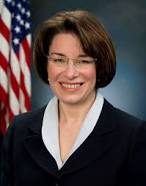
Senator Amy Klobuchar

Minnesota’s Senator Amy Klobuchar, who is a member of the Committee and the author of the Freedom to Export to Cuba Act (S.491) ending the U.S. embargo of Cuba, introduced Ralph Kaehler, whose family has been operating a livestock, row crop, and canning vegetable farm in Minnesota for nearly 130 years.

The Senator prefaced her introduction with this statement: “For too long, export and travel restrictions have prevented American farmers and ranchers from seeking opportunities in Cuba. That is why I have introduced bipartisan legislation to lift the trade embargo on Cuba, and this hearing allowed us to focus on how we can ensure that our farmers and ranchers benefit from normalized relations between our two countries.”

Mr. Kaehler testified that his farm was “an exhibitor in the First U.S./Cuba Food and Agriculture Exposition [in Havana] in 2002.” It “was the only one with live animals— affectionately known as the ‘Cuban Ark’ . . . to exhibit the diversity of U.S. livestock producers, and to introduce Cuba to the typical USA farm family.”

“Since then, the Kaehler Family has led over 10 trade delegations to Cuba. These missions have included producers from seven different states and a bipartisan mix of state lawmakers and officials. To date, some of the most successful exports to Cuba we have facilitated include shipments of livestock, dried distillers grains, powdered milk, animal milk replacer, and texturized calf feed.”

“Given the opportunity, U.S. farmers do well in Cuba. We have a significant advantage of shorter shipping over Europe, South America, Asia, and other major exporters. In addition, Cuba can take advantage of U.S. rail container service and sizing options, which also brings significant benefits to smaller privately owned businesses like ours. On top of all this, the U.S. produces a wide variety of affordable and safe food products that Cubans want to eat.”

“Unfortunately, some of the policies currently in place diminish the natural advantages American agriculture enjoys over its competitors. For instance, requirements for using third country banks for financing adds a lot of paperwork, time, and personalities to every transaction. Coupled with a restrictive cash‐in advance shipping policy . . . there is a very small margin for error before a shipper faces demurrage fees. As a family operation trying to build our business through exports, this self‐inflicted inefficiency can be tough to manage.”

Mr. Kaehler then made three specific recommendations to Congress. “First, . . . improve the trade financing rules for Cuba. . . . Second, . . . small firms like ours . . . need marketing support and assistance [from USDA] to help support our companies and figure out exactly what’s going on in markets abroad. . . . [Third,] I hope that Congress will expand the universe of people involved in U.S.‐Cuba trade by allowing a greater variety of goods and services to be traded.”

=========================================================

[1] A quick examination of the official websites of the Committee’s 20 members reveals that seven have made statements favoring at least some aspects of U.S.-Cuba reconciliation (Boozman (Rep., AK), Brown (Dem., OH), Heitkamp (Dem., ND), Hoeven (Rep., ND), Klobuchar (Dem., MN), Leahy (Dem., VT) and Stabenow (Dem., MI)). Only two have negative statements about that reconciliation (Grassley (Rep., IA) and Perdue (Rep., GA)). The other eleven members‘ websites do not reveal any position on Cuba (Bennet (Dem., CO), Casey (Dem., PA), Cochran (Rep., MS), Donnelly (Dem., IN), Ernst (Rep., IA), Gillibrand (Dem., NY), McConnell (Rep., KY), Roberts (Rep., KS), Sasse (Rep., NE), Thune (Rep., SD) and Tillis (Rep., NC)). A more thorough examination of the records of the last 11 would probably uncover other indications of their positions on reconciliation with Cuba.


The Council of the Americas and the Americas Society: Other Supporters of U.S.-Cuba Reconciliation

The Council of the Americas (COA) [1] and the Americas Society (AS) [2] previously announced their support of the December 17th announcement of the U.S.-Cuba rapprochement and of the more recent presidential rescission of the U.S. designation of Cuba as a “State Sponsor of Terrorism.”

On April 21st COA and AS held their 45th annual Washington Conference at the U.S. Department of State. The theme this year was “Integration & Innovation: The Americas Agenda.” One of its speakers was U.S. Secretary of State John Kerry.

Secretary Kerry quoted President Obama’s speech at the recent Summit of the Americas: the U.S. is engaged in “a new chapter of engagement in this region. I believed that our nations had to break free from the old arguments, the old grievances that had too often trapped us in the past, that we had a shared responsibility to look to the future and to think and act in fresh ways. [There is] . . . a new era of cooperation between our countries, as equal partners, based on mutual interest and mutual respect.” This commitment was being met, Kerry said, –“and not solely because of our new policy towards Cuba.”

Therefore, stated Kerry, “what we need is . . . a common agenda for the shared progress, a blueprint for the next steps that will help to ensure the democratic and economic promise in the region is actually fulfilled. That is why the [U.S.] is engaged throughout the Americas on priorities that our partner governments and its citizens themselves have identified as important. These priorities fall into three broad categories. They include the building blocks of shared prosperity – education, innovation, trade, investment. They include energy and environmental security. And they include reconciliation and strengthening democratic and inter-American institutions across the board.”

Kerry specifically addressed Cuba. He said, “In December, President Obama made the courageous decision to update our Cuba policy, which was doing far more to isolate [U.S.] from our friends in the hemisphere than it was to isolate Havana. In Panama, the President and I met for hours with our Cuban counterparts, the first such formal meetings since the 1950s. And we’re committed to moving forward on the path to normalized relations. This new course is based not on a leap of faith, but on a conviction that the best way to promote U.S. interests and values while also helping to bring greater freedom and opportunity to the Cuban people is exactly what we are doing.”

Kerry also said the “same principle applies to Venezuela. In Panama, President Obama spoke briefly with President Maduro, and a week earlier, State Department Counselor Tom Shannon was in Caracas at the invitation of the government. It is no secret that relations between our two countries have been severely strained in recent years. But I began my tenure as Secretary with a long conversation with the then-foreign minister of Venezuela in an effort to promote a more productive relationship, and the [U.S.] remains open to further addressing our differences and attempting to find areas of common ground.”

Another speaker at the Conference was New Jersey Governor Chris Christie, who said he is opposed to the new U.S. rapprochement with Cuba, describing the Castro government as a ”dictatorial family regime that denies freedoms to their people and is a sponsor of terrorism.” He spoke of the Cuban government’s asylum of Assata Shakur, who was convicted of murdering a New Jersey state trooper in 1973. Stating that he is not opposed on principle to welcoming Cuba back into the “family of civilized nations, there is still a ways to go for that to happen.”

=====================================================

[1] The COA says it is, “the premier international business organization whose members share a common commitment to economic and social development, open markets, the rule of law, and democracy throughout the Western Hemisphere. The Council’s membership consists of leading international companies representing a broad spectrum of sectors, including banking and finance, consulting services, consumer products, energy and mining, manufacturing, media, technology, and transportation.”

[2] The COA is affiliated with the AS, which describes itself as “the premier forum dedicated to education, debate, and dialogue in the Americas. Its mission is to foster an understanding of the contemporary political, social, and economic issues confronting Latin America, the Caribbean, and Canada, and to increase public awareness and appreciation of the diverse cultural heritage of the Americas and the importance of the inter-American relationship.” The COA and AS have a Cuba Working Group, which includes “corporate leaders from the worlds of banking, financial services, energy, telecommunications, hospitality, pharmaceuticals, and law. Working group meetings look at the steps companies can take under current U.S. restrictions to pre-position themselves for future investment. This effort has produced a series of papers on regulations and laws affecting U.S. business activity under the U.S. embargo and in Cuba.”


Does Cuba Have a Right To Terminate the U.S. Lease of Guantanamo Bay?

Whether Cuba has a legal right to terminate its lease of Guantanamo Bay to the U.S. is an important issue that has been addressed by Michael J. Strauss, an expert in international relations with a specialty in territorial leases by states. [1] A prior post referred to his 2013 article that touched on this topic, and this post is based upon his more extensive discussion of the issue in his 2009 book and a 2014 article. His book also helps clarify the history regarding the amount of the rent charged to the U.S. under the lease. [2]

Does Cuba have a legal right to terminate the lease?

As the lease does not grant Cuba an express right of termination and as there has been no decision by a court or arbitrator on the validity of any other purported termination right, no definitive answer can be given as to whether Cuba has a legal right to terminate the lease. At least the following four theories have been suggested for such a result.

First, after the Revolution, Cuba asserted that the lease was perpetual and, therefore, invalid. For example, a 1970 book by the Cuban Ministry of Foreign Affairs asserted, “The contract for the lease in perpetuity . . . lacks existence and juridical validity because it is faulty in its essential elements: a) radical incapacity of the government of Cuba to cede a piece of national territory in perpetuity; b) for the same reason, the object and the reason are illegal; c) consent was wrested through irresistible and unjust moral violence.” (Book at 104, 171.)

Strauss, however, rejects the notion that the lease is perpetual. As noted in the prior post, the lease does not have a set termination date, unlike most U.S. leases (commercial and residential) and most leases “at the state level” (or “are otherwise open to termination by various means”). (Book at 106.) The absence of a termination date, however, does not mean that the lease is perpetual as most perpetual “leases [at the state level] . . . tend to explicitly [so] specify.” (Book at 107.)

Moreover, “the lease has had clearly stated conditions by which it can be ended.” The original 1903 lease was for “the time required for the purposes of [U.S.] coaling and naval stations.” And the 1934 treaty, reconfirming the lease, provided that it could be terminated by U.S. abandonment of Guantanamo Bay or by mutual agreement. (Book at 108, 215, 233.)

In addition, on two occasions after the Cuban Revolution, the U.S. has considered terminating the lease. One was in U.S. internal discussions about ways to resolve the Cuban Missile Crisis of 1962, but that idea was rejected internally and not publicly disclosed. (Book at 109-12.) The second was the idea’s incorporation in section 201 of the Helms-Burton (Libertad) Act of 1996 requiring the U.S. in order to provide assistance to a hoped-for free and independent Cuba to “be prepared to enter into negotiations . . . to return the [U.S.] Naval Base at Guantanamo to Cuba or to renegotiate the present agreement under mutually agreeable terms.” (Book at 112-14, 249-50.)

A second legal theory for Cuba’s termination of the lease is a fundamental change in circumstances (rebus sic stantibus) from the lease’s negotiation and signing in 1903 to today. This theory is covered by Article 62 of the Vienna Convention on the Law of Treaties and was discussed in the prior post. Strauss discusses the views on this issue by international legal scholars and notes the reluctance of international tribunals to invoke this ground. Another difficulty with this theory is the passage of time (over 112 years). As a result, Strauss does not see it as a winning approach for Cuba. (Book at 114-19.) Related to this theory is the 1970 argument by Cuba that the purpose of the lease had ceased to exist: the purpose of the 1903 lease (enable the U.S. to maintain Cuba’s independence and protect its people) was negated by the 1934 treaty’s emphasis on friendly relations between the two countries and that treaty’s purpose was negated by the hostile relations after the Cuban Revolution. (Book at 171.)

A third legal theory, also discussed in the prior post, would be the argument that the lease was procured by “the threat of force or use of force in violation of the principles of international law embodied in the [U.N.] Charter” under Article 52 of said Vienna Convention. That Convention, however, provides in Article 4 that it can be used only by states that are parties to the Convention and only after they became parties, and Cuba became such a party on September 9, 1998. Moreover, the U.N. was not in existence when the lease was signed in 1903. Nor, says Strauss, has “a new peremptory norm of general international law emerged” on this issue that could be a basis for a Cuban claim of a right to terminate the lease. (Book at 119-21.) This theory was put forward in 1970 as part of an argument advanced in a book by Cuba’s Foreign Ministry. (Book at 171.)

The fourth legal theory for a Cuban claim to a right to terminate would be based on alleged U.S. breach of the lease. This is covered by Article 60 of said Vienna Convention and is limited to a “material breach,” which for present purposes is “the violation of a provision essential to the accomplishment of the object or purpose of the treaty.” Strauss discussed two possible grounds for this theory:

  • The lease restricts U.S. use of Guantanamo Bay to a “coaling station” or a “naval station,” and Cuba would have to argue and prove that the U.S. has exceeded those uses. Strauss is skeptical of such a general argument because the U.S. consistently has opted for a broad interpretation of these limitations with Cuba’s tacit agreement and because it should be difficult to satisfy the definition of “material” breach. However, the U.S. use of Guantanamo as a facility for detention of alleged terrorists after 9/11 and the U.S.’ alleged violations of the human rights of such detainees would be a stronger claim reinforced by consistent Cuban objections to such uses and by the remote possibility that Cuba could be subject to liability for any human rights violations at the Base. (Book at 121-23, 144-55, 174; Cuba Responsibility.)
  • In Article III of the second part of the 1903 lease the U.S. “agrees that no person, partnership, or corporation shall be permitted to establish or maintain a commercial, industrial or other enterprise within [Guantanamo].” The U.S. has clearly breached this provision by having a McDonald’s Restaurant and a bowling alley on the site, but it is difficult to see such ventures as a “material breach” of the lease. A stronger argument for such a claim could be built on the U.S.’ more recently having private-contractor employees participate in the interrogation and alleged abuse of detainees. Such an argument also ties in with the assertion that the U.S.’ use of Guantanamo as a detention facility and its alleged abuse of detainees constitutes a material breach of the lease. But do such breaches affect the object and purpose of the lease and thus constitute a material breech? (Book at 123; Private Sector; Cuba Responsibility.)

The Amount of the Rent

The original 1903 lease called for annual rent of $2,000 in gold coin for Guantanamo Bay and Bahía Honda without a breakdown for the two territories. Because the Guantanamo Bay territory constituted 94.5% of the total territory, the rent hypothetically could be divided on that basis, resulting in annual rent for Guantanamo of $1,890. This amount, argues Strauss, was “considerably higher than what any other party would have paid in 1903 for renting the same territory.” In other words, the rent was a material element, not a token or trivial amount. (Book at 126.)

In 1916, however, the U.S. presumably abandoned Bahía Honda, and the rent remained at $2,000 in gold coin, which in Strauss’ judgment was still in excess of the fair market value of the Guantanamo territory. (Book at 127.)

In 1933, at the start of the Great Depression, the U.S. left the gold standard, and the next year (1934), the U.S. Dollar was devalued with “the value of old U.S. gold dollars being fixed at $1.693125 in legal U.S. currency. The annual rent of $2,000 in gold for Guantanamo Bay, when converted at this rate, became $3,386.25. This was the amount the [U.S.] began paying annually to Cuba, by U.S. government check, starting in 1934.” This change was made unilaterally by the U.S. without a signed agreement with Cuba, which acquiesced in the change. (Book at 127-30.)

Similar changes were made unilaterally by the U.S. in 1973 with an increase of the annual rental check to $3,676.50 (based upon a 1972 revision in the value of the old U.S. gold dollar) and in 1974 to $4,085 (based upon a 1973 revision in the value of the old U.S. gold dollar). (Book at 130-31.) [3]

As mentioned in a prior post, since 1974 the $4,085 figure has continued to be used by the U.S. for the annual rental checks that have not been cashed by Cuba since the Cuban Revolution take-over of the government in 1959 (except for the first one in 1959). (Book at 136-37).

As Strauss recognizes, the rental amount has never been adjusted to reflect ever changing fair market values of the territory. As a result, the annual rental for at least the half-century after the Cuban Revolution has become a token payment. (Book at 131-32.)

=========================================================

[1] Strauss is Lecturer in International Relations at the Centre d’Etudes Diplomatiques et Stratégiques, Paris, specializing in territorial leases as phenomena of international relations and international law for resolving sovereignty disputes. Prior to entering academia, he was an international journalist and served as bureau chief for Agence France-Presse’s AFX News in Paris, Knight-Ridder Financial News in Madrid, and Dow Jones News Service in Geneva. He took his Ph.D. in International Relations and Diplomacy from the above Centre and his M.Sc. in Journalism from Columbia University, where he was an International Fellow in the School of International Affairs. He is the author of The Viability of International Leases in Resolving International Sovereignty Disputes: A Comparative Study.

[2] The Strauss article that was cited in the prior post is Cuba and State Responsibility for Human Rights at Guantanamo, 37 So. Ill. Univ. L.J. 533, 533-36 (2013) [hereafter “Cuba Responsibility”].  This post is based upon Strauss’ The Leasing of Guantanamo Bay (Praeger International 2009) [hereafter “the Book”] and U.S. Socialism in Cuba: Implications of Prohibiting the Private Sector at Guantanamo Bay, 24 Am. Soc’y for Study of Cuban Economy 129 (2014) [hereafter “Private Sector”]

[3] The earlier post erroneously asserted the $4,085 rental fee started in the mid-1930’s.


Congressional Opponents of U.S.-Cuba Reconciliation Accept Terrorism Rescission

On April 23 U.S. Representative Ileana Ros-Lehtinen (Rep., FL), a Cuban-American, announced that congressional opponents of U.S.-Cuba reconciliation reluctantly had accepted President Obama’s decision to rescind the U.S. designation of Cuba as a “State Sponsor of Terrorism” that was the subject of a prior post. [1]

She said that she and 35 other representatives had been preparing to draft a resolution opposing the rescission before a joint decision was made not to go forward. The reason was their conclusion that a “joint resolution to repeal President Obama’s de-listing of Cuba from the state sponsor of terrorism list would not have the far-ranging implications that many had assumed it would.” Legally, Ros-Lehtinen said, Congress cannot prevent the White House from taking Cuba off the list because not all the statutes that govern designation of a country as a state sponsor of terrorism provide a way for Congress to block a de-listing.

The Congressional Research Service and the State Department, on the other hand, earlier had said a joint resolution by both houses could block the rescission, provided the resolution withstood a veto by Mr. Obama.

Several analysts had cast doubt on whether there was enough support in Congress to try to block Mr. Obama’s decision. Indeed, Christopher Sabatini, a scholar of U.S.-Cuba relations at Columbia University, suggested that the Republicans’ legal review provided cover for the possibility that the votes to oppose rescission were not there.

“This was the hard-liners’ white flag,” Mr. Sabatini said. “They had been planning to present a piece of legislation in the allotted 45 days to overturn the removal of Cuba from the list, but couldn’t get a majority. Rather than risk looking even more isolated, they abandoned it.”

Nevertheless, according to Ros-Lehtinen, she and the other 35 representatives “are concentrating our efforts on promoting legislation that will hold the Castro regime accountable for its nefarious activities. We plan to file broader legislation regarding Cuba that will help ensure that U.S. national security is protected and that our country continues to advocate for human rights on the island. Removing Cuba from the State Sponsor of Terrorism list does not truly lift significant sanctions as many sanctions remain codified in law.”

A week earlier just such a bill, the Cuban Human Rights Act of 2015 (H.R.1782) was introduced in the House by Rep. Chris Smith (Rep., NJ), the chair of the House global human rights subcommittee; the cosponsors (as of April 23) are Ileana Ros-Lehtinen (Rep.,FL), Mario Diaz-Balart (Rep., FL), Albio Sires (Dem.,NJ), Carlos Curbelo (Rep., FL), Leonard Lance (Rep., NJ),Tom MacArthur (Rep., NJ), Mark Meadows (Rep., NC), Rodney Frelinghuysen (Rep., NJ), Frank LoBiondo (Rep., NJ), Peter King (Rep., NY) and Dana Rohrsbacher (Rep., CA).

According to the official summary, H.R.1782 expresses the sense of Congress that the U.S.-Cuba relationship should not be changed, nor should any federal law or regulation be amended, until the government of Cuba ceases violating the human rights of the people of Cuba; the U.S. should overcome the jamming of radio and television signals of the Radio y Television Marti by the government of Cuba, and the Broadcasting Board of Governors should not cut staffing, funding, or broadcast hours for Radio y Television Marti; if certain human rights conditions are not met the U.S. Permanent Representative to the U.N. should oppose and encourage other U.N. members to oppose Cuba’s continued membership on the U.N. Human Rights Council; and the annual Stae Department trafficking-victims report to Congress should include an in-depth analysis of the facilitation of or involvement in severe forms of human trafficking by any official of the government of Cuba or of companies wholly or partially owned by the government of Cuba.

On the other hand, the summary says the bill may not be construed as: prohibiting the donation of food to nongovernmental organizations or individuals in Cuba; restricting the export of medicine or medical supplies to Cuba, or abrogating any requirement that such exports be verified in conformity with the Cuban Democracy Act of 1992 or any other applicable federal law; or prohibiting or restricting any other form of assistance specified in the Cuban Democracy Act of 1992, including telecommunications, mail, and support for democracy.

=============================================

[1] This post is based upon the following: Ros-Lehtinen, Press Release: Any Legislation Regarding Cuba Must Be Substantive and Have Significant Legal Effect (April 23, 2015); Archibold, Cuba Moves Closer to Exit U.S. Terror List, N.Y. Times (April 24, 2015); Whitefield, Republicans won’t challenge Cuba’s removal from terrorism list, Miami Herald (April 23, 2015); Whitefield, Cuba human rights bill introduced; State says Cuba will talk about return of fugitives, Miami Herald (April 15, 2015); Chris Smith, Press Release: Bill to Promote Cuban Human Rights introduced in House of Representatives, (April 15, 2015).


Committee To Protect Journalists Criticizes Cuba’s Censorship of the Press

On April 21st the Committee To Protect Journalists ranked Cuba as having the 10th most censored press in the world. [1] The following is its statement about Cuba:

  • “Despite significant improvements in the past few years-such as the elimination of exit visas that had prohibited most foreign travel for decades-Cuba continues to have the most restricted climate for press freedom in the Americas. The print and broadcast media are wholly controlled by the one-party Communist state, which has been in power for more than half a century and, by law, must be “in accordance with the goals of the socialist society.” Although the Internet has opened up some space for critical reporting, service providers are ordered to block objectionable content. Independent journalists and bloggers who work online use websites that are hosted overseas and must go to foreign embassies or hotels to upload content and get an unfiltered connection to the Internet. These critical blogs and online news platforms are largely inaccessible to the average Cuban, who still has not benefited from a high-speed Internet connection financed by Venezuela. Most Cubans do not have Internet at home. The government continues to target critical journalists through harassment, surveillance, and short-term detentions. Juliet Michelena Díaz, a contributor to a network of local citizen journalists, was imprisoned for seven months on anti-state charges after photographing an incident between residents and police in Havana. She was later declared innocent and freed. Visas for international journalists are granted selectively by officials.”
  • “Though the government has for the most part done away with long-term detentions of journalists, author-turned-critical blogger Ángel Santiesteban Prats has been imprisoned since February 2013 on allegations of domestic violence. The writer and other local independent journalists maintain that he was targeted in retaliation for writing critically about the government on his blog, Los Hijos que Nadie Quiso (The Children Nobody Wanted).”

The Committee’s List is based upon its “research, as well as the expertise of the organization’s staff, . . . [with respect to] the absence of privately owned or independent media, blocking of websites, restrictions on electronic recording and dissemination, license requirements to conduct journalism, restrictions on journalists’ movements, monitoring of journalists by authorities, jamming of foreign broadcasts, and blocking of foreign correspondents.”

These issues about freedom of the press in Cuba should be part of the U.S.-Cuba discussions about Cuban human rights that were covered in an earlier post about the U.S. Department of State’s report about Cuba’s human rights record for 2013 and that will be covered in the soon-to-be-released Department’s report for 2014.[2]

========================================================

[1] This List is part of CPJ’s Annual report, “Attacks on the Press,” to be released on April 27th. This post is based upon Comm. To Protect Journalists, 10 Most Censored Countries (April 21, 2015); Assoc. Press, Eritrea, North Korea Called World’s Most Censored States, N.Y. Times (April 21, 2015); Gladstone, Eritrea and North Korea Are World’s Most Censored Countries, Advocacy Group Says, N.Y. Times (April 21, 2015).

[2] Other posts discussed the Cuban Foreign Minister’s recent speech about its human rights, the U.N. Human Rights Council’s Universal Periodic Review of Cuba, the U.S. and Cuba’s having the same concept of human rights and the initial U.S.-Cuba discussions about U.S. and Cuban human rights.

Cuba Holds Municipal Elections

On April 19th Cuba held the first round of elections for representatives or delegates to its municipal assemblies (Municipal Assemblies of People’s Power), a sort of neighborhood council that oversees local matters like water, sewers, street repair and insect fumigation. The total vote was approximately 7,553,000, representing 88.3% of the total electorate. [1]

Eligible voters, under article 132 of the Cuban Constitution, are all Cuban men and women, 16 years of age and older, unless ruled ineligible in accordance with electoral law. Voting in Cuba is a right and a civic duty, but is not a legal obligation. Voting is secret and the public can witness the count under Cuban law.

Elected were 11,425 delegates to the municipal councils while 1,164 districts where no candidate received at least 50% of the vote will go to a second round of voting on April 26th. Of those elected, 34.87% are women and 14.95% are youth. Of the elected delegates, 59.24% are members of the Communist Party of Cuba, which shows that it is not obligatory to be a party member in order to be elected.

Of the 27,379 candidates competing for 12,589 positions, two were Cuban dissidents who failed to become the first openly declared political opponents to win election in Cuba since the 1959 revolution, each failing in races for Havana municipal assemblies. In response to these two candidacies, Cuban media and electoral officials published disparaging information about the two men, including in the official candidate biographies hung by the government around their electoral districts.

One of these dissident candidates, Hildebrando Chaviano, 65, a lawyer who writes for Diario de Cuba, a website fiercely critical of the government, said, “The vote was clean. The count was clean. The people don’t want change. They still want the revolution. I still consider this a success. People know who we are now.”

Mercedes López
Mercedes López

Mercedes López Acea, First Secretary of the Communist Party in Havana and member of its Political Bureau, as well as a Council of State Vice President, said, “Today we ratify and defend the socialism we are constructing.” She emphasized that the election safeguards the rights of Cubans and validates the country’s participative democracy. “Among those nominated are young people, women, workers in a variety of occupations. . . . . This is an opportunity for all of us together to make the homeland stronger, on the basis of what all Cuban men and women want.” She added that the updating of Cuba’s economic model will advance in accordance with the work and dedication all Cuban men and women put to the task, saying, “Difficulties exist and have been identified, now we must work to resolve them.”

Articles in Granma featured photographs of Cuban leaders voting: Fidel Castro, Raúl Castro and Miguel Díaz-Canel Bermúdez, the First Vice President and the reputed presidential successor to Raúl Castro.

Raúl Castro
Raúl Castro
Fidel Castro
Fidel Castro
Miguel Diaz
Miguel Diaz


The date of the election, April 19, was chosen because it is the date when Cuba defeated the U.S.-sponsored invasion at the Bay of Pigs.

This is this blogger’s first examination of a Cuban election. It is based almost exclusively on Cuban sources. Do those sources provide fair reporting of the election? Was it a fair election? Those are questions to ponder as the hoped-for U.S.-Cuban reconciliation goes forward.

=================================

[1] This post is based upon Loforte, More than 7 million Cubans exercised their right to vote, Granma (April 20, 2015); Hernández, Raúl casts his vote, Granma, April 20, 2015); Loforte, Fidel exercises his right to vote, Granma (April 19, 2015); Election day in Cuba, Granma (April 19, 2015); Castellanos, Voting is a tribute to our history, Granma (April 19, 2015); Hernández, Elections during historic times, Granma (April 19, 2015); Reuters, Two Cubans Lose Bids to Become First Opponents Elected to Office, N.Y. Times (April 19, 2015); Assoc. Press, 2 Cuban Dissidents Up for Election in Unprecedented Vote, N.Y. times (April 18, 2015); Mendoza & Medina, The right to vote in the Cuban electoral rules (final) (+inforgraphic), Granma (April 16, 2015).


Other Remarks by President Obama at the Seventh Summit of the Americas

On April 10-11, U.S. President Barack Obama attended the Seventh Summit of the Americas in Panama. In addition to the previously reported speech at the plenary session and his comments before and after his private meeting with President Raul Castro, Obama made the following remarks on April 10 that will be summarized in this post: (1) Speech at the CEO Summit; (2) Responses to Questions at the CEO Summit; and (3) Remarks to the Civil Society Forum.

 Obama’s Speech at the CEO Summit

“When I came into office, in 2009, obviously we were all facing an enormous economic challenge globally.  Since that time, both exports from the United States to Latin America and imports from Latin America to the United States have gone up over 50 percent.  And it’s an indication not only of the recovery that was initiated — in part by important policies that were taken and steps that were taken in each of the countries in coordination through mechanisms like the G20 — but also the continuing integration that’s going to be taking place in this hemisphere as part of a global process of integration.”

“[S]ome trends . . . are inevitable. . . . [G]lobal commerce, because of technology, because of logistics, it is erasing the boundaries by which we think about businesses not just for large companies, but also for small and medium-sized companies as well.”

“[T]echnology is going to continue to be disruptive.  I’m glad that my friend, Mark Zuckerberg, is here.  Obviously what he’s done with Facebook has been transformative.  But what’s important to recognize is, is that it’s not just companies like Apple and Google and Facebook that are being transformed by technology.  Traditional industries are being changed as well.  Small businesses are being changed as well.  How we buy, sell, market, all that is shifting.  And that’s not going to go away.”

“And what that means is, is that going forward, for the hemisphere to continue to experience the growth that’s necessary, I think there are a couple of principles that we just have to follow.”

“The first is, our people have to be the best trained in the world.  We have to not only educate our children, but we have to give our people the capacity to continue to learn throughout their lives — because the economy is changing and workers have to adapt.  It’s going to be very rare where somebody works at one place for 30 years with just one skill.  So the investments that all of us have to make in education, not just through primary or secondary schools, but if young people are not going to universities, they can still at least get technical training and advanced degrees.”

“And this is where technology can be our friend.  We initiated something called “100,000 Strong” to improve the exchanges between students in Latin America and the [U.S.].  And part of what we’re doing is starting to figure out how can we use technology to reach more young people, not just the folks who are at the top of the economic pyramid, but reach down and access remote areas where suddenly a young person in a small village, if they are linked through the Internet, have access to the entire world.  And companies I think can play an important role because public-private partnerships will make these kinds of investments more effective.”

“Point number two —We have a lot of infrastructure we need to build in the [U.S.] and obviously there’s a lot of infrastructure that needs to be built throughout the region.  The more we can coordinate and work together on infrastructure, the better off we’re going to be. . . .”

“Number three, the issue of broad-based economic development.  [There are] areas . . . that are isolated, that are not part of that growth process — all of us have to deal with that. And that includes [the U.S.]. Because one of the challenges that we’re all facing, when you look at global growth patterns, is that even when economies are growing, the gaps between rich and poor oftentimes are accelerating, and not only is that not good for social stability, not only is that not good for opportunity, it’s not good for business.  Because the truth of the matter is, is that when you have a growing middle class and an aspirational poor that are able to access their way into the middle class, then those become the consumers that drive the marketplace much more so than folks at the very top.”

“[A]t a certain point, if only folks at the top are doing well, and we’re not focused on broad-based growth, then growth starts to stall.  And so taking the steps to train, to educate, to give access to opportunity, to make sure that infrastructure is reaching everyplace and not just some places — that becomes a very high priority.”

“And the last point I’ll make is the issue of governance. . . [V]iolence . . . is still a problem in portions of the hemisphere.  And a lot of it has to do with lack of opportunity. But part of it also has to do with the difficulties of establishing strong security if we also are not combining that with transparency, with government accountability, with a criminal justice system and a judicial system that is perceived as fair and legitimate. . . ”

“And again, this is an area where we have to work regionally as opposed to separately. . . . But issues of personal security, reducing corruption, governance — those are economic agendas.  Those are not simply security agendas.”

Obama’s Responses to Questions at CEO Summit

“One of the advantages that we may have today that we didn’t have, let’s say, 15 or 20 or 30 years ago is I think it used to be viewed as either you have a government-status economic model, or you have a complete free market, and everything was very ideological sometimes in this region in discussing how economic development went forward.”

“[B]y virtue of wisdom and some things that didn’t work and some things that did, everybody . . . throughout the hemisphere, I think has a very practical solution — or a practical orientation.  Maybe not everybody, but almost everybody. . . .   And so the question then becomes, what’s the appropriate role for government, what’s the appropriate role for the private sector, and how do we fill gaps to get results.”

“I believe that the free market is the greatest wealth generator and innovator and is a recipe for success for countries.  And I think it’s very important for us to initiate reforms that can free up the entrepreneurship and the talents of our people.  But I also think that there are going to be market failures.  There are times where the market isn’t meeting a social need that is necessary in order for businesses to thrive and societies to thrive. Where is it that both businesses and government can work together to address a gap or a market failure?”

“One area is in education.  I think that we have to make a public investment through good schools, paying our teachers, training them properly, building infrastructure for schools.  But one of the things that we’ve learned in the [U.S.], for example, is that we have an outstanding community college system. . . . But for too long . . . these community colleges weren’t talking to businesses to ask, what should we be training people for and how should we train them.  And by soliciting input from business, suddenly the training programs in these community colleges became much more effective and were much more likely to lead to jobs in the future.  That’s the kind of collaboration that’s I think very important.”

“The same is true with respect to connectivity. . . . [T]he Internet wouldn’t have been created without government investment.  It didn’t just kind of spring to life on its own.  But now in every country we recognize there’s an infrastructure that has to be built. We also have to be working together with the private sector to make sure that it’s built in a way that anticipates how rapidly things are changing because there may be circumstances here where people can entirely leap-frog old technologies and go straight to new technologies.”

“[O]ne of the questions . . . all of us as leaders, and regionally, should be asking is, to what extent are we making joint investments that aren’t protecting the old models, but rather are opening up new models that may be more efficient and reach more people.”

The third point is . . . technology and globalization are disruptive.  And usually somebody is doing well with the status quo and they don’t want change, and so sometimes breaking down regulations is painful politically.  That’s a very sensitive thing and a very difficult thing.

“[O]ur strategy has to be to recognize that there are going to be some regulatory barriers, and we have to work in concert to try to break some of those down and harmonize regulations across countries and across, in some cases, industries.  But in some cases, we may need new regulations to adapt to new times. . . . ”

“[E]ven as we end old regulations that no longer make sense, or are inhibiting innovation and growth and investment, in some cases we may need new regulatory approaches to, for example, limit and reduce carbon.  And we should do it in an efficient way so that we’re harnessing the ingenuity of the private sector — we set a bar, we set a price and we say, you tell us how you are you going to reduce carbon. . . .”

“And that approach to regulation — thinking what regulations work today in a practical way to meet our goals, and how do we do it in a way that is the least bureaucratic and the least disruptive, but recognizing that there are still goals that have to be met. . . .”

The U.S. “is very committed to working with all the countries that are participating in this summit.  We are consulting intensively on a bilateral basis, but we’re also very interested in working on a regional level. . . .”

It “does require some joint investment and recognizing that we have to think beyond our borders in order to do the right thing for our people.  It is good for the [U.S.] for some young person in Honduras to have access to the Internet, have access to education, and have access to opportunity.  It’s good for the [U.S.] if Brazil is growing at a rapid pace.  It’s good for the [U.S.] if Panama continues to thrive, or Mexico is continuing to succeed.”

Obama’s Civil Society Forum Speech

“I am proud to be with you at this first-ever official gathering of civil society leaders at the Summit of the Americas. And I’m pleased to have Cuba represented with us at this summit for the very first time.”

“We’re here for a very simple reason.  We believe that strong, successful countries require strong and vibrant civil societies.  We know that throughout our history, human progress has been propelled not just by famous leaders, not just by states, but by ordinary men and women who believe that change is possible; by citizens who are willing to stand up against incredible odds and great danger not only to protect their own rights, but to extend rights to others.”

“I had a chance to reflect on this last month when I was in the small town of Selma, Alabama where, 50 years ago, African-Americans marched in peaceful, nonviolent protest — not to ask for special treatment but to be treated equally, in accordance with the founding documents of our Declaration of Independence, our Bill of Rights.  They were part of a civil rights movement that had endured violence and repression for decades, and would endure it again that day, as many of the marchers were beaten.”

“But they kept marching.  And despite the beatings of that day, they came back, and more returned.  And the conscience of a nation was stirred.  Their efforts bent, in the words of Dr. Martin Luther King, the arc of the moral universe towards justice.  And it was their vision for a more fair and just and inclusive and generous society that ultimately triumphed.  And the only reason I stand here today as the President of the United States is because those ordinary people — maids, and janitors, and schoolteachers — were willing to endure hardship on my behalf.”

“And that’s why I believe so strongly in the work that you do.  It’s the dreamers — no matter how humble or poor or seemingly powerless — that are able to change the course of human events.  We saw it in South Africa, where citizens stood up to the scourge of apartheid.  We saw it in Europe, where Poles marched in Solidarity to help bring down the Iron Curtain.  In Argentina, where mothers of the disappeared spoke out against the Dirty War.  It’s the story of my country, where citizens worked to abolish slavery, and establish women’s rights and workers’ rights, and rights for gays and lesbians.”

“It’s not to say that my country is perfect — we are not.  And that’s the point.  We always have to have citizens who are willing to question and push our government, and identify injustice.  We have to wrestle with our own challenges — from issues of race to policing to inequality.  But what makes me most proud about the extraordinary example of the [U.S.] is not that we’re perfect, but that we struggle with it, and we have this open space in which society can continually try to make us a more perfect union.”

“We’ve stood up, at great cost, for freedom and human dignity, not just in our own country, but elsewhere.  I’m proud of that.  And we embrace our ability to become better through our democracy.  And that requires more than just the work of government.  It demands the hard and frustrating, sometimes, but absolutely vital work of ordinary citizens coming together to make common cause.”

“So civil society is the conscience of our countries.  It’s the catalyst of change.  It’s why strong nations don’t fear active citizens.  Strong nations embrace and support and empower active citizens.  And by the way, it’s not as if active citizens are always right — they’re not.  Sometimes people start yelling at me or arguing at me, and I think, you don’t know what you’re talking about.  But sometimes they do.  And the question is not whether they’re always right; the question is, do you have a society in which that conversation, that debate can be tested and ideas are tested in the marketplace.”

“And because of the efforts of civil society, now, by and large, there’s a consensus in the Americas on democracy and human rights, and social development and social inclusiveness.  I recognize there’s strong differences about the role of civil society, but I believe we can all benefit from open and tolerant and inclusive dialogue.  And we should reject violence or intimidation that’s aimed at silencing people’s voices.”

“The freedom to be heard is a principle that the Americas at large is committed to.  And that doesn’t mean, as I said, that we’re going to agree on every issue.  But we should address those issue candidly and honestly and civilly, and welcome the voices of all of our people into the debates that shape the future of the hemisphere.”

“As the United States begins a new chapter in our relationship with Cuba, we hope it will create an environment that improves the lives of the Cuban people -– not because it’s imposed by us, the [U.S.], but through the talent and ingenuity and aspirations, and the conversation among Cubans from all walks of life so they can decide what the best course is for their prosperity.”

As we move toward the process of normalization, we’ll have our differences, government to government, with Cuba on many issues — just as we differ at times with other nations within the Americas; just as we differ with our closest allies.  There’s nothing wrong with that.  But I’m here to say that when we do speak out, we’re going to do so because the [U.S.] does believe, and will always stand for, a certain set of universal values.  And when we do partner with civil society, it’s because we believe our relationship should be with governments and with the peoples that they represent.”

“It’s also because we believe that your work is more important than ever.  Here in the Americas, inequality still locks too many people out of our economies.  Discrimination still locks too many out of our societies.  Around the world, there are still too many places where laws are passed to stifle civil society, where governments cut off funding for groups that they don’t agree with.  Where entrepreneurs are crushed under corruption.  Where activists and journalists are locked up on trumped-up charges because they dare to be critical of their governments.  Where the way you look, or how you pray, or who you love can get you imprisoned or killed.”

“And whether it’s crackdowns on free expression in Russia or China, or restrictions on freedom of association and assembly in Egypt, or prison camps run by the North Korean regime — human rights and fundamental freedoms are still at risk around the world.  And when that happens, we believe we have a moral obligation to speak out.”

“We also know that our support for civil society is not just about what we’re against, but also what we’re for.  Because we’ve noticed that governments that are more responsive and effective are typically governments where the people are free to assemble, and speak their minds, and petition their leaders, and hold us accountable.”

“We know that our economies attract more trade and investment when citizens are free to start a new business without paying a bribe.   We know that our societies are more likely to succeed when all our people — regardless of color, or class, or creed, or sexual orientation, or gender — are free to live and pray and love as they choose.  That’s what we believe.”

“And, increasingly, civil society is a source of ideas — about everything from promoting transparency and free expression, to reversing inequality and rescuing our environment.  And that’s why, as part of our Stand with Civil Society Initiative, we’ve joined with people around the world to push back on those who deny your right to be heard.  I’ve made it a mission of our government not only to protect civil society groups, but to partner with you and empower you with the knowledge and the technology and the resources to put your ideas into action.  And the U.S. supports the efforts to establish a permanent, meaningful role for civil societies in future Summits of the Americas.”

“[W]hen the [U.S.] sees space closing for civil society, we will work to open it.  When efforts are made to wall you off from the world, we’ll try to connect you with each other.  When you are silenced, we’ll try to speak out alongside you.  And when you’re suppressed, we want to help strengthen you.  As you work for change, the [U.S.] will stand up alongside you every step of the way.  We are respectful of the difference among our countries.  The days in which our agenda in this hemisphere so often presumed that the [U.S.] could meddle with impunity, those days are past.”

“[W]e do have to be very clear that when we speak out on behalf of somebody who’s been imprisoned for no other reason than because they spoke truth to power, when we are helping an organization that is trying to empower a minority group inside a country to get more access to resources, we’re not doing that because it serves our own interests; we’re doing it because we think it’s the right thing to do.”

“I hope that all the other countries at the Summit of the Americas will join us in seeing that it’s important.  Because sometimes, as difficult as it is, it’s important for us to be able to speak honestly and candidly on behalf of people who are vulnerable and people who are powerless, people who are voiceless.  I know, because there was a time in our own country where there were groups that were voiceless and powerless.  And . . . world opinion helped to change those circumstances.  We have a debt to pay, because the voices of ordinary people have made us better.  That’s a debt that I want to make sure we repay in this hemisphere and around the world.”

Conclusion

These comments show that President Obama’s interest at the Summit of the Americas was not only fostering the further normalization of the United States’ relations with Cuba. Indeed, he has set forth a broad vision of improved hemispheric relations that acknowledges past errors and emphasizes the need for the U.S. and other countries of the Americas to focus on current and future problems and opportunities. Thank you, Mr. President!


Presidents Obama and Castro’s Meeting at the Summit of the Americas

Raul Castro & Barack Obama

On April 11th U.S. President Barack Obama and Cuba’s President Raul Castro had a private meeting at the Seventh Summit of the Americas in Panama after each of them had given their major speeches. Here are their public statements immediately before that meeting  as well as Obama’s subsequent press conference on these issues. [1]

 President Barack Obama’s Pre-Meeting Comments

“This is obviously a historic meeting. The history between the United States and Cuba is obviously complicated, and over the years a lot of mistrust has developed. But during the course of the last several months, there have been contacts between the U.S. and the Cuban government. And in December, as a consequence of some of the groundwork that had been laid, both myself and President Castro announced a significant change in policy and the relationship between our two governments.”

“[A]fter 50 years of policy that had not changed on the part of the [U.S.], it was my belief that it was time to try something new, that it was important for us to engage more directly with the Cuban government and the Cuban people. And as a consequence, I think we are now in a position to move on a path towards the future, and leave behind some of the circumstances of the past that have made it so difficult, I think, for our countries to communicate.”

“Already we’ve seen majorities of the American people and the Cuban people respond positively to this change. And I truly believe that as more exchanges take place, more commerce and interactions resume between the [U.S.] and Cuba, that the deep connections between the Cuban people and the American people will reflect itself in a more positive and constructive relationship between our governments.”

“Now, obviously there are still going to be deep and significant differences between our two governments. We will continue to try to lift up concerns around democracy and human rights. And as you heard from President Castro’s passionate speech this morning, they will lift up concerns about U.S. policy as well.” [2]

“But I think what we have both concluded is that we can disagree with the spirit of respect and civility, and that over time it is possible for us to turn the page and develop a new relationship in our two countries.”

“And some of our immediate tasks include normalizing diplomatic relations and ultimately opening an embassy in Havana, and Cuba being able to open an embassy in Washington, D.C. so that our diplomats are able to interact on a more regular basis.”

“So I want to thank President Castro for the spirit of openness and courtesy that he has shown during our interactions. And I think if we can build on this spirit of mutual respect and candidness, that over time we will see not just a transformation in the relationship between our two countries, but a positive impact throughout the hemisphere and the world.”

“And President Castro earlier today spoke about the significant hardships that the people of Cuba have undergone over many decades. I can say with all sincerity that the essence of my policy is to do whatever I can to make sure that the people of Cuba are able to prosper and live in freedom and security, and enjoy a connection with the world where their incredible talents and ingenuity and hard work can thrive.”

 President Raul Castro’s Pre-Meeting Comments (English translation)

“Mr. President, friends from the press, we have been making long speeches and listening to many long speeches too, so I do not want to abuse the time of President Obama or your time.”

“I think that what President Obama has just said, it’s practically the same as we feel about the topics, including human rights, freedom of the press. We have said on previous occasions to some American friends that we are willing to discuss every issue between the [U.S.] and Cuba. We are willing to discuss about those issues that I have mentioned and about many others, as these — both in Cuba but also in the [U.S.].”

“I think that everything can be on the table. I think that we can do it, as President Obama has just said, with respect for the ideas of the other. We could be persuaded of some things; of others, we might not be persuaded. But when I say that I agree with everything that the President has just said, I include that we have agreed to disagree. No one should entertain illusions. It is true that we have many differences. Our countries have a long and complicated history, but we are willing to make progress in the way the President has described.”

“We can develop a friendship between our two peoples. We shall continue advancing in the meetings which are taking place in order to re-establish relations between our countries. We shall open our embassies. We shall visit each other, having exchanges, people to people. And all that matters is what those neighbors can do; we are close neighbors, and there are many things that we can have.”

“So we are willing to discuss everything, but we need to be patient — very patient. Some things we will agree on; others we will disagree. The pace of life at the present moment in the world, it’s very fast. We might disagree on something today on which we could agree tomorrow. And we hope that our closest assistants –some of them are here with us today — we hope that they will follow the instructions of both Presidents.”

President Obama’s Post-Meeting Press Conference

Immediately after his meeting with President Castro, Obama held a press conference with the following additional remarks about Cuba.

“In keeping with the Inter-American Democratic Charter, we continue to stand up strongly for democracy and human rights.  This was the first Summit of the Americas to include a formal role for civil society.  As I said at yesterday’s forum, the [U.S.] will continue to deepen our support for civil society groups across the Americas and around the world.  I’m pleased that there was widespread agreement among the nations here that civil society groups have a permanent role in future summits.  And the [U.S.] will support this work through the new innovation center we’re creating to empower civil society groups across Latin America.”

“How to promote greater opportunity for the Cuban people was also a major focus of my meeting with President Castro, the first between leaders of our two nations in more than half a century.  I told President Castro in private what I’ve have said in public — that our governments will continue to have differences and the [U.S.] will continue to stand firmly for universal values and human rights.  At the same time, we agreed that we can continue to take steps forward that advance our mutual interests. We’ll continue to work toward reestablishing diplomatic relations, reopening embassies in Havana and Washington, and encouraging greater contacts and commerce and exchanges between our citizens.”

“I’m optimistic that we’ll continue to make progress and that this can indeed be a turning point — not just between the [U.S.] and Cuba, but for greater cooperation among countries across the region.”

“[W]ith respect to Cuba, there is majority support of our policy in the [U.S.], and there’s overwhelming support for our policy in Cuba.  I think people recognize that if you keep on doing something for 50 years and it doesn’t work, you should try something new.”

“And so the American people don’t need to be persuaded that this is, in fact, the right thing to do.  I recognize that there are still concerns and questions that Congress may have; we’ve got concerns and questions about specific activities that are taking place in Cuba, and human rights and reform.  And there were two members of the Cuban civil society that were in attendance at the meeting that I had yesterday who expressed much of what they have to go through on a day-to-day basis.  They were supportive of our policy of engagement with Cuba. And so I don’t think that it’s so much we have to persuade anybody.”

“The issue of the State Sponsor of Terrorism list — as you know, the State Department has provided a recommendation; it’s gone through our interagency process.  I’ll be honest with you, I have been on the road, and I want to make sure that I have a chance to read it, study it, before we announce publicly what the policy outcome is going to be.” [2]

“But in terms of the overall direction of Cuba policy, I think there is a strong majority both in the United States and in Cuba that says our ability to engage, to open up commerce and travel and people-to-people exchanges is ultimately going to be good for the Cuban people.”

“It was a candid and fruitful conversation between me and Raul Castro.  I can tell you that, in the conversations I’ve had so far with him — two on the phone and, most recently, face-to-face — that we are able to speak honestly about our differences and our concerns in ways that I think offer the possibility of moving the relationship between our two countries in a different and better direction.”

“We have very different views of how society should be organized.  And I was very direct with him that we are not going to stop talking about issues like democracy and human rights and freedom of assembly and freedom of the press — not because we think we are perfect and that every country has to mimic us exactly, but because there are a set of universal principles for which we stand.”

“And one of the goals of my administration is to have some consistency in speaking out on behalf of those who oftentimes don’t have a voice.  And I think during his speech in the plenary session, he was pretty clear about areas of U.S. policy he doesn’t like, and I suspect he’s going to continue to speak out on those.”

“What’s been clear from this entire summit, though, is the unanimity with which, regardless of their ideological predispositions, the leaders of Latin America think this is the right thing to do.  Because what they see is the possibility of a more constructive dialogue that ultimately benefits the Cuban people, and removes what too often has been a distraction or an excuse from the hemisphere acting on important challenges that we face.”

“So I am cautiously optimistic that over the coming months and coming years that the process that we’ve initiated, first announced in December, reaffirmed here at the Summit of the Americas, will lead to a different future for the Cuban people and a different relationship between the United States and Cuba.

“On Cuba, we are not in the business of regime change. We are in the business of making sure the Cuban people have freedom and the ability to participate and shape their own destiny and their own lives, and supporting civil society.”

“And there’s going to be an evolution, regardless of what we do, inside of Cuba.  Partly it’s going to be generational.  If you listened to President Castro’s comments earlier this morning, a lot of the points he made referenced actions that took place before I was born, and part of my message here is the Cold War is over.  There’s still a whole lot of challenges that we face and a lot of issues around the world, and we’re still going to have serious issues with Cuba on not just the Cuban government’s approach to its own people, but also regional issues and concerns.  There are going to be areas where we cooperate as well.  Cuban doctors deployed during the Ebola crisis made a difference; Cuban activity in Haiti in the wake of the earthquake made a difference.  And so there may be areas of collaboration as well.”

“What I said to President Castro is the same thing that I’ve said to leaders throughout the region.  We have a point of view and we won’t be shy about expressing it.  But I’m confident that the way to lift up the values that we care about is through persuasion.  And that’s going to be the primary approach that we take on a whole host of these issues — primarily because they don’t implicate our national security in a direct way.”

“And I think that we have to be very clear if Cuba is not a threat to the United States.  That doesn’t mean we don’t have differences with it.  But on the list of threats that I’m concerned about, I think it’s fair to say that between ISIL and Iran getting a nuclear weapon, and activities in Yemen and Libya, and Boko Haram, Russian aggression in Ukraine and the impact on our allies there — I could go down a pretty long list — climate change — so I think our approach has to be one of trying to work with the region and other countries, and be very clear about what we believe and what we stand for, and what we think works and what doesn’t.”

“And so often, when we insert ourselves in ways that go beyond persuasion, it’s counterproductive.  It backfires.  That’s been part of our history — which is why countries keep on trying to use us as an excuse for their own governance failures.  Let’s take away the excuse.  And let’s be clear that we’re prepared to partner and engage with everybody to try to lift up opportunity and prosperity and security for people in the region.”

I “did not get into the [minute] details [about rescinding the State Sponsor of Terrorism with President Castro.] As I said before, the State Sponsor of Terrorism recommendation will be coming to me.  I will read it; I’ll review it.  There’s a process whereby if, in fact, I accept those recommendations, Congress has an opportunity to review it, as well, and it will be there for people to see.”

“I think that the concerns around the embassy are going to be mostly on the Cuban side.  They haven’t dealt with an American embassy in Cuba in quite some time.  And changing in this way is, I’m sure, an unsettling process.  We’re accustomed to this.  We . . . “are familiar with how that gets done in a way that’s consistent with improving diplomatic relations over the long term.  This is probably a more profound shift for them than it is for us.”

“But we stand ready to move forward.  We’re confident that it can lead to an improved dialogue.  And our bottom line at the end is, is that it can lead to an improved set of prospects for the Cuban people.”

========================================

[1] In addition to the hyperlinked text of these remarks, this post is based upon the following: Lederman & Kuhnhenn, In historic face to face, Obama and Castro vow to turn the page, Wash. Post (April 11, 2015), DeYoung & Miroff, Obama and Castro hold historic meeting, agree to foster a ‘new relationship,’ Wash. Post (April 11, 2015).  Future posts will cover other aspects of the Summit of the Americas. Prior posts set forth substantial extracts of Obama’s and Castro’s major speeches at the Summit.

[2] As discussed in a prior post, President Obama on April 14th rescinded the designation of Cuba as a State Sponsor of Terrorism, to be effective in 45 days.


Cuban President Raul Castro’s Major Speech at the Summit of the Americas

On April 10 and 11, Cuba for the first time was welcomed to the Summit of the Americas. Presidents Raul Castro and Barack Obama exchanged handshakes and friendly greetings, and their speeches promised commitment to the process of reconciliation. Other leaders of the Americas celebrated this demonstration of reconciliation.

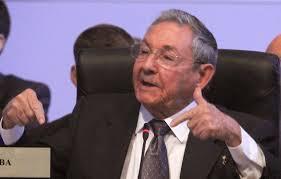
On April 11th after President Obama’s speech that was discussed in a prior post, President Castro delivered his major Summit speech, most of which was a critical review of the history of U.S. relations with Cuba and other Latin American countries.

This post contains substantial extracts from Castro’s speech. Other posts will examine the two presidents’ subsequent private meeting at the Summit plus Obama’s comments on other subjects and the reactions from other leaders.

 President Castro’s Speech

President RAul castro
President Raul Castro

“In 1800, there was the idea of adding Cuba to the [U.S.] to mark the southern boundary of the extensive empire. The 19th century witnessed the emergence of such [U.S.] doctrines as the Manifest Destiny, with the purpose of dominating the Americas and the world, and the notion of the ‘ripe fruit’, meaning Cuba’s inevitable gravitation to the [U.S.], which looked down on the rise and evolution of a genuine rationale conducive to emancipation.”

“Later on, through wars, conquests and interventions that expansionist and dominating force stripped Our America of part of its territory and expanded as far as the Rio Grande.”

“After long and failing struggles, José Martí organized the ‘necessary war’ [for independence against Spain], and created the Cuban Revolutionary Party to lead that war and to eventually found a Republic ‘with all and for the good of all’ with the purpose of achieving ‘the full dignity of man’. . . . Martí committed to the duty ‘of timely preventing the [U.S.] from spreading through the Antilles as Cuba gains its independence, and from overpowering with that additional strength our lands of America.’”

On “April 11, 1898, the President of the [U.S.] requested Congressional consent for military intervention in the [Cuban] independence war already won with rivers of Cuban blood, and that legislative body issued a deceitful Joint Resolution recognizing the independence of the Island ‘de facto and de jure.’ Thus, [the U.S.] entered [this war] as [Cuba’s supposed] ally and seized the country as an occupying force.”

“Subsequently, an appendix was forcibly added to Cuba’s Constitution, the Platt Amendment, that deprived it of sovereignty, authorized the powerful neighbor to interfere in [Cuba’s] internal affairs, and gave rise to Guantánamo Naval Base, which still holds part of our territory without legal right. It was in that period that the [U.S.] invaded the country, and there were two military interventions and support for cruel dictatorships.”

At the time, the prevailing [U.S.] approach to Latin America was the ‘gunboat policy’ followed by the ‘Good Neighbor’ policy. Successive interventions ousted democratic governments and in twenty countries installed terrible dictatorships, twelve of these simultaneously and mostly in South America, where hundreds of thousands were killed. President Salvador Allende [of Peru] left us the legacy of his undying example.”

“It was precisely 13 years ago that a [U.S.] coup d’état staged against beloved [Venezuelan] President Hugo Chavez Frías was defeated by his people. Later on, an oil coup would follow.”

“On January 1st, 1959, sixty years after the U.S. troops entered Havana, the Cuban Revolution triumphed and the Rebel Army commanded by Fidel Castro Ruz arrived in the capital.”

“On April 6, 1960, barely one year after victory, [U.S.] Assistant Secretary of State Lester Mallory drafted a wicked memorandum, declassified tens of years later, indicating that ‘The majority of Cubans support Castro […] An effective political opposition does not exist […]; the only foreseeable means of alienating internal support [to the government] is through disenchantment and disaffection based on economic dissatisfaction and hardship […] to weaken the economic life of Cuba […] denying it money and supplies to decrease monetary and real wages, to bring about hunger, desperation and overthrow of government.’”

“We have endured severe hardships. Actually, 77% of the Cuban people were born under the harshness of the blockade, but our patriotic convictions prevailed. Aggression increased resistance and accelerated the revolutionary process. Now, here we are with our heads up high and our dignity unblemished.”

“When we had already proclaimed socialism and the people had fought in the Bay of Pigs to defend it, President Kennedy was murdered, at the exact time when Fidel Castro, leader of the Cuban Revolution, was receiving [Kennedy’s] message seeking to engage Cuba in a dialogue.”

“After the [U.S.] Alliance for Progress, and [after] having paid our external debt several times over while unable to prevent its constant growth, our countries were subjected to a wild and globalizing neoliberalism, an expression of imperialism at the time that left the region dealing with a lost decade.”

“Then, the [U.S.] proposal of a ‘mature hemispheric partnership’ resulted in the imposition of the Free Trade Association of the Americas (FTAA), –linked to the emergence of these Summits– that would have brought about the destruction of the economy, sovereignty and common destiny of our nations, if it had not been derailed at [the Fourth Summit of the Americas at] Mar del Plata [Argentina] in 2005 under the leadership of Presidents Kirchner, Chavez and Lula. The previous year, Chavez and Fidel had brought to life the Bolivarian Alternative known today as the Bolivarian Alliance for the Peoples of Our America.”

“We have expressed to President Barack Obama our disposition to engage in a respectful dialogue and work for a civilized coexistence between our states while respecting our profound differences. I welcome as a positive step his recent announcement that he will soon decide on Cuba’s designation in a list of countries sponsor of terrorism, a list in which it should have never been included.”

“Up to this day, the [U.S.] economic, commercial and financial blockade is implemented against the island with full intensity causing damages and scarcities that affect our people and becoming the main obstacle to the development of our economy. The fact is that it stands in violation of International Law, and its extraterritorial scope disrupts the interests of every State.”

“We have publicly expressed to President Obama, who was also born under the blockade policy and inherited it from 10 former Presidents when he took office, our appreciation for his brave decision to engage the U.S. Congress in a debate to put an end to such policy.” In an apparent extemporaneous addition, Castro said, “I apologize to Obama for expressing myself so emotionally. President Obama has no responsibility for this. There were 10 presidents before him; all have a debt to us, but not President Obama. . . . I have read his books — parts of them — and I admire his life.”

“This and other issues should be resolved in the process toward the future normalization of bilateral relations.”

“As to us, we shall continue working to update the Cuban economic model with the purpose of improving our socialism and moving ahead toward development and the consolidation of the achievements of a Revolution that has set to itself the goal of ‘conquering all justice.’”

“Venezuela is not, and it cannot be, a threat to the national security of a superpower like the United States. We consider it a positive development that the U.S. President has admitted it.”

A major section of the Castro speech covered Cuba’s continued advocacy for the ideals of the Revolution, for true international governance of the Internet, for changes in hemispheric relations and cooperation against cyber warfare, climate change, terrorism, drug-trafficking organized crime and inequality and for eradication of poverty, illiteracy and hunger. He also commended the efforts in these areas of CELAC [Community of Latin American and Caribbean States], UNASUR [Union of South American Nations], CARICOM [Caribbean Community], MERCOSUR [Southern Common Market], ALBA-TCP [Bolivarian Alliance of the Peoples of Our America—Peoples’ Trade Treaty], SICA [System for Integration of Central America] and ACS [Association of Caribbean States].

Castro concluded with these words: “Cuba, a small country deprived of natural resources, that has performed in an extremely hostile atmosphere, has managed to attain the full participation of its citizens in the nation’s political and social life; with universal and free healthcare and education services; a social security system ensuring that no one is left helpless; significant progress in the creation of equal opportunities and in the struggle against all sorts of discrimination; the full exercise of the rights of children and women; access to sports and culture; and, the right to life and to public safety.”

“Thanks to Fidel and the heroic Cuban people, we have come to this Summit to honor Martí’s commitment, after conquering freedom with our own hands ‘proud of Our America, to serve it and to honor it […] with the determination and the capacity to contribute to see it loved for its merits and respected for its sacrifices.’”

Conclusion.

It would be easy to criticize this speech as an unnecessary historical review going back to the late 19th century and as an unproductive way to advance the cause of Cuba-U.S. reconciliation in 2015.

On the other hand, I see the speech as a necessary recital to the U.S., other countries in the hemisphere and the world of the reasons for Cuba’s historical and current suspicions of U.S. motives and actions and for Cuba’s wariness in engaging in the current negotiations for restoration of normal relations with the U.S. Nevertheless, this history is not preventing Cuba ifrom engaging in those negotiations, and by its actions Cuba is demonstrating that such reconciliation is in Cuba’s national interest.


President Obama’s Major Speech at the Summit of the Americas

On April 10 and 11, Cuba for the first time was welcomed to the Summit of the Americas. Presidents Raul Castro and Barack Obama exchanged handshakes and friendly greetings, and their speeches promised commitment to the process of reconciliation. Other leaders of the Americas celebrated this demonstration of reconciliation.

President Obama made several speeches and remarks at the Summit. This post will discuss his April 11th speech to the Summit’s plenary meeting; subsequent posts will cover his other remarks and those of President Castro.

 President Obama’s Speech

Obama

“When I came to my first Summit of the Americas six years ago, I promised to begin a new chapter of engagement in this region.  I believed that our nations had to break free from the old arguments, the old grievances that had too often trapped us in the past; that we had a shared responsibility to look to the future and to think and act in fresh ways.  I pledged to build a new era of cooperation between our countries, as equal partners, based on mutual interest and mutual respect.  And I said that this new approach would be sustained throughout my presidency; it has, including during this past year.  I’ve met that commitment.”

“We come together at a historic time.  As has already been noted, the changes that I announced to U.S. policy toward Cuba mark the beginning of a new relationship between the people of the United States and the people of Cuba.  It will mean, as we’re already seeing, more Americans traveling to Cuba, more cultural exchanges, more commerce, more potential investment.  But most of all, it will mean more opportunity and resources for the Cuban people.  And we hope to be able to help on humanitarian projects, and provide more access to telecommunications and the Internet, and the free flow of information.”

“We continue to make progress towards fulfilling our shared commitments to formally reestablish diplomatic relations, and I have called on Congress to begin working to lift the embargo that’s been in place for decades.  The point is, the [U.S.] will not be imprisoned by the past.  We’re looking to the future and to policies that improve the lives of the Cuban people and advance the interests of cooperation in the hemisphere.”

“This shift in U.S. policy represents a turning point for our entire region.  The fact that President Castro and I are both sitting here today marks a historic occasion.  This is the first time in more than half a century that all the nations of the Americas are meeting to address our future together.  I think it’s no secret — and President Castro, I’m sure, would agree — that there will continue to be significant differences between our two countries.  We will continue to speak out on behalf of universal values that we think are important.  I’m sure President Castro will continue to speak out on the issues he thinks are important.”

“But I firmly believe that if we can continue to move forward and seize this momentum in pursuit of mutual interests, then better relations between the [U.S.] and Cuba will create new opportunities for cooperation across our region — for the security and prosperity and health and dignity of all our people.”

“Now, alongside our shift toward Cuba, the [U.S.] has deepened our engagement in the Americas across the board.  Since I took office, we’ve boosted U.S. exports and also U.S. imports from the rest of the hemisphere by over 50 percent.  And that supports millions of jobs in all of our countries.  I’ve proposed $1 billion to help the people of Central America strengthen governance, and improve security and help to spark more economic growth and, most importantly, provide new pathways for young people who too often see their only prospects an underground economy that too often leads to violence.”

“We’re partnering with countries across the region to develop clean, more affordable and reliable energy that helps nations to combat the urgent threat of climate change, as [Brazil’s] President Rousseff already noted.  Our 100,000 Strong in the Americas initiative is working to bring 100,000 students from Latin America to the [U.S.] and 100,000 students from the [U.S.] to Latin America.  The new initiatives that I announced in Jamaica will help empower a new generation of young people across the Americas with the skills and job training that they need to compete in the global economy.”

“During the course of my meetings with CARICOM [Caribbean Community], as well as my meetings with SICA [System for Integration of Central America] as well as the discussions that I’ve had with many of you bilaterally, there have been additional ideas that we’re very interested in — finding ways in which we can expand access to the Internet and broadband; how we can structure private-public partnerships to rebuild infrastructure across the region; and to expand our commercial ties in a broad-based and inclusive way.  Because I am firmly of the belief that we will only succeed if everybody benefits from the economic growth, not just a few at the top.”

“At home, I’ve taken executive actions to fix as much of our broken immigration system as I can, which includes trying to help people come out of the shadows so that they can live and work in a country that they call home.  And that includes hundreds of thousands of young people we call DREAMers, who have already received temporary relief.  And I’m remaining committed to working with our Congress on comprehensive immigration reform.”

“So the bottom line is this:  The [U.S.] is focused on the future.  We’re not caught up in ideology — at least I’m not.  I’m interested in progress and I’m interested in results.  I’m not interested in theoretic arguments; I’m interested in actually delivering for people.  We are more deeply engaged across the region than we have been in decades.  And those of you have interacted with me know that if you bring an issue to my attention, I will do my best to try to address it.  I will not always be able to fix it right away, but I will do my best.”

“I believe the relationship between the [U.S.] and the Americas is as good as it has ever been.  I’m here today to work with you to build on this progress.  Let me just mention a few areas in which I think we can make more progress.”

“First, we will continue to uphold the Inter-American Democratic Charter, which states that “the peoples of the Americas have a right to democracy.”  I believe our governments, together, have an obligation to uphold the universal freedoms and rights of all our citizens.  I want to again commend [Panama’s] President Varela and Panama for making civil society groups from across the region formal partners in this summit for the first time.  I believe the voices of our citizens must be heard.  And I believe going forward, civil society should be a permanent part of these summits.”

“Second, we have to focus on reigniting economic growth that can fuel progress further in those communities that have not been reached.  And that means making the Americas more competitive.  We still have work to do to harmonize regulations; encourage good governance and transparency that attracts investment; invest in infrastructure; address some of the challenges that we have with respect to energy.  The cost of energy in many communities — in many countries, particularly in Central American and the Caribbean, are so high that it presents a great challenge to economic development, and we think that we can help particularly around clean energy issues.”

“We have to confront the injustice of economic inequality and poverty.  I think that collectively we are starting to identify what programs work and which programs do not work.  And we should put more money in those things that do work, and stop doing those things that don’t.  We don’t have money to waste because of too many young people out there with enormous needs.  I think President Varela is right to focus particularly on education and skills building.  And this is an agenda which we should all tackle collectively.”

“Third, we have to keep investing in the clean energy that creates jobs and combats climate change.  The [U.S.] is today leading this global effort, along with many of you.  And I should point out that America’s carbon pollution is near its lowest level in almost two decades.  Across the Americas, I think we have the opportunity to expand our clean energy partnerships and increase our investments in renewables.”

“And finally, we have to stand firm for the security of our citizens.  We must continue to join with our partners across the region, especially in Central America, but also in the Caribbean, to promote an approach, a holistic approach that applies rule of law, respects human rights, but also tackles the narco-traffickers that devastate so many communities.  This is a shared responsibility.  And I’ve said before that the [U.S.] has a responsibility to reduce the demand for drugs and to reduce the flow of weapons south, even as we partner with you to go after the networks that can cause so much violence.”

“So, a new relationship with Cuba.  More trade and economic partnerships that reduce poverty and create opportunity, particularly focusing on education.  Increased people-to-people exchanges.  More investment in our young people.  Clean energy that combats climate change.  Security cooperation to protect our citizens and our communities.  That’s the new chapter of engagement that the [U.S.] is pursuing across the Americas.”

“I want to make one last comment addressing some of the points that [Ecuador’s] President Correa raised and I’m sure will be raised by a few others during this discussion.  I always enjoy the history lessons that I receive when I’m here.  I’m a student of history, so I tend to actually be familiar with many of these episodes that have been mentioned.  I am the first one to acknowledge that America’s application of concern around human rights has not always been consistent.  And I’m certainly mindful that there are dark chapters in our own history in which we have not observed the principles and ideals upon which the country was founded.”

“Just a few weeks ago, I was in Selma, Alabama celebrating the 50th anniversary of a march across a bridge that resulted in horrific violence.  And the reason I was there, and the reason it was a celebration, is because it was a triumph of human spirit in which ordinary people without resort to violence were able to overcome systematic segregation.  Their voices were heard, and our country changed.”

“America never makes a claim about being perfect.  We do make a claim about being open to change.  So I would just say that we can, I suppose, spend a lot of time talking about past grievances, and I suppose that it’s possible to use the [U.S.] as a handy excuse every so often for political problems that may be occurring domestically.  But that’s not going to bring progress.  That’s not going to solve the problems of children who can’t read, who don’t have enough to eat.  It’s not going to make our countries more productive or more competitive in a global economy.”

“So I just want to make very clear that when we speak out on something like human rights, it’s not because we think we are perfect, but it is because we think the ideal of not jailing people if they disagree with you is the right ideal.”

“Perhaps President Correa has more confidence than I do in distinguishing between bad press and good press.  There are a whole bunch of press that I think is bad, mainly because it criticizes me, but they continue to speak out in the [U.S.] because I don’t have confidence in a system in which one person is making that determination.  I think that if we believe in democracy it means that everybody has the chance to speak out and offer their opinions, and stand up for what they believe is right, and express their conscience, and pray as they would, and organize and assemble as they believe is appropriate — as long as they’re not operating violently.”

“So we will continue to speak out on those issues not because we’re interested in meddling, but because we know from our own history.  It’s precisely because we’re imperfect that we believe it’s appropriate for us to stand up.  When Dr. King was in jail, people outside the United States spoke up on his behalf.  And I would be betraying our history if I did not do the same.”

“The Cold War has been over for a long time.  And I’m not interested in having battles that, frankly, started before I was born.  What I am interested in is solving problems, working with you.  That’s what the [U.S.] is interested in doing.  That’s why we’ve invested so much in our bilateral relationships, and that’s why I will continue to invest in creating the kind of spirit of equal partnership and mutual interest and mutual respect upon which I believe progress can advance.”