The top officials of the U.S. Commission on International Religious Freedom –Its Chairperson, Robert P. George, and its Vice Chairperson, Katrina Lantos Swett –recently have been entering the public forum to discuss that freedom. A prior post reviewed their recent essay in the Wall Street Journal entitled “Religious Freedom Is About More Than Religion.”
The Criticism
Now in the Washington Post they have criticized the U.S. Government for its alleged failure to comply with the requirements of the International Religious Freedom Act of 1998 (“the Act“). They assert that the statute requires all administrations to conduct annual reviews and designations of “countries of particular concern,” defined as those governments engaging in or allowing ‘systematic, ongoing, egregious” violations.’” Unfortunately, they continue, “neither Republican nor Democratic administrations have consistently designated countries that clearly meet the standard for offenders.”
Now, the Commission leaders say, “a key deadline for action [is] arriving this month, [and] it is time to confront this unwise failure to act.”As a result, they ask Congress to press the executive branch “to apply the International Religious Freedom Act fully and the country designation process decisively.”
Analysis
George and Swett apparently refer to section 402 (b)(1) (A) of the Act, which states:
“Not later than September 1 of each year, the President shall review the status of religious freedom in each foreign country to determine whether the government of that country has engaged in or tolerated particularly severe violations of religious freedom in that country during the preceding 12 months or since the date of the last review of that country under this subparagraph, whichever period is longer. The President shall designate each country the government of which has engaged in or tolerated violations described in this subparagraph as a country of particular concern for religious freedom.”
Guidance on this requirement is provided in section 402(b)(1)(B) of the Act, which says that such presidential review “shall be based upon information contained in the latest [State Department} Country Reports on Human Rights Practices, the [State Department’s] Annual Report [on International Religious Freedom], and on any other evidence available and shall take into account any findings or recommendations by the [U.S.] Commission [on International Religious Freedom] with respect to the foreign country.”
Given these statutory provisions, I think George and Swett erroneously say that various administrations have failed to comply with section 402 (b)(1)(A) of the Act. That provision, as I read it, invests the president with the exclusive authority to make the determination of whether another country has “engaged in or tolerated particularly severe violations of religious freedom.” In so doing, the president determination shall be based on any available evidence, including said reports by the State Department and the Commission.
Moreover, Ms. Swett undercut her and Mr. George’s criticism when she acknowledged the Commission has limited authority when compared with the U.S. Department of State and implicitly the U.S. President.
In an interview about whether or not the U.S. should grant a visa to an Indian politician, she said, “The State Department has a more difficult job than we do because they are balancing American security interests, American commercial interests, American cultural interests, American exchange interests, a whole range of diplomatic interests, and one of the things that they are putting into that mix is the defense of our fundamental values, human rights and religious freedom and other such things. Because of its much larger portfolio the State Department cannot be as single-minded as we are.”
On August 7, 2013, the U.S. Department of State announced its formation of the Office of Faith-Based Community Initiatives as “the [U.S.] portal for engagement with religious leaders and organizations around the world . . . [to ensure] that their voices are heard in the policy process and [to work] with those communities to advance U.S. diplomacy and development objectives.”
John Kerry
In making this announcement, U.S. Secretary of State John Kerry said, “there is common ground between the Abrahamic faiths, and, in fact, between the Abrahamic faiths and all religions and philosophies. . . . All of these faiths are virtuous and in fact, most of them, tied together by the golden rule, as well as fundamental concerns about the human condition, about poverty, about relationships between peoples, our responsibilities each to each other. And they all come from the same human heart.”
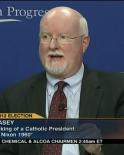
The Director of the new Office is Dr. Shaun Casey, a professor of Christian ethics at Wesley Theological Seminary in Washington, D.C. and a Senior Advisor for Religious Affairs and National Evangelical Coordinator for Barack Obama’s 2008 presidential campaign.
At the announcement of the new Office, Dr. Casey said, “religious leaders and faith communities . . . have an influence and shape our foreign policy concerns here in the [U.S., and it is] essential for the [U.S.] to understand them and to bring them into our diplomacy and diplomatic efforts.”
The Office already has a Strategy on Religious Leader and Faith Community Engagement to encourage “U.S. government officials to develop and deepen their relationships with religious leaders and faith communities . . . to advance the following objectives:”
“Promote sustainable development and more effective humanitarian assistance.”
“Advance pluralism and human rights, including the protection of religious freedom.”
“Prevent, mitigate, and resolve violent conflict and contribute to local and regional stability and security.”
The executive branch of the U.S. federal government also has the following other agencies or offices relating to religion and faith-based communities:
The State Department’s Office of International Religious Freedom, which is headed by an Ambassador at Large for International Religious Freedom, who serves as the principal advisor to both the President of the U.S. and Secretary of State for Religious Freedom globally.
The State Department’s Envoy to Monitor and Combat Anti-Semitism, who since 2004 has developed and implemented policies and projects to support efforts to combat anti-Semitism.
The State Department’s Envoy to the Organization of Islamic Cooperation, who since 2010 has sought to deepen and expand U.S. partnerships with OIC member countries and Muslim communities around the world.
U.S. Agency for International Development’s Center for Faith-Based and Community Initiatives, which provides “a bridge for faith-based and community groups seeking to connect with USAID’s mission, . . . [convenes] faith-based and community groups to catalyze new opportunities for collaboration between these groups, and between these groups and the government [and helps] to eliminate barriers encountered by faith-based and community organizations seeking to partner with USAID on a range of global development issues, including global health, child survival and food security.”
The White House’s Office of Faith-based and Neighborhood Partnerships, which “coordinates Centers for Faith-based and Neighborhood Partnerships in various federal agencies . . . . [and] coordinates the President’s Advisory Council on Faith-based and Neighborhood Partnerships.”
In a prior post I described my April 1989 meeting in El Salvador with Salvador Ibarra. He told me and others that a Salvadoran judge had appointed him to represent one of the Salvadoran national guardsmen accused of raping and murdering the four American church women in December 1980.[1]
Someone from the U.S. Embassy, he told us, had asked Ibarra to call a press conference and announce that he had investigated and had found no involvement of higher officials in this horrible crime. This, however, was not true, and he refused to hold a press conference. In response he received death threats that prompted him and his family to flee the country.
I recently came across a May 1985 article that has additional information about his involvement in this notorious case.
The article confirms that Ibarra was appointed by a Salvadoran court to represent one of the national guardsmen accused of this crime, that Ibarra was pressured to not contradict a false statement that the possibility of a cover-up by higher officials had been investigated and found to be baseless and that he received death threats if he did not go along with this strategy.
This pressure, the article reports Ibarra having said, came from other defense lawyers. One was the half-brother of the director of the Salvadoran National Guard while another was a childhood friend of the Salvadoran Minister of Defense at the time, Jose Guillermo Garcia.[2]
When Ibarra told the other lawyers he would not cooperate in this plan, the article states Ibarra said he “was abducted by Salvadoran security forces, held prisoner at national guard headquarters and tortured.” The purpose of his detention and torture, Ibarra said in the article, “was to get him off the case, either by killing him or forcing him to flee the country.”
Sadly Ibarra is deceased, and I cannot ask him questions about this article. But neither account of his involvement in the case directly contradicts the other. Perhaps both are true. There undoubtedly are additional details about this case that probably would emerge in an extended conversation that unfortunately will never happen.
In any event, Ibarra is still a witness and inspiration to me of a courageous lawyer who risked his life to stand up for the truth and zealously to represent his client in a very important case. Moreover, as discussed in the prior post, after having fled to the U.S. because of these pressures, he later returned to his country to be a lawyer for the Lutheran Church’s human rights office, an occupation that again put his life on the line during the Salvadoran Civil War.
Muchas gracias, Salvador Ibarra!
[1] Many prior posts have discussed this horrible crime, its various judicial and non-judicial investigations and my visits to the site of the crime and of the women’s graves in El Salvador.
[2] Other posts have discussed Garcia’s involvement in legal proceedings about this and other crimes in that country.
The first was the congregational unison Prayer of Confession that spoke to the sin of pride that infects most of us in these times. The words went as follows:
“Oh Lord, we come before you, knowing that even in our vast knowledge we remain ignorant of ourselves, deceiving and blinding ourselves. We lose hold of that knowledge given us at creation, of God’s generous and continuing favor toward us, and of the original nobility that God bestowed upon our ancestor Adam. When we do remember our great gifts, we think of them as belonging to us alone, in boasting and self-assurance, when we ought instead to honor those gifts among our neighbors, for Scripture bids us to esteem others above ourselves, and to apply ourselves wholly to doing them good. We despise others, and forget that in despising them we despise ourselves, for we re together made in the image of God.”
The second part of the service was the hymn Tu Has Venido a la Orilla (Lord, You Have Come to the Lakeshore), whose gentle melody is reminiscent of a rocking boat by a lakeshore and which is easy to sing. Its lyrics are based upon Matthew 4: 18-20, when Jesus encountered two fishermen (Peter and Andrew) casting their net into the Sea of Galilee and asked them to follow him and be fishers of men and women.The lyrics go on to urge us to do the same.
Here are the words of its refrain as translated into English: “O Lord, with Your eyes You have searched me, And, while smiling, have called out my name. Now my boat’s left on the shoreline behind me, Now with You I will seek other seas.” The four verses go as follows:
“You have come up to the lakeshore, Looking neither for wise nor wealthy.You only wanted that I should follow.” (Refrain)
“You know that I own so little, In my boat there’s no money or weapons, You’ll only find there my nets and labor.” (Refrain)
“You need the caring of my hands.Through my tiredness, may others find resting. You need a love that just goes on loving.”(Refrain)
“You, who have fished other oceans, Ever longed for by souls that are waiting, My dear and good friend, as thus You call me.”(Refrain)
The Presbyterian Hymnal also contains the original Spanish verses. While most of the Westminster congregants sing the English version, some sing the Spanish. With my very rudimentary Spanish language skills, I softly sang the Spanish words to remind me of my one trip to Spain and many others to Latin America and of my friends throughout the latter region. It thus becomes for me a song of solidarity.
Cesáreo Gabaráin
This hymn was written in 1979 by Cesáreo Gabaráin (1936-1991), a Spanish Roman Catholic priest and composer of over 500 liturgical songs. He also held the position of Chaplain Prelate for Pope John Paul II.
[1] The bulletin and audio and video recordings of the service are online.
This beloved hymn was sung as an anthem by the choir at the July 28th worship service at Minneapolis’ Westminster Presbyterian Church.[1] Listening to it was enriching although joining in congregational singing of the hymn would have been even more meaningful.
At least for me, however, there is not enough time while listening to an anthem or singing a hymn to ponder the true meaning and significance of its words. I recently have discovered that gaining a better and deeper understanding of a hymn or anthem requires subsequent meditation on the words, researching the hymn’s history and writing an essay recording the results of that meditation and research. In short, such a practice has become a spiritual discipline.[2]
The Lyrics
Here are the lyrics of the three verses of “Come, Thou Fount of Every Blessing:”
1. Come, thou Fount of every blessing,
tune my heart to sing thy grace;
streams of mercy, never ceasing,
call for songs of loudest praise.
Teach me some melodious sonnet,
sung by flaming tongues above.
Praise the mount! I’m fixed upon it,
mount of thy redeeming love.
2. Here I raise mine Ebenezer;
hither by thy help I’m come;
and I hope, by thy good pleasure,
safely to arrive at home.
Jesus sought me when a stranger,
wandering from the fold of God;
he, to rescue me from danger,
interposed his precious blood.
3. O to grace how great a debtor
daily I’m constrained to be!
Let thy goodness, like a fetter,
bind my wandering heart to thee.
Prone to wander, Lord, I feel it,
prone to leave the God I love;
here’s my heart, O take and seal it,
seal it for thy courts above.
The hymn testifies to the amazing graces God provides to human beings. God bestows “streams of mercy, never ceasing.” By God’s “help I’m come” thus far in my life, and with God’s “good pleasure, [ I hope] safely to arrive at home.” “Jesus sought me when a stranger, wandering from the fold of God; he, to rescue me from danger.” [3]
Confession of sin also is prominent in the hymn. The human being has a “wandering heart” that is “prone to wander” and “prone to leave the God I love.” The human can be and has been a “stranger, wandering from the fold of God.”
Therefore, the human being needs constraints, binders and fetters to combat this impulse to wander. The human needs God to “tune my heart to sing thy grace.”
God responds to this need with “goodness.” The human in turn responds with “songs of loudest praise.” “Praise the . . . mount of thy redeeming love.” “Fount of every blessing.” The human then offers “my heart, O take and seal it, seal it for thy courts above.”
The hymn’s reference to raising “my Ebenezer” long baffled me. The answer is found in the following passages of First Samuel in the Hebrew Bible (the Old Testament), which is believed to have been written in the seventh century BCE:
Israel was engaged in battles with the Philistines. While Israel’s troops were encamped near the village of Ebenezer, the Philistines routed Israel and seized the Arc of the Covenant in accordance with the ancient custom of taking the statue of the god of the defeated enemy as booty. (1 Samuel 4-5.)
Seven months later the Philistines returned the Arc of the Covenant to Israeli people in the town of Beth-shemesh who subsequently delivered it to the people of the town of Kiriath-jearim. (1 Samuel 6-7:1.)
Twenty years passed, and Samuel, a prophet and judge, told the people of Israel. “If you are returning to the Lord with all your heart, then put away the foreign gods [and idols] . . . from among you. Direct your heart to the Lord, and serve Him only, and he will deliver you out of the hand of the Philistines.” (1 Samuel 7: 2-3.)
The people did as they were told, and Samuel said, “Gather all Israel at [the town of] Mizpah, and I will pray to the Lord” for forgiveness for your sins and for deliverance from the Philistines. The Israeli people then gathered at Mizpah for this religious ceremony. (1 Samuel 7: 4-6.)
When the Philistines learned of this assembly, their troops advanced to attack the Israeli people at Mizpah. The Lord, however, “threw [the Philistines] into confusion; and they were routed before Israel.” (1 Samuel 7: 7-11.)
To commemorate this event, “Samuel took a stone and set it up between Mizpah and [the village of] Jeshanah, and named [the stone] Ebenezer [stone of help and the site of the prior victory of the Philistines]; for he said, “Thus far the Lord has helped us.” (1 Samuel 7:12.) In other words, Samuel publicly dedicated this stone, according to another blogger, “as a monument to God’s help, God’s faithfulness, God’s eternal covenant. And as the people got on with their lives, the stone stood there, visible to all who passed that way, a reminder of judgment and repentance, mercy and restoration.”
Thus, “Here I raise my Ebenezer; hither by thy help I’m come” is a metaphorical way of saying that I recognize that God has helped me reach this point in my life and that it is important to create an outward expression of this recognition and gratitude.
The Lyricist
Robert Robinson
The lyrics were written around 1757 by Robert Robinson, an Englishman then age 22 and a recent convert to Evangelical Methodism. In 1759 after a brief period at a Congregational Chapel, he joined Stone-Yard Baptist Chapel in Cambridge, England. There he remained for most of the rest of his life, first as Lecturer and then, from 1762 to at least 1788, as Pastor.
Although Robinson had argued against Unitarianism for many years, in 1788 he apparently converted to that faith although never doubting the full divinity of Jesus Christ. In 1790 he visited Joseph Priestly, a noted Unitarian in Birmingham, England [4] and preached several sermons at his chapels. There Robinson died and was buried in that city’s Dissenters’ Burial Ground.
The Composer, Publisher and Arranger
Asahel NettletonJohn Wyeth
In the U.S., the hymn is usually set to an American folk tune known as Nettleton, composed by Asahel Nettleton (1783 –1844), an American theologian and pastor from Connecticut who was highly influential during the Second Great Awakening.
In 1813 the hymn and music were included in the Repository of Sacred Music, Part Second that was published by John Wyeth, a Philadelphia printer. This book and its predecessor, the Repository of Sacred Music, were highly successful, selling over 150,000 copies. In the preface to his work, Wyeth claimed three qualifications as a compiler of sacred music: years of attention to the charms of church music; acquaintance with the taste of eminent teachers; and the possession of more than a thousand pages of music to use.
Howard Don Small
The musical arrangement used at Westminster on July 28th was by Howard Don Small (1933-2007), who had been the Choirmaster and Organist at Minneapolis’ St. Mark’s Episcopal Cathedral. When he retired from St. Mark’s in 1998, a choir member expressed appreciation for Small’s “qualities of professionalism, musicianship, and leadership;” gratitude . . . for the opportunity to grow, learn, and deepen my spirituality; sadness – that [Small] will be leaving, but also; happiness – that [Small] will be able to be relieved of the extreme pressure of your role to do things at a manageable and enjoyable pace.”
Conclusion
Melanie OhnstadJere Lantz
Merely recounting the involvement over 250 years of four men in the creation, publication and arrangement of this hymn (and anthem) and then the Westminster choir’s singing the hymn under the direction of Jere Lantz with the organ accompaniment by Westminster Minister of Music & the Arts/Organist, Melanie Ohnstad, brings to mind two Scriptural passages.
All of these individuals are members of the “cloud of witnesses” (Hebrews 12:1-2) who meld their different gifts into one body to produce something pleasing to God (Romans 12: 3-8). Including Samuel in this cloud of witnesses, as we should, expands the time period to over 2,700 years.
I must confess that the Howard Don Small arrangement that was sung by the choir made a significant, and, I think, unfortunate change in the lyrics. Instead of “Here I raise my Ebenezer; hither by thy help I’m come,” they sang “Here I find my greatest pleasure; In the help I hope I’m come.” (I am not too sure about the latter part of this substitution.) This change undoubtedly was prompted by the arranger’s knowing that many people today do not understand the reference to “raising my Ebenezer.”
This wording change, however, obliterates Robinson’s meaning and also prevents people from researching and discovering that true meaning. A professor at Gordon-Conwell Theological Seminary, Gary A. Parrett, has been crusading against such changes to this hymn. His article in Christianity Today expressed the following reasons for this opposition, which I endorse:
“Robinson [undoubtedly] felt he had found just the right expression to say what needed to be said. His phrasing, in this case, was succinct, biblical, pointed, poignant, and poetic.”
The “revisions are, at best, inconsistent attempts to be culturally relevant. How can the revisers leave in words like hither and fetter, as they typically do, while Ebenezer is heartlessly expunged?”
The revisions ignore the Biblical foundation for Robinson’s words, as pointed out above. As Parrett says, the “single word [Ebenezer] ushers the worshiper into both the biblical episode and the greater narrative of God’s redemptive dealings with his people. It points us, also, to Robinson’s dramatic conversion three years before he penned the hymn, inviting us to reflect upon our own stories and to remember God’s faithful dealings with us. By removing the word from the hymn, we likely remove it from believers’ vocabularies and from our treasury of spiritual resources.”
“What we have in such revisions is the worst sort of accommodation, even contribution, to biblical illiteracy. Our faith is filled with names and terms that were unfamiliar to us when we joined the family—atonement, propitiation, Sabbath, Passover, Melchizedek. What are we to do with such terms? We teach! How difficult would it be to simply explain the reference to Ebenezer?”
[1] The bulletin and a video and audio recording of this service are available online.
[3] These words remind me of the third verse of another great hymn, Amazing Grace: “Through many dangers, toils and snares I have already come; ‘Tis Grace that brought me safe thus far and Grace will lead me home.”
[4]Priestly (1733 –1804) was an 18th-century English theologian, Dissenting clergyman, natural philosopher, chemist, educator, and political theorist. He usually is credited with the discovery of oxygen
The top officials of the U.S. Commission on International Religious Freedom have set forth compelling reasons why religious freedom around the world is important. Its Chairperson, Robert P. George, and its Vice Chairperson, Katrina Lantos Swett, have done so in an essay in the Wall Street Journal entitled “Religious Freedom Is About More Than Religion.”
Dr. Robert P. GeorgeDr. Katrina Lantos Swett
They assert, “To respect fundamental human rights is to favor and honor the [human being] . . . who is protected by those rights—including the rights to freedom of speech, press, assembly and religion.” Therefore, honoring the individual human being favors “human flourishing in its many dimensions. For those who regard humans not just as material beings but also as spiritual ones—free, rational and responsible—it is obvious that their spiritual well-being is no less important than their physical, psychological, intellectual, social and moral well-being.”
Such human flourishing “requires respect for their freedom—as individuals and together with others in community—to address the deepest questions of human existence and meaning. This allows them to lead lives of authenticity and integrity by fulfilling what they conscientiously believe to be their religious and moral duties.”
Moreover, religious “faith by its nature must be free. A coerced ‘faith’ is no faith at all. Compulsion can cause a person to manifest the outward signs of belief or unbelief. It cannot produce the interior acts of intellect and will that constitute genuine faith.” Indeed, coercion “in the cause of belief, whether religious or secular, produces not genuine conviction, but pretense and inauthenticity.”
Religious freedom, therefore, must “include the right to change one’s beliefs and religious affiliation. It also includes the right to witness to one’s beliefs in public as well as private, and to act—while respecting the equal right of others to do the same—on one’s religiously inspired convictions in carrying out the duties of citizenship.”
As a result, “one of the aims of U.S. foreign policy should be to combat . . . [religious] intolerance—not just because religious freedom reduces the risk of sectarian conflict, but more fundamentally because it protects the liberty that is central to human dignity.”
Conclusion
This statement echoes the words of the international legal instruments that appropriately guide the work of the U.S. Commission on International Religious Freedom: the Universal Declaration of Human Rights, which the U.S. supported in the U.N. General assembly in 1948, and the International Covenant on Civil and Political Rights, which the U.S. ratified in 1992.
The Universal Declaration opens with these words in its Preamble: “recognition of the inherent dignity and of the equal and inalienable rights of all members of the human family is the foundation of freedom, justice and peace in the world.” It then declares in Article 18, “Everyone has the right to freedom of thought, conscience and religion; this right includes freedom to change his religion or belief, and freedom, either alone or in community with others and in public or private, to manifest his religion or belief in teaching, practice, worship and observance.”
These latter words are essentially repeated in Article 18(1) of the International Covenant. Its Article 18(2) goes on to say, “No one shall be subject to coercion which would impair his freedom to have or to adopt a religion or belief of his choice.”