On May 3, 2012, 10 teenager members of the Diyar Dance Theater of Bethlehem, Palestine presented their “Portraits of Fear . . . Room for Hope” at the Women’s Club of Minneapolis’ packed auditorium. It was the opening event in Westminster Presbyterian Church’s Palestinian Arts Festival.
This performance emphasized the process of creating hope in the midst of fear in the following six segments:
Palestinian young people come together from different neighborhoods to discover their identities and self-confidence in the midst of oppression.
The young people try to develop a positive spirit in the face of depressing information in the newspapers about the occupation.
The young people live within many social constraints created by men oppressing women, the old oppressing the young and the strong oppressing the weak.
The young people face lack of work opportunities with 40% youth unemployment.
Fears of isolation help the young people unite to become stronger as a community.
The young people find strength by uniting to forge hope, artistic confidence and a feeling of freedom.
The Diyar Dance Theater is a program of the Evangelical Lutheran Christmas Church of Bethlehem, Palestine, which is a partner of Westminster Presbyterian Church. Its mission is to celebrate Bethlehem’s rich history and culture and to nurture creativity, imagination and freedom of expression.
On May 6, 2012, two Palestinian Christian hymns had their world premiers during the Sunday morning worship service at Minneapolis’ Westminster Presbyterian Church. Both were commissioned by two Westminster members to celebrate the church’s partnership with Evangelical Lutheran Christmas Church of Bethlehem, Palestine.
The music for these hymns was written by Palestinian musicians Marwan Abado, Naser Musa and Georges Lammam. They along with three others (Antoine Lammam, Miles Jay and Tim O’Keefe) constitute the Georges Lammam Ensemble who were present and played and sung the hymns and other Middle Eastern music during the service. The lyrics for both were written by Rev. Dr. Mitri Raheb, the Pastor of the Christmas Church.
The first hymn, Ahar (We Are Free), had three verses and refrain that were a Christian response to the realities of the contemporary Middle East. The hymn’s lyrics in Arabic were on the cover of the church bulletin for the service shown at the right. The verses were sung in Arabic by the Ensemble to their own accompaniment on Middle Eastern instruments. The refrain was sung in English by the congregation:
“We’re free, unbound from slavery.
We’re free, in our humanity.
As dark as it may seem, we’ll work toward the dream until we see the beam, the light of liberty.
We’re free. We’re free. We’re free.”
The lyrics for the other hymn, Ghanu Lil Hayat (A Hymn for Life) had a message of resurrection to be sung in the Easter season. Its two verses were sung in Arabic by the Palestinian musicians with their own accompaniment, and the congregation repeated the first verse in Arabic:
Lai sa ho wa ha hou naa ha hou naa
Kuf fu a’n nii bu kaa caa ma naa buu ha y aat
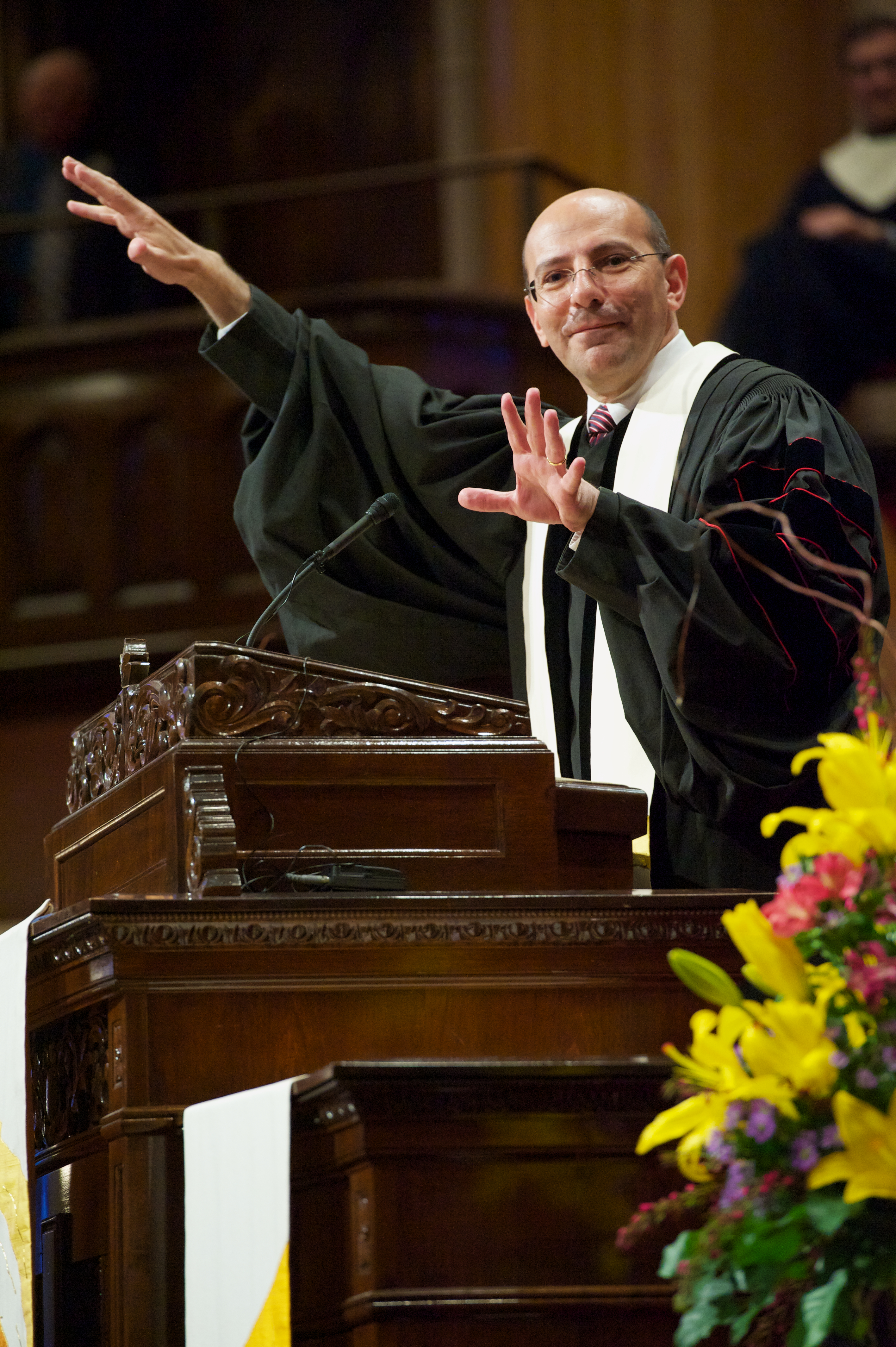
Rev. Raheb (Northenscold photo)
Rev. Raheb delivered the sermon, “A Village Tour,” based on this passage from the Gospel of Mark (1: 35-39):
“In the morning, while it was still very dark, [Jesus] got up and went out to a deserted place, and there he prayed. And Simon and his companions hunted for him. When they found [Jesus], they said to him, ‘Everyone is searching for you.’ He answered, ‘Let us go on to the neighboring towns, so that I may proclaim the message there also; for that is what I came out to do.’ And he went throughout Galilee, proclaiming the message in their synagogues and casting out demons.”
This passage, Raheb said, was a short summary of Jesus’ political program. In the context of His having been born, raised and lived under Roman occupation and having been oppressed day and night, He was faced with the question, how can His people be liberated?
To answer this question, Raheb continued, Jesus chose not to go to Rome, the capitol of the occupying power, to demand that the people be liberated. Nor did He have any desire to be a king or religious leader or the founder of a political party. Jesus had a different concept of liberation. Instead He chose to go on a village tour to preach, teach and heal the people who were marginalized, who were not in control of their lives. Jesus told them that their liberation starts in the mind and in the heart and that they–the outsiders– were being called to be His ambassadors for the Kingdom of God. We are free!
The service was attended by a local Islamic imam and was live-streamed to the Internet and watched by members of Christmas Church in Bethlehem and by Christians in Europe. It is now archived and can be watched by anyone. It was the concluding event in Westminster’s Palestinian Arts Festival.
In my opinion, this worship service was one of the most meaningful in Westminster’s recent history. It fully integrated the mission of our global partnerships with our worship service. It emphasized that God speaks and acts in different ways, in different times and in different places. We in the United States do not have a monopoly on understanding God and Jesus. The Bible was not written in English in 21st century U.S.A. We can gain additional perspectives on God and Jesus from symbolically standing in the shoes of our brothers and sisters in different places and circumstances. Jesus lived and worked in an era of occupation.
As noted in a prior post, on April 22nd CBS-TV’s 60 Minutes aired the report “Christians of the Holy Land.” It reported that Christians have been leaving Palestine in large numbers for years and that its Christian population is now less than two percent. The program explored differing explanations for this decline.
Rev. Dr. Mitri Raheb, the Pastor of Evangelical Lutheran Christmas Church, said that Palestinian Christians, once a powerful minority, are becoming the invisible people, squeezed between a growing Muslim majority and burgeoning Israeli settlements. “If you see what’s happening in the West Bank, you will find that the West Bank is becoming more and more like a piece of Swiss cheese where Israel gets the cheese that is the land, the water resources, the archaeological sites. And the Palestinians are pushed in the holes behind the walls.”
The Israeli Ambassador to the U.S., Michael Oren, however, vigorously disagreed. He asserted that the Christians in Palestine were being persecuted by Islamic extremism and that the Israeli government did not bother to respond to a 2009 Christian document, Kairos, because it allegedly made inflammatory accusations that Israel had crimes historically associated with anti-Semitism.
Rev. Raheb and others rejected the Ambassador’s assertion that Islamic extremism was the basic cause of the Christian exodus. Raheb said he was a member of the Christian group that wrote and published Kairos: A Moment of truth: A word of faith, hope and love from the heart of Palestinian suffering. This document, he said, criticized Islamic extremism and advocated non-violent resistance to the Israeli occupation which they called a sin against God. This document was endorsed by the leaders of 13 Christian denominations, including Greek Orthodox, Roman Catholic, Lutheran and Anglican.
The 60 Minutes reference to the Kairos document calls for a more complete account of its contents. It is available on the web and opens with descriptions of what it calls “The reality on the ground: ” “Israeli occupation of Palestinian territories, deprivation of our freedom.” Here are the specifics of that accusation:
“1.1.1 The separation wall erected on Palestinian territory, a large part of which has been confiscated for this purpose, has turned our towns and villages into prisons, separating them from one another, making them dispersed and divided cantons. Gaza, especially after the cruel war Israel launched against it during December 2008 and January 2009, continues to live in inhuman conditions, under permanent blockade and cut off from the other Palestinian territories.”
“1.1.2 Israeli settlements ravage our land in the name of God and in the name of force, controlling our natural resources, including water and agricultural land, thus depriving hundreds of thousands of Palestinians, and constituting an obstacle to any political solution.”
“1.1.3 Reality is the daily humiliation to which we are subjected at the military checkpoints, as we make our way to jobs, schools or hospitals.”
“1.1.4 Reality is the separation between members of the same family, making family life impossible for thousands of Palestinians, especially where one of the spouses does not have an Israeli identity card.”
“1.1.5 Religious liberty is severely restricted; the freedom of access to the holy places is denied under the pretext of security. Jerusalem and its holy places are out of bounds for many Christians and Muslims from the West Bank and the Gaza strip. Even Jerusalemites face restrictions during the religious feasts. Some of our Arab clergy are regularly barred from entering Jerusalem.”
“1.1.6 Refugees are also part of our reality. Most of them are still living in camps under difficult circumstances. They have been waiting for their right of return, generation after generation. What will be their fate?”
“1.1.7 And the prisoners? The thousands of prisoners languishing in Israeli prisons are part of our reality. The Israelis move heaven and earth to gain the release of one prisoner, and those thousands of Palestinian prisoners, when will they have their freedom?”
“1.1.8 Jerusalem is the heart of our reality. It is, at the same time, symbol of peace and sign of conflict. While the separation wall divides Palestinian neighbourhoods, Jerusalem continues to be emptied of its Palestinian citizens, Christians and Muslims. Their identity cards are confiscated, which means the loss of their right to reside in Jerusalem. Their homes are demolished or expropriated. Jerusalem, city of reconciliation, has become a city of discrimination and exclusion, a source of struggle rather than peace.”
“1.2 Also part of this reality is the Israeli disregard of international law and international resolutions, as well as the paralysis of the Arab world and the international community in the face of this contempt. Human rights are violated and despite the various reports of local and international human rights’ organizations, the injustice continues.”
The Kairos document concludes with these appeals to the peoples of Palestine and beyond:
“8. Finally, we address an appeal to the religious and spiritual leaders, Jewish and Muslim, with whom we share the same vision that every human being is created by God and has been given equal dignity. Hence the obligation for each of us to defend the oppressed and the dignity God has bestowed on them. Let us together try to rise up above the political positions that have failed so far and continue to lead us on the path of failure and suffering.”
“9.1 This is a call to see the face of God in each one of God’s creatures and overcome the barriers of fear or race in order to establish a constructive dialogue and not remain within the cycle of never-ending manoeuvres [sic] that aim to keep the situation as it is. Our appeal is to reach a common vision, built on equality and sharing, not on superiority, negation of the other or aggression, using the pretext of fear and security. We say that love is possible and mutual trust is possible. Thus, peace is possible and definitive reconciliation also. Thus, justice and security will be attained for all.”
“9.3 Trying to make the state a religious state, Jewish or Islamic, suffocates the state, confines it within narrow limits, and transforms it into a state that practices discrimination and exclusion, preferring one citizen over another. We appeal to both religious Jews and Muslims: let the state be a state for all its citizens, with a vision constructed on respect for religion but also equality, justice, liberty and respect for pluralism and not on domination by a religion or a numerical majority.”
“9.4 To the leaders of Palestine we say that current divisions weaken all of us and cause more sufferings. Nothing can justify these divisions. For the good of the people, which must outweigh that of the political parties, an end must be put to division. We appeal to the international community to lend its support towards this union and to respect the will of the Palestinian people as expressed freely.”
“10. In the absence of all hope, we cry out our cry of hope. We believe in God, good and just. We believe that God’s goodness will finally triumph over the evil of hate and of death that still persist in our land. We will see here ‘a new land’ and ‘a new human being,’ capable of rising up in the spirit to love each one of his or her brothers and sisters.”
Rev. Dr. Mitri RahebWestminster Presbyterian Church
Today (April 22nd), Rev. Dr. Mitri Raheb, the Pastor of Evangelical Lutheran Christmas Church in Bethlehem, Palestine, will appear on CBS-TV’s “60 Minutes” program.
Parker PalmerParker Palmer @ Westminster Town Hall Forum
On April 19th Parker Palmer spoke on “Healing the Heart of Democracy” at Minneapolis’ Westminster Town Hall Forum. This Forum was co-sponsored by United Theological Seminary of the Twin Cities. A video of the Forum is available on the web.
The talk was drawn from his 2001 book, Healing the Heart of Democracy: The Courage to Create a Politics Worthy of the Human Spirit. “Heart” for this purpose means the core of the human self and includes all human faculties, not just emotions. Palmer then identified five “habits of the heart” (a phrase coined by Alexis de Tocqueville in the early 19th century) that help make democracy possible.
The first such habit was an understanding that we are all in this together. All of us need to embrace the fact that we are dependent upon, and accountable to, one another, including the stranger.
The second habit was an appreciation of the value of “otherness.” Although we are interdependent with everyone, we spend most of our lives in “tribes” or lifestyle enclaves. Thus, when we encounter people who are not part of our “tribe,” we need to practice the ancient tradition of hospitality to the stranger and see strangers as opportunities to learn about other aspects of human life, as ambassadors from different circumstances.
An ability to hold tension in life-giving ways was the third habit of the heart Palmer described. Our lives are filled with contradictions that we can use to expand our hearts and open our lives to new understandings of ourselves and our world.
The fourth habit was developing and using a sense of our own personal voice and agency. We need to be participants, not spectators in the issues of our day. Speak out and act out your own version of the truth while checking and correcting it against the truths of others.
Palmer’s final habit of the heart was developing a capacity to create community. Communities do not come ready-made. We must create community in the places where we live and work.
In the U.S. today, however, Palmer asserted, we are engaged in the politics of the broken-hearted. Sometimes this erupts in rage and violence. Violence happens when people do not know what else to do with their suffering. Other times the broken heart can cause new capacity for change.
Palmer concluded his remarks by saying he will always put his money on hope. Hope always gives him something to do.
Parker Palmer is a writer, activist and founder of the Center for Courage and Renewal. He is the author of nine books. He holds a B.A. degree from Minnesota’s Carleton College and a Ph.D. from the University of California at Berkeley.
The opening event at noon (CDT) on Thursday, May 3rd, will be a Westminster Town Hall Forum presentation entitled “Playing for Peace in Gaza” by Patrick McGrann. A Minnesota native, McGrann has spent the last 15 years creating toys and events for young people living in the midst of violence. He now lives in Gaza where he has taught at the Islamic University, lead the rebuilding of the American International School and developed educational partnerships between the Middle East and the West. The Forum is free and open to the public and broadcast on Minnesota Public Radio. The Forum is preceded by a half-hour of free music and followed by a free reception and a discussion group.
Diyar Dance
Later that same day (May 3rd) at 7:30 p.m. at the Women’s Club of Minneapolis (410 Oak Grove Street) 14 young dancers from the Diyar Dance Theatre of Bethlehem, Palestine will perform. Tickets at $10 are available at Westminster on Sundays or on the web. Starting at 5:00 p.m. the public is welcome to dine at the Women’s Club; call 612-813-5300 for reservations. A reception with dessert will follow the performance.
On Friday, May 4th, at 6:00 p.m. an art exhibit, Room for Hope, opens at Westminster. It brings realistic, abstract and provocative images by Palestinian artists expressing their visions of the present and their hopes for the future.
Ibtisam Barakat (Steve Fisch credit)
Also on Friday, May 4th, at 7:30 p.m. will be a concert at Westminster. Ibtisam Barakat will present her “Freedom Doors Made of Poems.” She grew up in Ramallah, West Bank, and now lives in the U.S. Her work focuses on healing social injustices and the hurts of wars, especially those involving young people. Ibtisam emphasizes that conflicts are more likely to be resolved with creativity, kindness, and inclusion rather than with force, violence, and exclusion. The concert will also include Palestinian musicians playing music from their homeland.
On Saturday, May 5th at 1:00 p.m. a Palestinian Short Film Festival will be presented in Westminster’s Great Hall.
Rev. Dr. Mitri Raheb
The concluding event of the Festival will be part of Westminster’s Sunday worship service on May 6th at 10:30 a.m. (CDT). Rev. Dr. Mitri Raheb of Evangelical Lutheran Christmas Church in Bethlehem, Palestine will be the preacher. Palestinian musicians will lead the world debut of specially commissioned music during the service. Our guests will sing in Arabic while Westminster members and others sing in English. For those who cannot attend the service, it is live-streamed and subsequently archived on the web.
This historic Festival is the outgrowth of Westminster’s partnership with the Christmas Church and of mission trips to that church by Westminster members. (Westminster also has partnerships with churches and other organizations in Brazil, Cameroon and Cuba.)
A prior post expressed my gratitude for teachers, professors and professional colleagues who have helped me. But that hardly exhausts my reasons for gratitude.
I was blessed for having met and married Mary Alyce. An intelligent, attractive woman, she gave birth to our two sons, Alan and Brian, and bore the major responsibility for raising them to adulthood. All of us have been healthy without major accidents, another blessing. There have been problems along the way, of course, but we have managed to confront and surmount them. I am grateful.
For 24 years, 1957 through early 1981, I had no religious or spiritual life. I clearly suffered from the sin of pride. Yet I give thanks for those years. They gave me a strong sense of what it is like to be without a spiritual grounding as well as an understanding and appreciation for intellect, logic and reason. I am grateful.
In May 1981 I had a major turning when I could admit to myself and others that I did not have all the answers to life and when I joined Minneapolis’ Westminster Presbyterian Church. I am now in my 31st year of active membership at this church, and it has been and continues to be a major blessing in my life. I lament the way that Christianity is often presented to the rest of the world today, especially in my home state of Iowa over their recent Republican caucuses. I, therefore, strive to present in my own way an intelligent person’s understanding of the faith. I am grateful.
I now have four grandchildren. They are wonderful, intelligent, curious, polite and healthy human beings. I am now concerned to do what I can to help them go to college and achieve all that they can be. I am grateful.
My practice of law provided an excellent income, and my wife and I were able to save for our retirement, making it possible for me to retire at age 62. As I read the many stories in the press about so many people today unexpectedly not being able to retire for financial reasons, I know that I am privileged. I am grateful.
I am also glad that I decided to retire from lawyering early at age 62 in order to have time, energy and good health to do things I wanted to do. Similarly I am glad I retired at the end of 2010 from my part-time job of law school teaching and from volunteering as an arbitrator for the Financial Institutions Regulatory Authority in order to create time for writing and doing things I wanted to do. I am grateful.
For all these blessings, I give thanks to God and to those named and unnamed individuals who helped me along the way.
Jim de Jong, my friend, died on October 31, 2011, just one day short of his 70th birthday.
He was a Professor of German at Normandale Community College in Bloomington, Minnesota from 1969 through 1996, when he was forced to take early disability retirement because of multiple sclerosis. He held degrees from Western Illinois University (B.A., 1964), the University of Chicago (M.A., 1966) and the University of Minnesota (Ph.D., 1975). He was survived by his wife Sheila, daughter Anne-Marie, son Peter (Jill) and four grandsons.
Jim and I quickly discovered we shared some things in common besides our love for Westminster. We both were born in the same hospital in Keokuk, Iowa–only two years apart. We both held degrees from the University of Chicago. We both were interested in politics and liked to travel. We both then were parents of teenagers with all that that entails. And I at least knew a few words and phrase auf Deutsch.
Jim as a Professor of German had a special love and passion for one of the masterpieces of Germany’s greatest writer, Johann Wolfgang von Goethe. His Hermann und Dorotheais a love story of Dorothea, a poor refugee, and Hermann, the young son of a wealthy German businessman. His father is opposed to his son’s marrying Dorothea because she is below their status. Hermann’s mother, however, assists the son in overcoming his father’s opposition to the marriage. For Jim, this was a story that is “eternally valid, in contemporary dress” and could reach students no matter what time or place.
Jim’s collection of 162 editions of this epic poem now resides at the Elmer L. Andersen Library on the West Bank of the University of Minnesota.
As an undergraduate, Jim spent a year abroad at the University of Vienna. As reported in The Haunted Land: Facing Europe’s Ghosts After Communism Jim was befriended in Vienna by a lecturer from Czechoslovakia who was forced to try to recruit Jim as a spy for the Communist regime. After I learned this, I liked to tease Jim that I did not know if he had been–and perhaps still was– a spy for the Communists or for the CIA. Jim never answered my implicit question, and only redently did I learn from Sheila that Jim was interested in a CIA career, but was disqualified because of her British citizenship.
Jim was a good friend, always interested in what my wife and I, our sons and grandchildren were doing. Our Ecuadorian granddaughter still remembers at a very young age being in Jim and Sheila’s home one Christmas when in accordance with German custom, they decorated their Tannenbaum with actual burning candles.
Jim had the gift of being able to laugh at himself. He liked to tell us about his and Sheila’s vacation in Scotland to visit some of her relatives. Jim became ill and needed medical care. No medical doctor was available. “No problem,” Jim added–with a twinkle in his eye–“I was treated by a veterinarian.”
Later Jim discovered that he had suffered a heart attack just two days before they left home for that vacation. He converted this bad news into proof of his intestinal fortitude.
During his last years, Jim’s multiple sclerosis forced him to be confined to bed at home with occasional stays in hospitals and nursing homes.
I know how much Jim missed not being able to attend Westminster’s worship services and our Virtues and Values adult education class on Sunday mornings and to visit his grandsons in Boston and then Chicago.
Yet he did not complain or grumble about his plight. Jim accepted the limitations imposed by his disease with dignity and grace. He liked to tell us about the friendships he had made with his health care aides from Africa. There always was another language Jim wanted to learn.
Jim was still able to laugh and tell jokes. Some were even “off color.” He was a kind, gentle soul that we all will miss.
Minneapolis’ Westminster Presbyterian Church since 2002 has had a partnership with a Presbyterian-Reformed church in Matanzas, Cuba, a city of approximately 150,000 on the north shore of the island about 56 miles east of Havana.[1]
The existence of this partnership and my going on three Westminster mission trips to Cuba–November 2002, January 2004 and October/November 2007–have sparked an interest in learning more about Cuba and the history and politics of U.S.-Cuban relations. I already have shared some of the conclusions I have reached as a result of this personal involvement with Cuba and Cubans.[2] Now I would like to share some reflections on religious life in Cuba after the Cuban Revolution of 1959.
First, I give thanks to God and Jesus for the miracle of the survival of the Christian churches in Cuba. Over the 52 years of the Cuban Revolution, these churches indeed have been engaged in a struggle for survival.
Many of their fellow Christians, including pastors, starting in 1959, fled the island to escape the negative aspects of the Cuban Revolution. The Cuban government expelled many foreign-born Roman Catholic priests who were seen as supporters of the pre-Revolution Batista regime and as opponents of the Revolution. The Cuban government since 1959 has controlled and severely restricted any construction of church property, which I see as a policy to control use of limited resources. The Cuban government in 1965-67 sent many Christians and others regarded as undesirable to forced labor camps in the Sierra Mastre Mountains at the eastern end of the island.
The Cuban government in 1961 closed and prohibited Christian schools and confiscated their property. This included the well-known Presbyterian Escuela la Progressiva in the city of Cardenas, now known as the home-town of Elian Gonzalez.
In the early 1960’s the Communist Party of Cuba banned Christians and other religious citizens from party membership, which was a requirement for many jobs controlled by the state. On my second visit to Cuba, I met a man who said he had been in seminary with the pastor of our partner church, but had left the church and only had returned after he had retired as a history teacher. (That ban lasted until 1991 or after the collapse of the Soviet Union.)
The Cuban government in 1976 amended the country’s constitution to make scientific materialism or atheism the official or established philosophy or religion. (That provision was deleted after the collapse of the Soviet Union, in 1992.)
The Cuban government still permits very limited church access to radio and TV. The Cuban government still controls and limits the publishing of religious materials. In fact, I believe, the only authorized such publisher on the island is our partner church. They print church bulletins and newsletters and other religious materials for most of the Protestant churches on the island.
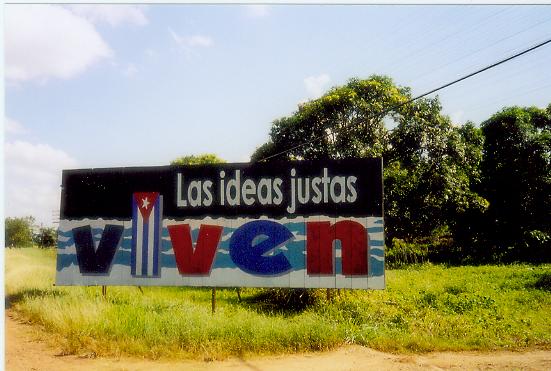
The Cuban government plasters the island with billboards proclaiming the virtues of the Revolution and the sayings of Fidel, Che Guevara and Jose Marti, the 19th century Cuban poet and patriot. In contrast, the Cuban churches apparently are not permitted to have any billboards with competing messages of the good life.
Just compare our partner church with the next-door provincial headquarters of the Communist Party of Cuba. The church has virtually no identifying sign or message. The Party (CCP) has a bright red sign in its parking lot, and its building used to have a billboard with a Fidel quotation on top.
The Revolutionary socialist or communist philosophy and polices since 1959 have resulted in a leveling down of the society economically. Thus, there has been no prosperous middle class such as we have in the U.S., to provide financial and other support to the Cuban churches.
It, therefore, was not surprising for me to hear an active member of our partner Cuban church say that earlier she was not brave enough to be a Christian.
Martin Luther King, Jr. Center, Havana
In 2007 we visited Havana’s Martin Luther King, Jr. Center which is affiliated with the adjacent Baptist Church. The church’s pastor, Raul Suarez, said that in 1984 he learned that Jesse Jackson, a candidate for the Democratic nomination for President that year, was coming to Cuba. Jackson said that Fidel Castro had invited him to discuss the status of 22 U.S. citizens then being held by the Cuban government. Jackson said that he also wanted an invitation from a Cuban church so that he could participate in a religious service in Cuba. Jackson asked Suarez, then Executive Secretary of the Cuban Council of Churches and Director of International Relations of the Cuban Baptist Church, if that would be possible. Jackson also gave Suarez a letter to provide to Castro on this issue. Castro responded that it would not be a problem even though atheism was the established “religion” in the Cuban constitution at the time.
Jackson made his trip to Cuba in June 1984 and gave a speech to 4,000 students at the University of Havana with Castro in attendance. Afterwards the two of them and their aides walked a few blocks to the nearby Methodist Church where Jackson would be preaching. As they neared the church, Suarez heard a Castro aide say to Fidel, “Take off your hat, you are close to a church.” Fidel took off his hat. Suarez was surprised by this comment and Fidel’s response. Suarez told Fidel that the people in the Plaza de Revolution (supporters of the Revolution) and the people in the church were one and welcomed Fidel to the church. Fidel said, do not ask me to preach.
There were 700 to 800 people in the church that day, including 35 church leaders and the Roman Catholic Archbishop (now Cardinal). When Castro entered the church, the choir extemporaneously cried, “Fidel, Fidel, Fidel.” Castro did make a short speech from the pulpit with a cross behind him. (Another Cuban pastor who was present told me that Castro obviously felt uncomfortable with the Bible on the lectern and awkwardly put his hands behind his back.) Castro praised Dr. King and Jackson and said there was a need for more exchanges between the churches and the government.
Later that same day Suarez was invited to a dinner with Fidel and Jackson. This was the first time he had ever shaken Fidel’s hand, and Fidel asked him to come to the airport the next day to say goodbye to Jackson.
Soon thereafter Suarez asked for a meeting of religious leaders with Fidel and submitted to Fidel a document of concern about the official policy of atheism’s limiting the space for religion. This resulted in a four-hour meeting between Fidel and about 14 Protestant leaders and the College of the Roman Catholic Bishops. Fidel expressed surprise at the Protestant ecumenicism, saying that when he was a boy in Jesuit schools, Roman Catholics disparaged Protestants. At the end of the meeting Castro made a covenant with these leaders: the churches will made an effort to understand “us” while Fidel and the Cuban Communist Party will make an effort to understand the churches. This agreement, said Fidel, should be easier for the churches than for the party.
After the collapse of the Soviet Union there have been signs of a more tolerant Cuban policy toward the churches, some of which have already been mentioned: elimination of scientific materialism as the established “religion” in Cuba and of the Communist Party’s ban on religious people becoming members of the Party.
Pope John Paul II & FidelMass in Plaza de Revolucion
In addition, Pope John Paul II visited Cuba in 1998 and celebrated mass before a huge crowd in Plaza de Revolucion (the site of many Revolutionary celebrations and long speeches by Fidel). The next year Cuban Protestants had a similar gathering in that Plaza.
Recently Pope Benedict XVI announced his planned visit to Cuba in 2012, and the Cuban government said that it would release many political prisoner
In 2004, during my second visit to Cuba, Patriarch Bartholomew of the Greek Orthodox Church was in Havana for the dedication of the new Greek Orthodox Cathedral that was paid for by the Cuban government.
These developments, in my opinion, were real politik moves by the Cuban government to gain international allies to help combat el Gringos de Norte.
In short, Revolutionary Cuba has made life very difficult for churches and religious people, especially from 1959 through 1989. On the other hand, there were no assassinations or disappearances of priests or other religious people who were opposed to the regime like what happened in El Salvador.
Pursuant to statutory authorization the U.S. government and a quasi-independent U.S. commission have been releasing annual reports on religious freedom in the world that have been very critical of such freedom in Cuba. These reports will be discussed in a subsequent post.
This then is the historical context in which Westminster initiated its partnership with the church in Matanzas in 2002, a relationship that has grown and become more meaningful for the people of both churches. A future post will discuss our Cuban partnership.
[1]See Post: Minneapolis’ Westminster Presbyterian Church (April 6, 2011).
[2] In the “Tag Cloud” at the top right of my blog, click on “Cuba” to look at the posts about Cuba.
This coming Fall, the Westminster Town Hall Forum will welcome the following speakers: Norm Ornstein, Jeffrey Sachs, Tom Brokaw and Chris Matthews.[1]
Norm OrnsteinJeffrey Sachs
Norm Ornstein:”Broken Government: Where Do We Go from Here?” (September 15). Ornstein is a Resident Scholar at the American Enterprise Institute for Public Policy Research in Washington, D.C. He is an election analyst for CBS News and writes a weekly column for Roll Call, the Capitol Hill newspaper. He also serves as co-director of the Transition to Governing Project that seeks to create a better climate for governing. A Minnesota native, he earned M.A. and Ph.D. degrees in political science from the University of Michigan.[2]
Jeffrey Sachs: “Reawakening American Virtue and Prosperity” (October 20). Sachs is Director of The Earth Institute and Professor of Health Policy and Management at Columbia University. As a leading economist, he advocates continuing economic development with environmental sustainability and mitigating human-induced climate change. His latest book is The Price of Civilization, a blueprint for America’s economic recovery. He holds B.A., M.A. and Ph.D. degrees from Harvard University.[3]
Tom BrokawChris Matthews
Tom Brokaw: “The Time of Our Lives: Past, Present, Promise (November 8). Brokaw is a Peabody and Emmy Award-winning journalist. He served as anchor and managing editor of the NBC Nightly News from 1983 to 2005 and now is a special correspondent for the network. His latest book is The Time of Our Lives: Past, Present, Promise which examines changes in America’s life since the Great Depression of the 1930’s and a reflection on our future.[4]
Chris Matthews: “Jack Kennedy: Elusive Hero” (December 8). Matthews is a writer, political commentator and the host of the nightly MSNBC show “Hardball with Chris Matthews”and the weekly NBC panel discussion “The Chris Matthews Show.” Before entering journalism, he was on the staff of four members of Congress and former Speaker of the House Tip O’Neill and also served as a speechwriter for President Jimmy Carter. His latest book is Jack Kennedy: Elusive Hero.[5]
The Forum engages the public in reflection and dialogue on the key issues of our day from an ethical perspective. [6] The Forum is nonpartisan and nonsectarian. Forums are free and open to the public. They are held from noon to 1:00 p.m. (CT) at Westminster Presbyterian Church, Nicollet Mall and 12th Street, in downtown Minneapolis. Each forum is preceded by music at 11:30 a.m. A public reception and small group discussion follow the forum from 1:00 to 2:00 p.m. The Forum presentations also are broadcast on Minnesota Public Radio.
[6] See Post: Westminster Town Hall Forum (July 25, 2011); Post: Westminster Town Hall Forum: Krista Tippett (July 26, 2011); Post: Westminster Town Hall Forum Marcus Borg (July 27, 2011).