U.S. Secretary of State Speaks to the Cuban People

On August 14, 2015, the U.S. formally opened its Embassy in Havana, Cuba with the raising of the American flag and a program featuring remarks by U.S. Secretary of State John Kerry that were telecast and broadcast live throughout the island.[1] Thus, his message, in one sense, was directed to the Cuban people, and the words in bold in the following remarks were especially addressed to them.

John Kerry @ U.S. Embassy in Havana
Secretary & U.S. Flag at Havana Embassy
Kerry & U.S. Flag at Havana Embassy

Kerry’s Remarks

Kerry started by recognizing that “this is truly a memorable occasion – a day for pushing aside old barriers and exploring new possibilities” and that Presidents Obama and Castro had made “a courageous decision to stop being the prisoners of history and to focus on the opportunities of today and tomorrow.”

The U.S. needs to recognize that “U.S. policy is not the anvil on which Cuba’s future will be forged. Decades of good intentions aside, the policies of the past have not led to a democratic transition in Cuba. It would be equally unrealistic to expect normalizing relations to have, in a short term, a transformational impact. After all, Cuba’s future is for Cubans to shape. Responsibility for the nature and quality of governance and accountability rests, as it should, not with any outside entity; but solely within the citizens of this country.”

“But the leaders in Havana – and the Cuban people – should also know that the United States will always remain a champion of democratic principles and reforms. . . .[We] will continue to urge the Cuban Government to fulfill its obligations under the UN and inter-American human rights covenants – obligations shared by the United States and every other country in the Americas.”

“And indeed, we remain convinced the people of Cuba would be best served by genuine democracy, where people are free to choose their leaders, express their ideas, practice their faith; where the commitment to economic and social justice is realized more fully; where institutions are answerable to those they serve; and where civil society is independent and allowed to flourish.”

We “believe it’s helpful for the people of our nations to learn more about each other, to meet each other. That is why we are encouraged that travel from the United States to Cuba has already increased by 35 percent since January and is continuing to go up. We are encouraged that more and more U.S. companies are exploring commercial ventures here that would create opportunities for Cuba’s own rising number of entrepreneurs, and we are encouraged that U.S. firms are interested in helping Cuba expand its telecommunications and internet links, and that the government here recently pledged to create dozens of new and more affordable Wi-Fi hotspots.”

“The restoration of diplomatic ties will also make it easier for our governments to engage. After all, we are neighbors, and neighbors will always have much to discuss in such areas as civil aviation, migration policy, disaster preparedness, protecting marine environment, global climate change, and other tougher and more complicated issues. Having normal relations makes it easier for us to talk, and talk can deepen understanding even when we know full well we will not see eye to eye on everything.”

“We are all aware that . . . the overall U.S. embargo on trade with Cuba remains in place and can only be lifted by congressional action – a step that we strongly favor. For now, the President has taken steps to ease restrictions on remittances, on exports and imports to help Cuban private entrepreneurs, on telecommunications, on family travel, but we want to go further. The goal of all of these changes is to help Cubans connect to the world and to improve their lives. And just as we are doing our part, we urge the Cuban Government to make it less difficult for their citizens to start businesses, to engage in trade, access information online. The embargo has always been something of a two-way street – both sides need to remove restrictions that have been holding Cubans back.”

Kerry also thanked “leaders throughout the Americas who have long urged the United States and Cuba to restore normal ties [and] the Holy Father Pope Francis and the Vatican for supporting the start of a new chapter in relations between our countries.”

He then paid “tribute to the people of Cuba and to the Cuban American community in the United States. Jose Marti once said that ‘everything that divides men…is a sin against humanity.’ Clearly, the events of the past – the harsh words, the provocative and retaliatory actions, the human tragedies – all have been a source of deep division that has diminished our common humanity. There have been too many days of sacrifice and sorrow; too many decades of suspicion and fear. That is why I am heartened by the many on both sides of the Straits who . . . have endorsed this search for a better path.”

“We have begun to move down that path without any illusions about how difficult it may be. But we are each confident in our intentions, confident in the contacts that we have made, and pleased with the friendships that we have begun to forge. And we are certain that the time is now to reach out to one another, as two peoples who are no longer enemies or rivals, but neighbors – time to unfurl our flags, raise them up, and let the world know that we wish each other well.”

Conclusion

In attendance at the ceremony were Embassy staff, including Jeffrey DeLaurentis, the charge d’affaires; other U.S. federal government officials, including Assistant Secretary of State for Western Hemisphere Affairs, Roberta Jacobson, who led the U.S. delegation in recent negotiations with Cuba; other countries’ diplomats; U.S. Senators Patrick Leahy (Dem., VT), Barbara Boxer (Dem., CA), Amy Klobuchar (Dem., MN) and Jeff Flake (Rep., AZ); [2] U.S. Representatives Karen Bass (Dem., CA), Steve Cohen (Dem., TN), Barbara Lee (Dem., CA) and Jim McGovern (Dem., MA); [3] and James Williams, President of Engage Cuba, and Zane Kerby, President & CEO of American Society of Travel Agents.

Also in attendance was a Cuban delegation, including Josafina Vidal, who led the Cuban team in those negotiations; and Dr. José Ramón Cabañas Rodriguez, the new Cuban Ambassador to the U.S. [4]

Another highlight of the ceremony was the beautiful reading of a beautiful poem, “Matters of the Sea” or “Cosas del Mar,” by the Cuban-American poet, Richard Blanco. Afterwards Kerry walked around old Havana, met privately with Cuban Foreign Minister, Bruno Rodriguez Parrilla, participated in a joint press conference with Rodriguez and met with Cuban dissidents at the official Havana residence of the U.S. charge d’affaires These other events of the day will be discussed in subsequent posts.

=========================================================

[1] Gordon, Kerry Strikes Delicate Balance in Havana Trip for Embassy Flag-Raising, N.Y. Times (Aug. 14, 2015); Assoc. Press, A Festive Flag-Raising, Then Tough Talk on U.S.-Cuba Relations, N.Y. Times (Aug. 15, 2015);  DeYoung, In historic Cuba visit, Kerry presides over raising of U.S. flag over embassy in Havana, Wash. Post (Aug.14, 2015); Granma, Official reopening ceremony will take place today, Granma (Aug. 14, 2015); Parazza, Bécquer & Gomez, The challenge of building a future without forgetting the past, Granma (Aug. 15, 2015). A video of the ceremony also has been archived.

[2] Separate press releases celebrating the formal opening of the U.S. Embassy were issued by Senators Leahy, Boxer, Klobuchar and Flake. Back in the U.S. Senator Marco Rubio denounced the opening of the Embassy.

[3] Representatives Cohen, Lee and McGovern issued press releases welcoming the reopening of the Embassy in Havana.

[4]  Dr.Cabañas visited Minnesota last October and was mentioned in a prior post.
Comments About Cuba by White House Press Secretary 

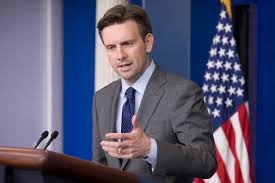
On the morning of July 20, 2015, Cuba officially opened its Embassy in Washington, D.C., and the United States did likewise in Havana although the ceremonial opening of the latter will be on August 14 when Secretary of State John Kerry goes to Havana to preside that event. Prior posts discussed the ceremonial opening of the Cuban Embassy and the joint press conference later that day at the U.S. Department of State by U.S. Secretary of State John Kerry and Cuba’s Foreign Minister Bruno Rodriguez. This post reviews the extensive July 20 comments about the U.S.-Cuba relationship by White House Press Secretary Josh Earnest.[1] A subsequent post will review the reactions to these events.

Emphasizing Secretary Kerry’s Comments

Josh Earnest
Josh Earnest

Earnest first underscored Secretary Kerry’s comments about the reopening of embassies by saying, “The [U.S.] welcomes today’s historic opening of the embassy of the [U.S.] in Havana, Cuba, and the opening of the Cuban embassy here in Washington, D.C.  Today’s openings are the result of respectful dialogue between the [U.S.] and the Republic of Cuba following the December 17th announcements by President Obama and President Raúl Castro to reestablish diplomatic relations between our two nations.”

“This is yet another demonstration that we don’t have to be imprisoned by the past.  We look forward to working collaboratively to normalize relations with the Cuban government and the Cuban people after more than a half-century of discord.  Beginning today, U.S. diplomats in Havana will have the ability to engage more broadly across the island of Cuba, with the Cuban government, Cuban civil society, and even ordinary Cuban citizens.”

“We look forward to collaborating with the Cuban government on issues of common interest, including counterterrorism and disaster response, and we are confident that the best way to advance universal values like freedom of speech and assembly is through more engagement with the Cuban people.”

U.S. Ambassador to Cuba

The Press Secretary said he did “not have a specific commitment in terms of when [a nominee for U.S. Ambassador to Cuba] would be announced or who that person would be.  We certainly do believe that U.S. interests in Cuba would be best represented by somebody serving as the ambassador there.” Later in the conference, when pressed, he said despite anticipated resistance to the appointment of anyone to that position by some Senate Republicans, he expected such an a nomination to be made by the President.

The “current Chief of Mission is a gentleman named Jeffrey DeLaurentis.  He is somebody who had previously served as the Deputy Assistant Secretary of State for the Bureau of Western Hemisphere Affairs.  He is somebody who has done two previous stints at the U.S. Interests Section in Havana, and somebody who has served in a wide variety of diplomatic roles, including as the political counselor to the U.S. Mission at the United Nations in Geneva, a political counselor at the U.S. embassy in Bogota, even did a stint here at the White House at the National Security Council.

So this is somebody . . . with a wide range of experience in a variety of roles, and we’ve got a lot of confidence in the ability of Ambassador DeLaurentis to represent U.S. interests on the island in Cuba.  But I certainly wouldn’t rule out that the President would nominate somebody to serve at the rank of ambassador at the U.S. embassy in Cuba.”

DeLaurentis’ “top agenda item will be to represent the interests of the [U.S.] on the island.  In some cases, that is going to involve making sure that U.S. businesses and U.S. individuals that are engaged in commercial activity on the island of Cuba, that their interests are represented and protected on the island.  That’s certainly one reason that we’ve seen some bipartisan support in Congress for this policy change.”

“But obviously diplomats who are working at the new U.S. embassy in Cuba will also have the ability to more freely travel throughout Cuba and to interact and engage the Cuban people and, yes, even some members of the political opposition.  And we believe that that will better represent the interest of the [U.S.] on the island.”

Cuban Human Rights.

The change in U.S. policy regarding Cuba “is consistent with the national security interests of the [U.S. and] . . . with the kinds of values that this President and previous Presidents have aggressively advocated all around the world.  Those values are the respect for the basic human rights that we hold dear in this country — freedom of speech, freedom of assembly, freedom of religion, freedom of the press.”

“It’s clear that Cuba has significant progress to make in all of those areas.  What’s also clear is that the previous [U.S.] . . . [did not] really make much progress [on these issues].  The President believed that a change was necessary.  And we’re hopeful that in the coming years we’ll start to see the kind of respect for basic human rights on the island of Cuba that the U.S.] has long advocated.”

[Moreover, an] overwhelming percentage of the Cuban people are supportive and optimistic about this change in policy because of a chance that is has to improve their prospects on the island nation of Cuba.”

“So the President is looking forward to these kinds of changes taking effect [so] that the Cuban people and the Cuban government start to enjoy the benefits and see the results from greater engagement with the [U.S.]”

“In the days after this agreement was announced back in December, a substantial number of individuals who had previously been held by the Cuban government for their political views were released.  And that’s an indication that the Cuban government is trying to at least change their reputation when it comes to these issues.“

“But we have got a long list of concerns.” In addition, “for a long time the U.S. policy of trying to isolate Cuba became a source of irritation in the relationship between the [U.S.] and other countries in the Western Hemisphere.  And by removing that source of irritation, the [U.S.] can now focus attention of . . . other countries in the Western Hemisphere on the Cuban government’s rather sordid human rights record.”

“And again, that is part of the strategy for seeking to engage the Cuban people more effectively, and bring about the kind of change that we would like to see inside of Cuba.”

U.S. Leverage To Effect Change in Cuba.

As a result of the change in U.S. policy regarding Cuba, the U.S. will “have the leverage of the other countries in the Western Hemisphere that now are no longer distracted by the U.S. embargo against Cuba. . . . In fact, . . . we’ve remove[d] that irritant and allowed the rest of the Western Hemisphere to focus more closely on the conduct and policies of the Cuban government. That certainly is a positive development.”

“[A]ny perceived leverage [for the U.S.] that was included in an embargo did not succeed in generating the kind of outcome that its most ardent advocates believe is important.  We didn’t see the kind of progress on human rights reforms that we would like to see while that embargo was in place.”

That is “why the President has called for the removal of the embargo and . . . to take steps to restore diplomatic ties between our two nations. [T]he policy of isolation . . . [has] failed and it was time to try a different approach to succeed in achieving the goal that we all share, which is a Cuba that thrives and a Cuban government that respects and even protects the basic human rights of their citizens.”

“[P]art of this agreement included ensuring that Cuban citizens have greater access to the Internet and greater access to information, and we believe that, equipped with that knowledge, that that’s a good thing for the Cuban people.”

“What is persuasive [about this enhanced U.S. leverage] is that most public polls indicate that upwards of 90 percent of the Cuban population actually support this policy change. . . . [This] is an indication that it’s not just the U.S. interests that are best served by this policy; it’s actually the interests of the Cuban people that are best served by this policy as well.”

This “is something that we can evaluate in the years to come.  I certainly am not going to make you wait 55 years to evaluate the success of this policy, but it’s clear that the previous policy could be evaluated over 55 years and it clearly did not bring about the kind of results that we’d like to see.”

============================================================

[1] White House, Press Briefing by Press Secretary Josh Earnest, 7/20/15.

The Reopening of U.S. and Cuba Embassies

On the morning of July 20, 2015, Cuba officially opened its Embassy in Washington, D.C., and the United States did likewise in Havana although the ceremonial opening of the latter will be on August 14 when Secretary of State John Kerry goes to Havana to preside over that event.[1]

This post will focus on the ceremonial opening of the Cuban Embassy; subsequent posts will discuss the afternoon’s joint press conference at the U.S. Department of State by U.S. Secretary of State John Kerry and Cuba’s Foreign Minister Bruno Rodriguez as well as reactions to the reopening of the embassies.

Opening of Cuba’s Embassy

Cuban Embassy
Cuban Embassy (Photo by Andrew Hamik)

Cuba’s opening was celebrated in the morning by the raising of its flag in front of its former Interests Section building. It was the same flag that was removed 54 years ago when the two countries severed diplomatic relations.

The event was attended by more than 500 people, including U.S. Assistant Secretary of State Roberta Jacobson, who led the U.S. delegation in negotiations with Cuba after the December 17, 2014, announcement of rapprochement; Tom Malinowski, Assistant Secretary for Democracy, Human Rights and Labor of the State Department, who has participated in those negotiations; Jeffrey DeLaurentis, current charge d’affaires of the U.S. Embassy in Havana; Ben Rhodes, U.S. Deputy National Security Advisor who led 18 months of behind-the-scenes secret negotiations with Cuban officials with the aim of restoring diplomatic ties; Wayne Smith, a Cuban expert who was forced to leave the U.S. Embassy in Havana in 1961 when the two countries broke diplomatic ties; U.S. Senators Patrick Leahy (Dem, VT), Amy Klobuchar (Dem., MN) and Jeff Flake (Rep., AZ) along with U.S. Representatives Barbara Lee (Dem., CA), Donna Edwards (Dem., MD), Kathy Castor (Dem., FL), Karen Bass (Dem., CA) and Raul Grijalva (Dem., AZ).[2]

Afterwards Senator Klobuchar, the author of a bill to end the U.S. embargo (Freedom to Export to Cuba Act), said in a press release, “The opening of the Cuban embassy in Washington, DC, marks an important step in modernizing our relationship with Cuba after more than 50 years of isolation. This evolution in our relationship with 11 million people 90 miles off of our shore was long overdue, and it is now time to not only open our own fully equipped and staffed embassy in Havana, but to lift the trade embargo once and for all. Passing my bipartisan bill to lift the embargo would benefit the people of both of our countries by boosting U.S. exports and allowing Cubans greater access to American goods.”[3]

Foreign Minister Rodriguez’s Speech

The attendees then went inside the Embassy, where they heard a speech by Cuba’s Foreign Minister, Bruno Rodriguez. Here are excerpts from those remarks.

The Cuban flag now flying in front of the Embassy “embodies the generous blood that was shed, the sacrifices made and the struggle waged for more than one hundred years by our people for their national independence and full self-determination, facing the most serious challenges and risks. Today we pay homage to all those who died in its defense and renew the commitment of the present generations, fully confident on the newer ones, to serve it with honor.”

“We evoke the memory of José Martí, who was fully devoted to the struggle for the freedom of Cuba and managed to get a profound knowledge about the United States: In his “North American Scenes” he made a vivid description of the great nation to the North and extolled its virtues. He also bequeathed to us a warning against its excessive craving for domination [over Cuba] which was confirmed by a long history of disagreements.”

“We’ve been able to make it through this date thanks to the firm and wise leadership of Fidel Castro Ruz, the historic leader of the Cuban Revolution, whose ideas we will always revere with utmost loyalty. We now recall his presence in this city, in April of 1959, with the purpose of promoting fair bilateral relations, as well as the sincere tribute he paid to Lincoln and Washington. The purposes that brought him to this country on such an early time [of the Cuban Revolution] are the same that have pursued throughout these decades and coincide exactly with the ones that we pursue today.”

“This ceremony has been possible thanks to the free and unshakable will, unity, sacrifice, selflessness, heroic resistance and work of our people and also the strength of the Cuban Nation and its culture.”

“I bring greetings from President Raúl Castro, as an expression of the good will and sound determination to move forward, through a dialogue based on mutual respect and sovereign equality, to a civilized coexistence, even despite the differences that exist between both governments, which makes it possible to solve bilateral problems and promote cooperation and the development of mutually beneficial relations, just as both peoples desire and deserve.”

“We know that this [rapprochement] would contribute to peace, development, equity and stability in the continent; the implementation of the purposes and principles enshrined in the U.N. Charter and in the Proclamation of Latin America and the Caribbean as a Zone of Peace, which was signed at the Second Summit of the Community of Latin American and Caribbean States held in Havana.”

“Today, the re-establishment of diplomatic relations and the re-opening of embassies complete the first stage of the bilateral dialogue and pave the way to the complex and certainly long process towards the normalization of bilateral relations.”

“The challenge is huge because there have never been normal relations between the United States of America and Cuba, in spite of the one and a half century of intensive and enriching links that have existed between both peoples.”

“The Platt Amendment, imposed [on Cuba by the U.S.] in 1902 under a military occupation, thwarted the liberation efforts that had counted on the participation or the sympathy of quite a few American citizens and led to the usurpation of a piece of Cuban territory in Guantánamo. Its nefarious consequences left an indelible mark in our common history.”

“In 1959, the [U.S.] refused to accept the existence of a fully independent small and neighboring island and much less, a few years later, a socialist Revolution that was forced to defend itself and has embodied, ever since then, our people’s will.”

“I have referred to history to reaffirm that today an opportunity has opened up to begin working in order to establish new bilateral relations, quite different from whatever existed in the past. The Cuban government is fully committed to that.”

“Only the lifting of the economic, commercial and financial blockade which has caused so much harm and suffering to our people; the return of the occupied territory in Guantánamo; and the respect for Cuba’s sovereignty will lend some meaning to the historic event that we are witnessing today.”

“Every step forward will receive the recognition and the favorable acceptance of our people and government, and most certainly the encouragement and approval of Latin America and the Caribbean and the entire world.

“We reaffirm Cuba’s willingness to move towards the normalization of relations with the [U.S.] in a constructive spirit, but without any prejudice whatsoever to our independence or any interference in the affairs that fall under the exclusive sovereignty of Cubans.”

[For the U.S.] to insist in the attainment of obsolete and unjust goals, only hoping for a mere change in the methods to achieve them will not legitimize them or favor the national interest of the [U.S.] or its citizens. However, should that be the case, we will be ready to face the challenge.”

“We will engage in this process, as was written by President Raúl Castro in his letter of July 1st to President Obama, “encouraged by the reciprocal intention of developing respectful and cooperative relations between our peoples and governments. From this Embassy, we will continue to work tirelessly to promote cultural, economic, scientific, academic and sports relations as well as friendly ties between our peoples.”

“We would like to convey the Cuban government’s respect and recognition to the President of the [U.S.] for urging the U.S. Congress to lift the blockade as well as for the change of policy that he has announced [last December], but in particular for the disposition he has showed to make use of his executive powers for that purpose.”

“We are particularly reminded of President Carter’s decision to open the respective Interests Sections back in September of 1977.” We also “express our gratitude to the members of Congress, scholars, religious leaders, activists, solidarity groups, business people and so many U.S. citizens who worked so hard for so many years so that this day would come.”

“To the majority of Cubans residing in the [U.S.] who have advocated and called for a different kind of relation of this country with our Nation, we would like to express our recognition. Deeply moved, they have told us that they would multiply their efforts and will remain faithful to the legacy of the patriotic emigration that supported the ideals of independence.”

“We would like to express our gratitude to our Latin American and Caribbean brothers and sisters who have resolutely supported our country and called for a new chapter in the relations between the [U.S.] and Cuba, as was done, with extraordinary perseverance, by a lot of friends from all over the world.”

“From this country José Martí organized the Cuban Revolutionary Party to conquer freedom, all the justice and the full dignity of human beings. His ideas, which were heroically vindicated in his centennial year, continue to be the main inspiration that moves us along the path that our people have sovereignly chosen.”

Opening of U.S. Embassy

 With the ceremonial opening of the U.S. Embassy in Havana not happening until August 14, the changes there were subtler. There was no raising of the U.S. flag. There was no changing of the sign on the building. The U.S. diplomats who previously worked in the Interests Section now worked in the Embassy. A future post will review the ceremonial opening of the Embassy, now scheduled for August 14.

===============================================

[1] This post is based upon the following: Ahmed & Davis, U.S. and Cuba Reopen Long-Closed Embassies, N.Y. Times (July 20, 2015); Schwartz, Embassies Reopen, as U.S., Cuba Restore Ties, W.S.J. (July 20, 2015); Ayuso, ‘Mojito diplomacy’ as Cuba reboots US relations in reopened embassy, El Pais (July 21, 2015); Gómez, Cuban flag waves in U.S. capital, Granma (July 20, 2015); Gómez, The flag day, Granma (July 21, 2015).

[2] The famous Cuban-American jazz pianist and a resident of Minnesota, Nachito Herrera, was invited to attend the opening of the Cuban Embassy, but unfortunately had to decline because of previously scheduled performances at the Dakota Jazz Club in Minneapolis with his new group The Universals, featuring saxophonist Mike Phillips, who has worked with Prince and Stevie Wonder; Cuban drummer Raul Pineda; Senegal bassist Cheikh Ndoye; and violinist Karen Briggs. (Bream, On special day for Cuba, Nachito Herrera gets emotional at the Dakota, StarTribune (July 21, 2015).) As previously noted in this blog, Nachito has frequently performed at Minneapolis’ Westminster Presbyterian Church.

[3] A similar press release was issued by Senator Leahy.

Cuba Announces Agreement To Restore Diplomatic Relations with the United States

On July 1, 2015, the U.S. and Cuba announced an agreement to restore diplomatic relations. This post will discuss Cuba’s announcement and reactions.[1] A prior post did the same for the U.S. announcement and reactions.

The Cuban government’s announcement of the resumption of diplomatic relations stated the following:

  • “The President of the Councils of State and Ministers of the Republic of Cuba, Army General Raúl Castro Ruz, and the President of the United States of America, Barack Obama, exchanged letters through which they confirmed the decision to reestablish diplomatic relations between the two countries and open permanent diplomatic missions in their respective capitals, from July 20, 2015.”
  • “By formalizing this step, Cuba and the United States ratified the intention to develop respectful and cooperative relations between both peoples and governments, based on the purposes and principles enshrined in the Charter of the United Nations and International Law, in particular the Vienna Conventions on Diplomatic and Consular Relations.”
  • “The Government of Cuba has decided to reestablish diplomatic relations with the United States in full exercise of its sovereignty, invariably committed to the ideals of independence and social justice, and in solidarity with the just causes of the world, and reaffirming each of the principles for which our people have shed their blood and ran all risks, led by the historic leader of the Revolution Fidel Castro Ruz.”
  • “With the reestablishment of diplomatic relations and the opening of embassies, the first phase concludes of what will be a long and complex process towards the normalization of bilateral ties, as part of which a set of issues will have to be resolved arising from past policies, still in force, which affect the Cuban people and nation.”
  • “There can be no normal relations between Cuba and the United States as long as the economic, commercial and financial blockade that continues to be rigorously applied, causing damages and scarcities for the Cuban people, is maintained. It is the main obstacle to the development of our economy, constitutes a violation of International Law and affects the interests of all countries, including those of the United States.”
  • “To achieve normalization it will also be indispensable that the territory illegally occupied by the Guantanamo Naval Base is returned, that radio and television transmissions to Cuba that are in violation of international norms and harmful to our sovereignty cease, that programs aimed at promoting subversion and internal destabilization are eliminated, and that the Cuban people are compensated for the human and economic damages caused by the policies of the United States.”
  • “In recalling the outstanding issues to be resolved between the two countries, the Cuban Government recognizes the decisions adopted thus far by President Obama, to exclude Cuba from the list of state sponsors of international terrorism, to urge the U.S. Congress to lift the blockade and to begin to take steps to modify the application of aspects of this policy in exercise of his executive powers.”
  • “As part of the process towards the normalization of relations, in turn, the foundations of ties that have not existed between our countries in all their history will need to be constructed, in particular, since the military intervention of the United States 117 years ago, in the independence war that Cuba fought for nearly three decades against Spanish colonialism.”
  • “These relations must be founded on absolute respect for our independence and sovereignty; the inalienable right of every State to choose its political, economic, social and cultural system, without interference in any form; and sovereign equality and reciprocity, which constitute inalienable principles of International Law.”
  • “The Government of Cuba reiterates its willingness to maintain a respectful dialogue with the Government of the United States and develop relations of civilized coexistence, based on respect for the differences between the two governments and cooperation on issues of mutual benefit.”
  • “Cuba will continue immersed in the process of updating its economic and social model, to build a prosperous and sustainable socialism, advance the development of the country and consolidate the achievements of the Revolution.”
Ramón Cabañas & Anthony Blinken

That same day (July 1) Ramón Cabañas Rodríguez, the Head of the Cuban Interests Section in Washington, delivered to Interim Secretary of State Anthony Blinken at the U.S. State Department a letter from Raúl Castro to President Obama, confirming that “the Republic of Cuba has decided to reestablish diplomatic relations with the United States of America and open permanent diplomatic missions in our respective countries, on July 20, 2015.” That letter went on to say the following:

  • “Cuba makes this decision, motivated by the mutual intention to develop relations of respect and cooperation between both peoples and governments.”
  • “Cuba likewise draws inspiration from the principles and objectives established in the United Nations Charter and international law, namely, sovereign equality; the settlement of disputes by peaceful means; abstention from acts or threat of aggression or the use of force against the territorial integrity or political independence of any States, non-intervention in matters within the domestic jurisdiction of any State, the promotion of friendly relations among nations based on respect for the principles of equal rights and that of the people’s right to self-determination, and cooperation in solving international problems and in promoting and encouraging respect for human rights and fundamental freedoms for all.”
  • “The above stated principles are in accordance with the spirit and norms established in the Vienna Convention on Diplomatic Relations of April 18, 1961 and the Vienna Convention on Consular Relations of April 24, 1963, to which both the Republic of Cuba and the United States of America are parties, and will govern diplomatic and consular relations between the Republic of Cuba and the United States of America.”

Cuba also confirmed that on July 1 Jeffrey DeLaurentis, the Head of the U.S. Interests Section in Havana, had delivered to the Cuban Foreign Ministry a July 1 letter from President Obama to President Castro that was quoted in the prior post about the U.S. announcement of restoration of diplomatic relations.

Cuban Reaction

According to a U.S. reporter for the New York Times, Cubans in the streets of Havana welcomed the news about the resumption of diplomatic relations.

Roberto, a parking attendant who minds cars near the U.S. Interests Section on the Malecon, said, ““This will benefit the country. Maybe, I don’t know, it will eventually benefit me.”

Regina Coyula, a blogger who for several years worked for Cuban state security, commented, “People realize that the Americans aren’t going to solve their problems, and nor is the government” of Cuba. The reaction to the December 17th announcement of rapprochement was “like a firework display. Everyone watched them. Everyone thought they were beautiful. And then they went back to their lives.”

Coyula added that with American money being spent in private restaurants and homes and on car services, those Cubans who are doing well will do even better. “The difference between those Cubas is only going to grow.”

“We’ve been waiting all our lives for this, and it’s very welcome,” said Carmen Álvarez, 76, who was walking with friends near the Interests Section. “We’re waiting with our arms and our minds wide open.”

Yosvany Coca Montes de Oca, 38, who began listing his one-bedroom apartment in Havana with Airbnb, the online house-sharing service, in April, said, “Things are going really well.” He used to get four or five Americans staying at his house every month. For the past two months, he has had more than 15 and has been showered with reservations. But Mr. Coca acknowledged that he was part of a privileged economic circle that was feeling the immediate benefit of new American interest in Cuba. Many Cubans, he said, felt little change. “For ordinary people, it doesn’t have a direct impact. People are mainly concerned with getting by day to day.”

More generally, the U.S. reporter concluded,“The euphoria that prompted Cubans to toot their horns and wave flags [on December 17th] . . . has given way to a tempered hope that an influx of Americans, and the eventual end of the trade embargo, will help pry open the economy and the political system.”

Similar positive comments from people on the street in Havana were captured by Granma, the official newspaper of Cuba’s Communist Party.

Other Reactions

Cuba’s Granma newspaper reported positive reactions to the restoration of diplomatic relations from China, Brazil, the European Union and the United Nations.

Conclusion

The Cuban announcement reiterated some of the issues that Cuba has raised before and after the December 17th announcement of rapprochement and that have been addressed in prior posts to this blog.

Foremost for Cuba is ending the U.S. embargo or blockade of Cuba. President Obama agrees that this should happen and again yesterday called on Congress to adopt legislation doing just that. Senators Amy Klobuchar, Jerry Moran and Angus King have introduced bills to that end, and in the House Charles Rangel, Bobby Rush and Jose Serano have authored similar bills. Now the relevant congressional committees need to hold hearings and report the bills to the floors of the respective chambers for voting them up or down.[2]

Related to ending the embargo or blockage is Cuba’s repeated allegation that it is illegal under international law and has damaged Cuba, allegedly $1.1 trillion as of last October. It is exceedingly unlikely that the U.S. will agree with these assertions and pay Cuba that sum of money. Therefore, this blogger has suggested that this Cuban claim, along with others by Cuba and the U.S., be submitted for resolution to the Permanent Court of Arbitration at the Hague in the Netherlands.[3]

The other significant issue for Cuba is ending the alleged U.S. illegal occupation of Guantanamo Bay and returning that territory to Cuba. Again it is exceedingly unlikely that the U.S. will agree with that allegation and demand. Remember that the Cuban government in 1906 leased that territory to the U.S. for use as a “coaling station” or “naval station” and that there are many problems with Cuba’s assertion that it has the right to terminate the lease. Therefore, this blogger has suggested that this Cuban claim and others relating to Guantanamo, including unpaid rent for the last 50-plus years, also be submitted for resolution to the Permanent Court of Arbitration.[4]

Cuba’s complaint about U.S. radio and television transmissions to Cuba (Radio and TV Marti), in this blogger’s opinion, is secondary. Again I see no U.S. acceptance of this complaint, and thus it too should be submitted to the Permanent Court of Arbitration.[5]

The other secondary Cuban complaint concerns the U.S. “programs aimed at promoting subversion and internal destabilization.” This refers to the covert, secret or “discreet” programs of the U.S. Agency for International Development (USAID), such as its social media program, the HIV workshop program and the hip-hop artist campaign. These programs, in this blogger’s opinion, are a stupid waste of U.S. taxpayers’ funds and should be terminated by the U.S. Any U.S. programs to promote democracy in Cuba should be joint ventures with the Cuban government.[6]

Now the more difficult work comes for the two countries’ diplomats to meet, discuss and negotiate to attempt to resolve or at least narrow these and many other issues. We wish them courage, persistence and humility in their work.

===============================================

[1] Statement by the Revolutionary Government, Granma (July 1, 2015); Letter from Cuban President Raúl Castro to Barack Obama (July 1, 2015); Interim Minister of Foreign Relations receives letter from U.S. President to Army General Raúl Castro Ruz, Granma (July 1, 2015); Cuba and the U.S. confirm reestablishment of diplomatic relations, Granma (July 1, 2015); Burnett, Cubans Greet Latest Step in U.S. Thaw With Hope Tempered by Reality,N.Y. Times (July 1, 2015).

[2] Prior posts have discussed bills to end the embargo in the U.S. House of Representatives and similar bills by Senators Klobuchar and Moran and King.

[3] A prior post concerned the October 2014 U.N. General Assembly’s overwhelming approval of a resolution condemning the embargo and Cuba’s allegation of $1.1 trillion of damages. Arbitration of Cuba’s alleged damages claim was suggested in another post.

[4] A post examined the 1906 lease of Guantanamo Bay; another, whether Cuba had a right to terminate the lease and another. arbitration of unresolved issues about the lease.

[5] One post looked at the status of Radio and TV Marti.

[6] Prior posts have covered USAID’s social media program; the U.S. Senate’s comments on that program; USAID’s HIV workshop program and reactions thereto by the U.S. government and by others; the New York Times’ criticism of the programs; criticism of the programs by the Latin American Working Group; and this bloggers’ open letter to President Obama complaining about the programs.

U.S. Announces Agreement To Restore Diplomatic Relations with Cuba

On July 1, 2015, the U.S. and Cuba announced an agreement to restore diplomatic relations. This post will discuss the U.S. announcement and reactions.[1] A subsequent post will do the same for the Cuban announcement and reactions.

U.S. Announcement

President Obama & Vice President Biden

In the White House’s Rose Garden, President Obama announced the plans to reopen the embassies. Here is what he said:

  • “More than 54 years ago, at the height of the Cold War, the United States closed its embassy in Havana.  Today, I can announce that the United States has agreed to formally re-establish diplomatic relations with the Republic of Cuba, and re-open embassies in our respective countries.  This is a historic step forward in our efforts to normalize relations with the Cuban government and people, and begin a new chapter with our neighbors in the Americas.”
  • “When the United States shuttered our embassy in 1961, I don’t think anyone expected that it would be more than half a century before it re-opened.  After all, our nations are separated by only 90 miles, and there are deep bonds of family and friendship between our people.  But there have been very real, profound differences between our governments, and sometimes we allow ourselves to be trapped by a certain way of doing things.”
  • “For the United States, that meant clinging to a policy that was not working.  Instead of supporting democracy and opportunity for the Cuban people, our efforts to isolate Cuba despite good intentions increasingly had the opposite effect -– cementing the status quo and isolating the United States from our neighbors in this hemisphere.  The progress that we mark today is yet another demonstration that we don’t have to be imprisoned by the past. When something isn’t working, we can -– and will –- change.”
  • “Last December, I announced that the United States and Cuba had decided to take steps to normalize our relationship.  As part of that effort, President Raul Castro and I directed our teams to negotiate the re-establishment of embassies.  Since then, our State Department has worked hard with their Cuban counterparts to achieve that goal.  And later this summer, Secretary Kerry will travel to Havana formally to proudly raise the American flag over our embassy once more.”
  • “This is not merely symbolic.  With this change, we will be able to substantially increase our contacts with the Cuban people.  We’ll have more personnel at our embassy.  And our diplomats will have the ability to engage more broadly across the island.  That will include the Cuban government, civil society, and ordinary Cubans who are reaching for a better life.”
  • “On issues of common interest –- like counterterrorism, disaster response, and development -– we will find new ways to cooperate with Cuba.  And I’ve been clear that we will also continue to have some very serious differences.  That will include America’s enduring support for universal values, like freedom of speech and assembly, and the ability to access information.  And we will not hesitate to speak out when we see actions that contradict those values.”
  • “However, I strongly believe that the best way for America to support our values is through engagement.  That’s why we’ve already taken steps to allow for greater travel, people-to-people and commercial ties between the United States and Cuba.  And we will continue to do so going forward.”
  • “Since December, we’ve already seen enormous enthusiasm for this new approach. Leaders across the Americas have expressed support for our change in policy; you heard that expressed by President Dilma Rousseff of Brazil yesterday.  Public opinion surveys in both our countries show broad support for this engagement. . . .
  • “Here in the United States, we’ve seen that same enthusiasm.  There are Americans who want to travel to Cuba and American businesses [that] want to invest in Cuba.  American colleges and universities . . . want to partner with Cuba.  Above all, Americans who want to get to know their neighbors to the south. And through that engagement, we can also help the Cuban people improve their own lives.”
  • “Americans and Cubans alike are ready to move forward.  I believe it’s time for Congress to do the same.  I’ve called on Congress to take steps to lift the embargo that prevents Americans from travelling or doing business in Cuba.  We’ve already seen members from both parties begin that work.  After all, why should Washington stand in the way of our own people?”
  • “Yes, there are those who want to turn back the clock and double down on a policy of isolation.  But it’s long past time for us to realize that this approach doesn’t work.  It hasn’t worked for 50 years.  It shuts America out of Cuba’s future, and it only makes life worse for the Cuban people.”
  • So I’d ask Congress to listen to the Cuban people.  Listen to the American people.  Listen to the words of a proud Cuban-American, Carlos Gutierrez, who recently came out against the policy of the past, saying, ‘I wonder if the Cubans who have to stand in line for the most basic necessities for hours in the hot Havana sun feel that this approach is helpful to them.’”
  • “Of course, nobody expects Cuba to be transformed overnight. But I believe that American engagement — through our embassy, our businesses, and most of all, through our people — is the best way to advance our interests and support for democracy and human rights.  Time and again, America has demonstrated that part of our leadership in the world is our capacity to change.  It’s what inspires the world to reach for something better.”
  • “A year ago, it might have seemed impossible that the United States would once again be raising our flag, the stars and stripes, over an embassy in Havana.  This is what change looks like.”
  • “In January of 1961, the year I was born, when President Eisenhower announced the termination of our relations with Cuba, he said:  It is my hope and my conviction that it is ‘in the not-too-distant future it will be possible for the historic friendship between us once again to find its reflection in normal relations of every sort.’  Well, it took a while, but I believe that time has come.  And a better future lies ahead.”
Secretary John Kerry

The same day Secretary of State John Kerry from Vienna, Austria also discussed the plans, including his intent to travel to Havana for the opening of the embassy later this month. His statement included the following:

  • “Later this summer, as the President announced, I will travel to Cuba to personally take part in the formal reopening of our United States Embassy in Havana. This will mark the resumption of embassy operations after a period of 54 years. It will also be the first visit by a Secretary of State to Cuba since 1945. The reopening of our embassy . . . is an important step on the road to restoring fully normal relations between the United States and Cuba. Coming a quarter of a century after the end of the Cold War, it recognizes the reality of the changed circumstances, and it will serve to meet a number of practical needs.”
  • “The United States and Cuba continue to have sharp differences over democracy, human rights, and related issues, but we also have identified areas for cooperation that include law enforcement, safe transportation, emergency response, environmental protection, telecommunications, and migration. The resumption of full embassy activities will help us engage the Cuban Government more often and at a higher level, and it will also allow our diplomats to interact more frequently, and frankly more broadly and effectively, with the Cuban people. In addition, we will better be able to assist Americans who travel to the island nation in order to visit family members or for other purposes.”

In addition, the State Department conducted a special briefing by a senior official on this historic development. This individual said, “We’re confident that our embassy in Havana will be able to operate similar to other embassies operating in restrictive environments. We will be able to meet and exchange opinions with a variety of voices and views both within the government and outside. We’ll be able to engage a broad range of Cuban civil society and citizens.” The conditions for “access to diplomatic facilities, travel of diplomats, and the level of staffing . . . are acceptable for carrying out the core diplomatic functions necessary for implementing the President’s new policy direction on Cuba.” There were not any agreed “constrains or restrictions” on the exact types of programs or facilities that each of our embassies conducts.

According to the State Department spokesperson, there will be future discussions or negotiations with Cuba over human rights, telecommunications, health issues, fugitives, law enforcement, U.S. claims for property expropriation, Cuban claims for damages under the embargo and U.S. broadcasts to the island. Until there is a nomination and confirmation of an ambassador, Jeffrey DeLaurentis will be the charge d’affaires and will lead the embassy.

Jeffrey DeLaurentis & Marcelinio Medina

Also earlier the same day Cuba’s Foreign Ministry confirmed that the head of the US Interests Section in Cuba, Jeffrey DeLaurentis, had delivered to the Acting Foreign Minister, Marcelino Medina, a letter from President Obama to Army General Raul Castro confirming “the restoration of diplomatic relations and the opening of embassies in the respective countries” on or after July 20. Here is the text of that letter:

  • “I am pleased to confirm, after high-level talks between our two governments, and in accordance with international law and practice, that the United States of America and the Republic of Cuba decided to restore diplomatic relations and permanent diplomatic missions in our respective countries 20 July 2015. This is an important step forward in the normalization process, which started last December, with regard to relations between our two countries and peoples.”
  • “In making this decision, the United States are encouraged by the mutual intention to enter into friendly and cooperative relations between our two peoples and governments, consistent with the purposes and principles enshrined in the Charter of the United Nations, in particular those relating to equality sovereign states, the settlement of international disputes by peaceful means, respect for the territorial integrity and political independence of States, respect for the equal rights and self-determination of peoples, non-interference in internal affairs States as well as promoting and encouraging respect for human rights and fundamental freedoms for all.”
  • “The United States and Cuba are parties to the Vienna Convention on Diplomatic Relations, signed in Vienna on April 18, 1961, and the Vienna Convention on Consular Relations, signed in Vienna on April 24, 1963. I am pleased to confirm the understanding the United States that the above conventions apply to diplomatic and consular relations between our two countries.”

Although the U.S. can easily change the plaque on its building in Havana to one proclaiming that it is the Embassy of the United States of America, the State Department has said it needs $6.6 million to retrofit the building to make it suitable as an embassy. This may require a supplemental appropriation by Congress.

The U.S. will need an Ambassador to Cuba, and such an appointment needs to be confirmed by the U.S. Senate. In the meantime, as just noted, the U.S. has a capable career diplomat running the interests section, Jeffrey DeLaurentis, who will be in charge.

Reactions to the Announcement

The announcement of re-establishment of diplomatic relations drew widespread praise. Senator Jeff Flake (Rep., AZ) stated, “It’s long past time for U.S. policy toward Cuba to be associated with something other than five decades of failure. It is difficult to overstate the importance of resuming diplomatic relations ‎with Cuba, in furthering our own national interests, benefiting our relations in the region, and encouraging a positive future for the Cuban people. I am confident that this move will lead to increased travel and contact between U.S. citizens and everyday Cubans, to the benefit of both.” Senator Amy Klobuchar (Dem., MN), a co-sponsor of a bill to expand U.S. travel to Cuba and the author of a bill to lift the trade embargo, said, “This is the first step that must happen in order to lift the embargo.” Democratic Senators Patrick Leahy (VT) and Benjamin Cardin (MD) issued similar positive statements.

Engage Cuba, a bipartisan public policy organization dedicated to coalescing and mobilizing American businesses, non-profit groups and concerned citizens for the purpose of supporting the ongoing U.S.‐Cuba normalization process and enacting legislation to reform U.S. travel and trade restrictions with Cuba, issued a statement of support. It said, “We applaud this important step in bringing the U.S. and Cuba closer together, and urge Congress to hasten the day when American travelers and companies have the freedom to engage with one of our nearest neighbors. Opening embassies in Washington and Havana is an important step toward the day when Americans can make their own decisions on where they travel, and our businesses can compete with the rest of the world. We are making history by making it clear that America’s engagement isn’t a concession, it is a show of strength and the best way to promote our values and create opportunities for both Americans and the Cuban people.”

Moreover, said Engage Cuba, “A vast majority of the American people – and 97% of the Cuban people – support re-establishing diplomatic relations. Today is a great day for the American and Cuban people who seek a brighter future for their two countries. After 54 years of a failed Cold war policy, better days finally lie ahead.”

A similar supportive statement came from the Center for Democracy in the Americas (CDA), which is “devoted to changing U.S. policy toward the countries of the Americas by basing our relations on mutual respect, fostering dialogue with those governments and movements with which U.S. policy is at odds, and recognizing positive trends in democracy and governance” and which is a member of Engage Cuba. CDA stated, “”This is a moment we have been working toward for many years. The restoration of diplomatic relations between our countries is a major achievement that will help to heal decades of mistrust and will open opportunities for the U.S. and Cuba to collaborate on issues of mutual interest like immigration, environmental conservation, and regional trade. We applaud the tireless work of Cuban and U.S. diplomats, policymakers, academics, and activists who have helped make this possible. We are ready to work with all our allies to defend these positive steps initiated by President Obama and to move forward with removing the embargo once and for all.”

The day before this announcement, President Obama held a joint press conference at the White House with the visiting President of Brazil, Dilma Rousseff.[2] In his opening remarks, Obama said, “As President, I’ve pursued a new era of engagement with Latin America where our countries work together as equal partners, based on mutual interest and mutual respect.  As we saw at the recent Summit of the Americas, the United States is more deeply engaged in the region than we’ve been in decades, and I believe the relationship between the United States and Latin America is as good as it’s ever been.  We’re focused on the future — what we can accomplish together.”

After he had reviewed the many ways that Brazil and the U.S. cooperate, Obama commented, “And finally, we’re working together to uphold democracy and human rights across Latin America.  I very much appreciate President Rousseff and Brazil’s strong support for our new opening toward Cuba.  I updated Dilma on our progress, including our work to open embassies in Havana and Washington.  And I believe that Brazil’s leadership in the region, as well as its own journey to democracy and a market economy can make it an important partner as we work to create more opportunities and prosperity for the Cuban people.”

In her response President Rousseff remarked about “the importance for Latin America of the recent decision made by President Obama and by President Raul Castro, even with the partnership with Pope Francis to the effect of opening up relations with — or resuming relations with Cuba, a very decisive milestone and point in time in U.S. relations with Latin America.  It is really about putting an end to the lingering vestiges of the Cold War.  And it ultimately elevates the level of the relations between the U.S. and the entire region. May I acknowledge the importance of that gesture to all of Latin America and also to world peace at large.  It is an important example of relations to be followed.”

These thoughts were echoed in the subsequent Joint Communique by the two presidents: “President Rousseff praised President Obama’s policy changes towards Cuba, and the Leaders agreed that the latest Summit of the Americas (held in Panama, on April 10 and 11, 2015) demonstrated the region’s capacity to overcome the differences of the past through dialogue, thereby paving the way for the region as a whole to find solutions to the common challenges facing the countries of the Americas.”

As anticipated, however, Senator Marco Rubio (Rep., FL), a Cuban-American, immediately issued a press release condemning the agreement.[3] It said:

  • “Throughout this entire negotiation, as the Castro regime has stepped up its repression of the Cuban people, the Obama Administration has continued to look the other way and offer concession after concession. The administration’s reported plan to restore diplomatic relations is one such prized concession to the Castro regime. It remains unclear what, if anything, has been achieved since the President’s December 17th announcement in terms of securing the return of U.S. fugitives being harbored in Cuba, settling outstanding legal claims to U.S. citizens for properties confiscated by the regime, and in obtaining the unequivocal right of our diplomats to travel freely throughout Cuba and meet with any dissidents, and most importantly, securing greater political freedoms for the Cuban people. I intend to oppose the confirmation of an Ambassador to Cuba until these issues are addressed. It is time for our unilateral concessions to this odious regime to end.”

Conclusion

I am glad that my recent concern about the delay in announcing resumption of diplomatic relations has been alleviated. This is an important development in the            reconciliation of our country with Cuba. Now all advocates for reconciliation need to notify their senators and representatives to oppose any of the measures put forward by Senator Rubio and others to try to block this important move.

======================================================

[1] This portion of the post is based upon the following: White House, Statement by the President on the Re-Establishment of Diplomatic Relations with Cuba (July 1, 2015); Letter from Barack Obama [to] Raúl Castro, Granma (July 1, 2015); Letters between Obama and Castro to restore diplomatic relations, el Pais (July 1, 2015); Kerry, Statement on Cuba (July 1, 2015); State Dep’t, Special Briefing on Re-Establishment of Diplomatic Relations with Cuba (July 1, 2015); Baker & Davis, U.S. and Cuba Reach an Agreement to Reopen Embassies, Officials Say, N.Y. Times (June 30, 2015); Schwartz, Córdoba & Lee, U.S., Cuba Reach Agreement to Establish Full Diplomatic Relations, W.S.J. (June 30, 2015); Center for Democracy in Americas, Press Release: CDA Applauds Announcement That U.S. And Cuba Will Reopen Embassies (June 30, 2015); Minister for Foreign Affairs will receive †he Head of †he Section of Interests of the United States, Granma (July 1, 2015); Ayuso, Cuba and the United States announced the reopening of embassies on Wednesday, El Pais (July 1, 2015); Flake, Re-Establishment of Diplomatic Relations with Cuba (June 30, 2015); Engage Cuba, Press Release: Statement from Engage Cuba on Announcement that U.S., and Cuban Embassies Will Re-open (July 1, 2015); Rubio, Rubio Comments On Obama Re-Establishing Diplomatic Relations With Cuba (July 1, 2015)

[2] This portion of the post is based upon the following: White House, Remarks by President Obama and President Rousseff of Brazil in Joint Press Conference (June 30, 2015); White House, Joint Communique by President Barack Obama and President Dilma Rousseff (June 30, 2015); Harris, Leader of Brazil Visits Amid Home Turbulence, N.Y. Times (June 30, 2015).

[3] Senator Rubio in a letter to Secretary Kerry in June “vowed to oppose the confirmation of any ambassador until issues like human rights, fugitive terrorists and billions of dollars of outstanding claims were resolved.” The Senator said it is “important that pro-democracy activities not be sacrificed in the name of ‘diplomacy’ just so that we can change the name of a building from ‘Interest Section’ to ‘Embassy,’ ” Similar negative press releases came from other Cuban-Americas in the Congress: Senator Robert Menendez (Dem., NJ) and Republican Representatives from Florida, Ileana Ros-Lehtinen and Mario Diaz-Balart.


Imminent U.S.-Cuba Restoration of Normal Diplomatic Relations?

May 29th is the date for the official U.S. rescission of its designation of Cuba as a “State Sponsor of Terrorism.” This was covered in a prior post.

In anticipation of that rescission, Cuba’s President, Raúl Castro on May 12th said to journalists, “This sort of unjust accusation [sponsor of terrorism] is about to be lifted, and we’ll be able to name ambassadors.” [1]

Later that same day the U.S. State Department said, “an exchange of ambassadors would be a logical step . . . only once we re-establish diplomatic relations. We do not have a fixed time for that. We are still in negotiations . . . with Cuban authorities about re-establishing diplomatic relations.”

The latter statement confirms there are still unresolved issues for such normalization.

The main one appears to be whether or not U.S. diplomats in Cuba would be free to travel wherever and whenever they wanted and Cuba’s complaints that U.S. diplomats having meetings with Cuban dissidents amounted to meddling in Cuba’s internal affairs in violation of international treaties on diplomatic relations.

Indeed, yesterday President Castro stated he had told President Obama that such diplomatic encounters remained Cuba’s chief concern about establishing normal relations, particularly programs at the American Interests Section in Havana to assist independent journalists. In Castro’s own words (English translation), “I told . . . President Obama . . . that . . . I was most worried about . . . they continue to do illegal things. For example, graduating independent journalists. [The U.S. gives Cuban journalists] . . . I don’t know how many classes, on screen, in teleconferences from the United States. I don’t know if they give them a diploma and of course they give them their corresponding monthly payment.”

The U.S. Interests Section does offer free classes in journalism, English and information technology, but students are not paid by the U.S.

Another unresolved issue for establishment of normal diplomatic relations is the U.S. insistence that it must be allowed to bring secure shipping containers into the country, in accordance with global diplomatic protocols.

Castro in his remarks to journalists yesterday also mentioned that the U.S. embargo or blockade “must be removed” [2] and the Guantanamo Naval Base, which was leased after the U.S. had taken over Cuba in the early 20th century, “should be returned to Cuba.” [3] Neither of these will happen immediately, and the latter may never happen.

Cuban negotiators are due to arrive in Washington as soon as this week for a fourth round of talks. Presumably at least some of these issues will be at the top of the agenda.

Conclusion

Jeffrey DeLaurentis
Jeffrey DeLaurentis

Once the U.S. and Cuba resolve these issues, each country first would change the names on their respective buildings from “interests section” to “embassy.” And the U.S. presumably would change the title of Jeffrey DeLaurentis, the current “Head of Mission” of the U.S. Interests Section in Havana to “Charge d’Affaires” or “Acting Ambassador.” (He already has the title of “Ambassador” from the previous Senate confirmation of his appointment as Alternate Representative for Special Political Affairs at the U.S. Mission to the United Nations.)

President Obama at some point would appoint someone to be the U.S. Ambassador to Cuba, but under Article II, Section 2(2) of the U.S. Constitution, the U.S. Senate, by a simple majority vote, has to give its “advice and consent” to such an appointment. Such a vote would be taken after hearings and consideration of the appointment by the U.S. Senate Foreign Relations Committee, currently chaired by Senator Bob Corker (Rep., TN). Two members of the Committee, both Cuban-Americans, Marco Rubio (Rep., FL) and Bob Menendez (Dem., NJ), are ardent foes of U.S.-Cuba reconciliation and are potential problems for such confirmation. And Rubio is the Chair of the Subcommittee on Western Hemisphere, Transnational Crime, Civilian Security, Democracy, Human Rights, and Global Women’s Issues, which might consider the nomination before the full Committee does so.

===================================================

[1] This post is based upon the following: Archibold, Cuba Ready to Exchange Diplomats, Raúl Castro Says, N.Y. Times (May 12, 2015); Trotta, Cuba’s Castro concerned over “illegal” activity at U.S. mission, Reuters (May 12, 2015); Assoc. Press, US and Cuba Ambassadors To Be Named Soon, N.Y. Times (May 12, 2015); Miroff, Cuba ready to name U.S. ambassador, Castro says, Wash. Post (May 12, 2015); Hernández, French President culminated successful visit to Cuba, Granma (May 21, 2015) (Google translation); Raúl: The process of updating the Cuban economic model “goes well, our pace” (+ video), Cubadebate (May 12, 2015) (Google translation); U.S. State Dep’t, Daily Press Briefing (May 12, 2015).

[2] Prior posts discussed bills to end the embargo in the U.S. House of Representatives and the U.S. Senate that were introduced in this Session of Congress. According to the Library of Congress, as of May 12th there had been no committee action on any of these bills.

[3] An earlier post reviewed issues relating to Guantanamo Bay while another post looked at whether Cuba had a legal right to terminate its lease of the Guantanamo territory..


Nancy Pelosi and Other House Democrats Visit Cuba

A delegation of Democratic members of the U.S. House of Representatives led by Nancy Pelosi, the Minority Leader of the House, visited the island, February 17-19. They went “to build upon the announcement of U.S. normalization of relations and other initiatives announced by President Obama” and “to advance the U.S.-Cuba relationship and build on the work done by many in the Congress over the years, especially with respect to agriculture and trade.” [1]

The eight members of the delegation were David Cicilline (RI), member of the House foreign Affairs and Judiciary Committees; Rosa DeLauro (CT), the senior Democrat on the House Agriculture Appropriations Subcommittee and Co-chair of the Democratic Steering and Policy Committee;  Eliot Engel (NY), the senior Democrat on the House Foreign Affairs Committee; Anna Eshoo (CA), Ranking Member on the House Energy and Commerce Committee’s Subcommittee on Communications Technology; Steve Israel (NY), Chair of the Democratic Policy and Communications Committee; Jim McGovern (MA), member of the House Agriculture Committee and Co-Chair of the congressional Tom Lantos Human Rights Commission; Collin Peterson (MN), the senior Democrat on the House Agriculture Committee; and Nydia Velazquez (NY), the senior Democrat on the House Small Business Committee. [2]

After their arrival in Cuba, they first went to the U.S. Interests Section’s building on Havana’s Malecon. There they met with the Chief of Mission, Jeffrey DeLaurentis, and his team. “We are proud of them and the U.S. Marines serving us there,” Pelosi said. 

cuba-nancy-pelosi-bruno-rodriguezOn February 18th the delegation had a three and one-half hour meeting with Cuban Foreign Minister, Bruno Rodriguez. and Josefina VIdal, the Foreign Ministry’s leader of the current negotiations with the U.S. (Left is a photograph of Pelosi and Rodriguez.) According to a Cuban website, they “discussed issues related to the current context of ties between the two countries, including restoring diplomatic relations, opening embassies and the debate in Congress on lifting the blockade [embargo] against Cuba.” Afterwards, Pelosi said, ““We discussed areas of interest to the United States and Cuba, and our delegation listened to their concerns, including the embargo, bank and credit financing,” Pelosi said. “We underscored our commitment to human rights in Cuba and agreed to build upon the historic opportunity before us to make progress in our relationship.”

Pelosi+Diaz

On the 19th Pelosi and the delegation met with Miguel Diaz-Canel, Cuba’s First Vice President and presumptive next Cuban president. (Right is a photograph of Pelosi and Diaz-Canel.) They talked about Cuba’s market-style economic reforms, bilateral relations and prospects of the U.S. Congress lifting the country’s 53-year-old trade embargo of Cuba. Afterwards Pelosi told reporters, “There is strong bipartisan support to lift the embargo in the Congress, however it’s not universal and it certainly does not appear to be shared by those in power who have the ability to bring a bill to the floor.”

The delegation also met with leaders of Cuba’s legislature (National Assembly), including its vice president, Ana María Mari Machado. According to Pelosi, “During the meeting, we exchanged views about the actions taken by President Obama and President Raúl Castro. We agreed to continue our interparliamentary dialogue on areas of agreement and disagreement.”

U.S. House of Representatives Democratic leader Pelosi, Archbishop of Havana Cardinal Ortega and members of a delegation of congressional Democrats pose for a photograph in Havana

Other meetings were held with Cuban Cardinal Jaime Ortega (left is a photograph of the Cardinal and the delegation); American students at the Latin American School of Medicine; young entrepreneurs of the island’s emerging private sector; and representatives of civil society, but not with Cuban dissidents.

At a press conference on their last day on the island, Pelosi said, “We’re very positively impressed by what we heard here about our future prospects and the relationship.” Representative Engel noted they had raised the topic of human because “We’re very concerned with human rights and dissident rights. I’d like to see more changes from the Cuban side.”  Representative McGovern concurred with this comment: “The best way to promote human rights is to accelerate this new process to establish formal embassies in Havana and Washington.” The delegation also said they also spoken with Cuban officials about U.S. food sales to the island, internet technology and the island’s emerging small-business sector.

============================================

[1] This post is based upon the following: Press Release, Pelosi Leads Congressional Delegation to Cuba (Feb. 17, 2015); Reuters, Pelosi Traveling with Lawmakers to Cuba, N.Y. Times (Feb. 17, 2015); Fram, Pelosi Leads House Democrats Visiting Cuba, Assoc. Press (Feb. 17, 2015); Press Release, Pelosi Statement on Historic Delegation’s Meetings in Havana (Feb. 18, 2015); Miller, Nancy Pelosi visits Havana, meets with top Castro regime officials, Wash. Times (Feb. 19, 2015); Oleaga, US, Cuba Relations Update: Representative Nancy Pelosi Leads congressional Delegation to Cuba, Hopes to Advance Renewed Relations, Latin Post (Feb. 19, 2015); Cuba FM Meets with Nancy Pelosi, Havana Times (Feb. 19, 2015); Cuban FM meets U.S. lawmakers on normalization of ties, Xinhua (Feb. 19, 2015); Trotta, U.S. congressional delegation meets Cuba’s heir apparent, Reuters (Feb. 19, 2015); Miroff, In Havana, Pelosi delegation promotes Obama’s Cuba thaw, Wash. Post (Feb. 19, 2015); Agence France-Presse, US-Cuba talks tackle human rights, reopening embassies (Feb. 19, 2015);Torres, Pelosi and other Democrats meet with Cuban officials in Havana, Miami Herald (Feb. 19, 2015); Miguel Diaz-Canel received the leader of the Democratic Party in the House of Representatives of the US, Granma (Feb. 19, 2015); Nancy Pelosi: The lock [embargo] is a “measure unsuccessfully,” CubaDebate (Feb. 19, 2015)(English translation by Google Translate); Press Release, Pelosi Statement on Historic Congressional Delegation’s Final Day of Meetings in Cuba (Feb. 20, 2015).

[2] Representative Peterson is a cosponsor of H.R.403 (Free Trade with Cuba Act) while Representatives DeLauro, McGovern and Velazquez are cosponsors of H.R.664 (Export Freedom to Cuba Act of 2015).